

Iran Is Back on the Strike Table: The Qeshm Attacks, Reported U.S.–Israeli Targets, and the Dates We Can Actually Verify
U.S. strikes have resumed near Hormuz as Israel presses Trump for a wider campaign. PN verifies the November incidents, the reported target categories, the disputed intelligence and what the January …
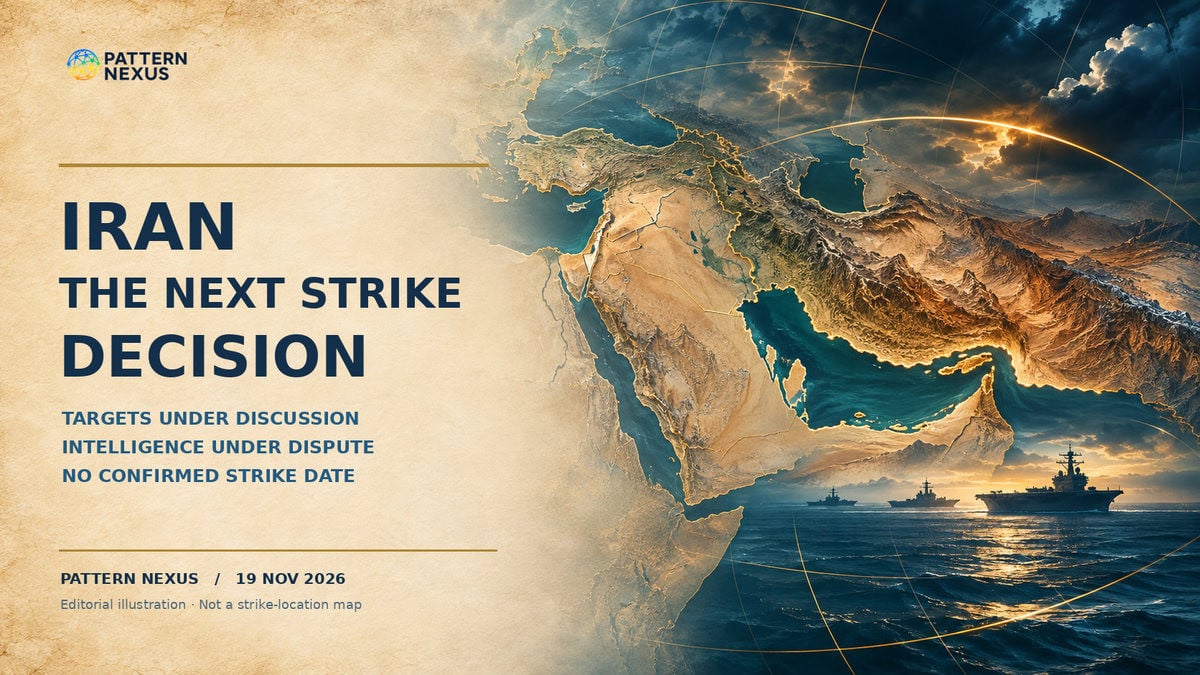
- A renewed strike is not merely hypothetical. On November 17, American aircraft hit an Islamic Revolutionary Guard Corps missile-launch site on Iran's Qeshm Island after Iranian drone attacks against U.S. facilities in Bahrain. American officials described the strike as self-defense. [4][5]
- The larger operation remains a reported proposal. According to the November 18–19 New York Times reporting, Israeli Prime Minister Benjamin Netanyahu is pressing for a joint campaign lasting four to seven days. President Donald Trump has not publicly approved that campaign. Four to seven days refers to a proposed duration, not a launch window. [1][2]
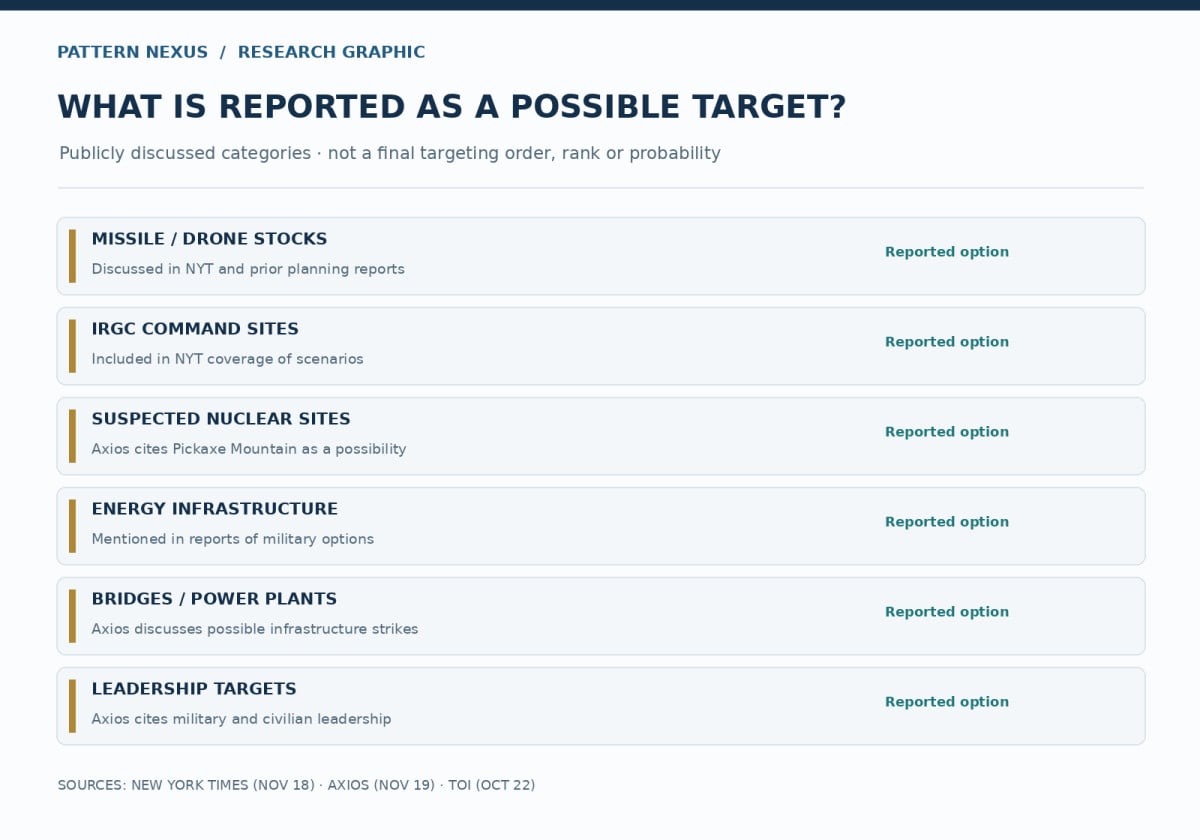
- The proposed target set is much wider than Qeshm. Reports discuss missile and drone stockpiles, IRGC command infrastructure, suspected nuclear facilities, energy facilities, bridges, power plants, and leadership targets. These are reported options, not an authenticated final target list. [1][2][14]
- The chemical and biological claims are disputed. Israel says it has intelligence on Iranian activity. Some U.S. officials have questioned the strength and purpose of the intelligence. No public evidence reviewed here establishes an imminent chemical or biological attack. [1][2][12]
- The nuclear inspection gap is real. The IAEA says it cannot currently verify the disposition of previously declared Iranian high-enriched material because inspectors lack access to most relevant sites. That is a safeguards failure, not evidence by itself that a nuclear weapon has been constructed. [8][9]
- No confirmed date exists for a new major U.S.–Israeli offensive. Trump mentioned January 1, 2027, in an interview without explaining its significance. The remarks were not a strike order, and the reported four-to-seven-day campaign has no verified start date. [3]
- The regional constraint is retaliation, not the ability to launch aircraft. Gulf governments fear attacks on oil, power, water, ports, shipping and other infrastructure. Diplomacy is active precisely because military escalation could extend beyond Iranian territory. [2][7][11]
The most important development of the week is not a leaked calendar for a new war. There is no authenticated calendar. It is that the United States is already using force at a limited level while its president considers whether to authorize an operation with radically different consequences.
That changes the analytical problem. A single missile-site strike near the Strait of Hormuz is intended to suppress an immediate threat. A coordinated campaign against arsenals, command centers, nuclear-related infrastructure and potentially energy systems would aim to change Iran's strategic capacity. Iran would not necessarily respond to those operations in the same way.
The distinction between what has happened, what officials say they are considering, and what analysts can reasonably infer will determine whether this situation is reported accurately—or inflated into another false countdown.
U.S. fighter aircraft struck the IRGC missile site on Qeshm Island on November 17.
Israel is seeking a proposed four-to-seven-day joint offensive; U.S. approval is not confirmed.
Chemical and biological threat intelligence is being challenged within U.S. policy circles.
Neither the campaign duration nor Trump’s January 1 remark identifies a strike day.
01 · RESEARCH
The War Is Already Active, but Its Intensity Is Being Debated
The February 28, 2026, U.S.–Israeli offensive began a war that has moved through direct air combat, maritime restrictions, regional drone attacks and stalled mediation. By November the conflict had not ended; it had settled into an intermittent and increasingly dangerous exchange around the Persian Gulf. The latest incidents occurred during that continuing war, not before one began. [4][5][7]
American forces conducted limited strikes around Qeshm Island earlier in November. On November 17, a U.S. military official confirmed a strike on an IRGC missile-launch site there. The reported justification was Iranian action against U.S. personnel and regional assets. Iran said it had targeted American military radar infrastructure in Bahrain; U.S. and Bahraini authorities said incoming attacks were intercepted. The public record does not substantiate Iranian claims that it destroyed the American radar. [4][5][10]
This is an important evidence boundary. A verified drone launch and a confirmed interception do not establish the destruction of the target. Similarly, a confirmed American strike does not, without a damage assessment, establish how much Iranian capability was destroyed.
A campaign against a launch site and a multi-day operation across industrial and nuclear-related infrastructure are different military and political decisions. Reporting on the first cannot be used as proof that the second has already been ordered.
02 · RESEARCH
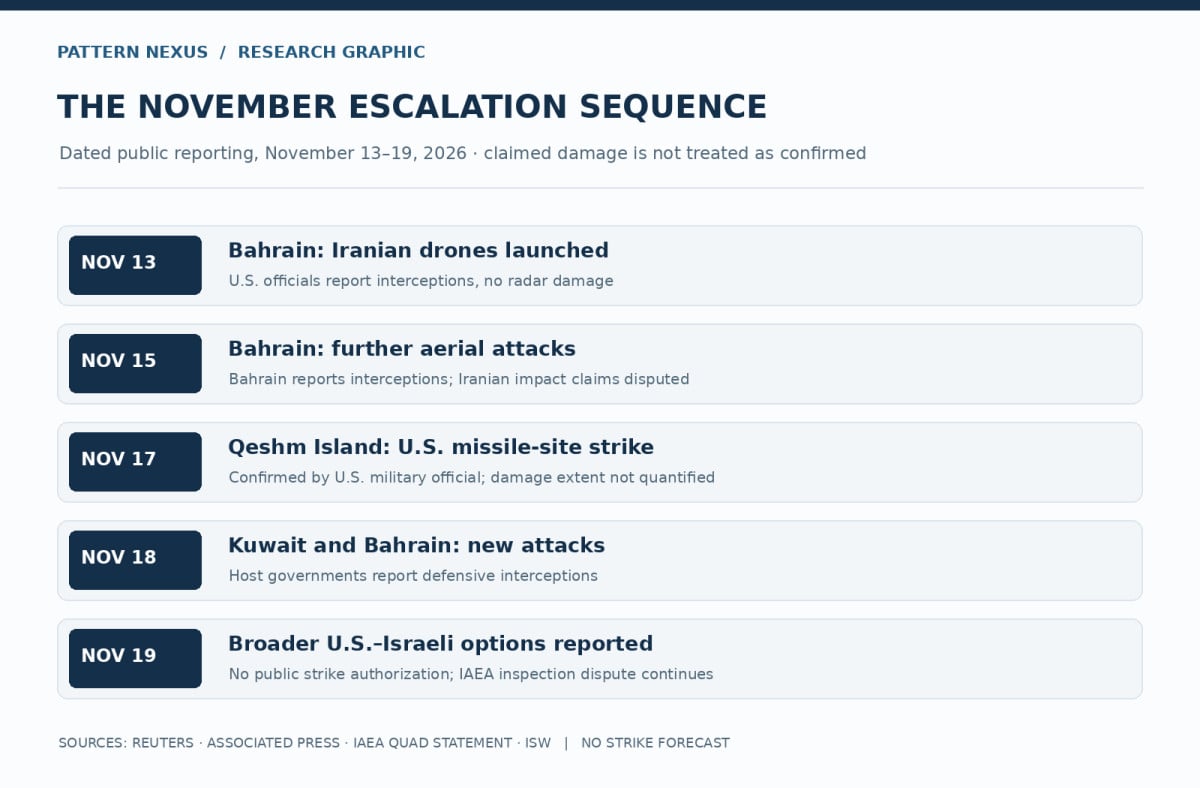
The November 13–19 Sequence
| Date | Publicly documented development | Evidence and limitation |
|---|---|---|
| November 13 | Iran launched drones toward Bahrain and claimed an attack on U.S. early-warning radar. | U.S. Central Command said two drones were intercepted; no U.S. damage was reported. [10][11] |
| November 15 | Bahrain reported intercepting further Iranian aerial attacks. | Iran claimed a six-drone attack on a U.S. radar position; the claimed damage is unverified. [10] |
| November 17 | U.S. aircraft struck an IRGC missile-launch site on Qeshm Island. Another Iranian attack targeted Bahrain. | The strike was confirmed to media by a U.S. military official; Bahraini and U.S. authorities reported interceptions. [4][5][10] |
| November 18 | Iranian drones targeted a base in Kuwait, and Bahrain reported further interceptions; Gulf diplomacy intensified. | Kuwait said its air defenses responded. Iranian statements about damage are not independently established. [6][7][11] |
| November 18–19 | The New York Times and Axios reported renewed White House deliberations over a larger U.S.–Israeli campaign. | Officials describe contingency plans and disagreements. There is no publicly confirmed authorization or launch date. [1][2] |
| November 19 | Western governments pressed Iran at the IAEA board to resume inspection access. Trump’s remarks about after January 1 circulated. | The safeguards dispute is documented; the January reference is not a deadline or an operations timetable. [3][8][9] |
This sequence has a measurable direction: retaliatory incidents are occurring more often, the geographic scope has reached Bahrain, Kuwait and shipping routes, and Washington is simultaneously debating an expanded operation. It does not establish that a large-scale strike is inevitable.
03 · RESEARCH
What Netanyahu Is Asking for—and What Trump Has Not Approved
The November 18 New York Times report, followed by additional reporting on November 19, describes Netanyahu advocating a short, intense U.S.–Israeli offensive. The proposed duration is four to seven days. Axios reports that Trump has requested assessments of how Iran might respond to various options, particularly whether a campaign could avoid devastating attacks on the oil and gas systems of Gulf partners. [1][2]
The request for retaliation assessments is itself informative. It indicates that the question under review is not simply whether target locations can be reached. It is whether an offensive would produce consequences the United States and its allies can absorb.
Israeli officials have argued that Iran is rebuilding its missile and drone inventory and advancing chemical and biological capabilities. Mossad director Roman Gofman reportedly visited Washington and met senior officials during the previous week. The claims have triggered internal disagreement: some officials reportedly support decisive action, while others question both the evidence and the strategic payoff. The reports also describe Gulf governments opposing another full-scale war. [1][2]
Trump's recent public statements are not a declaration of a final decision. He had called a large new offensive quite unlikely only days earlier. His comments since then have left open both further economic pressure and future strikes. The Pentagon's willingness to provide options should not be misreported as an instruction to execute them. [1][2][3]
The decision therefore has several layers: an Israeli request for military action; U.S. assessments of the threat intelligence; assessments of Iranian retaliation; economic and domestic political costs; and the possibility of negotiating an outcome short of the proposed campaign.
04 · RESEARCH
The Targets Being Discussed: Reported Categories, Not a Strike Plan
The public reporting identifies multiple possible target categories. They are not interchangeable. Each would carry a different escalation logic, and the presence of an option in a briefing is not confirmation that it will be selected.
| Reported category | What has actually been reported | Evidence status |
|---|---|---|
| Missile and drone arsenals | Both the New York Times coverage and October planning reports identify Iranian missile and drone stocks as potential targets. | Reported option, not an approved target list. [1][14] |
| IRGC command infrastructure | The New York Times account includes IRGC command centers among possible targets. | Reported option. Specific facilities and mission assignments unconfirmed. [1] |
| Suspected nuclear-related facilities | Axios identifies Pickaxe Mountain, a suspected underground nuclear site, as a potential option; prior reporting references other nuclear facilities. | Named in reporting, with no public evidence of an imminent strike at that site. [2][14] |
| Iranian energy infrastructure | Reporting describes options against Iranian energy sites. Some proposals would have major economic consequences. | Under discussion; no final U.S. authorization established. [1][14] |
| Power generation and bridges | Axios says power plants and bridges could be included in some scenarios. | Reported possibility, not a confirmed selection. [2] |
| Military or civilian leadership | Axios reports leadership targets have appeared in discussions. | Reported possibility; no verified individual target, order or timetable. [2] |
The distinction is not semantic. A strike against missile-launch equipment aims at a military capability. Widespread attacks on power plants, bridges or civilian infrastructure would raise different humanitarian and international humanitarian law questions, including whether a site qualifies as a military objective and whether foreseeable civilian harm would be excessive. The existence of a discussion is not proof of lawful target status.
For Pattern Nexus, these target categories are evidence of the range of options being debated, not a recommendation or prediction about what should be hit. No public data reviewed here support an exact strike sequence, a facility-by-facility hit list, or a reliable percentage likelihood for each category.
05 · RESEARCH
The Chemical and Biological Allegations Are Not the Same as Verified Capability
Chemical and biological weapons claims are now central to Israeli arguments for escalation. Israeli intelligence officials reportedly describe Iranian research and development activity and tests. Trump echoed concerns about gases and biological weapons in an interview. Other U.S. officials, however, have questioned how close Iran is to an actual deployable capability and whether the intelligence is being presented to push Washington toward war. [1][2]
The November 3 reporting already documented skepticism among U.S. officials and regional governments. The November 19 reporting demonstrates that the disagreement has not disappeared. A threat assessment has to separate research activity, production, weaponization, operational deployment, delivery capability and an actual intent to use a weapon. Public reporting does not establish that all of those steps have occurred. [1][2][15]
Separately, a CNN allegation concerning a possible radioactive or dirty-bomb threat in Washington is disputed. Iran rejected the report, and U.S. Secretary of State Marco Rubio said he saw no imminent threat to the capital. The U.S. intelligence director described increased threats to Americans but did not substantiate the specific dirty-bomb allegation publicly. This article does not use that allegation as evidence that Iran is preparing a mass-casualty attack. [3][12]
The existence of disagreement within the U.S. government is itself a relevant part of the story. Treating the Israeli position as established fact would erase the central evidentiary dispute reported by the same outlets advancing the story.
06 · RESEARCH
The Nuclear File: A Verified Monitoring Failure, Not Proof of a New Bomb
On November 19, the United States, Britain, France and Germany pressed Iran at the International Atomic Energy Agency's Board of Governors to restore access to nuclear facilities damaged in earlier strikes. Their joint statement said the agency has not recovered continuity of knowledge about Iran's previously verified stockpile of high-enriched uranium. Since February 2026, the statement said, in-field verification has been confined to Bushehr. [8][9]
This leaves the status and location of declared material uncertain. The previously recorded Iranian stockpile included uranium enriched to 60%, which is highly enriched but is not, by itself, evidence of an assembled nuclear weapon. Reuters reports that the three uranium-enrichment plants known to have been operating at the time of June 2025 strikes were destroyed or badly damaged; Iran has not adequately accounted for the previously known material. [8][9]
Iran argues that access to bombed sites during an ongoing threat of renewed strikes could expose information useful for subsequent attacks. Western governments maintain that the safeguards obligations still apply and that inspections remain necessary. Those are opposing positions concerning access; the verification gap itself is documented by the IAEA. [8][9]
There are two separate questions: Where is the safeguarded material now? and Does Iran possess an operational nuclear weapon? The first is unanswered. The second is not established by the absence of inspections. Both facts can be true simultaneously, and collapsing them into one assertion would overstate the evidence.
The IAEA dispute also creates a feedback problem: restricted verification increases uncertainty; uncertainty increases military concern; military threats then give Tehran an additional reason to resist access. The cycle makes intelligence claims more important precisely when independent verification is weakest.
07 · RESEARCH
U.S. Force Posture: Capacity Is Not Authorization
The U.S. has maintained substantial naval and air forces in the region. The carrier picture requires a date correction. Three American aircraft carriers were briefly in or near the theater following the arrival of USS Theodore Roosevelt, but by November 19 USS George Washington had returned to the Asia-Pacific. The Associated Press reports that Theodore Roosevelt and USS George H. W. Bush remained in the region. Therefore two, not three, is the current reported operating carrier count at this cutoff. [13]
The U.S. naval presence also supports a blockade affecting shipping to and from Iran. Naval forces provide deterrence, defense and strike options, but force posture is not a self-executing operation. It does not establish the date of a future offensive, the intent to launch one, or its selected targets. [7][13]
Reports of other military preparations and option development should be evaluated in that same way. They can raise the credibility that Washington could act rapidly; they cannot alone prove that a decision to act has already been made.
08 · RESEARCH
Hormuz, Gulf Bases and the Retaliation Constraint
Qeshm is not randomly significant. The island sits in the Strait of Hormuz, the passage linking the Persian Gulf to the Gulf of Oman. Limited military activity there interacts with a shipping blockade, Iranian coastal defenses, radar and drone incidents, and international vessel traffic. The operational friction matters because a localized exchange can have regional commercial consequences. [4][5][7]
Iranian attacks on U.S.-linked installations in Bahrain and Kuwait have been reported during the week. Bahrain hosts the U.S. Fifth Fleet, and Kuwait hosts U.S. military assets. In each case, Iran's claims of having inflicted damage must be kept separate from interceptions reported by the host governments and U.S. officials. [6][10][11]
Commercial shipping has also experienced actual attacks. United Kingdom Maritime Trade Operations recorded tanker incidents in the Strait of Hormuz during November 16–18, including fires and a reported missing crew member. Those official maritime advisories establish danger to vessels but do not, by themselves, resolve responsibility for every projectile or validate every Iranian claim about naval mines. ISW also cautions that it has not confirmed the claimed re-mining of the southern shipping route. [11][16]
Regional governments fear that a larger offensive could bring retaliation against Gulf oil and gas installations, electricity networks, water desalination, undersea cables, ports, or other infrastructure. This is a scenario risk described by regional officials, not confirmation that Iran has selected each item for attack. [2][7]
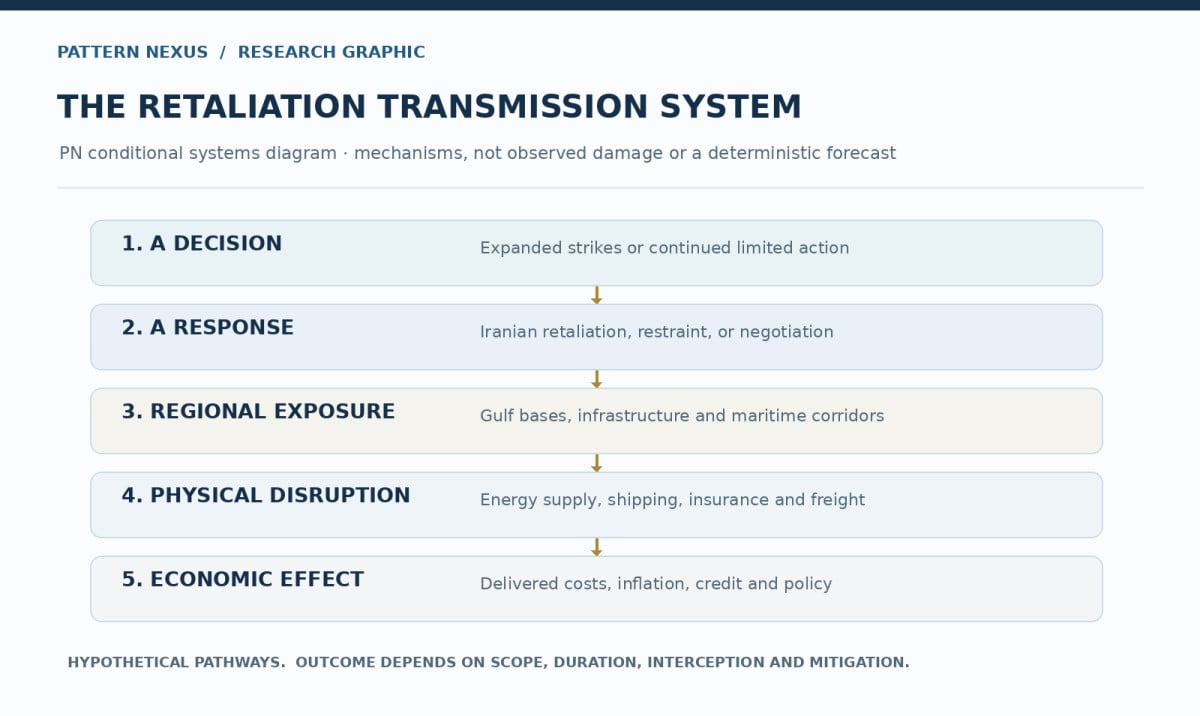
The strategic problem is the network effect. An attack against a military installation can trigger retaliation. Retaliation can move into shipping or energy. Commercial operators then react through routing, security, insurance, inventory, and financing decisions. Even a temporary shock can move beyond the battlefield into prices faced by countries that are not directly participating in the war.
09 · RESEARCH
The Dates: An Evidence-Based Calendar Without Invented Strike Days
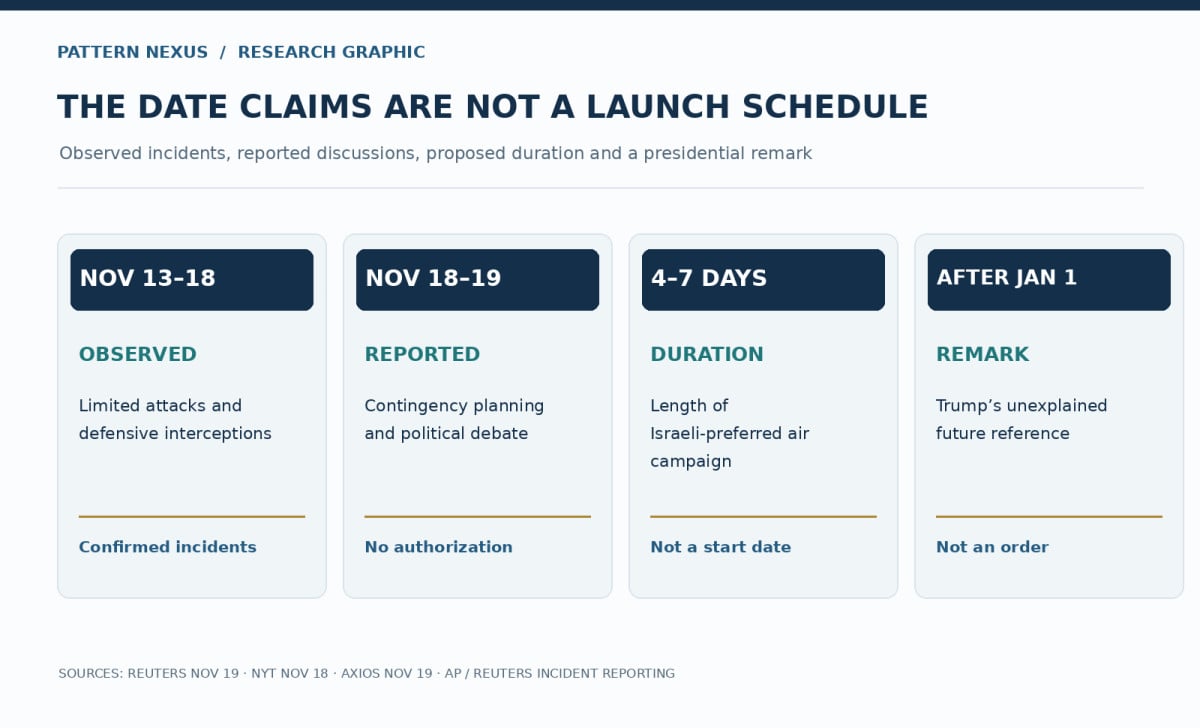
The calendar has been especially susceptible to exaggeration. Four different kinds of dates appear in current reporting, and they must not be combined.
| Date or interval | What it actually refers to | What it does not establish |
|---|---|---|
| November 3, 2026 | U.S. midterm election date; earlier October reporting discussed potential major strikes after the vote. [14] | Not a verified strike order or a still-valid launch day. |
| November 13–18 | Dates of confirmed or officially reported tactical attacks, interceptions and diplomatic activity. [4][5][6][10][11] | They are observed events, not a future launch timetable. |
| November 18–19 | Publication of new reporting on the White House's deliberations. [1][2] | Publication time is not a decision deadline. |
| Four to seven days | The proposed length of a wider Israeli-preferred air campaign. [1] | Not a projected start date or countdown. |
| Later this week | Axios expects deliberations may intensify after Trump's Asia trip. [2] | Not a scheduled strike, and return timing is not a launch order. |
| After January 1, 2027 | A phrase Trump used when discussing the future of the Iran conflict. He gave no reason for the date. [3] | Not a formal ultimatum, ceasefire deadline, or confirmed attack date. |
On the evidence currently available, there is no defensible claim that a major offensive is scheduled for a particular day in late November, December, or immediately after January 1. No source cited here provides an authenticated order or date.
The January 1 remark should be monitored because presidents can use public remarks to shape expectations. It cannot be converted into a planned operation without further corroboration. Similarly, a four-to-seven-day campaign discussed in government is not evidence that strikes will happen within the next four to seven days.
10 · RESEARCH
Diplomacy Is Still Operating
Oman, Qatar and other regional states continue diplomatic efforts. Reporting from the Associated Press says governments across the Gulf, along with Pakistan and Turkey, are pressing Washington to prevent renewed full-scale war. Their fear is not abstract: Iranian retaliation has already crossed into regional states, while the blockade and threats to shipping create economic costs even without a major air offensive. [5][7]
Axios reports Qatar and Pakistan remain engaged in mediation, with a Qatari meeting involving the Iranian foreign minister in Oman. No breakthrough is confirmed. The negotiating issues remain difficult: Iran's nuclear material and verification, sanctions, security assurances, maritime access, and the U.S. blockade. [2][5][7]
An absence of progress is not the same as an absence of diplomacy. If the blockade creates leverage that Washington judges sufficient, the United States may continue economic pressure rather than expand attacks. Gulf partners strongly favor avoiding an operation that could expose their infrastructure to further retaliation. [2][7]
Any prediction of an inevitable major air campaign has to explain why those restraints will fail. At present the public record establishes pressure for escalation and pressure against it.
11 · RESEARCH
The Energy and Financial Transmission Mechanism
A major campaign could affect global markets through several independent mechanisms: threat to Gulf production, refinery or power systems; risk to tanker transits and crews; higher insurance and freight costs; rerouting delays; fuel inventory behavior; and changes in expected supply. These links are plausible physical and financial pathways. None establishes an actual future oil-price level.
The current market tape actually provides a useful counterpoint to simplistic war headlines. Reuters reported Brent crude settled at $91.95 per barrel on November 18, down on the day as inventory and surplus-supply concerns outweighed some security risks. The market was not pricing every escalatory headline as a certain prolonged shortage. [17]
That does not make the Strait safe. It means the price signal incorporates other supply and demand forces alongside the conflict. A military event could disrupt logistics without immediately producing a durable price spike; conversely, a protracted interruption to physical supply could overwhelm existing surplus expectations.
The broader PN network is familiar: military action changes physical risk; physical risk changes maritime availability and insurance; those inputs change delivered energy cost; delivered energy cost moves transportation, chemicals, manufacturing, food production and inflation exposure. The strength of each link depends on real disruptions, durations, available substitutes and policy responses, not on the number of alarming posts circulating online.
12 · RESEARCH
Three Outcomes to Monitor Without Manufactured Probabilities
Scenario A: Limited retaliatory exchanges continue
U.S. strikes remain focused on immediate threats, while Iran continues calibrated attacks near military bases and shipping routes. Regional states intercept many projectiles, mediation continues, and neither Washington nor Tehran elects to expand to strategic industrial targets.
Evidence that would strengthen this case: continued narrow U.S. descriptions of strikes as self-defense; no new authorization of a broad campaign; continued carrier and regional defense operations; mediators remaining active. Evidence against it: official approval of a large operation or major uncontrolled escalation against civilian and energy systems.
Scenario B: A coordinated, broader U.S.–Israeli offensive begins
The administration authorizes an expanded operation resembling the campaign now being discussed. The first public confirmation would likely come from official statements or observable hostilities rather than from anonymous discussion of options. The target categories in reporting imply a wider military and economic scope than the Qeshm engagements.
Evidence that would strengthen this case: an explicit decision from Washington; authoritative announcement of campaign objectives; confirmed strikes extending beyond current localized engagements. Evidence against it: Trump explicitly ruling out major operations, an agreed diplomatic pathway, or continuing official insistence that the blockade is the preferred instrument.
Scenario C: Coercive diplomacy produces a partial pause
Mediators secure arrangements to reduce attacks, support limited verification or clarify shipping and blockade terms. Such a pause could happen without a comprehensive nuclear settlement and without resolving every underlying dispute.
Evidence that would strengthen this case: reciprocal announced commitments, restored inspection access, verified reduction in attacks, and written maritime arrangements. Evidence against it: renewed attacks that close negotiating channels, rejection of the mediators' terms, or explicit escalation decisions.
These are conditional paths, not numerical forecasts. No probability distribution, precise launch date, or intelligence-grade target list is provided because the necessary evidence is not public.
13 · RESEARCH
Trigger Dashboard: What Would Actually Change the Assessment
| Indicator | Evidence source to monitor | Interpretation |
|---|---|---|
| Formal U.S. authorization of a larger offensive | White House, Pentagon, CENTCOM and corroborated reporting | Converts a contingency from discussion to decision. |
| Verified geographic expansion of U.S.–Israeli strikes | Official statements, multi-source field reporting and independently assessed damage | Separates a regional campaign from limited self-defense strikes. |
| Iranian attacks causing confirmed damage or casualties in Gulf states | Bahrain, Kuwait, regional authorities and independently verified reporting | Raises retaliation and regional escalation risk. |
| Maritime incidents and vessel disruption | UKMTO advisories and shipping-operator reports | Measures physical shipping risk separately from propaganda claims. |
| IAEA inspections and nuclear material accounting | IAEA Board of Governors and Director General updates | Reduces or increases verified nuclear uncertainty. |
| Mediation progress | Oman, Qatar, Pakistan, U.S. and Iranian announcements | Tests whether a negotiated pause is viable. |
| Energy-market and insurance response | Verified benchmark pricing, shipping costs and physical outage reports | Tracks transmission into economic systems; price changes alone do not identify cause. |
An analyst should update these indicators independently. The presence of one does not automatically validate all the others.
14 · PATTERN NEXUS LENS
Pattern Nexus Lens: The Escalation Loop
This is a control-system problem under uncertainty. The United States is trying to apply military and economic pressure without inviting a regional response whose costs exceed the benefits. Iran is trying to increase the cost of the blockade and demonstrate that American regional partners cannot remain insulated from the conflict. Israel is pressing for action against military rebuilding and alleged unconventional-weapons activity before the threat becomes harder to address. Gulf countries are trying to prevent their economies and vital infrastructure from becoming the price of somebody else's escalation decision. [1][2][7][11]
Those objectives are mutually interactive. The U.S. can strike a launch site, and Iran can reply against a base. That reply may strengthen the argument for broader action. A broader operation may then create exactly the regional retaliation Washington sought to prevent. Every iteration can create information that the other side interprets as proof its original strategy was correct.
There is another information loop. The IAEA inspection gap makes the Iranian nuclear program harder to verify. Israeli intelligence fills some of that vacuum with allegations that American officials do not all interpret alike. Lack of agreed verification increases uncertainty, while the threat of another strike makes Iran less willing to reopen access. [1][2][8][9]
My working assessment is that the immediate, verified change is a higher tempo of limited conflict and active consideration of a larger campaign. The decisive unknown is the political authorization, followed by Iran's response. Military capacity is present. The publicly supported evidence for an imminent, dated major offensive is not.
A responsible forecast must preserve the difference between the ability to attack, the incentive to attack, the debate over attacking and the actual decision to attack. They are not the same state of the system.
15 · RESEARCH
Methodology, Caveats and Invalidation
This article is a time-bounded synthesis of contemporaneous November 13–19 reporting and official statements, with earlier October reporting used only to explain the origin of the post-midterms narrative. It does not rely on anonymous social-media countdowns or attribute unverified damage claims to an established outcome.
Evidence classes: (1) an official acknowledgement or observed incident; (2) high-quality attributed reporting of deliberations; (3) statements by interested parties; (4) PN conditional analytical scenarios. The article labels categories rather than making them appear equivalent.
Key limitations: detailed intelligence about chemical and biological capabilities is not public; the IAEA lacks access to key sites; target lists may change during deliberations; battlefield claims can be exaggerated; carrier presence does not establish strike authorization; and no independently verified day of a major offensive is available. Dates are source dates or incident dates unless expressly labelled otherwise.
Invalidation criteria: a documented formal operation order or official launch would supersede the no-date assessment; verified restoration of IAEA access would materially change the nuclear verification judgment; confirmed evidence of an operational chemical or biological program would alter the intelligence assessment; and a signed de-escalation agreement would weaken the broader-offensive scenario. Any such update should carry a new timestamp and source trail.
16 · READER QUESTIONS
FAQ
Has the United States already attacked Iran this week?
Yes. U.S. military sources confirmed a November 17 strike against an IRGC missile-launch site on Qeshm Island. This is a limited strike and must not be confused with the proposed new large-scale U.S.–Israeli operation. [4][5]
Is a four-to-seven-day air campaign confirmed?
No. Four to seven days is the reported duration of a plan preferred by Israel. It has not been publicly authorized by Trump, and no start date has been verified. [1][2]
What sites could be targeted?
Reported options include missile and drone arsenals, IRGC command infrastructure, suspected nuclear sites, energy infrastructure, power plants, bridges and leadership targets. This is a list of categories mentioned in reporting, not a final targeting order. [1][2][14]
Is January 1, 2027, the attack date?
No. Trump mentioned seeing what happens after January 1 but did not explain the date. Reuters reported that ambiguity directly. The statement does not confirm a scheduled operation. [3]
Does the IAEA know whether Iran has a bomb?
The agency is unable to verify the status and location of much previously declared high-enriched material because of restricted inspections. That uncertainty is serious but does not, by itself, establish an assembled nuclear weapon. [8][9]
Did Iran destroy American radars in Bahrain?
Iran claimed successful strikes, but U.S. and Bahraini officials reported interceptions and denied the claimed damage. The damage allegation is not established in the sources reviewed. [10][11]
Are the chemical and biological allegations verified?
No public evidence reviewed here proves an imminent deployable chemical or biological threat. Israeli officials have raised concerns, and American officials disagree about the strength and interpretation of that intelligence. [1][2]
Are three American carriers still positioned in the region?
Not according to the November 19 AP update. Three were briefly present, but George Washington returned to Asia-Pacific operations. Two remain supporting the regional effort. [13]
What would most decisively change the outlook?
A formal decision authorizing major strikes, verified widespread new attacks, confirmed Iranian retaliation affecting Gulf infrastructure, or a verifiable negotiated arrangement would change the assessment. Such developments should be distinguished from public speculation about a calendar date.
SOURCES
Research and Data Sources
Sources below include primary official statements, agency incident reporting, and identified news accounts. Reported strike options are not presented as executed orders.
- [1] The New York Times. Trump Weighs New Strikes on Iran as Israel Presses for Action, Officials Say. November 18, 2026. Primary reporting on deliberations, proposed campaign, U.S. divisions and reported target categories; paywalled original.
- [2] Axios. Trump weighs strikes on Iran as Israel warns of chemical weapons. November 19, 2026. Additional reporting on possible targets, Mossad visit, Gulf objections and contingency discussions.
- [3] Reuters. Trump says US will see what happens in conflict with Iran after January 1. November 19, 2026. Confirms January 1 remark and explicitly notes no explanation of its significance.
- [4] Associated Press. A 2-month lull ends with Iran’s third strike on US targets in Bahrain, and US retaliation. November 17, 2026. Confirms Qeshm U.S. action and reported interceptions.
- [5] Reuters. US, Iran exchange fire despite talks with mediators. November 17, 2026. U.S. strike, Qeshm geography, Iranian claim and diplomatic contacts.
- [6] Reuters. Iran fires at Kuwait after US strike on Iranian island. November 18, 2026. Kuwait and Bahrain reports and attribution of claimed impacts.
- [7] Associated Press. Mideast nations ramp up efforts to avert all-out war as Israel urges Iran strikes, officials say. November 18, 2026. Regional diplomacy, fears about Gulf infrastructure and reciprocal strikes.
- [8] United Kingdom, France, Germany and United States. Quad statement to IAEA Board of Governors, November 2026. November 19, 2026. Official joint statement on loss of inspection continuity and safeguarded material.
- [9] Reuters. West presses Iran at IAEA to let inspections resume at bombed nuclear sites. November 19, 2026. Independent coverage of safeguards dispute and damaged enrichment plants.
- [10] Reuters. Bahrain intercepts Iranian aerial attacks as Tehran says it attacked US base. November 15, 2026. November 13–15 Bahrain incidents; distinguishes Iranian claims from reports of interception.
- [11] Institute for the Study of War / Critical Threats Project. Iran Update, November 18, 2026. November 18, 2026. Daily conflict analysis, the Gulf exchanges, shipping reports, mine-claim caveat.
- [12] Reuters. Threats from Iran have increased substantially, US intelligence director says. November 18–19, 2026. Hearing statements and lack of public confirmation of a specific dirty-bomb plot.
- [13] Associated Press. US military returns to 2 aircraft carriers in the Middle East. November 19, 2026. Current carrier count: two; briefly three before George Washington left.
- [14] The Times of Israel, summarizing The New York Times. US, Israel said to draft plans for resumed strikes on Iran after midterm elections. October 22, 2026. Earlier post-midterms plan reports and prospective categories; historical context, not current authorization.
- [15] The Times of Israel, summarizing The New York Times. Israel said to tell skeptical US, Gulf countries that Iran may use chemical weapons. November 3, 2026. Early chemical-weapons intelligence claim and skepticism.
- [16] United Kingdom Maritime Trade Operations. Recent Incidents: November 2026 warnings. November 13–18, 2026. Official maritime incident alerts; reports projectile strikes and fires without attributing all incidents to one side.
- [17] Reuters. Oil prices settle lower as traders weigh surplus supply outlook. November 18, 2026. Benchmark closing prices and explanation of inventory and geopolitical market drivers.
This is a public research synthesis of documented events and stated options. It is not a strike forecast, targeting recommendation or operational guide.
Article overview
U.S. strikes have resumed near Hormuz as Israel presses Trump for a wider campaign. PN verifies the November incidents, the reported target categories, the disputed intelligence and what the January 1 remark does—and does not—mean.
Каква е вашата реакция?
 Харесай
0
 Не ми харесва
0
 Любов
0
 Смешно
0
 Уау
0
 Тъжен
0
 Ядосан
0

Nexus (Christopher)
Founder of Pattern Nexus. I research markets, macro, geopolitics, AI, history, ancient systems, and the patterns most people overlook. I’m also building Market Radar, a trading scanner designed to read pressure, risk, confirmation, and setup quality before ch…
Related research

Larak Strike Turns Hormuz Into a Mine-War Energy Shock
U.S. forces struck two Iranian launchers on Larak Island near the Strait of Hormuz on August 30 after U.S. officials said IRGC personnel we…
3 shared topics, 1 shared asset, same research avenue.
One System, Many Flags: Ukraine, Iran, North Korea and the Illusion of Separate Wars
The United States can arm Ukraine while temporarily easing pressure on Russian oil, convert stockpile transfers into new procurement, court…
4 shared topics, same research avenue.
War Is Back On: The U.S.–Iran Ceasefire Has Collapsed Into a Wider Logistics and Chokepoint War
The United States is striking Iranian military, port, power, transportation, and logistics infrastructure. Iran is retaliating against the …
4 shared topics, same research avenue.
Kuwait Turns Iran’s Gulf Strikes Into a U.S. Base-Resilience Test
Iran said it targeted U.S. drone and missile installations at Kuwait’s Ali Al Salem air base on November 18, while Bahrain reported another…
3 shared topics, same research avenue.
Washington Turns a Third Carrier in the Middle East Into a Hormuz Escalation Test
The USS Theodore Roosevelt has arrived in the Middle East, joining two other U.S. aircraft carriers already in the region amid the Iran war…
3 shared topics, same research avenue.
Houthis Turn a Bab el-Mandeb Withdrawal Into a Two-Chokepoint Energy Stress Test
Yemen’s southern forces said on November 15, 2026, that they were redeploying from Dhubab airport and the Bab el-Mandeb area toward Aden, w…
3 shared topics, same research avenue.
Washington Turns a Third Carrier Into an Iran-War Escalation Option
The United States is dispatching the USS Theodore Roosevelt carrier strike group and the Makin Island amphibious ready group toward the Mid…
3 shared topics, same research avenue.
Tehran Turns Hormuz Reopening Into a Seven-Day Energy-Security Bargain
Iranian Foreign Minister Abbas Araghchi says Tehran has sent Washington a seven-day roadmap through Qatar that would reopen the Strait of H…
3 shared topics, same research avenue.
Коментари (0)
Security Check
Please complete the captcha to verify you are human.