
LHS 3844 b: The Dead Rock That Shows Why Earth-Sized Does Not Mean Earth-Like
JWST has given astronomers one of the clearest looks yet at the surface of a rocky exoplanet, LHS 3844 b, also called Kuaʻkua. The result is not alien life, not oxygen, and not a second Earth. It is a dark, hot, likely airless super-Earth orbiting a red dwarf star every 11 hours, with a basalt-like or space-weathered surface and no detectable atmosphere. The discovery matters because it shows that the exoplanet era is moving from planet detection into planet interpretation, and it forces a harder lesson: Earth-sized does not mean Earth-like.
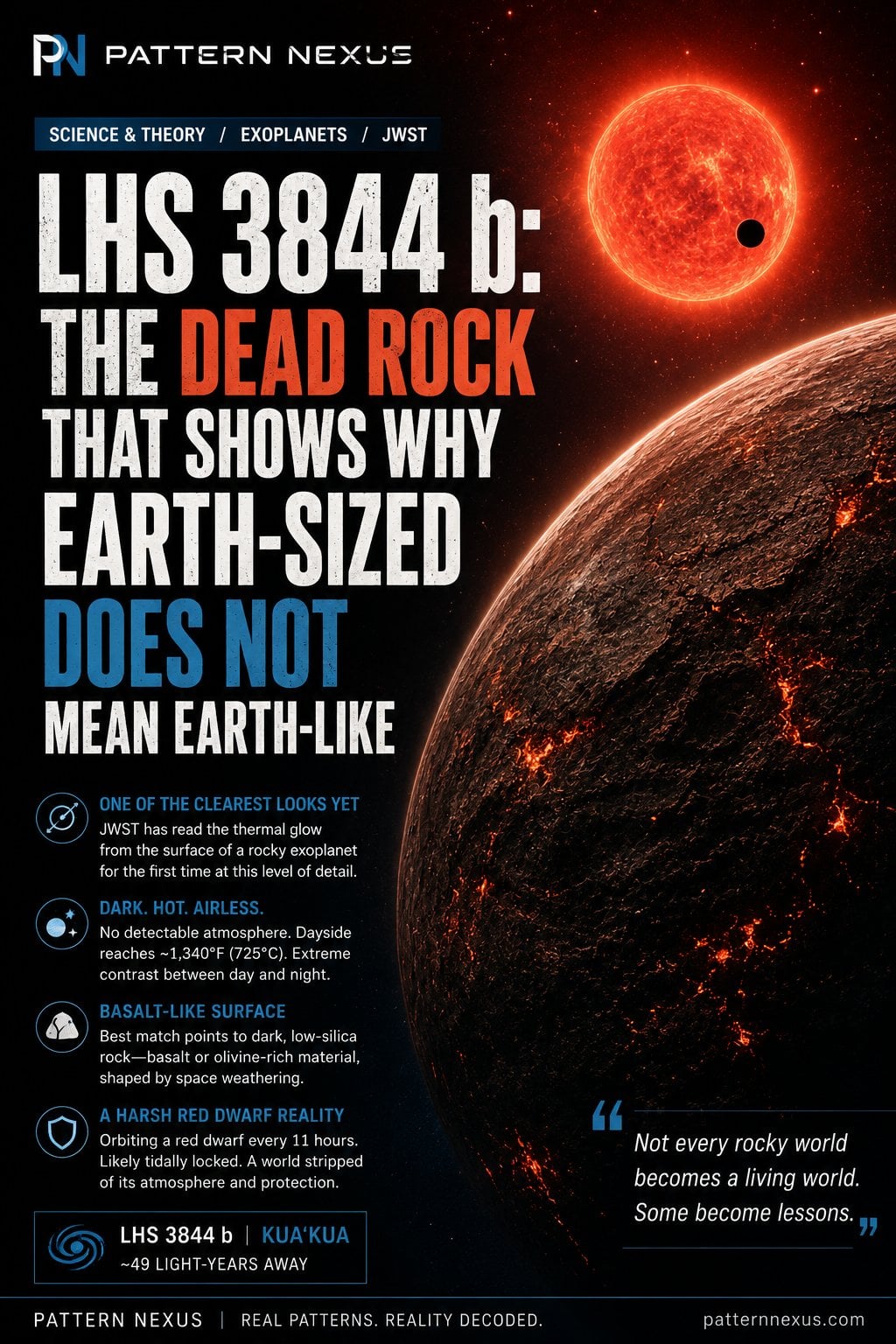

Science & Theory / Exoplanets / JWST / Rocky Worlds
LHS 3844 b: The Dead Rock That Shows Why Earth-Sized Does Not Mean Earth-Like
JWST did not find alien life here. It found something colder in meaning and hotter in physics: a dark, exposed, likely airless rocky planet orbiting a red dwarf every 11 hours. And that may be just as important, because it shows the search for habitable worlds is not about finding planets the size of Earth. It is about finding systems that survived.
Quick Read
LHS 3844 b, also called Kuaʻkua, is the exoplanet that was reported on recently. It is not another K2-18 b story, and it is not an oxygen or alien-life story. It is almost the inverse. JWST has given astronomers one of the clearest looks yet at the surface of a rocky exoplanet, and the result appears to be a dark, hot, likely airless world with no protective atmosphere.
The planet is about 49 light-years away, roughly 30 percent larger than Earth, and it orbits a red dwarf star in only about 11 hours. Because it is so close to its star, it is likely tidally locked, meaning one side constantly faces the star while the other faces permanent darkness. Reuters reported that its dayside reaches around 1,340°F, or about 725°C, while the nightside shows no detectable heat signature, which fits the picture of a world without a substantial atmosphere to move heat around.
The important part is not that this planet looks like Earth. It does not. The important part is that JWST is now moving from detecting exoplanets into reading rocky surfaces, testing surface composition, looking for volcanic gases, checking whether atmospheres survived, and showing that planet size alone tells us almost nothing about habitability.
Planet
LHS 3844 b, officially named Kuaʻkua, a rocky super-Earth around 49 light-years away.
Orbit
It circles its red dwarf star in roughly 11 hours, placing it extremely close to the star.
Main Finding
JWST data point to a dark, hot, likely airless surface with no detectable substantial atmosphere.
Real Lesson
A planet can be rocky and near Earth-sized while still being nothing like Earth as a living system.
This Is Not K2-18 b
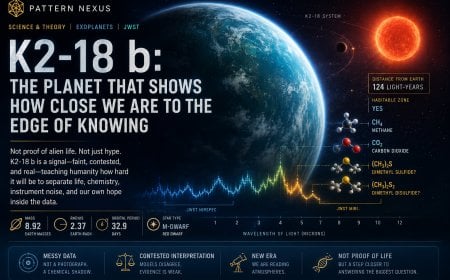
The first thing to clear up is that this is not K2-18 b. We already covered that story, and K2-18 b belongs to a different category of scientific tension. K2-18 b is about a possible hydrogen-rich atmosphere, methane, carbon dioxide, disputed DMS or DMDS signals, and whether an atmospheric molecule can be interpreted as a possible biosignature without turning weak evidence into alien-life mythology.
LHS 3844 b is a different lesson. It is not about a maybe-ocean world. It is not about a possible life molecule. It is not about oxygen. It is not a planet that invites the public to imagine alien plankton or a hidden biosphere under clouds.
This one is harsher. JWST looked at a rocky world and appears to have found a dark, barren, exposed surface with no meaningful atmospheric protection. In some ways, that is a cleaner result than K2-18 b, but it is not less important. It shows the other side of the exoplanet search: not the worlds that might be alive, but the worlds that tell us how easily rocky planets can fail.
That distinction matters because the public tends to treat every rocky planet as a potential Earth until proven otherwise. LHS 3844 b is the correction. It is what happens when a planet may have the right general size category but the wrong star, the wrong orbit, the wrong thermal environment, the wrong atmospheric history, and no surviving protective layer.
What LHS 3844 b Actually Is
LHS 3844 b is a rocky super-Earth orbiting a small red dwarf star about 49 light-years away. It was originally discovered by NASA’s TESS mission, which searches for the tiny dips in starlight caused when planets pass in front of their stars. That method tells us a planet is there, gives us a radius, and helps define its orbit, but it does not automatically tell us what the surface is made of, whether the world has an atmosphere, or whether it is remotely habitable.
What makes LHS 3844 b so useful is that it is close enough, hot enough, and arranged favorably enough for JWST to study the infrared light coming from the planet itself. That is the important shift. We are not only detecting the planet’s shadow anymore. We are beginning to measure the planet’s heat.
The world orbits its star in roughly 11 hours. That alone tells you this is not a comfortable place. A planet orbiting that close to a red dwarf is living under intense stellar forcing, and it is likely tidally locked, with one side in permanent day and the other in permanent night.
Reuters reported the dayside temperature at around 1,340°F, or about 725°C. That is not “warm.” That is not “desert planet.” That is a furnace-facing hemisphere. The nightside, meanwhile, appears extremely cold by comparison because there is no detectable atmosphere moving heat from the day side to the night side. That one fact tells you almost everything about the planet’s habitability story. No atmosphere means no weather, no pressure cycle, no surface liquid water, no climate buffer, and no meaningful surface protection.
So the basic picture is this: a rocky world, larger than Earth, extremely close to a red dwarf, likely tidally locked, with a dark surface and no substantial atmosphere. It is not a second Earth. It is a stripped rock.
JWST Looked at the Surface, Not Just the Shadow
This is the part that makes the discovery so important. For decades, exoplanet science was mostly about finding planets and estimating their basic properties. We knew a planet existed because the star dimmed. We could estimate size, orbital period, sometimes mass, sometimes density, and sometimes atmospheric features if the planet was large or favorable enough.
But LHS 3844 b pushes into a different category. JWST’s mid-infrared instrument measured thermal emission from the planet, meaning it looked at the heat signature of the world. In the 2026 study, researchers reported a 5 to 12 micron thermal emission spectrum, and that spectrum gave clues about the surface composition.
That is a major transition. We are not simply asking, “Is there a planet?” We are asking, “What kind of rock is it?” That sounds subtle, but it is one of the biggest shifts in exoplanet science. Once you can begin studying surfaces, you are no longer doing only exoplanet detection. You are doing exoplanet geology.
This is where JWST becomes more than a telescope in the public imagination. It becomes a translation machine. It turns heat into spectrum, spectrum into composition, composition into geologic history, and geologic history into a better understanding of whether rocky planets around red dwarfs survive as living worlds or end as exposed planetary bones.
That does not mean JWST sees mountains, lava fields, craters, or continents directly. It means it can read the infrared fingerprint of the surface well enough to compare it against possible rock types. That is still extraordinary. It is not a photograph of alien geology. It is a chemical and thermal inference from light, but that is how the next era begins.
The Dead Rock Problem
LHS 3844 b matters because it is a reminder that most rocky planets may not be living worlds, even if they look promising in a catalog.
This is one of the traps in how the public understands exoplanets. A headline says “Earth-sized,” and the imagination fills in oceans, clouds, continents, maybe even life. But Earth-sized is not Earth-like. A planet can have a familiar radius and still be a burned-off, airless, tidally locked, radiation-blasted object with no climate and no surface stability.
That is what makes LHS 3844 b useful. It is not useful because it is friendly. It is useful because it is exposed. Its lack of atmosphere makes the surface easier to study, and that gives scientists a rare opportunity to read the rocky composition of an exoplanet directly through infrared light.
The irony is that dead worlds may teach us how to find living ones. If you only study planets with atmospheres, you are always fighting clouds, hazes, gases, chemistry, and model degeneracy. But an airless planet exposes the surface more directly. It gives you a cleaner test case for what rock looks like in JWST data.
So LHS 3844 b is not a failure of the search. It is part of the calibration system. It tells us what a stripped rocky planet looks like, and that helps define what future habitable candidates should not look like.
Why Earth-Sized Does Not Mean Earth-Like
The phrase “Earth-sized” is one of the most misleading phrases in public science communication. It sounds like similarity, but most of the time it means only scale. Size is important, but it is not destiny.
Earth is not habitable simply because of its radius. Earth is habitable because of a whole layered arrangement: distance from the Sun, atmosphere, magnetic environment, plate tectonics, volatile cycling, oceans, carbon cycle, stable pressure, long-term climate regulation, and a biosphere that transformed the planet over billions of years.
Take away the atmosphere and Earth becomes radically different. Move it too close to the Sun and the oceans boil. Put it around a more violent star and the atmosphere may be stripped. Lock one side to permanent day and one side to permanent night, and the climate problem becomes extreme. Remove tectonic and volatile cycling, and the planet loses one of the core systems that stabilizes surface conditions over deep time.
LHS 3844 b is the lesson in one object. It is rocky. It is not a gas giant. It is relatively close in size to Earth compared with many exoplanets. But none of that gives it Earth’s system. The planet appears to be missing the protective and regulatory layers that make Earth Earth.
That is why the public category is broken. We should stop asking whether a planet is “Earth-sized” as if that means anything by itself. The better question is whether the planet has retained the conditions that allow a surface environment to persist.
The Red Dwarf Stripping Machine
LHS 3844 b orbits a red dwarf star, and that matters because red dwarfs dominate the galaxy. If planets around red dwarfs can commonly retain stable atmospheres, then the potential inventory of habitable worlds becomes enormous. If many close-in rocky red dwarf planets are stripped bare, then the galaxy may be full of Earth-sized rocks that are not Earth-like in any meaningful sense.
Red dwarfs are attractive for exoplanet hunting because their planets are easier to detect. A small star produces a deeper transit when a planet passes in front of it. Close-in planets orbit quickly, so astronomers get repeated transits faster. That makes red dwarf systems extremely useful for finding and studying small planets.
But the same geometry that makes detection easier can make habitability harder. The habitable zone around a red dwarf is much closer to the star than Earth is to the Sun. Close orbit means stronger tidal effects, greater chance of tidal locking, and exposure to stellar activity over long periods. If the star is active early in its life, high-energy radiation can erode or remove atmospheres from close-in rocky planets.
LHS 3844 b is not in the habitable zone; it is much too close and much too hot. But it still matters for the larger red dwarf question because it shows what a close-in rocky world can become: a bare surface with no detectable atmospheric blanket.
The point is not that every red dwarf planet is dead. The point is that red dwarf habitability cannot be reduced to planet size and orbital distance. The survival of an atmosphere may be the first gate. Without that, the rest of the habitability conversation collapses.
No Detectable Atmosphere Changes the Whole Story
A planet’s atmosphere is not just air. It is protection, pressure, circulation, chemistry, heat transport, surface stability, and memory. It records the planet’s relationship with its star, interior, volcanism, impacts, magnetic environment, and time.
On LHS 3844 b, JWST found no evidence for a substantial atmosphere. The 2026 study reports that the data disfavor trace concentrations of gases such as carbon dioxide and sulfur dioxide, with strong upper limits. That matters because these gases would be potential signs of an atmospheric layer or volcanic outgassing.
If there is no substantial atmosphere, then heat cannot efficiently circulate from the dayside to the nightside. That fits the extreme thermal contrast. The dayside burns under the star. The nightside receives no redistributed warmth. The surface becomes an exposed boundary between rock and space.
That is what makes the planet feel so stark. There is no soft layer between the world and its star. No weather system. No ocean buffer. No atmospheric shield. No pressure system. No cloud deck hiding complexity. Just rock, radiation, thermal emission, and time.
This is also why LHS 3844 b is not a disappointment scientifically. An airless planet is easier to read at the surface because there is less atmospheric confusion in the signal. In the same way K2-18 b teaches us the difficulty of atmospheric interpretation, LHS 3844 b teaches us the opportunity of surface interpretation when the atmosphere is gone.
Basalt, Mantle Rock, and Space Weathering
The surface interpretation is one of the most interesting parts of the study. The JWST spectrum is best matched by a dark, low-silica surface, such as basalt or other olivine-rich material. In plain terms, this does not look like a bright, silica-rich continental crust like parts of Earth. It looks more like darker volcanic or mantle-linked rock.
That matters because surface composition tells a story about planetary history. Basalt is common on rocky worlds. Earth’s ocean crust is basaltic. The Moon has basaltic maria. Mars has basaltic volcanic provinces. Mercury has darkened, space-weathered terrain. So when LHS 3844 b appears dark and basalt-like, it places the planet in a family of rocky bodies shaped by heat, volcanism, exposure, and time.
But the study also raises the possibility of space weathering. A surface exposed to stellar radiation, charged particles, micrometeorite impacts, and no atmospheric protection can darken over time. That means the observed darkness may not only reflect the original rock type. It may also reflect billions of years of exposure.
This is where the planet becomes more than a dead rock. It becomes a record. Its surface may be telling us about the long-term interaction between rocky planets and red dwarf environments. It may show how exposed planets age, how their surfaces darken, and what happens when there is no atmosphere to protect or recycle the crust.
The surface is not “featureless” because nothing happened. It may be featureless because time, radiation, and exposure have erased or muted the signatures we hoped to see.
The Missing Volcanic Gas Question
One of the deeper questions is whether LHS 3844 b is geologically dead or only quiet from the angle JWST can currently measure.
On rocky planets, volcanic gases can help build and replenish atmospheres. If a planet is actively outgassing carbon dioxide, sulfur dioxide, water vapor, or other volatiles, then even a hostile planet may show atmospheric traces. In LHS 3844 b’s case, the new data found no evidence of accumulated volcanic gases.
That matters because it suggests the planet may not be actively replenishing an atmosphere, or that any gases released are quickly stripped away or too low in abundance to detect. Either way, the system does not look like a planet maintaining a stable volatile cycle.
This is important for habitability because a living planet is not just a rock in the right place. It needs cycling. It needs interior and surface processes that can regulate chemistry over time. Earth’s long-term habitability depends heavily on the carbon cycle, volcanism, weathering, oceans, plate tectonics, and atmospheric feedbacks. Without those systems, the surface environment becomes much harder to stabilize.
LHS 3844 b appears to lack that kind of stabilizing machinery, at least from what the current data can show. That does not make it boring. It makes it a boundary case for what rocky planets look like when the machinery fails or never survives.
What This Means for Habitability
LHS 3844 b is not habitable in any ordinary sense. The dayside is far too hot, the orbit is far too close, the atmosphere appears absent, and there is no meaningful basis for surface liquid water.
But the discovery still matters for habitability because negative examples are part of the map. If we only focus on the exciting candidates, we misunderstand the filter. Worlds like LHS 3844 b show what can go wrong. They show how rocky planets can lose atmospheres, become tidally locked furnaces, and end up as exposed geology instead of living systems.
That is the larger habitability lesson: life is not just about ingredients. It is about preservation. A planet can form rocky. It can sit around a common star. It can be near Earth-sized. It can have minerals and heat and maybe even have had volatiles earlier in its history. But if the atmosphere does not survive, if the star strips the planet, if the orbit locks the climate into extremes, if geological cycling shuts down, the living window closes.
In that sense, LHS 3844 b is not only a dead planet. It is a failed pathway. It tells us that the galaxy may be full of rocky worlds that almost look promising in a catalog but fail at the system level.
That is why this discovery belongs next to the K2-18 b discussion. One planet warns us not to turn chemistry into life too quickly. The other warns us not to turn size into habitability too quickly.
The K2-18 b Contrast
K2-18 b and LHS 3844 b are almost perfect opposites in the public imagination.
K2-18 b gives people hope because it may have a hydrogen-rich atmosphere, methane, carbon dioxide, and possibly disputed sulfur-bearing molecules associated with biology on Earth. It becomes a story about whether a faint atmospheric signal could be life.
LHS 3844 b gives people the harder lesson because it appears to have no substantial atmosphere at all. Instead of asking whether the atmosphere contains biosignatures, we are asking what the exposed surface is made of and whether the planet has any surviving volatile system.
One is the danger of overinterpreting a molecule. The other is the danger of overinterpreting a planet’s size.
Together, they show the real shape of the exoplanet era. It will not be a simple march from “planet found” to “life found.” It will be a messy sorting process. Some worlds will have atmospheres we struggle to interpret. Some will be stripped bare. Some will look promising until the details collapse. Some may look dead until a deeper signal appears. And somewhere inside that sorting process, we may eventually find a world where the system-level evidence points toward life.
But LHS 3844 b is telling us not to cheat the process. The universe does not owe us second Earths just because a planet is rocky.
Pattern Nexus Lens
LHS 3844 b is not a life story. It is a filter story.
At the first layer, there is detection: TESS found the transit, proving the planet exists and giving astronomers the basic orbital geometry.
At the second layer, there is thermal measurement: JWST measured the planet’s infrared emission, allowing scientists to move from shadow-based detection toward surface-level interpretation.
At the third layer, there is surface composition: the spectrum points toward a dark, low-silica surface such as basalt or olivine-rich material, possibly altered by long-term space weathering.
At the fourth layer, there is atmospheric absence: no detectable substantial atmosphere, no strong sign of heat redistribution, and no clear evidence for accumulated volcanic gases.
At the fifth layer, there is stellar forcing: a close orbit around a red dwarf, likely tidal locking, extreme temperature contrast, and a history shaped by exposure.
At the sixth layer, there is habitability failure: a rocky planet can have the right general size category and still lack the systems that make a living world possible.
At the seventh layer, there is the media layer: the public hears “Earth-sized exoplanet” and imagines another Earth, while the data says dark, hot, barren rock.
That is why this matters. The planet is not telling us where life is. It is telling us where life is not, and that is just as important if we are trying to map the real filters between planet formation and living worlds.
My Read
My read is that LHS 3844 b is one of those discoveries people will underestimate because it does not give them the emotional payoff they want. There is no alien ocean here. No oxygen headline. No possible biosignature molecule. No “we may not be alone” framing that gets everyone excited.
But that is exactly why it matters.
This planet is the dead side of the search. It is the exposed rock after the atmosphere is gone, after the star wins, after the orbit locks, after the volatile system fails, after the public fantasy of “Earth-sized” gets stripped down to what the data actually says.
And that is valuable because the search for life is not only about finding hopeful signals. It is about understanding the filters. How many rocky planets lose their atmospheres? How many red dwarf worlds are stripped early? How many near-Earth-sized planets are just airless furnaces? How many worlds look promising from far away until JWST or the next telescope reads them more clearly?
LHS 3844 b is not a second Earth. It is a warning against lazy categories.
Earth-sized does not mean Earth-like. Rocky does not mean habitable. Nearby does not mean reachable. A planet is not a living system because it fits inside a size box. It has to retain atmosphere, pressure, chemistry, cycling, stability, and time.
K2-18 b taught the public not to confuse a disputed molecule with life. LHS 3844 b teaches the public not to confuse a rocky planet with Earth.
That is the deeper story. JWST is not only showing us where life might be. It is showing us how many worlds probably failed before life ever had a chance.
Sources
- Reuters: Astronomers get the best look yet at the surface of an exoplanet
- arXiv: The dark and featureless surface of rocky exoplanet LHS 3844 b from JWST mid-infrared spectroscopy
- Max Planck Institute for Astronomy: A barren rocky exoplanet with no protection from cosmic radiation
- University of Chicago: Scientists get best-ever look at distant planet’s surface with Webb telescope
- EurekAlert: Astronomers explore the surface composition of a nearby super-Earth
- NASA Exoplanet Catalog: LHS 3844 b
- NASA/Webb: Illustration of Exoplanet LHS 3844 b and Its Star
- NASA/Webb: Simulated Thermal Emission Spectrum of Exoplanet LHS 3844 b
- EurekAlert / MPIA: Mercury analog image for LHS 3844 b
- EurekAlert / MPIA: Infrared spectrum of LHS 3844 b’s hot dayside
Pattern Nexus is not just tracking the planets that might be alive. It is tracking the filters that decide whether rocky worlds survive long enough to become living systems or end as exposed rock under a hostile star.
Frequently Asked Questions
আপনার প্রতিক্রিয়া কি?
 পছন্দ করুন
0
পছন্দ করুন
0
 অপছন্দ
0
অপছন্দ
0
 ভালোবাসা
0
ভালোবাসা
0
 মজার
0
মজার
0
 বাহ!
0
বাহ!
0
 দুঃখজনক
0
দুঃখজনক
0
 গোস্বামী
0
গোস্বামী
0

Founder of Pattern Nexus. I research markets, macro, geopolitics, AI, history, ancient systems, and the patterns most people overlook. I’m also building Market Radar, a trading scanner designed to read pressure, risk, confirmation, and setup quality before chasing a move. Pattern Nexus is where I connect the dots between data, history, technology, and the bigger system playing out around us.







মন্তব্যসমূহ (0)