
The Scientist Layer Is Getting Fragile: Amy Eskridge, Missing Researchers, China’s Strategic Death Cluster, and the Knowledge Bottleneck Beneath Modern Power
A growing list of dead and missing scientists, aerospace personnel, nuclear-linked workers, military AI researchers, hypersonic specialists, and exotic propulsion figures has forced a darker question into public view: what happens when civilization’s most sensitive knowledge is concentrated inside a thin layer of human nodes? This is not only a UFO story. It is a knowledge-continuity story, a national-security story, and a Pattern Nexus control-stack story.
Quick Read
The viral version of this story wants to start with aliens, ultraterrestrials, anti-gravity, zero-point energy, missing scientists, dead researchers, future humans, and Amy Eskridge. That is part of the story, but it is not the whole story. It is the loudest layer, the layer that makes people either lean in or immediately laugh it off, and that is exactly why the deeper structure gets missed.
The deeper Pattern Nexus frame is bigger than the UFO label. Modern civilization depends on a thin layer of people who understand propulsion, nuclear systems, advanced materials, space monitoring, military AI, drones, hypersonics, directed energy, classified aerospace, data security, and exotic research that the public is usually trained to ridicule before it is ever allowed to understand. The public sees agencies, labs, universities, contractors, and press releases. Underneath that public layer are specific human beings carrying knowledge that is not evenly distributed, not fully documented, and not always replaceable.
When that layer starts showing unexplained attrition, the question is not only “who did it?” That is the obvious question, but it is not the only one. The larger question is why the system is so dependent on fragile human nodes in the first place. If a civilization’s most sensitive future technologies depend on a narrow band of scientists, engineers, military researchers, contractors, and classified-program insiders, then the loss of those people is not just personal tragedy. It is a continuity problem.
This Is Not Just A UFO Story
The easiest way to discredit this entire subject is to shove it into the UFO box and then laugh at the box. That is the oldest trick in the system: take a real structural question, attach it to the strangest layer, and then force everyone to argue about the strangest layer until the structural question disappears.
That is exactly what happens here. The Amy Eskridge story contains the wildest material in the whole file: ultraterrestrials, P-47s, P-52s, future humans, anti-gravity, zero-point energy, directed-energy harassment, suppressed propulsion, and claims that the beings commonly called “grays” are not extraterrestrials in the normal sense, but future descendants of humanity. That layer is strange. It is also the layer that gets used to make people stop looking at everything else around it.
Those claims are not established public fact. They belong in the contested and speculative layer, and they should be treated that way. But the structural question underneath them is not speculative at all. The real question is this: who controls advanced knowledge before it becomes public technology?
That question applies whether someone believes the UAP layer or not. It applies to nuclear propulsion. It applies to hypersonic thermal materials. It applies to military AI decision systems. It applies to fusion. It applies to space-weather warning. It applies to directed-energy weapons. It applies to drone swarms. It applies to high-end microelectronics. It applies to classified aerospace programs and contractor networks. It applies to every domain where the public is told, “nothing to see here,” while governments and defense industries quietly pour money into the same categories behind closed doors.
Directed-energy systems are not imaginary. High-energy lasers and high-power microwave systems are active defense priorities. That does not prove Amy Eskridge was targeted with one, and I am not going to pretend it does. But it does prove the category of technology itself is real, militarized, and strategically relevant. That distinction matters because the entire subject is designed to collapse into ridicule if the layers are not separated correctly.
The lazy version says Amy talked about weird things, so ignore everything. The Pattern Nexus version says Amy talked about weird things inside an ecosystem where some of the surrounding technologies are real, militarized, classified, and strategically sensitive. That makes the overlap worth examining, not because every claim is proven, but because the system around the claim is real.
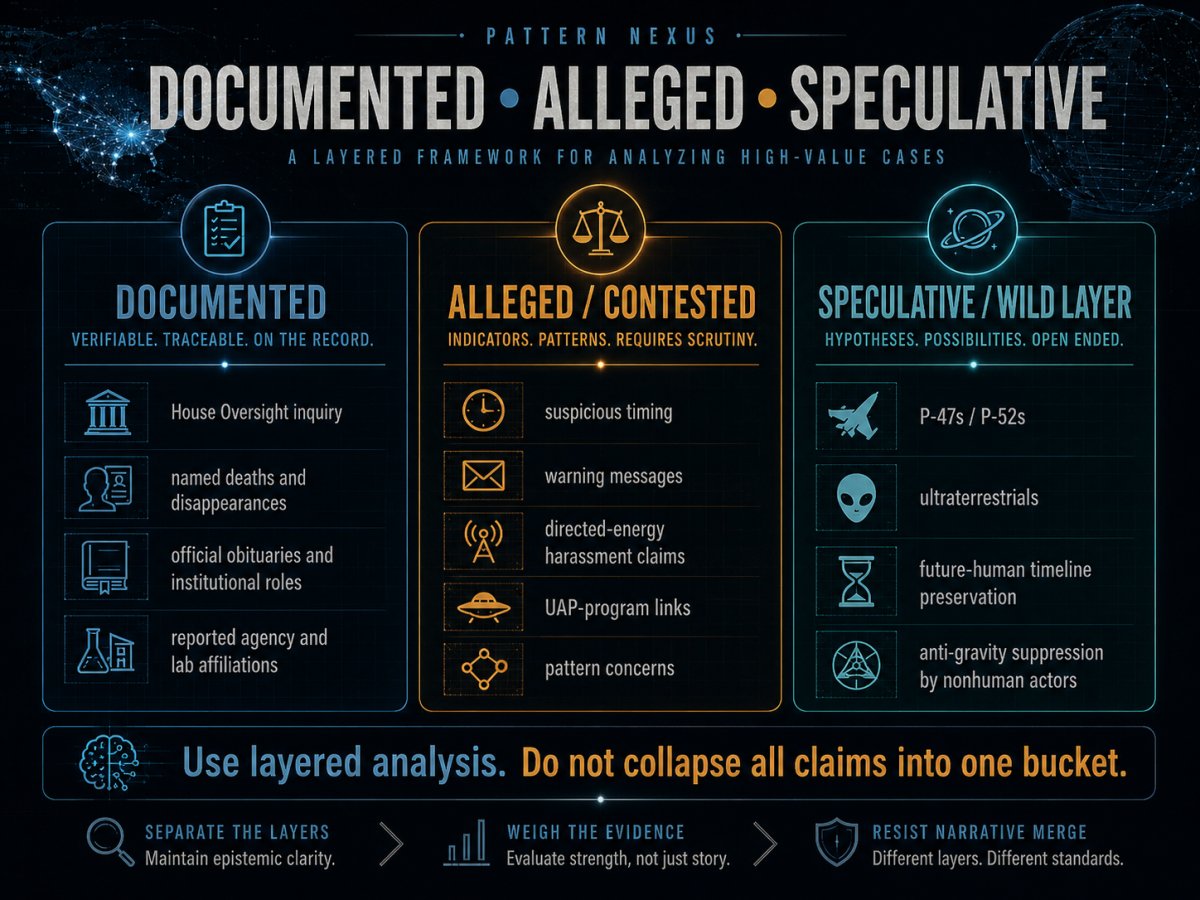
The Three Layers: Documented, Alleged, Speculative
This story has to be separated into layers or it collapses under its own weight. That is where most people fail. They either take every claim literally, or they throw the entire thing away because one part sounds too strange. Both approaches are intellectually weak. A serious analysis has to separate what is documented, what is alleged, and what is speculative, then ask what pattern remains after that separation.
| Layer | What Belongs Here | How To Handle It |
|---|---|---|
| Documented Layer | Congressional letters, FBI interest, named deaths and disappearances, official obituaries, university statements, reported job titles, known agency or lab connections. | Treat as factual when sourced. Do not exaggerate. Do not mislabel administrators as scientists or allegations as proof. |
| Contested Layer | Claims that certain deaths are suspicious, family concerns, missing-person anomalies, no public cause of death, unexplained timing, limited official information, alleged UAP or classified-program connections. | Treat as unresolved. The point is not instant proof. The point is the pattern signal and the lack of public clarity. |
| Speculative / Wild Layer | P-47s, P-52s, future humans, ultraterrestrials, anti-gravity suppression, zero-point energy suppression, targeted directed-energy harassment claims. | Include because it explains why the story caught fire, but do not make the entire article depend on proving it. |
The mistake most people make is choosing only one layer. The mainstream dismissal layer wants only documented facts, but it refuses to notice the pattern those facts create when they are placed on the same map. The conspiracy layer wants the wild layer to carry everything, so every uncertainty becomes proof before the work is actually done.
Both are weak. The stronger position is to hold all three layers at the same time. You can say something is documented without pretending the contested claims are settled. You can say something is speculative without pretending it has no cultural or strategic meaning. You can say a pattern exists without claiming every point in the pattern has the same cause. That is where the real signal is.
Amy Eskridge And The Huntsville Node
Amy Eskridge is not just another name on a viral list. She is the emotional and symbolic center of the entire story because her life, work, location, claims, and death sit directly on the boundary line between conventional aerospace culture and the forbidden edge of exotic propulsion.
Her name is often misspelled in viral posts as Escridge or Esgridge. The correct name is Amy Catherine Eskridge. She died on June 11, 2022, at age 34. Her obituary identifies her as chairwoman and president of The Institute for Exotic Science in Huntsville, Alabama, and says she graduated from the University of Alabama in Huntsville with a double major in chemistry and biology.
That background matters because Huntsville is not random. Huntsville is Rocket City. Huntsville is Marshall Space Flight Center territory. Huntsville is aerospace culture, propulsion culture, defense contracting, NASA history, military-industrial engineering, and fringe breakthrough-physics imagination all stacked on top of each other. It is exactly the kind of place where the official and unofficial versions of advanced science can exist near each other without ever being publicly acknowledged as connected.
That is the real reason Amy’s story carries weight. She was not operating from nowhere. She was operating from one of the most important aerospace ecosystems in the United States, inside a city where propulsion, defense, NASA, contracting, and private experimental ideas have been culturally embedded for decades.
Her public story sits at the collision point between conventional credentials, unconventional research, anti-gravity claims, zero-point energy discussions, UAP disclosure culture, and alleged threats around exotic propulsion work. Archived interview material tied to her includes references to Hal Puthoff, ultraterrestrial theory, plasma-thruster patent discussion, alleged intimidation, and her stated belief that private threats could be buried unless she made herself visible.
That does not mean every claim around her is proven. It means her story is not disposable. Amy matters because she exposes a boundary problem. There is the science the public is allowed to respect. There is the science the defense system quietly funds. There is the science academia refuses to touch because it risks reputation. There is the science that gets labeled impossible until a military program needs it. Then there is the category Amy lived inside: the unstable borderland where aerospace, exotic physics, private contractors, UAP claims, intelligence whispers, and human vulnerability overlap.
That is why her story keeps coming back. It is not only because people are fascinated with aliens or anti-gravity. It is because Amy represents the unresolved file. She represents the question of what happens to people who get too close to knowledge that is not supposed to be public yet, or knowledge that the system wants to keep trapped between ridicule and classification.
The Amy Eskridge Layer: What Is Solid, What Is Claimed, What Is Unknown
| Category | Details | Strength |
|---|---|---|
| Name | Amy Catherine Eskridge | Solid |
| Date of death | June 11, 2022 | Solid |
| Age | 34 | Solid |
| Location | Huntsville, Alabama | Solid |
| Education | University of Alabama in Huntsville; double major in chemistry and biology, per obituary. | Solid |
| Organization | Chairwoman and president of The Institute for Exotic Science. | Solid |
| Research identity | Exotic propulsion, anti-gravity, zero-point-energy-adjacent discussion, UAP-adjacent claims. | Publicly claimed / documented through interviews and obituary framing |
| Cause framing | Widely reported as self-inflicted gunshot wound. | Reported, but public documentation remains limited |
| Alleged warning statements | Claims circulated that she said she would not kill herself. | Alleged / circulated in later reporting |
| Directed-energy harassment | Claims she experienced burns or attacks related to directed-energy systems. | Alleged; not independently proven |
| P-47 / P-52 material | Future-human / ultraterrestrial theory associated with Hal Puthoff discussions in interviews. | Speculative / narrative layer |
| PN relevance | Human node at the overlap of Huntsville aerospace, exotic propulsion, UAP narratives, and knowledge-suppression claims. | High |
The point is not to force the Amy story to carry more weight than it can carry. That is how the article would get weaker, not stronger. The point is to put her in the correct frame. Amy Eskridge is not proof of every exotic claim attached to her name. Amy Eskridge is a pressure point where multiple systems touch: aerospace, frontier physics, UAP culture, alleged suppression, public ridicule, and unresolved death.
Her story reveals how quickly frontier research can move from curiosity to taboo. It also reveals how badly the public handles unresolved information. Either people worship the mystery and turn every detail into proof, or they mock it and refuse to look at the surrounding structure. Very few people do the harder work, which is to map the knowledge system around it. That is what this article is doing.
Hal Puthoff, Zero-Point Energy, And Why The Borderland Exists
Hal Puthoff matters to this story because he represents the credentialed edge of the weird zone. That does not mean every claim connected to him is automatically true. It means the public boundary between “crazy” and “advanced theoretical speculation” is not nearly as clean as people pretend.
The public hears “zero-point energy” and immediately thinks science fiction. But Puthoff and others have published speculative technical work around the quantum vacuum, zero-point fields, inertia, and field-propulsion concepts. That does not prove free energy, anti-gravity, P-47s, P-52s, or future humans. It does prove that some of the ideas being laughed at in public have also been explored in technical language by people who were not random internet accounts.
That boundary is where reputations go to die. It is also where militaries look when conventional platforms hit physical limits. When rockets, jets, drones, missiles, satellites, and energy systems begin running into the same bottlenecks over and over again, the defense world has every incentive to explore the edges privately while allowing the public to think the edge is ridiculous.
That is why this subject cannot be handled with middle-school skepticism. The fact that a claim sounds strange does not automatically make it false. The fact that a claim is written in technical language does not automatically make it true. The real work is in the boundary layer, and Amy lived in that boundary layer. So did many of the people who end up in these discussions, whether the public wants to admit it or not.
The U.S. Scientist And Personnel Cluster
The viral version usually says “scientists,” but that is not precise enough. The stronger frame is scientists, technical personnel, aerospace personnel, nuclear-complex personnel, defense-linked workers, and military research leadership. That wording matters because the list is not one clean professional category. It is one sensitive-system category.
This is where people get sloppy. If one person was an administrator instead of a physicist, they say the entire pattern collapses. If one person was a contractor instead of a government scientist, they act like that makes the connection irrelevant. That is not how sensitive systems work. Facilities, programs, and classified-adjacent ecosystems are not made only of PhDs writing papers. They are made of scientists, engineers, administrators, security personnel, contractors, technicians, leadership, and people who understand how the system actually functions on the ground.
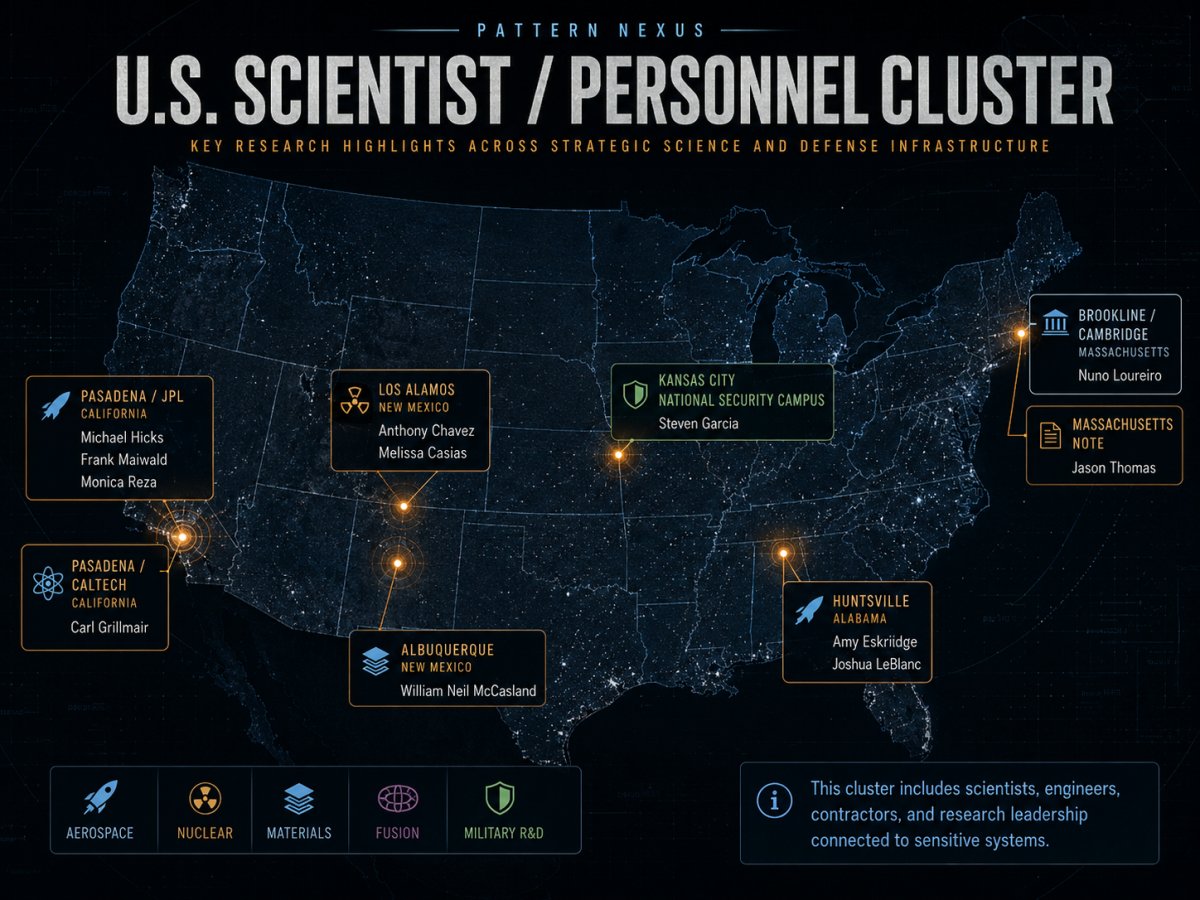
| Name | Status | Date | Field / Role | Why It Matters In The PN Frame |
|---|---|---|---|---|
| Amy Catherine Eskridge | Deceased | June 11, 2022 | Institute for Exotic Science, Huntsville; exotic propulsion / anti-gravity claims. | Symbolic center of the UAP/exotic propulsion layer. Sits at the overlap between Rocket City, frontier physics, suppression claims, and public uncertainty. |
| Michael David Hicks | Deceased | July 30, 2023 | NASA JPL scientist, comets and asteroids, DART, NEAT, Dawn, Deep Space 1. | Planetary defense and deep-space observation sit inside the space-continuity layer. His public cause of death was not widely given in the reporting summary. |
| Matthew Sullivan | Deceased | May 12, 2024 | Former Air Force intelligence officer; Bronze Star recipient; alleged UAP crash-retrieval exposure according to reporting. | Connects the story to military intelligence and UAP testimony claims. Some reporting states his death was ruled an accidental overdose. |
| Frank Maiwald | Deceased | July 2024 | NASA JPL imaging spectroscopy engineer. | Imaging spectroscopy is part of the sensor layer: seeing, mapping, detecting, classifying. His public cause of death was not given in the summarized reporting. |
| Anthony Chavez | Missing | May 2025 | Former Los Alamos employee; construction foreman. | Not a nuclear scientist in the strict sense, but Los Alamos-connected personnel. The relevance is site access, facility familiarity, and sensitive-location proximity. |
| Monica Reza | Missing | June 22, 2025 | NASA JPL metallurgist/materials engineer; director of Materials Processing Group. | Materials are the hidden layer behind rockets, engines, thermal loads, deep-space systems, and propulsion reliability. She was connected to rocket-engine alloy work. |
| Melissa Casias | Missing | June 26, 2025 | Los Alamos administrative assistant. | This is not a scientist case. It is a sensitive-site personnel case. Her phone, purse, and wallet were reportedly left at home. |
| Joshua LeBlanc | Deceased | July 22, 2025 | NASA Marshall electrical engineer; nuclear propulsion projects for Mars. | One of the strongest future-systems cases. Nuclear propulsion is not ordinary aerospace; it is part of the deep-space access layer. |
| Steven Garcia | Missing | August 2025 | Contractor at Kansas City National Security Campus; non-nuclear components for nuclear weapons. | Not simply “a scientist.” This is nuclear-weapons-complex personnel. That still matters because weapons systems are not just warheads; they are component chains. |
| Jason Thomas | Deceased | December 2025 | Assistant director of chemical biology at Novartis. | Weaker for aerospace/nuclear, stronger for bio-technical continuity. Reporting states drowning and no foul play according to the medical examiner. |
| Nuno F.G. Loureiro | Deceased | December 2025 | MIT plasma physicist / fusion scientist; director of MIT Plasma Science and Fusion Center. | Fusion and plasma physics are core future-energy domains. He was fatally shot at his Brookline home, and authorities opened a homicide investigation. |
| Carl Grillmair | Deceased | February 16, 2026 | Caltech astronomer / astrophysicist, IPAC. | Astronomy, exoplanets, galactic structure, and NASA telescope work. A suspect was charged, but the motive was not publicly clear in early reporting. |
| William Neil McCasland | Missing | February 2026 | Retired Air Force major general; former Air Force Research Laboratory commander. | Extremely important because this is not just a scientist; it is military R&D leadership. This case connects directly to advanced aerospace command knowledge. |
The first thing that jumps out is that the public list is messy. That does not make it meaningless. Messy patterns are often the only patterns you get in real life. The world does not hand you a clean spreadsheet with perfect labels, perfect dates, and one obvious cause. It gives you partial information, wrong spellings, family statements, official silence, media summaries, agency language, and missing context.
Some cases have known causes. Some have suspects. Some involve people who were not scientists. Some involve sensitive locations rather than sensitive research. Some involve aerospace, some involve nuclear systems, some involve UAP claims, and some may be ordinary tragedy pulled into an extraordinary pattern. That does not erase the signal. It changes what the signal is.
The signal is not “every one of these people was killed for the same reason.” That is too easy and too sloppy. The stronger signal is this: a visible number of people near advanced technical, classified-adjacent, or strategically sensitive systems have died or disappeared in a compressed period, and the public is being asked to accept fragmented explanations without being shown the full continuity map.
That is different, and it is stronger. It does not require pretending every case is the same. It only requires noticing that the names cluster around systems that matter: aerospace, nuclear, materials, fusion, defense research, command leadership, UAP-adjacent claims, and sensitive technical infrastructure.
The U.S. Pattern Is Not One Profession. It Is One Control Layer.
If you look only for “scientists,” the pattern gets weaker because not every person in the list fits that label cleanly. If you look for strategic knowledge nodes, the pattern gets stronger. That is the correct frame. Sensitive systems are not protected by job titles. They are protected, operated, remembered, and quietly carried by networks of people who sit near the same kind of civilizational leverage.
| PN Layer | People / Cases | Why This Layer Matters |
|---|---|---|
| Space observation / planetary defense | Michael Hicks, Frank Maiwald, Carl Grillmair | Sensor systems, telescope missions, deep-space observation, asteroid/comet tracking, planetary defense, exoplanet science. |
| Propulsion / future mobility | Amy Eskridge, Joshua LeBlanc, Monica Reza | Exotic propulsion claims, nuclear propulsion, rocket-engine materials, space access. |
| Nuclear / weapons complex | Anthony Chavez, Melissa Casias, Steven Garcia, Nuno Loureiro | Los Alamos, weapons components, fusion, plasma physics, nuclear-adjacent systems. |
| Military R&D leadership | William Neil McCasland | Air Force Research Laboratory, advanced aerospace, command-level knowledge continuity. |
| UAP / classified-adjacent narrative | Amy Eskridge, Matthew Sullivan, William McCasland | UFO crash-retrieval claims, advanced aerospace lore, disclosure ecosystem. |
| Bio / chemical knowledge layer | Jason Thomas | Chemical biology, pharmaceutical research, scientific continuity outside aerospace. |
This is why the mainstream dismissal misses the point. It keeps asking whether every person fits the same job title. That is not the Pattern Nexus question. The Pattern Nexus question is whether these people sit near the same kind of civilizational leverage: space systems, nuclear infrastructure, materials, fusion, aerospace, military research, propulsion, UAP-adjacent disclosure, classified knowledge, or sensitive-site access.
Many of them do. That is the map. It is not a perfect murder board, and it does not need to be. It is a control-layer map showing where human knowledge, institutional secrecy, advanced technology, and vulnerability overlap.
The China Mirror
The China layer changes the whole article because it prevents this from being dismissed as a purely American internet panic wrapped around UFO culture. Without China, the story can be pushed into the same exhausted box: weird Americans, UAP influencers, conspiracy people, and viral panic. With China, the frame changes. Now it becomes a global strategic-knowledge problem.
Reports in 2026 described a cluster of Chinese scientists or technical specialists who died in recent years in strategically sensitive fields. These fields included military AI, wargaming, drones, data security, space systems, microelectronics, hypersonics, materials, and biomedical chemistry. That does not automatically prove a coordinated assassination campaign, and the article does not need to make that jump. The stronger frame is that China is showing the same type of vulnerability inside its own advanced technical layer.
That is the correct way to frame it: not proven assassination campaign, not random trivia, but a strategic knowledge attrition signal. The China cases are colder than the U.S. cases. They are less mythological and more directly tied to state power. Military AI. Hypersonics. Drones. Space systems. Data security. Microelectronics. Materials. These are not random research areas. These are the building blocks of 21st-century military and technological advantage.
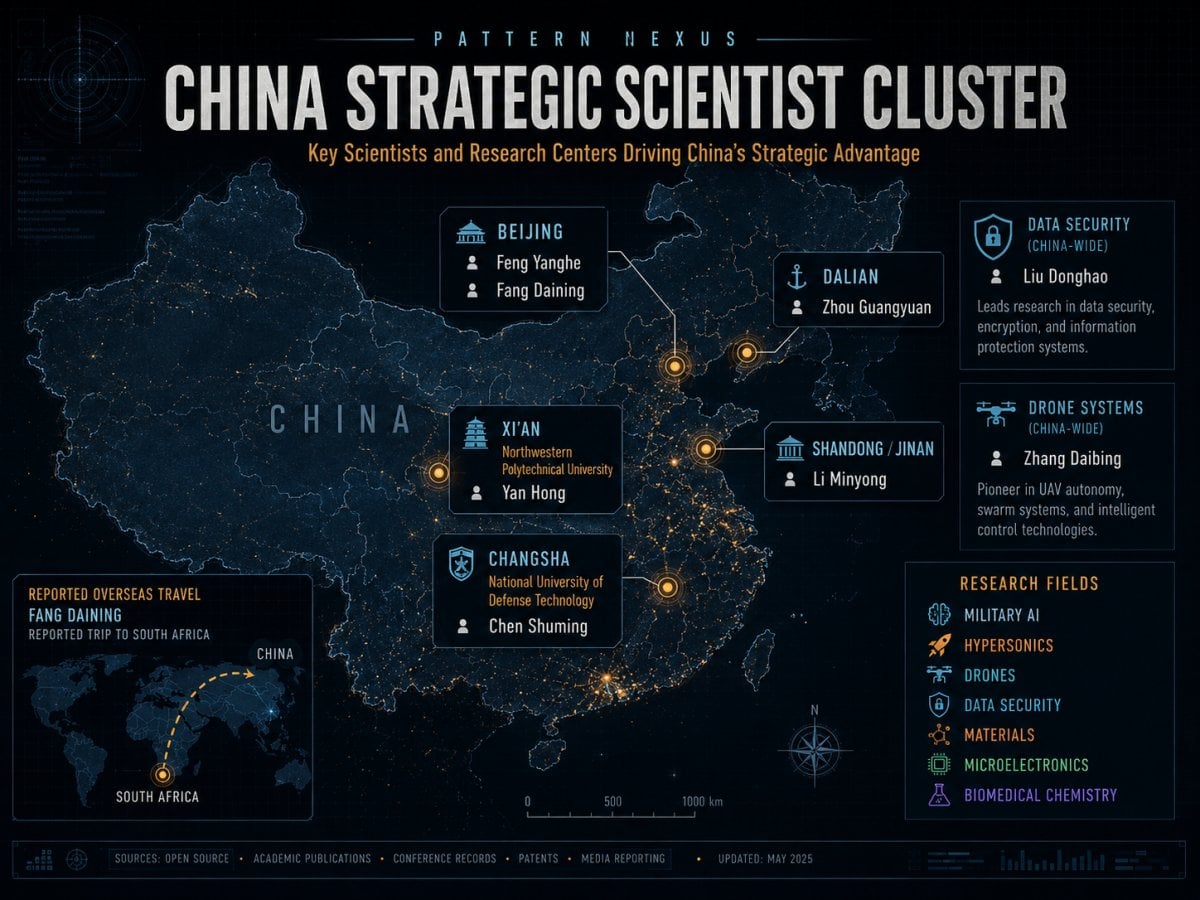
| Name | Reported Field | Reported Death Details | PN Relevance |
|---|---|---|---|
| Chen Shuming | Military microelectronics, high-end weapons chips, National University of Defense Technology. | Died in a car accident in 2018, age 57, according to later summaries. | Microelectronics are the hidden hardware layer beneath missiles, drones, guidance, communications, autonomy, and command systems. |
| Feng Yanghe | Military AI, reinforcement learning, intelligent planning, wargaming, command simulation. | Died July 1, 2023, age 38, in a Beijing traffic accident. | One of the strongest China cases. His work sits directly inside the AI war-planning and command-decision layer. |
| Zhou Guangyuan | Chemistry, materials, polymers, Dalian Institute of Chemical Physics. | Died December 2023, age 51; cause not publicly clear in summary reporting. | Materials research is the hidden layer behind aerospace, energy, stealth, engines, coatings, and survivability. |
| Liu Donghao | Data science / data security. | Died after an unspecified accident in March 2024. | Data security is the control layer for identity, cyber systems, state secrecy, surveillance, and military information resilience. |
| Zhang Xiaoxin | Space systems / space-weather or satellite-linked expertise. | Died in a reported car accident in December 2024, age 62. | Space weather and satellite monitoring touch communications, military timing, grid risk, navigation, early warning, and space-domain awareness. |
| Zhang Daibing | Drone systems / unmanned platforms. | Died January 2025, age 47; cause not disclosed in summary reporting. | Drone systems are now a live battlefield control layer. Losing drone experts affects autonomy, swarms, targeting, and industrial-military adaptation. |
| Li Minyong | Medicinal chemistry, chemical biology, drug design, fluorescent sensing. | Died November 16, 2025, age 49. | Less direct to aerospace, but important to the bio-technical knowledge layer. |
| Fang Daining | Hypersonics, ultra-strong materials, spacecraft and advanced engines, Beijing Institute of Technology. | Died February 2026, age 68, after reports of an unexpected medical episode abroad. | Hypersonics are not just missiles. They are materials, heat, stress, structure, guidance, manufacturing, and survivability under extreme conditions. |
| Yan Hong | Hypersonic / high-speed propulsion, Northwestern Polytechnical University. | Died March 2026, age 56, following illness. | Directly relevant to the propulsion layer. High-speed propulsion sits at the front edge of state military capability. |
China’s list is not the same as the U.S. list, and that matters. The U.S. list has more UAP gravity, more missing-person anomalies, more NASA/JPL and nuclear-lab adjacency, and more public chaos. The China list is colder and more strategic. It clusters around the hard state-power stack: military AI, wargaming, drone systems, data security, space systems, microelectronics, hypersonic materials, high-speed propulsion, and biomedical chemistry.
That does not prove a foreign operation. But it absolutely proves the vulnerability is not only American. The fragile scientist layer is global, and that is the part people should be paying attention to.
Feng Yanghe And The AI War Brain Layer
Feng Yanghe deserves special attention because his case is not just another scientist death. His work points directly at the future of war, and that makes him one of the most important names in the China layer.
Chinese reporting described Feng as an expert known for designing China’s first artificial intelligence “brain” for military operations. His research areas included reinforcement learning, intelligent gaming, intelligent planning, military simulation, and deduction technology. He and his team developed an AI system called War Skull, which could draft operation plans, assess risk, and provide backup plans based on incomplete tactical data.
That is not ordinary AI. That is command architecture. That is decision acceleration. That is battlefield cognition. That is the move from humans using computers to computers shaping the options humans believe they have. In a future conflict, the state that can simulate faster, adapt faster, and compress decision cycles faster has an advantage before the first shot is even fired.
This is why Feng matters. He was not just building a model. He was working on the layer where war becomes computation. In Pattern Nexus terms, Feng sits inside the intelligence-to-action layer:
If that layer gets disrupted, a country does not just lose a researcher. It loses a piece of future command speed. It loses part of the translation layer between raw data and state action. That is why the death of a military AI researcher is not just an academic loss. It is a strategic systems event.
Fang Daining, Yan Hong, And The Hypersonic Layer
Hypersonics are often reduced to speed, but that is amateur framing. The real hypersonic problem is not just going fast. The real problem is surviving fast. Once a vehicle moves through the atmosphere at hypersonic speeds, speed becomes only one piece of the puzzle. The rest of the problem becomes heat, pressure, materials, guidance, engine stability, manufacturing tolerances, thermal protection, shockwave behavior, fuel flow, sensor performance, and vehicle control.
That is why Fang Daining and Yan Hong matter. Fang was reported as a key scientist in China’s hypersonic weapons program and linked to ultra-strong materials for spacecraft and advanced engines. Yan Hong was described as a leading researcher in hypersonic and high-speed propulsion technologies at Northwestern Polytechnical University, a university already sensitive in U.S.-China technology competition.
This is not fringe. This is the front edge of state power. Hypersonics compress decision time. They stress missile defense. They force new early-warning systems. They demand better materials, better engines, better software, better manufacturing, and better command networks. They sit right at the intersection of physics, engineering, industrial capacity, military doctrine, and geopolitical pressure.
So when hypersonic experts die unexpectedly, the proper question is not simply “was it definitely foul play?” That question matters, but it is not enough. The better question is: how many human minds actually understand the full stack well enough to keep the program moving?
That is the knowledge-bottleneck problem. Advanced systems do not run on slogans. They run on people who know what breaks, what works, what failed last time, what can be manufactured, and what only looks good on paper.
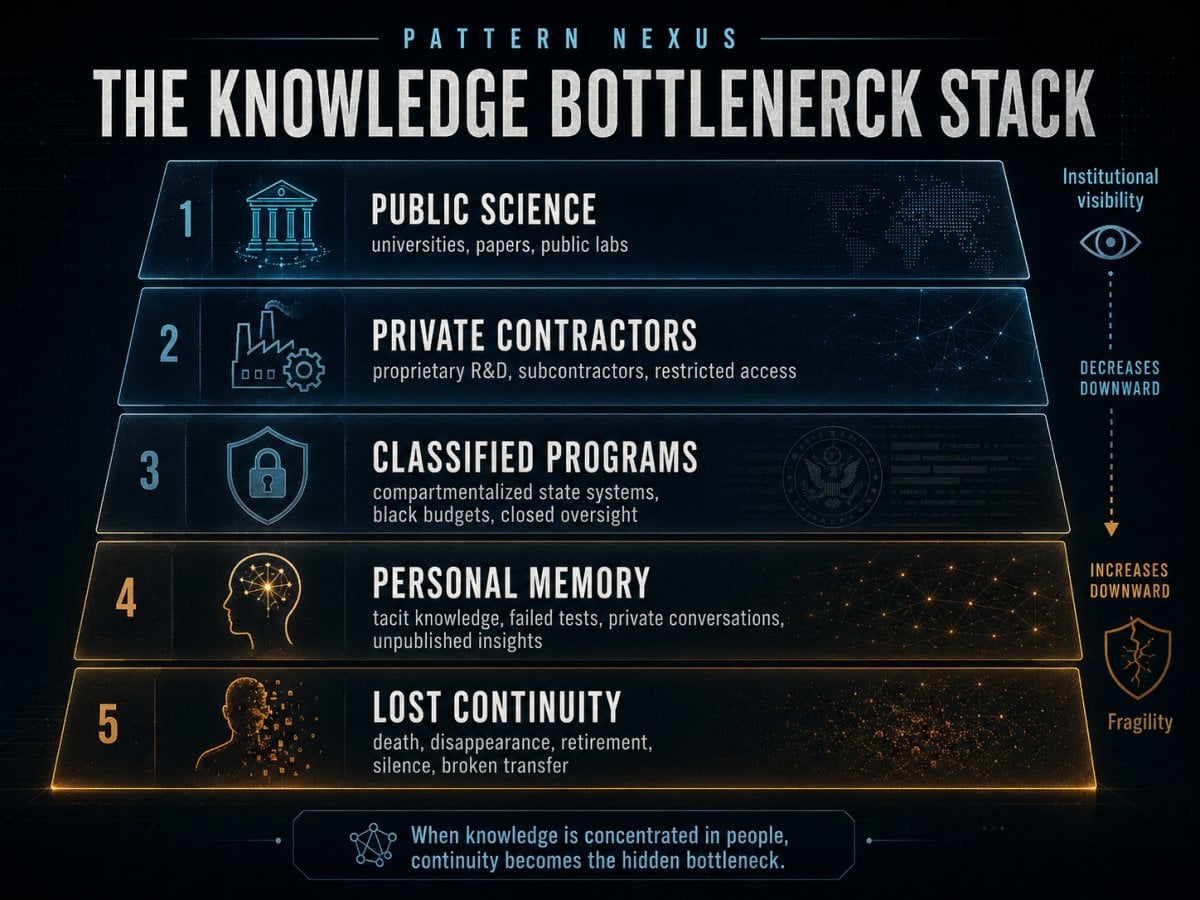
The Real Pattern: Human Nodes Inside Strategic Systems
The important thing is not that every case has the same cause. The important thing is that every advanced system has the same weakness: people. The public thinks power lives in technology, but technology is downstream of knowledge, and knowledge is downstream of minds.
Minds are mortal. That sounds obvious, but the system behaves like it forgets this. When knowledge is classified, compartmentalized, privatized, over-specialized, or locked inside contractor networks, the death or disappearance of one person can remove more than a résumé line. It can remove a bridge between programs, a bridge between theories, a bridge between failed experiments, a bridge between public science and classified application, a bridge between one generation of research and the next.
That bridge is often invisible until it is gone. It is the person who remembers why one test failed. It is the person who knows why one material behaved differently under real conditions than it did in the model. It is the person who heard the private conversation, saw the prototype, read the old file, understood the limitation, or knew which official explanation was missing the real reason.
That is the part nobody wants to admit. Modern power is not as institutionally redundant as it looks. It is brittle, because a lot of what matters does not live cleanly inside public reports, official archives, or polished institutional statements. It lives inside experience.
| System | Public Thinks It Is Protected By | What It Actually Depends On | Fragility Point |
|---|---|---|---|
| Nuclear weapons complex | Agencies, labs, contractors, security clearances. | Personnel who understand components, maintenance, production, classification boundaries, and institutional memory. | Losing people can create continuity gaps even if the facility remains intact. |
| Space propulsion | NASA, contractors, universities, budgets. | Engineers who understand engines, materials, thermal behavior, failures, and mission constraints. | Advanced propulsion knowledge is narrow, expensive, and often not easily replaced. |
| Hypersonics | Missile programs and national strategy. | Materials experts, propulsion scientists, thermal engineers, guidance specialists. | Few people understand the full flight regime from theory to manufacturing. |
| Military AI | Algorithms and compute. | Researchers who understand command logic, simulation, adversarial modeling, and doctrine. | AI decision systems inherit the worldview of their designers. |
| UAP / exotic propulsion | Public ridicule or classified silence. | Borderland researchers, private contractors, old program knowledge, interviews, leaks, and undocumented claims. | The subject is reputationally toxic, making continuity even more fragile. |
| Directed energy | Defense programs and weapons budgets. | RF, microwave, laser, power, cooling, beam control, targeting, and testing expertise. | Public understanding lags military development by years or decades. |
| Space weather / satellite monitoring | Weather agencies and satellites. | Specialists who understand solar effects, orbital systems, communication risk, and early warning. | Failures ripple into GPS, communications, grid stability, and military timing. |
| Materials science | Lab equipment and patents. | Tacit knowledge from experiments, failures, heat behavior, fracture behavior, coatings, alloys. | The most important details often live in experience, not papers. |
This is why the scientist layer matters. It is not sentimental. It is structural. If the people carrying the living thread disappear, retire, die, get silenced, or are removed from the chain of continuity, the institution can remain standing while the knowledge degrades underneath it.
The Official Investigation Does Not Settle The Pattern. It Confirms The Pattern Is Legible.
The House Oversight letter matters because it shows the pattern crossed the threshold from internet speculation into official inquiry. That does not mean the government has confirmed a single unified conspiracy. It does not mean every death is connected. It does not mean every missing person was targeted. It does not mean every claim is proven.
What it does mean is that the pattern became legible enough to ask federal agencies for answers. That matters. When the state starts asking about public reporting involving people with access to sensitive U.S. scientific information, it is acknowledging the category of risk even if it has not publicly named the full cause.
The important language is not the dramatic part. It is the category: sensitive scientific information, personnel safety, scientific secrets, national security, and the possibility that the loss of certain people could matter beyond the individual case. That is the real frame.
This is not just “who died?” It is “what knowledge was attached to them?” It is “what systems did they understand?” It is “what continuity may have been lost?” It is “who else knew what they knew?” And it is “why is the public never shown the full continuity map when these cases happen?”
Why The Mainstream Frame Fails
The mainstream frame usually does three things. First, it mocks the weirdest claim. Second, it points out that some cases have ordinary explanations. Third, it declares the entire pattern dead. That is not analysis. That is narrative management.
If one case has a suspect, that does not erase the missing-person cases. If one person was not technically a scientist, that does not erase sensitive-site access. If one death was ruled accidental, that does not erase the broader personnel-protection question. If one UAP claim is unproven, that does not erase the real defense-technology overlap. If one family rejects a conspiracy theory, that does not erase the national-security issue of how fragile the knowledge layer is.
A serious analysis does not need every case to prove the same thing. It only needs the cases to reveal the same vulnerability, and they do. The vulnerability is that modern power depends on a thin, uneven, poorly understood layer of technical human continuity. The public sees institutions and assumes redundancy. But the deeper you go into advanced fields, the more you find specialized people carrying highly specific knowledge that is not easily replaced.
Why The Lazy Conspiracy Frame Also Fails
The conspiracy frame has its own weakness because it wants certainty too fast. It wants every death to be linked. It wants every illness to be a hit. It wants every car crash to be an operation. It wants every missing person to be proof. That is emotionally satisfying, but it is analytically weak.
The real world is messier than that. Some deaths are accidents. Some deaths are illness. Some deaths are suicide. Some disappearances may involve mental health, personal crisis, exposure, crime, or ordinary tragedy. Some murders may be local violence with no strategic motive. Ignoring that does not make the pattern stronger. It makes it easier to dismiss.
The point is not to deny ordinary explanations where they exist. The point is to say that even after ordinary explanations are allowed, the remaining pattern is still worth mapping, especially when the cases cluster around NASA, JPL, Los Alamos, MIT fusion, Caltech astrophysics, Air Force Research Laboratory, nuclear propulsion, hypersonics, military AI, space systems, drone systems, materials science, directed energy, and exotic propulsion.
That is not nothing. It may not be one clean conspiracy chart, but it is absolutely a map of fragile knowledge nodes sitting near sensitive systems.
The Wild Layer: P-47s, P-52s, And The Future-Human Claim
Now we get to the part that makes everyone uncomfortable, and I am not going to pretend it is not wild. The transcript centers heavily on Amy’s discussion of P-47s and P-52s, beings allegedly from 47,000 and 52,000 years in the future. The claim is that these beings are not extraterrestrial in the normal sense. They are ultraterrestrial: future branches of humanity, shaped by a catastrophic timeline in which humans go underground and evolve into what UFO lore calls “grays.”
That is not established public fact. But it is still important to the article because it explains the mythological structure around the story. Inside that narrative, anti-gravity and zero-point energy are not merely technologies. They are timeline threats.
If humans develop advanced propulsion or free-energy-like systems early enough, maybe they avoid the catastrophe. If they avoid the catastrophe, then the future beings who depend on that catastrophe never exist. So inside the mythology, the future beings have an incentive to preserve the disaster timeline. That is a strange claim, but as a narrative system, it is coherent.
And whether true or false, coherent myths matter because they shape how people interpret hidden power. The older religious version was angels and demons. The Cold War version was spies and secret weapons. The modern version is UAPs, ultraterrestrials, time loops, future humans, black programs, private aerospace, and suppressed energy.
Pattern Nexus does not need to prove the mythology to analyze its function. The function is obvious: it gives the public a story language for a deeper fear. That fear is that civilization-changing knowledge exists, but is being blocked, buried, classified, ridiculed, or controlled before the public ever gets close to it.
The Better Frame For The P-47 / P-52 Material
The article should not depend on proving future humans. That would make the wildest layer carry the entire structure, and that is not necessary. The better frame is this: the P-47 / P-52 story is the wild symbolic layer built around a real structural anxiety, which is that certain technologies could break the current control system if they became public too soon.
That is the real point. A world with cheap abundant energy is not the same political world. A world with advanced propulsion is not the same military world. A world with gravity manipulation would not have the same aerospace industry. A world with dramatically cheaper access to space would not have the same geopolitical order. A world with defense-grade directed energy in private hands would not have the same security model. A world where UAP capabilities are admitted would not have the same public trust structure.
This is why the suppression narrative persists. It is not only about aliens. It is about control. It is about the possibility that certain technological breakthroughs would not merely create new products. They would rearrange power itself.
Control Systems And Suppressed Knowledge
Pattern Nexus has covered this over and over: control does not require one perfect central planner. Control can emerge through incentives, secrecy, classification, institutional fear, liability, funding channels, ridicule, career destruction, patent control, contractor capture, national-security claims, and selective disclosure.
That is exactly how frontier knowledge gets managed. You do not have to burn every book. You just make certain questions unfundable. You do not have to imprison every researcher. You just make them unemployable. You do not have to censor every claim. You just attach the claim to ridicule. You do not have to prove every case false. You just make the public embarrassed to look.
That is how the permission stack works. The public thinks truth wins because it is true. That is not how systems operate. Truth needs permission to move through institutions. It needs funding permission, publication permission, academic permission, media permission, search visibility permission, patent permission, and often security clearance permission.
- Narrative permission
- Academic permission
- Funding permission
- Publication permission
- Patent permission
- Security clearance permission
- Media legitimacy permission
- Search visibility permission
- Institutional memory permission
That is the real suppression machine. It does not need to be perfect. It only needs to be durable enough that most people never reach the question before they are trained to laugh at it.
The Scientist Layer Is A Continuity Layer
The deeper issue is not death. Everyone dies. The deeper issue is continuity. When a society depends on sensitive knowledge, it has to protect the continuity of that knowledge. That means protecting people, but it also means protecting context.
Context is the part that never fits neatly into a press release. It is lab notes, private conversations, failed tests, prototype history, source code, simulation assumptions, unpublished papers, contractor relationships, classified program boundaries, and the quiet memory of why something worked or failed. It is the difference between having data and understanding what the data means.
- Lab notes
- Private conversations
- Failed tests
- Prototype history
- Source code
- Simulation assumptions
- Unpublished papers
- Contractor relationships
- Classified program boundaries
- Why one test failed
- Why one alloy worked
- Why one plasma model broke
- Why one sensor showed an anomaly
- Why one propulsion claim never made it into formal publication
- Why one researcher became afraid
If that continuity breaks, the institution may survive while the knowledge dies. That is the real danger. The building remains. The logo remains. The agency remains. The archive remains. The press release remains. But the living thread is gone.
That is how civilizations forget things while pretending they preserved them. They keep the institution, but lose the person who understood the system underneath the institution.
The Intelligence Layer Is Fragile Too
This is not only about scientists. It is also about intelligence, and I do not mean IQ or spy agencies in the narrow sense. I mean intelligence as a civilizational layer: the ability of a society to perceive reality, process information, preserve memory, update models, and respond before failure.
When the intelligence layer gets fragile, the whole system starts acting stupid. Not because nobody is smart, but because the smart nodes are isolated, removed, ignored, compartmentalized, overworked, silenced, or dead. A system can be full of brilliant individuals and still behave like an idiot if those individuals are not allowed to connect, transfer knowledge, or challenge the narrative layer above them.
That is what makes this article bigger than Amy Eskridge. Amy is the gateway. Her story pulls people in because it is strange, unresolved, and emotionally loaded. But the larger article is about the fragility of the knowledge layer under modern power.
Why China Makes This A Strategic Systems Problem
The U.S. cases raise concern, but the China cases raise the stakes. If only the U.S. had a strange cluster, the story could be dismissed as domestic media chaos. But when China also has a reported cluster involving military AI, hypersonics, drones, space systems, data security, microelectronics, and materials science, the pattern changes.
Now the question becomes: are advanced states entering a phase where scientists themselves become strategic terrain?
That question is not insane. History already has examples of scientists being targeted, recruited, surveilled, threatened, protected, or absorbed into state programs. Nuclear scientists mattered. Rocket scientists mattered. Cryptographers mattered. Cyber specialists matter. AI researchers matter. Hypersonic experts matter. Semiconductor engineers matter. Drone autonomy specialists matter.
The battlefield is not just land, sea, air, space, and cyber. The battlefield is also human expertise. The person who understands the bottleneck becomes the bottleneck. In a world where power is increasingly defined by technical capability, the people who understand the next capability become strategic assets before the public even knows their names.
The “No Evidence” Trap
One of the most abused phrases in modern information warfare is “there is no evidence.” Sometimes that phrase is true and useful. Sometimes it means exactly what it says. But sometimes it means something very different.
- The evidence is classified.
- The evidence is compartmentalized.
- The evidence is in a contractor system.
- The evidence is inside an agency that will never release it.
- The evidence is not admissible.
- The evidence was never documented.
- The evidence was destroyed.
- The evidence is a pattern, not a smoking gun.
- The evidence is buried under national-security privilege.
- The evidence is visible only when multiple domains are viewed together.
That is why Pattern Nexus does not treat “no public proof” as the same thing as “nothing happened.” They are not the same sentence. No public proof means no public proof. It does not mean no event, no connection, no suppression, no classified file, or no vulnerability.
It only means the public has not been given enough to close the case. That is exactly why the pattern has to be mapped. If the answer was already clean, public, and complete, there would be no need for this kind of article in the first place.
The Pattern Does Not Need Perfection
A bad analyst needs a perfect pattern. A good analyst studies imperfect patterns because that is how reality usually shows itself. The world does not hand you clean data. It gives you noise, contradictions, misreported names, unclear causes, wrong dates, bad transcripts, family denials, political opportunism, media distortion, government silence, agency language, classified gaps, anonymous sources, unverified claims, real deaths, real grief, real missing people, and real strategic fields.
The job is not to pretend all of that is clean. The job is to map the layers without collapsing them into one bucket. The U.S. pattern is not a solved murder board. The China pattern is not a proven assassination campaign. The Amy Eskridge layer is not established proof of ultraterrestrials.
But together, they reveal something very real: modern power is more dependent on fragile human knowledge than the public understands.
The Pattern Nexus Matrix
| Question | Mainstream Answer | Conspiracy Answer | Pattern Nexus Answer |
|---|---|---|---|
| Are all these deaths connected? | No, stop asking. | Yes, obviously. | Not proven. But the cluster reveals a strategic vulnerability. |
| Is Amy Eskridge proof of suppressed anti-gravity? | No, fringe nonsense. | Yes, she was killed for it. | Amy is a symbolic node in the exotic propulsion / Huntsville / UAP / knowledge-suppression layer. Treat claims carefully but do not erase the signal. |
| Does the FBI/Congress investigation prove a conspiracy? | No. | Yes. | It proves the pattern became legible enough to warrant official attention. That alone matters. |
| Are the China deaths relevant? | Maybe, but separate. | Proof of global scientist war. | They are highly relevant because they cluster in strategic domains like military AI, hypersonics, drones, data security, and space systems. |
| What is the real risk? | Public paranoia. | Secret assassination campaign. | Knowledge continuity failure inside sensitive systems. |
| What should readers watch? | Official conclusions only. | Every rumor. | Names, fields, institutions, dates, access, classification proximity, and whether knowledge continuity is being protected. |
What This Article Is Actually Claiming
This article is not claiming every person on every viral list was murdered. It is not claiming every missing person was taken by a foreign power. It is not claiming every death was tied to UAPs. It is not claiming P-47s and P-52s are proven. It is not claiming Amy Eskridge’s most extreme claims are confirmed public fact.
It is making a different claim: the scientist layer is fragile because modern civilization concentrates strategic knowledge inside small numbers of people, many of whom work inside classified, contractor-driven, or reputation-sensitive systems where public accountability is limited.
That is the claim, and that claim is already visible. You do not need to prove every rumor to see that modern systems are more fragile than their institutions admit.
Why This Matters To The Average Person
People think this subject is far away from them because they hear NASA, JPL, Los Alamos, hypersonics, military AI, UAP programs, fusion, and classified aerospace, and they assume it belongs to some distant world they will never touch. That is wrong. The scientist layer affects the normal world because the normal world is downstream of the systems these people help build, maintain, or understand.
- Energy prices
- Weapons systems
- Satellite communications
- GPS
- Internet routing
- Drug discovery
- Grid stability
- AI military decision-making
- Drone warfare
- Space access
- Nuclear deterrence
- Missile defense
- Surveillance
- Economic dominance
- Public trust
If the knowledge layer breaks, the public does not get an announcement saying “civilizational continuity has degraded.” The public gets higher costs, more instability, more war risk, more secrecy, more shortages, more official confusion, more “unexpected” failures, and more narratives that do not make sense.
That is why this matters. The public usually only sees the downstream symptoms. Pattern Nexus is trying to map the upstream structure.
The Amy Question
Amy Eskridge’s story will keep bothering people because it hits a nerve. A young researcher in Huntsville. Exotic propulsion. Anti-gravity claims. Zero-point energy. Warnings. Alleged harassment. Sudden death. UAP-adjacent interviews. Future-human theories. Aerospace family and cultural proximity. A story too strange for official respect, but too connected to ignore.
This is exactly the kind of story the modern system cannot process. If it is false, the system still fails because it cannot explain why so many people find it plausible. If it is partly true, the system fails because it let the public sit in darkness. If it is fully true, then the system is not merely hiding information; it is hiding the operating structure of reality.
That is why Amy is not going away. She represents the unresolved file. She represents the thing the public is told not to look at, while the surrounding categories keep showing up in defense budgets, research programs, classified language, and quiet institutional concern.
The China Question
China’s scientist deaths raise a different question. Less mythology, more strategy. Military AI. War Skull. Hypersonics. Drones. Space systems. Microelectronics. Data security. Materials. Chemical biology.
These are not random fields. These are the building blocks of 21st-century state power. If China is losing people in these fields, that matters. If the U.S. is losing people in adjacent fields, that matters. If both are happening during a period of accelerating U.S.-China competition, AI militarization, drone warfare, hypersonic arms races, space-domain competition, and energy-grid stress, that matters even more.
Again, the point is not to declare proof before proof exists. The point is to understand why these names cluster where they do. The cluster itself does not answer every question, but it tells you where the stress is appearing.
The Final Pattern
The old world fought over land. Then it fought over sea lanes. Then oil. Then chips. Then data. Now the fight is moving deeper into knowledge, talent, classified continuity, and the scientists, engineers, programmers, materials experts, physicists, and military researchers who understand the pieces everyone else only names.
This is why the scientist layer is getting fragile. The world is moving into systems so complex that only a thin layer of people can operate them, and that thin layer is now a strategic target, a narrative target, a psychological target, and possibly, in some cases, a physical target.
That does not require aliens. It does not require grays. It does not require a perfect conspiracy. It only requires the world to be exactly what it already is: competitive, classified, brittle, militarized, fragmented, obsessed with control, and dependent on people it does not know how to replace.
Pattern Nexus Lens
The system wants this story split into two fake choices: either everything is connected, or nothing is happening. Pattern Nexus rejects that frame because it is too simple for the world we are actually living in.
The real issue is not whether every name belongs on one perfect conspiracy chart. The real issue is that the world’s most sensitive technological systems depend on a fragile layer of human knowledge, and that layer is showing stress.
When the people who understand the future start disappearing from the present, the correct response is not ridicule. It is pattern recognition.
Sources
- House Oversight Committee press release on missing nuclear and rocket scientists
- House Oversight Committee April 20, 2026 DOE letter
- ABC News overview of U.S. scientists/personnel deaths and disappearances
- Amy Eskridge obituary
- Archived Amy Eskridge final interview listing
- Puthoff-related zero-point field paper
- China Daily profile of Feng Yanghe and War Skull
- India Today summary of Chinese scientist deaths
- NDTV overview of U.S. and China scientist death/disappearance reporting
- Economic Times overview of Chinese scientist-death reporting
- SCMP report on Fang Daining
- SCMP report on Yan Hong
- SCMP report on Li Minyong
- Taylor & Francis memorial collection for Li Minyong
- Shandong University profile for Minyong Li
- AP report on Nuno F.G. Loureiro
- Caltech memorial for Carl Grillmair
- ABC7 / CNN-based report on William Neil McCasland’s disappearance
- National Defense Magazine reporting on directed-energy weapons
Pattern Nexus note: Sources above support names, dates, institutional roles, official inquiry, reported fields, and publicly reported claims. Speculative claims are identified in the article as speculative and are not treated as established public fact.
Frequently Asked Questions
আপনার প্রতিক্রিয়া কি?
 পছন্দ করুন
0
পছন্দ করুন
0
 অপছন্দ
0
অপছন্দ
0
 ভালোবাসা
0
ভালোবাসা
0
 মজার
0
মজার
0
 বাহ!
0
বাহ!
0
 দুঃখজনক
0
দুঃখজনক
0
 গোস্বামী
0
গোস্বামী
0

Founder of Pattern Nexus. I research markets, macro, geopolitics, AI, history, ancient systems, and the patterns most people overlook. I’m also building Market Radar, a trading scanner designed to read pressure, risk, confirmation, and setup quality before chasing a move. Pattern Nexus is where I connect the dots between data, history, technology, and the bigger system playing out around us.


মন্তব্যসমূহ (0)