
The Trap of Reality: Consciousness, the Observer, and the Field Layer Beneath Spacetime
Donald Hoffman is closer to the truth because he is trying to step outside the interface. Tom Bilyeu is still trying to explain the interface from inside itself. But both views leave something unfinished. Hoffman gives us conscious agents and the headset. Tom gives us biology and identity. ESFD asks what neither side fully answers: what is the field mechanism that turns consciousness, spin, time, electromagnetic structure, and observation into the rendered reality we experience?
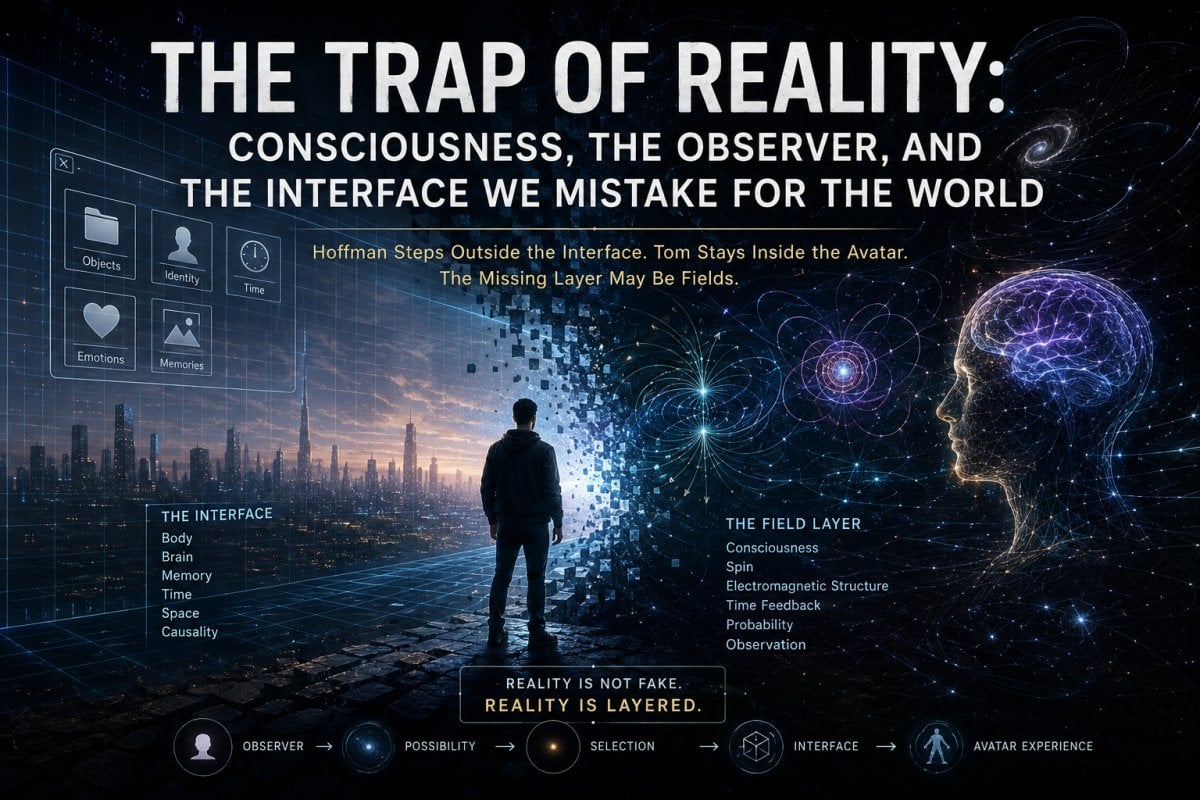
Quick Read
This piece compares two very different views of reality: Donald Hoffman’s conscious-agent and interface theory, and the more biological identity view represented by Tom Bilyeu in the conversation. Hoffman argues that consciousness is closer to fundamental and that spacetime, objects, brains, and bodies may be part of an evolved interface rather than base reality. Tom accepts the simulation metaphor, but he keeps returning to biology, memory, personal continuity, and the avatar as the real boundary of the self.
My view is that Hoffman is closer, but not complete. Tom is trapped inside the render. Hoffman sees past the render, but his model still needs a stronger physical mechanism. That is where my private theory comes in. I refer to it as ESFD, or Electromagnetic Spin-Field Dynamics. I have only shared parts of this theory with a few people, and I am not presenting the full framework here. For this article, I am using only the relevant part: the idea that consciousness may require a field-based bridge to become a stable local reality.
In simple terms, ESFD asks whether consciousness, spin, electromagnetic fields, time, gravity-like behavior, and observer feedback are separate mysteries, or whether they are different expressions of one deeper operating structure. I do not think consciousness alone explains everything. I also do not think biology alone explains everything. There has to be a mechanism between the deeper observer and the rendered world. That mechanism, in my view, is field-based.
The point is not that reality is fake. The point is that reality is layered. The body is real inside this layer. The brain is real inside this layer. Memory is real inside this layer. Death is real inside this layer. Pain is real inside this layer. Love is real inside this layer. But none of that proves this layer is the foundation.
Core Split
Tom treats the biological avatar as the final self. Hoffman treats the avatar as a rendered interface.
ESFD Addition
ESFD is my private field-based framework. For this article, it means consciousness needs a mechanism: a field bridge connecting observation, spin, EM structure, time, and spacetime emergence.
Main Claim
Reality is not fake. Reality is layered. The trap is believing the layer we experience is the base layer.
Why It Matters
The observer problem is not a side issue. It may be the missing piece in physics, consciousness, identity, free will, death, and AI.
Executive Summary
This article compares two very different views of reality: Donald Hoffman’s conscious-agent and interface theory, and the more conventional biological identity view represented by Tom Bilyeu’s stance in the conversation. It then builds a third layer through ESFD, or Electromagnetic Spin-Field Dynamics, which is my private field-based theory trying to bridge the gap between consciousness, physics, spin, electromagnetic structure, time, gravity-like behavior, and the observer.
I want to be clear from the start because most readers will not know what ESFD means. I am not presenting ESFD here as a finished public scientific theory. I have not fully released it. I have only shown pieces of it to a few people. In this article, I am using ESFD as a working lens to explain why I think Hoffman is closer than Tom, but still incomplete. ESFD, in the narrow form used here, is the idea that consciousness does not simply float above physics, and physics does not simply create consciousness from dead matter. There may be a field mechanism between them.
That field mechanism is where spin, electromagnetic structure, time-feedback, gravity-like resistance, probability, and observation become relevant. In normal language: if consciousness interacts with this reality, there has to be a way for it to become local, structured, measurable, and stable. Bodies, brains, particles, fields, time, and memory do not just appear from nowhere. There has to be an interface layer. My view is that the interface layer is field-based.
Hoffman’s model argues that consciousness is not a late-stage accident produced by matter. Instead, consciousness or conscious agents may be closer to fundamental. Space, time, physical objects, and even brains may be part of a species-specific interface rather than objective reality itself. In his interface theory, our perceptions work more like desktop icons than windows into the thing-in-itself. A rock is real inside the interface, but it may not be a constituent of base reality. Spacetime is useful, but it may not be fundamental. [1] [2]
Tom Bilyeu’s position is much closer to a biological identity view. He can accept the simulation metaphor. He can accept rendering, computational efficiency, and the idea that the universe may not be locally real in the naïve sense. But when the conversation moves toward what exists outside the headset, he pulls everything back into the body, the brain, memory, biology, and personal continuity. For Tom, if the biological self dissolves, then the “you” that matters dissolves with it.
That is where the disagreement becomes important. Tom is not unintelligent. He is asking the grounded question most people would ask: what does any of this mean for the human being living inside the experience? What happens to my memories? What happens to my personality? What happens to my children, my past, my fears, my love, my trauma, my preferences, my sense of self? Those are valid questions. But from my perspective, they are still headset-bound questions. They assume the local biological avatar is the final unit of identity. They assume the rendered self is the real boundary of the self.
Hoffman is closer because he is at least trying to step outside the interface. He is asking what renders spacetime, what the observer actually is, and whether science can eventually describe the first layer of structure outside the headset. That aligns with the broader ESFD instinct: the world we experience is not base reality. It is a stabilized layer emerging from deeper relationships.
But Hoffman is not complete either. His conscious-agent model gives us observers, Markov chains, experiences, actions, and interface icons. That is useful, but it is still too abstract. It does not fully explain the field mechanism. It does not fully explain how consciousness couples to spin, electromagnetic structure, time feedback, gravity, probability, and spacetime emergence. It explains the direction of escape from the interface, but it does not fully explain the machinery of the interface.
That is where ESFD comes in.
ESFD says consciousness should not be reduced to neurons, but it also should not be left floating in pure abstraction. If consciousness interacts with this reality layer, there must be a translation mechanism. There must be a field bridge. The brain may not create consciousness, but it may function as a local receiver, limiter, resonator, stabilizer, and interface structure. The body may not be the source of the self, but it may be the local rendering of a deeper field-perspective inside spacetime.
In this framework, consciousness is fundamental or near-fundamental, but it expresses through fields. Spin may be one of the organizing principles. Electromagnetic fields may function as the coherence layer. Time may emerge from repeated state transition and observer limitation. Gravity may reflect deeper field resistance, curvature, or relational density. The observer may not simply watch reality. The observer may participate in the selection, stabilization, and rendering of the local state path.
The point is not that reality is fake.
The point is that reality is layered.
The body is real inside this layer. The brain is real inside this layer. Memory is real inside this layer. Pain is real inside this layer. Death is real inside this layer. But none of that proves this layer is the foundation. That is the trap of reality: the interface is convincing enough to make the avatar believe it is the whole being.
The Core Divide
There is a major difference between understanding the simulation metaphor and actually escaping the assumptions built into the simulation.
That is what stood out to me most in the conversation between Donald Hoffman and Tom Bilyeu.
Tom understands the metaphor. He understands why people compare reality to a video game. He understands rendering, computational efficiency, non-locality, and the idea that the universe may not work the way our senses tell us it works. He understands why the Planck scale sounds like a pixel size and why a finite tick rate sounds similar to the way a game engine updates a rendered world.
But every time the conversation moves toward what exists outside the headset, he pulls it back into the biological self. He keeps returning to the avatar.
Donald Hoffman, on the other hand, is at least trying to get beyond the avatar.
That does not mean I agree with every piece of his model. I do not. But I think his direction is far closer to the deeper structure of reality than Tom’s position. Tom is still inside the trap of reality. Donald is trying to look at the trap from the outside.
The trap is not that reality is fake. I do not think that is the right way to frame it. The trap is that the layer we experience feels final. It feels complete. It feels like base reality because everything about our biology, senses, memory, language, and social conditioning forces us to treat it that way.
We wake up inside a body. We experience time moving forward. We remember being younger. We feel pain. We feel fear. We see other people. We watch things die. We watch things age. We learn physics through objects, motion, force, space, mass, and causality.
Then we assume those things are fundamental.
But that assumption may be wrong.
That is where Hoffman becomes important. He is not just saying “reality is a simulation” in the shallow pop-culture way. He is saying spacetime itself may not be fundamental, that the observer has not been properly modeled in science, and that what we call the physical world may be more like a headset interface than the base layer of existence.
That matters because every scientific theory is built through observation.
Science does not happen from nowhere. It is not a godlike view from outside reality. It is observers using instruments, comparing measurements, building models, and trying to infer the structure behind what they experience. If the observer is treated as secondary, then science may be missing one of the primary components of reality.
Newton ignored the observer.
Einstein included the observer, but mostly as a measuring frame: clocks, rulers, reference frames, and relative motion.
Quantum mechanics made the observer unavoidable.
But even quantum mechanics never fully explained what the observer is.
That is the gap.
And that gap is where the entire conversation becomes interesting.
What makes Tom and Donald useful together is that they expose both sides of the problem. Tom shows why the human brain refuses to let go of the local self. Donald shows why the local self may not be the final truth. Tom is asking from inside the rendered room. Donald is asking what renders the room. My view is that both questions matter, but they are not the same question.
If you only ask Tom’s question, you never escape biology. If you only ask Donald’s question, you risk floating into abstraction without a mechanism. The harder path is to ask both questions at once: what is the local self inside the interface, and what deeper structure allows that interface to exist at all?
Hoffman’s Conscious-Agent and Interface Theory
Donald Hoffman’s theory, developed across his work on conscious agents and interface theory, argues that perception does not reveal true reality directly. Instead, perception gives us a species-specific interface designed for fitness, survival, and adaptive behavior. It is not built to show us the truth. It is built to help us navigate.
His desktop metaphor is important. A computer desktop icon does not show you the actual structure of the file. The icon hides the complexity. It gives you a usable symbol. You can drag it, open it, delete it, and interact with it without needing to know the deeper code, hardware, memory structures, operating system logic, or electrical states underneath.
Hoffman argues our perception of physical objects may work the same way. The rock, the tree, the brain, the body, the chair, and even spacetime itself may be interface icons. They are real within the interface, but they may not be base reality. His interface theory specifically argues that physical objects and spacetime are among the properties and categories of the human interface, not necessarily constituents of objective reality. [1] [2]
That is a radical claim, but it is not as irrational as people assume. Physics itself has already moved away from naïve realism. Matter is not solid in the old sense. Time is not absolute. Space bends. Measurement matters. Quantum states do not behave like ordinary objects. Non-locality disrupts simple everyday assumptions about separability. At very small scales, the ordinary meaning of spacetime becomes unstable.
This is why I think people misunderstand Hoffman when they hear him say things like the brain or neurons are not fundamental. He is not saying the brain is useless. He is not saying neuroscience is fake. He is saying the brain may be part of the interface. Inside the interface, the brain matters. If you damage it, the local self changes. If you alter its chemistry, experience changes. If memory systems fail, identity changes. But that still does not prove the brain is the foundation of consciousness. It may prove the brain is the local dashboard through which consciousness is rendered into this layer.
Hoffman formalizes his theory through conscious agents. In simplified form, a conscious agent has a space of possible experiences, a space of possible actions, and probabilistic maps connecting perception, decision, and action. These are often represented with Markovian structures. In this model, what physics calls particles, fields, or spacetime may be shorthand for deeper interactions among conscious agents. [3]
This is why Hoffman’s model is so different from standard physicalism. Instead of starting with particles and trying to explain consciousness, he starts with consciousness or observation and tries to explain particles and spacetime.
That inversion is the powerful part.
It does not prove he is right. But it changes the question.
The old question is:
How does matter produce consciousness?
Hoffman’s question is:
How does consciousness produce the appearance of matter?
That is why his position is closer to my own view than Tom’s.
Hoffman also argues that spacetime is not an a priori objective reality. In some of his models, spacetime can emerge from interactions among agents, with subjective time emerging from the finite capacity of observers. A finite observer cannot take in infinite information at once. It samples. It repeats. It sequences. That repeated sampling creates subjective time. [4] [5]
That matters because time has always been one of the most suspicious parts of reality to me. Time feels fundamental because we are trapped inside sequence. But when you look closer, time behaves more like a coordination structure, a feedback condition, or a relational ordering system than a simple universal river. It dilates. It depends on speed and gravity. It may break down at extreme scales. It may be connected to information, entropy, and observation.
Hoffman’s model points in that direction. He is saying the observer is not just sitting inside spacetime. The observer may be part of what constructs spacetime.
That is the part Tom cannot fully accept.
Where I start to separate from Hoffman is not the direction. It is the missing bridge. I can follow him when he says spacetime is not fundamental. I can follow him when he says the observer matters. I can follow him when he says the body and brain are rendered interface structures. But I still want to know what the mechanism is. What turns observer-potential into field structure? What turns field structure into spacetime? What turns spacetime into biology? What turns biology into memory and identity?
That is where I think the conversation needs to go next.
Tom Bilyeu’s Biological Identity View
Tom’s position is not stupid. It is grounded, practical, and biologically realistic. He keeps returning to the question most people actually care about:
What does any of this mean for me?
Not consciousness in the abstract. Not an infinite observer. Not some universal field. But me. The person with memories, fears, preferences, biology, love, trauma, personality, goals, and death anxiety.
Tom’s view is basically this: if you remove the biology, you remove the person. If you remove the brain, memory, personality, and continuity, then whatever remains may be something, but it is not “you” in any meaningful sense.
That view lines up with a lot of neuroscience. Brain injury can alter personality. Damage to specific regions can impair self-reference, memory, emotional regulation, and identity. Research on the ventral medial prefrontal cortex, for example, suggests that damage to this region can impair a person’s ability to connect memories to present and future self-models. Scientific American summarizes this line of research by describing memory as part of the glue that holds together core identity. [6] [7]
From Tom’s perspective, that matters. If a chemical can dissolve the ego, if Alzheimer’s can destroy memory, if trauma can change personality, if brain damage can turn someone into a different version of themselves, then why would we pretend the biological self is not central?
That is a fair challenge.
But I think he draws the wrong conclusion from it.
The fact that biology shapes the local self does not prove biology is the source of consciousness.
It proves biology is part of the local interface.
A damaged radio distorts the signal. That does not prove the radio created the station.
A broken screen distorts the image. That does not prove the screen created the movie.
A corrupted game file changes the avatar. That does not prove the avatar is the player.
Tom sees the fragility of the avatar and assumes the avatar is all there is.
I see the fragility of the avatar and see evidence that the avatar is not the foundation.
This is the central break between Tom’s worldview and mine.
Tom can accept that the universe may be computational. He can accept that reality may render only what needs to be rendered. He can accept that the universe may behave like a game engine. But when it comes to identity, he retreats back into biology.
That is the trap.
He is using headset evidence to define the boundary of what can exist outside the headset.
Inside the headset, that makes sense.
Outside the headset, it may be completely backwards.
Tom is still useful in this conversation because he forces the question that abstract theories often avoid. It is easy to say the avatar is not the player. It is harder to explain what happens to the avatar’s memory, personality, love, trauma, and continuity. That is why his pushback matters. He prevents the conversation from becoming empty spiritual language.
But he also limits the conversation by treating biology as the final reality. From a deeper field view, biology is not irrelevant. It is the local operating interface. It is how this version of self becomes stable enough to move through spacetime. But the operating interface should not be confused with the origin of the signal.
That is the difference between taking biology seriously and worshiping biology as the foundation.
Comparison of the Three Views
The cleanest way to compare the three positions is to separate the layer each one is trying to explain.
Hoffman is trying to explain reality from consciousness.
Tom is trying to explain consciousness from biology.
ESFD is trying to explain how consciousness becomes local reality through fields.
Because ESFD is not a public mainstream theory, I need to define how I am using it here. ESFD stands for Electromagnetic Spin-Field Dynamics. In my own private work, it is broader than this article. But in this context, the core point is that reality may require a field-coupling layer between consciousness and physical experience. That layer would involve spin, electromagnetic structure, time-feedback, probability, and observer participation. I am not saying this is proven. I am saying it is the missing class of mechanism neither Hoffman nor Tom fully explains.
| Aspect | Hoffman’s Conscious-Agent Model | Tom’s Biological Identity View | ESFD Field-Coupling View |
|---|---|---|---|
| Ontological Basis | Consciousness or conscious agents are fundamental. Physical space, time, and objects are species-specific interface icons. | The brain and body are fundamental to the self. Consciousness and identity arise from neural processes inside spacetime. | Consciousness and fields may be inseparable layers. Spin, electromagnetic structure, gravity-like behavior, time, and observer coupling may generate local reality. |
| Perception | Perception is an evolved interface. It hides objective reality and gives us usable symbols. | Perception is a brain-generated model of an external world or simulation environment. | Perception is the local rendering of field-coupled consciousness inside a spacetime interface. |
| Spacetime | Spacetime is not fundamental. It is constructed by the observer or by conscious-agent dynamics. | Spacetime is the arena we live inside, whether physical or simulated. | Spacetime is an emergent field-interface structure created through observer-field interactions. |
| Self and Identity | The self is a conscious agent experiencing sequences of perceptions. | The self is the biological organism, memory structure, personality, and continuity pattern. | The self is a local field-perspective expressed through a biological avatar and stabilized by memory, EM coherence, and time-feedback loops. |
| Mechanism | Markov chains, conscious agents, perception-action loops, and interface construction. | Neural networks, chemistry, memory, brain regions, and biological continuity. | Consciousness couples to spin, EM fields, possible coherence structures, gravity-like resistance, probability, and emergent time structures. |
| Strength | Escapes naïve realism and puts the observer back at the center of reality. | Grounded in neuroscience, biology, and observable changes to identity through brain states. | Attempts to build the missing bridge between consciousness and physical field mechanics. |
| Weakness | Too abstract and not yet mechanically grounded enough. | Too trapped inside the biological avatar and unable to explain the hard problem of consciousness. | Speculative and requires much stronger mathematical formalization and experimental grounding. |
Each view catches something real.
Tom catches the biological fact that the self inside this world depends on the brain, memory, chemistry, and continuity.
Hoffman catches the deeper possibility that the biological self may not be the source, but the interface.
ESFD tries to catch the missing mechanism: the field layer that could connect consciousness, biology, spacetime, and observation into one system.
That is why I do not see this as a simple debate where one person is right and one person is wrong. Tom is right about the fragility of the local self. Hoffman is right that the local self may not be the foundation. ESFD is my attempt to ask what kind of physical or pre-physical mechanism could make both observations true at once.
The Gaps in Both Models
Both Hoffman and Tom leave major questions unanswered.
Hoffman treats consciousness or observers as fundamental, but he does not fully explain how consciousness couples into physical structure. He gives us conscious agents, experiences, actions, Markov kernels, and interface icons. That is mathematically interesting, but it does not yet explain the field mechanics behind the interface.
How does a conscious agent become a brain?
How does a probability transition become a neuron?
How does an observer construct spacetime?
How does consciousness generate field behavior?
How does one consciousness become many local perspectives?
How does memory survive, dissolve, transfer, or reconfigure outside the local biological frame?
These are not small gaps. These are the entire mechanism.
Tom’s model has the opposite problem. It has biology, but no foundation for consciousness. It can describe correlations between brain states and subjective experience, but correlation is not origin. It can show that memory depends on brain structure, but it does not explain why memory feels like something. It can show that self-reference involves the vmPFC and other networks, but it does not explain why a physical system has a first-person interior at all.
That is the hard problem.
Materialists often talk around it. They say consciousness emerges from complexity. But emergence is not an explanation unless the mechanism is shown. Saying consciousness emerges from neurons does not explain why electrical and chemical activity should produce subjective experience. It just renames the mystery.
Hoffman avoids that by starting with consciousness. But then he has to explain how consciousness becomes structured reality.
Tom avoids that by starting with biology. But then he has to explain how biology becomes conscious.
ESFD starts from a different place:
Consciousness and field behavior may not be separate problems.
They may be two sides of the same deeper operating system.
The gap I am pointing at is not just philosophical. It is structural. If Hoffman is right that spacetime is an interface, then the next question is what the interface is made of. If Tom is right that biology shapes the local self, then the next question is why biology has subjective experience at all. Both roads lead to the same missing layer.
That missing layer cannot just be “code” in the shallow simulation sense. Code is a metaphor. It helps us think about rendering, compression, rules, and hidden structure. But the universe does not have to be a literal computer game for the metaphor to be useful. The deeper layer may be field-like rather than computer-like. It may involve relationships, phase states, coherence, spin, probability, and observation rather than lines of code written somewhere outside the universe.
This is why I do not like stopping at “simulation theory.” It is too easy. It gives people a metaphor and then they think they understand the structure. But a metaphor is not a mechanism. The real question is not whether this is “a simulation.” The real question is what kind of system produces stable experience, spacetime, identity, and causality from something deeper.
That is where the field question begins.
The ESFD Field-Coupling Hypothesis
The core ESFD idea is simple, even if the mechanics are extremely complex:
Consciousness is not produced by dead matter, but it is also not disconnected from physical structure. Consciousness expresses through field systems. Spin, electromagnetic structure, gravity, time, and observer feedback may be different aspects of the same underlying process.
Before going further, I need to define ESFD in plain English because this is not a mainstream term. ESFD stands for Electromagnetic Spin-Field Dynamics. It is my own private theory framework. I have been developing it around the idea that spin may be more than a property sitting inside physics. Spin may be one of the generative or organizing behaviors that links field structure, time, gravity-like resistance, electromagnetic coherence, and the way reality stabilizes into observable form.
In the context of consciousness, ESFD does not mean “the brain makes consciousness because electricity exists.” That would be too simple. It also does not mean “consciousness magically makes matter.” That would be too vague. The claim is more specific: consciousness may require a field-interface mechanism to become local, structured, and experienced inside spacetime. The brain may be one expression of that mechanism, not the origin of the entire phenomenon.
In this model, the universe is not a machine made of dead objects. It is a field-mediated reality system.
The observer is not a passive witness sitting inside spacetime.
The observer participates in the formation of spacetime experience.
The brain is not dismissed. It is reinterpreted. The brain is not the creator of consciousness in a simple materialist sense. It is the local interface, receiver, resonator, limiter, and translation layer through which deeper consciousness expresses inside biological spacetime.
This is why electromagnetic fields matter. EM field theories of consciousness argue that brain waves and related electromagnetic structures may be causally relevant to consciousness and brain function. Some researchers argue that most physicalist theories of consciousness ultimately depend on electromagnetic dynamics whether they admit it or not, because the material structure of the brain and body is intrinsically electromagnetic. [8] [9]
This does not prove ESFD. But it shows that the EM layer is not random. The brain is not just wet chemistry. It is an electrical, magnetic, field-producing system. It is constantly generating oscillations, coherence patterns, signal gradients, and feedback structures.
That matters because consciousness appears unified even though the brain is distributed. Field models offer one possible answer: the field may provide the binding layer.
Spin also matters. Some quantum consciousness theories have proposed that consciousness may be connected to quantum spin, arguing that spin plays a role in quantum effects and may relate to spacetime structure. [10] That fits the ESFD instinct because spin is not a side property. It is one of the most fundamental features in physics. It shows up everywhere: particles, magnetism, angular momentum, quantum states, and possibly spacetime structure itself.
If spin is fundamental, and if consciousness is connected to state selection, coherence, or field organization, then spin cannot be ignored.
This is where I have always felt modern physics is too fragmented. It treats spin, time, gravity, EM fields, consciousness, and observation like separate categories. ESFD asks whether those categories are actually different expressions of one deeper structure.
The hypothesis can be framed in layers:
Layer One: Fundamental Consciousness or Observer-Potential
This is not the ego. It is not personality. It is not the local human self. It is the capacity for experience, observation, selection, and perspective. This is closer to what Hoffman is pointing toward with conscious agents, although I do not think the agent model alone is enough.
Layer Two: Field Structure
Spin, electromagnetic fields, quantum potentials, vacuum states, gravity-like resistance, and time-feedback dynamics form the operating layer through which consciousness can express locally. This is the layer I think is missing from both Hoffman’s abstraction and Tom’s biology.
Layer Three: Emergent Spacetime
Space and time arise as relational interface structures. They are not the container of reality. They are rendered coordination layers produced by deeper field relationships.
Layer Four: Biological Interface
The body and brain stabilize consciousness into a local organism. Neurons, EM fields, memory, sensory systems, and biological feedback render the local world. This is where neuroscience is extremely useful, but it may be studying the interface rather than the source.
Layer Five: Identity and Narrative
The ego, memory stack, personality, trauma history, preferences, goals, and self-concept form the avatar identity inside the rendered world. This identity is real and meaningful inside the layer, but it may not be the whole being.
Tom argues mostly from Layer Four and Layer Five.
Hoffman argues from Layer One and tries to explain Layer Three.
ESFD focuses on Layer Two: the missing mechanics layer.
That is the central contribution.
Consciousness alone is not enough. Computation alone is not enough. Biology alone is not enough. Math alone is not enough. There has to be an interface mechanism.
That mechanism, in my view, is field-based.
This is also why I am careful not to turn this into a finished claim. The point is not to say, “Here is the final answer.” The point is to say the current debate is missing the level where the answer probably has to live. If consciousness is fundamental, it still has to become structured. If biology is real, it still has to become conscious. If spacetime is emergent, it still has to emerge from something. ESFD is my attempt to look directly at that missing something.
Identity, Continuity, Death, Free Will, and AI
Identity and Continuity
Tom’s strongest point is identity. He keeps pressing the question: what does “you” even mean outside the headset?
That question matters.
If your memories disappear, are you still you?
If your personality changes, are you still you?
If your brain is damaged and your behavior changes, are you still you?
If your consciousness is uploaded into another system, is that you or just a copy?
If you dissolve into one consciousness, does the individual self survive in any meaningful way?
These are serious questions. Tom is right to press them.
But his mistake is assuming that if the local avatar-self does not survive unchanged, then there is no deeper self.
That does not follow.
The five-year-old version of you is gone in many ways. The teenage version is gone. The version from ten years ago is gone. Your cells changed. Your beliefs changed. Your memories changed. Your emotional structure changed. Your identity changed.
Yet something experiences continuity.
So what is continuous?
Not the body exactly.
Not the personality exactly.
Not memory perfectly.
Not belief.
Not preference.
There is something deeper than the content of the self.
There is the witnessing structure.
There is the field of experience.
There is the “I am” before the details attach.
In philosophy, Locke connected personal identity to consciousness and memory, while later critics showed problems with simple memory continuity models. [11] [12] ESFD does not ignore those problems. It absorbs them. It says identity is not a fixed object. It is a persistent field-pattern expressed through time, memory, biology, and observer continuity.
The local self is real, but not final.
The avatar is meaningful, but not the whole being.
This is the hardest part to communicate because people hear “you are not your body” and think it means the body does not matter. That is not what I am saying. The body matters. The local personality matters. Memory matters. Love matters. Pain matters. The avatar is not meaningless. The avatar is the form through which this layer is experienced. But being meaningful is not the same thing as being fundamental.
A chapter in a book is real. It has structure, emotion, memory, and consequence. But the chapter is not the entire book. A wave is real. It has shape and motion. But the wave is not separate from the field or medium that supports it. The local self may be like that: real as a pattern, but not independent from the deeper structure that allows the pattern to exist.
Death
Death is where the discussion gets emotionally charged.
Tom is right that people care about survival. People care whether “I” continue. They do not just want abstract consciousness to exist somewhere. They want to know whether the self they experience survives death.
ESFD does not make a cheap claim here.
The local avatar dies. The biological system shuts down. The memory interface collapses. The personality structure as we know it may dissolve. The body stops maintaining the field pattern that supported that local identity.
But that does not prove consciousness itself is deleted.
It may mean the local configuration dissolves back into a deeper field state.
Think of a standing wave. The wave exists because a medium and a structure sustain it. When the structure is removed, the standing wave disappears. But the underlying field did not vanish. The specific organized pattern ended.
This is not the same as saying a cartoon soul floats away. It is not religious literalism. It is not materialist deletion either.
It is a layered model.
The avatar ends.
The field remains.
Whether the pattern can persist, reconfigure, branch, reconnect, or retain memory outside biological spacetime is an open question.
But it should not be dismissed just because the headset cannot describe what is outside the headset.
That is the key distinction. I am not claiming certainty about personal survival. I am saying materialist certainty about deletion is also an assumption. If the brain is the source of consciousness, then death probably ends consciousness. But if the brain is an interface for consciousness, then death may be the collapse of the local interface, not the destruction of the deeper field. Those are very different possibilities.
Free Will
The free will debate is usually framed badly.
People ask whether neurons determine behavior. But if neurons are part of the headset, then that is not the deepest version of the question.
The deeper question is whether the observer-field has agency in selecting, biasing, or participating in state transitions.
A probabilistic system does not automatically create free will. Tom is right about that. Randomness is not freedom. A dice roll is not agency.
But strict determinism may also be incomplete if the local biological system is only the rendered side of deeper observer-field dynamics.
ESFD points toward layered agency.
At the biological layer, behavior is constrained.
At the psychological layer, behavior is patterned.
At the social layer, behavior is influenced.
At the field layer, possibility exists.
At the observer layer, selection may occur.
That does not prove free will in the simplistic sense. It suggests that the old free will versus determinism argument may be too small. The avatar may be constrained, but the deeper observer-field may not be reducible to the avatar’s constraints.
This is why I do not like the normal free will debate. It acts like there are only two options: either the avatar is completely free, or the avatar is completely determined. But what if the avatar is constrained while the deeper observer participates in path selection? What if choice is not a violation of causality but a higher-layer interaction with possibility? That would not be simple free will. It would be layered agency.
AI Consciousness
AI makes this even more important.
If consciousness is produced only by biology, then AI consciousness is unlikely unless the machine recreates biological processes closely enough.
If consciousness is fundamental, then biology may not be the only possible interface.
But ESFD would add a stricter condition:
Computation alone is not enough.
A language model can process symbols. It can simulate personality. It can reflect human language. It can model emotional and philosophical patterns. But that does not automatically mean it has first-person experience.
For AI to be conscious under an ESFD model, it would likely need the right kind of field coupling. It would need internal coherence, feedback, memory, self-reference, energy structure, and possibly electromagnetic or quantum-field dynamics that can support subjective states.
That means the question is not:
Can AI talk like a conscious being?
The real question is:
Can an artificial system become a stable observer-interface for consciousness?
That is a much deeper question.
This is where most AI debates are too shallow. One side says AI is just autocomplete. The other side starts treating every emotional output like evidence of inner experience. I think both sides are missing the interface question. If consciousness is field-coupled, then language behavior alone is not enough. But if biology is not the only possible interface, then dismissing machine consciousness forever is also too simple.
The real question is whether a system can develop the correct kind of coherence, feedback, embodiment, memory continuity, energetic structure, and field interaction to host or interface with subjective experience. That is not the same as passing a Turing test. It is not the same as sounding human. It is a deeper architecture question.
Suggested Experiments and Models
To move ESFD out of pure speculation, it has to become more formal and testable. The theory needs equations, predictions, falsifiable claims, and experimental hooks.
This section is not meant to pretend the theory is finished. It is meant to point toward the kind of work that would be necessary if this framework is going to become more than an interpretive lens. If the theory is real, it should eventually be able to make contact with measurement. If it cannot make contact with measurement, then it remains philosophy.
1. Brain-Field Interaction Experiments
If consciousness couples to fields, then changes in conscious state should correlate with measurable changes in field structure beyond ordinary neural firing alone.
Researchers could use high-resolution EEG, MEG, magnetic sensors, and controlled EM stimulation to test whether specific conscious states correspond to specific global field patterns. This would build on EM field theories of consciousness, which treat brain-generated fields as causally relevant rather than passive byproducts. [8]
The key would be to look for patterns that are not just local firing events, but whole-field organization. If consciousness is unified through field coherence, then conscious state changes should show up not only as isolated neural activity but as shifts in the global field structure of the brain-body system.
2. Anesthetic and Coherence Studies
Anesthesia is one of the clearest windows into consciousness because it can shut down experience without destroying the brain. If consciousness depends on coherent field patterns, then anesthesia may disrupt those patterns in a specific way.
Orch OR and related quantum consciousness models have proposed that microtubules, electric oscillations, magnetic effects, and possibly nuclear spins may participate in consciousness. These models are controversial, and critics argue the brain is too warm, wet, and noisy for the required quantum coherence. [13] [14] But the question remains testable: what exactly changes in the field and coherence structure when consciousness disappears under anesthesia?
The important part is not assuming Orch OR is right. The important part is that anesthesia gives us a clean transition point. Consciousness is present, then it is gone, then it returns. If a field-based theory is correct, that transition should involve measurable changes in coherence, phase relationships, EM structure, or some deeper organizing behavior.
3. EM Field Mapping of Qualia
If conscious experience has an EM-field component, then different subjective states should produce identifiable field signatures.
The experiment would be straightforward in concept but difficult in practice: map the brain’s electromagnetic patterns during specific reported experiences and look for stable structures that correspond to color, sound, emotion, memory, imagery, or self-reference.
This would not prove the EM field is consciousness by itself. But it could show whether conscious experience tracks with field-level organization in a way that ordinary neural firing models do not fully capture. If qualia have field signatures, that would be a major clue.
4. Observer-Linked Quantum Experiments
ESFD does not require the old claim that consciousness directly collapses the wavefunction in the simple Wigner sense. That interpretation is largely discarded in mainstream physics. [15] But ESFD does leave room for the observer to participate in state selection through a deeper field mechanism.
That means carefully designed quantum experiments could test whether conscious involvement changes outcomes in any measurable way compared to automated measurement. This would require strict controls, replication, and statistical rigor.
This is also where the theory has to be careful. I am not claiming human thought magically overrides quantum systems. That is not the point. The question is whether observation, measurement, field coupling, and conscious participation are all part of a deeper selection process that current models do not fully describe.
5. Conscious-Agent Field Models
Hoffman’s conscious-agent model could be extended with explicit field variables. Instead of purely abstract perception-action loops, each agent could include field states, spin states, EM coupling, and transition probabilities that depend on field structure.
The question would be:
Can a network of observer-field interactions generate something that behaves like spacetime?
If so, ESFD would begin to formalize the missing bridge between Hoffman’s abstract observer model and physical reality.
This is one of the more important directions because it keeps Hoffman’s observer-first insight but forces it into a more mechanical structure. Conscious agents alone may be too abstract. Field variables alone may be too physicalist. The bridge would be a model where observer transitions and field transitions are connected.
6. AI Field Architecture Tests
If consciousness requires field coupling, then digital AI systems may not be conscious simply because they process language. But neuromorphic or analog systems with richer EM dynamics might be better candidates.
This suggests a new research direction: not just artificial intelligence, but artificial observer-interface design.
The point would not be to make AI sound more human. The point would be to study whether certain artificial architectures can generate stable field coherence, memory continuity, recursive self-modeling, embodiment feedback, and energy-field relationships that look more like a consciousness interface than a symbol-processing engine.
Counterarguments and Responses
Counterargument: Consciousness-causes-collapse is discredited.
That is mostly true in the old form. The Wigner-style idea that consciousness directly collapses the wavefunction is largely rejected by modern physicists, and Wigner himself later moved away from it. [15]
But ESFD does not need the old simplistic version. The claim is not that human thought magically collapses reality. The claim is that the observer may be part of a deeper field process through which local reality becomes stabilized.
That is different.
Consciousness may not “cause collapse” as an external force. Consciousness and collapse may both be expressions of a deeper observer-field dynamic.
This distinction matters because a lot of people attack the weakest version of the idea. They hear “observer” and assume someone is saying a human mind literally creates physical objects by looking at them. That is not the argument here. The argument is that observation, measurement, field interaction, and state selection may be more connected than our current models fully explain.
Counterargument: The brain is too warm, wet, and noisy for quantum consciousness.
This is a serious objection to many quantum consciousness theories. The brain is biologically messy. Decoherence is a major problem. Orch OR has been criticized for relying on quantum effects that may not survive in the brain’s environment. [14]
But that objection does not eliminate all field-based models. Consciousness may not require long-lived fragile quantum states in the way critics assume. It may involve mesoscopic coherence, EM field dynamics, spin networks, resonance structures, or other forms of field organization that are not yet fully modeled.
The correct response is not to declare victory either way. The correct response is to test the mechanism.
This is why I am careful with the theory. If a specific quantum consciousness mechanism fails, that does not automatically mean every field-based view fails. It means that mechanism failed. The broader question remains: what role do fields, coherence, spin, and electromagnetic structure play in subjective experience?
Counterargument: Hoffman’s model is too abstract to be useful.
This is partly true. Hoffman’s conscious-agent theory is mathematically interesting, but it needs stronger empirical hooks. If conscious agents cannot be measured, modeled, or connected to known physics, then the theory risks becoming metaphysics with equations.
That is exactly why ESFD matters.
ESFD keeps Hoffman’s observer-first insight, but demands the missing field mechanism.
I do not want to stop at “conscious agents are fundamental.” That may be true, but it is not enough. If conscious agents are fundamental, how do they generate a body? How do they generate time? How do they generate electromagnetic fields? How do they generate the experience of mass, memory, gravity, and identity? Without that bridge, the theory remains incomplete.
Counterargument: Biology already explains consciousness well enough.
Biology explains many correlations. It does not explain subjective experience itself.
Brain damage changes identity. That is real. Memory depends on neural structure. That is real. Self-reference maps to brain networks. That is real.
But none of that answers why physical processes feel like something from the inside.
That is the hard problem, and it has not been solved.
It is not enough to say “neurons fire and consciousness happens.” That describes correlation. It does not explain the conversion from physical process to first-person experience. If a person says consciousness emerges from complexity, the next question is how. What is the mechanism? What makes one complex system aware and another complex system not aware? Where does subjectivity enter the picture?
Counterargument: This sounds like pseudoscience.
It can become pseudoscience if handled carelessly.
That is why ESFD has to be disciplined. It needs clear definitions, mathematical models, testable predictions, and honest counterarguments. It should not overclaim. It should not pretend speculation is proof. It should not use quantum language as decoration.
But bold theories are not automatically pseudoscience. They become useful when they generate better questions, better models, and testable predictions.
ESFD should be treated as a research framework, not a finished doctrine.
This is why I am saying directly that ESFD is my private working theory. I am not pretending it is mainstream. I am not pretending it is settled. I am not saying the science is finished. I am saying the current models are missing a layer, and this is the layer I think deserves attention.
Pattern Nexus Lens
The Pattern Nexus lens sees this entire debate as a layer confusion problem.
Most people argue from the wrong layer.
Materialists argue from the object layer.
Simulation theorists argue from the code layer.
Spiritual thinkers argue from the consciousness layer.
Physicists argue from the mathematics layer.
Neuroscientists argue from the brain layer.
But the real structure may require all of them.
The object layer is real as experience.
The brain layer is real as interface.
The code layer is useful as metaphor and possibly as structure.
The consciousness layer may be fundamental.
The field layer may be the missing mechanism.
The math layer may describe the relationships.
The mistake is picking one layer and calling it the whole universe.
That is what Tom does with biology.
That may be what Hoffman risks doing with conscious agents and Markov chains.
ESFD tries to connect the layers.
It asks whether consciousness, spin, fields, time, and gravity are not separate mysteries but different expressions of one deeper operating structure.
This is why the conversation matters. It is not just philosophy. It is not just simulation theory. It is not just death anxiety. It is not just neuroscience.
It is about whether the reality we experience is a final container or a rendered interface.
And if it is an interface, then the next question becomes unavoidable:
What renders it?
This is the same Pattern Nexus structure that shows up across other systems. People confuse the visible interface with the underlying operating layer. In markets, they confuse price with liquidity. In geopolitics, they confuse headlines with corridors and constraints. In technology, they confuse the app with the infrastructure. In consciousness, they confuse the avatar with the observer. The same mistake repeats: the surface layer feels like the whole system because it is the part we interact with.
But the surface layer is rarely the whole system.
Reality may work the same way.
Closing
I think Donald Hoffman is closer to the truth because he is willing to challenge the deepest assumption: that spacetime is fundamental and that the body is the source of the self.
Tom is intelligent, but he keeps defending the avatar. He accepts the simulation metaphor, but only until it threatens the biological identity of the player. Then he pulls everything back into the body, the brain, the memory, the personality, and the fear that without those things there is no “you.”
That is understandable.
But it is still the trap.
The trap of reality is not that the world is fake.
The trap is that the world is convincing.
It is convincing enough to make the avatar believe it is the whole being. It is convincing enough to make the brain believe it creates consciousness. It is convincing enough to make spacetime feel like the container instead of the rendered structure. It is convincing enough to make death look like deletion instead of transition, collapse, return, or transformation into a deeper state we do not yet understand.
Hoffman is trying to step outside the interface.
Tom is still negotiating with the interface.
My view is that the real answer sits underneath both of them.
Reality is layered. Consciousness is not an accident. The observer matters. Spacetime is not final. The brain is an interface. The body is a local rendering. Identity is a branch, not the whole tree. And somewhere beneath the world we perceive is a deeper field structure where spin, time, electromagnetism, gravity, probability, and consciousness may not be separate mysteries at all.
They may be different faces of the same operating system.
That is the conversation worth having.
Not because it gives us an easy answer.
Because it forces the better question.
If this world is an interface, what is the field layer beneath it?
If the brain is not the source, what is it receiving, limiting, translating, or stabilizing?
If spacetime is not fundamental, what deeper structure gives rise to it?
If the observer is not a passive object inside the universe, then what role does observation play in producing the universe we experience?
That is where this has to go next.
Sources
- Donald D. Hoffman, “The Interface Theory of Perception.” University of California, Irvine. https://sites.socsci.uci.edu/~ddhoff/interface.pdf
- Donald D. Hoffman, “Time and Conscious Agents.” University of California, Irvine. https://sites.socsci.uci.edu/~ddhoff/HoffmanTime.pdf
- Donald D. Hoffman and Chetan Prakash, conscious-agent formalism and Markovian modeling of perception/action dynamics. https://sites.socsci.uci.edu/~ddhoff/HoffmanTime.pdf
- Hoffman, “Time and Conscious Agents,” discussion of spacetime as a construction of observers and possible emergence from conscious-agent interactions. https://sites.socsci.uci.edu/~ddhoff/HoffmanTime.pdf
- Hoffman, “Time and Conscious Agents,” discussion of subjective time arising from finite observers sampling experience repeatedly. https://sites.socsci.uci.edu/~ddhoff/HoffmanTime.pdf
- Scientific American, “How Our Brain Preserves Our Sense of Self.” https://www.scientificamerican.com/article/how-our-brain-preserves-our-sense-of-self/
- Social Cognitive and Affective Neuroscience research discussed by Scientific American on vmPFC damage, self-reference, memory, and identity. https://www.scientificamerican.com/article/how-our-brain-preserves-our-sense-of-self/
- Frontiers in Human Neuroscience, “Electromagnetic field theories of consciousness: opportunities and obstacles.” https://www.frontiersin.org/journals/human-neuroscience/articles/10.3389/fnhum.2023.1342634/full
- Frontiers in Human Neuroscience, discussion of physicalist theories of consciousness and electromagnetic dynamics. https://www.frontiersin.org/journals/human-neuroscience/articles/10.3389/fnhum.2023.1342634/full
- Hu and Wu, “Spin-Mediated Consciousness: Theory, Experimental Studies, Further Development & Related Topics.” arXiv. https://arxiv.org/abs/quant-ph/0208068
- Stanford Encyclopedia of Philosophy, “Locke on Personal Identity.” https://plato.stanford.edu/entries/locke-personal-identity/
- Stanford Encyclopedia of Philosophy, discussion of Reid’s criticism of Locke’s memory theory of personal identity. https://plato.stanford.edu/entries/locke-personal-identity/
- Orchestrated Objective Reduction overview, Penrose-Hameroff Orch OR model and microtubule theory. https://en.wikipedia.org/wiki/Orchestrated_objective_reduction
- Orchestrated Objective Reduction criticisms, including decoherence and “warm, wet, noisy” objections. https://en.wikipedia.org/wiki/Orchestrated_objective_reduction
- Consciousness Causes Collapse overview and criticism of Wigner-style consciousness-collapse interpretations. https://en.wikipedia.org/wiki/Consciousness_causes_collapse
- “Quantum Models of Consciousness from a Quantum Information Science Perspective.” arXiv. https://arxiv.org/html/2501.03241v3
Source note: This article uses the sources above as reference points for Hoffman’s interface theory, biological identity research, EM field theories of consciousness, spin-consciousness models, Orch OR, and philosophical identity debates. ESFD remains a Pattern Nexus field-coupling hypothesis and should be read as a theoretical synthesis, not a settled scientific claim.
Qual é a sua reação?
 Curtir
0
Curtir
0
 Não Gostar
0
Não Gostar
0
 Amor
0
Amor
0
 Engraçado
0
Engraçado
0
 Uau
0
Uau
0
 Triste
0
Triste
0
 Bravo
0
Bravo
0

Founder of Pattern Nexus. I research markets, macro, geopolitics, AI, history, ancient systems, and the patterns most people overlook. I’m also building Market Radar, a trading scanner designed to read pressure, risk, confirmation, and setup quality before chasing a move. Pattern Nexus is where I connect the dots between data, history, technology, and the bigger system playing out around us.


Comentários (0)