
Consolidating Power: The Global Carrier Pattern and the Caribbean Surge
U.S. carrier strike groups are on the move — from the Ford in the Mediterranean to the Iwo Jima Amphibious Ready Group now under SOUTHCOM in the Caribbean. The pattern points to global force consolidation and strategic readiness for simultaneous regional pressure events — not mere exercises. Consolidating Power, Carrier Strike Groups, U.S. Navy, SOUTHCOM, Iwo Jima ARG, Venezuela, Trump, Amphibious Assault, Global Deployment, Deterrence Strategy, Geopolitics, Military Buildup, U.S. Defense Posture, Pattern Nexus, Foreign Policy
Consolidating Power: Carrier Movements, SOUTHCOM Surge, and the Pattern Behind It
Published October 23, 2025 | by Pattern Nexus
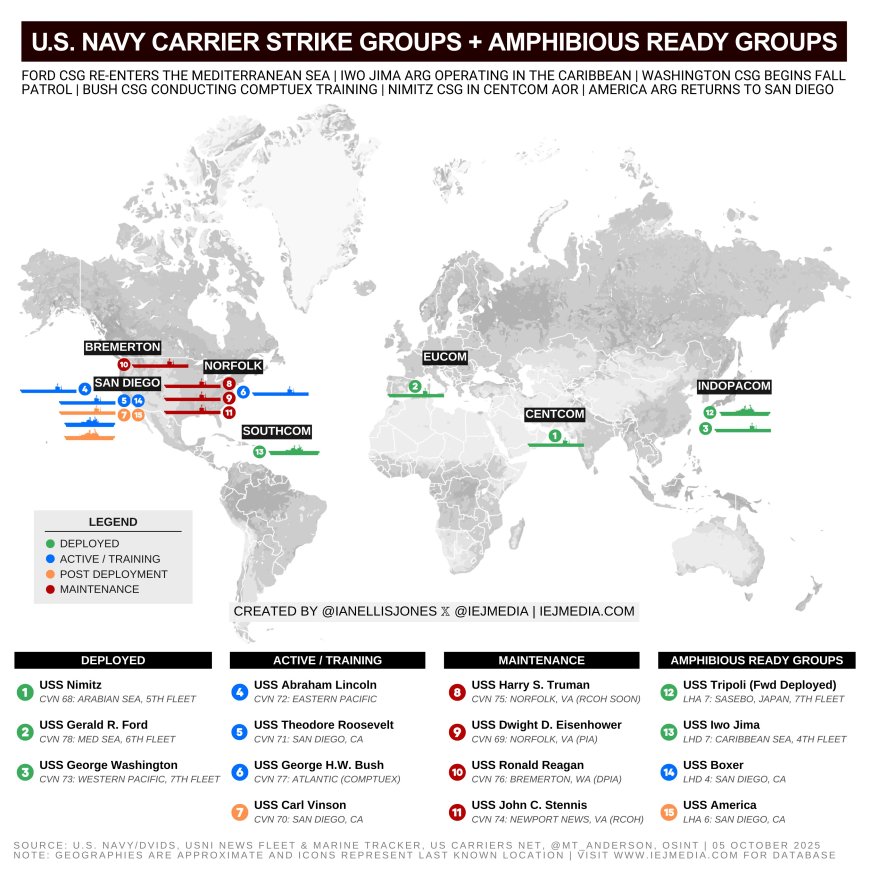
Across the globe, the U.S. Navy’s carrier strike groups are in motion — and when you plot their positions together, a pattern emerges. The Ford has re-entered the Mediterranean. The Nimitz sits in the Arabian Sea. The Washington group is in the Pacific. But one movement stands out: Iwo Jima Amphibious Ready Group — the same expeditionary force we’ve been tracking — is now operating under SOUTHCOM in the Caribbean.
That’s not normal. You don’t park an ARG in the Caribbean unless you’re expecting to project force quickly onto land. It’s positioned for flexibility — within hours of Venezuela, Colombia, or Central America. With Tomahawk-capable destroyers already in-theater, the carrier logistics create a bridge between the strike group and the expeditionary assets on standby.
The Re-Positioning
This redeployment isn’t about showmanship. It’s about consolidation. The U.S. is quietly aligning its carrier groups across multiple theaters to create instant global redundancy. Each major fleet region — CENTCOM, INDOPACOM, EUCOM, and now SOUTHCOM — has a ready amphibious element either in place or on alert.
In plain terms: if one region flares, another fills the gap. That’s deterrence architecture — layered, mobile, and backed by logistics hubs already prepared for escalation. It’s also an unmistakable signal that Washington is preparing for simultaneous regional pressure events.
- Ford CSG – re-enters the Mediterranean after extended readiness delay.
- Washington CSG – begins West Pacific fall patrol as China tensions rise.
- Bush CSG – conducting complex training in the Atlantic, aligning with NATO readiness cycles.
- Iwo Jima ARG – fully operational under SOUTHCOM, within range of Venezuelan and Colombian coastlines.
Each move alone looks routine. Together, they form a geopolitical outline — **power projection without overt declaration**.
Why the Caribbean Matters
The Caribbean isn’t a war zone, but it’s about to become one of the most strategically contested zones on the planet. It’s the intersection point between U.S. homeland defense, the Panama Canal trade arteries, Venezuelan oil routes, and the Atlantic drug-smuggling corridor. Whoever controls the Caribbean corridor controls the supply lines, migration flows, and leverage points of the entire Western Hemisphere.
And now, with Trump openly discussing potential land-based operations inside Venezuela, the Iwo Jima ARG’s presence becomes more than deterrence — it’s tactical readiness. Amphibious ships like these are built for exactly that: fast insertion, air-lift assault, and limited-duration occupations. It’s not “show of force.” It’s the opening move in a playbook we’ve seen before — from Libya 2011 to Panama 1989.
The Bigger Signal
People keep framing this as a “regional exercise.” It’s not. It’s a signal relay across commands. SOUTHCOM’s posture completes the global rotation — meaning every combatant command now has an active or training carrier group, an amphibious package, and a quick-reaction Marine detachment. That’s a power structure meant to project and sustain, not simply to deter.
We’re watching the U.S. shift from reactive deployment to strategic entrenchment. It’s not about whether a strike happens this month — it’s about establishing the capability to launch one whenever it’s politically useful. The “readiness” narrative is just the camouflage.
Reading Between the Lines
If you zoom out far enough, the pattern becomes obvious. The global map isn’t just a deployment chart — it’s an operational handoff. As one theater stabilizes, another ramps up. It’s a fluid network of firepower where command boundaries blur. That’s the hallmark of a new doctrine: distributed dominance.
From a policy standpoint, this gives Washington leverage in three directions simultaneously — against China in the Pacific, Russia in Europe, and unstable regimes in the Western Hemisphere. From a geopolitical standpoint, it’s also a test: how far can U.S. global logistics stretch before signaling a true multipronged confrontation?
Sources:
- U.S. Navy – Official Fleet and Deployment Releases (October 2025)
- U.S. Southern Command – Current Operations and Mission Overview
- Reuters – U.S. Carrier Movements and Regional Posture Updates
- U.S. Department of Defense – Global Force Posture Statements
- Stars and Stripes – Fleet Activity Reports and Amphibious Group Tracking
- MarineTraffic – Real-Time Vessel Tracking (Ford, Nimitz, Iwo Jima)
- NBC News – Trump Remarks on Land Operations and Venezuela Policy
Hvad er din reaktion?
 Synes godt om
0
Synes godt om
0
 Dislike
0
Dislike
0
 Kærlighed
0
Kærlighed
0
 Sjov
0
Sjov
0
 Wow
0
Wow
0
 Trist
0
Trist
0
 Vred
0
Vred
0

Founder of Pattern Nexus. I research markets, macro, geopolitics, AI, history, ancient systems, and the patterns most people overlook. I’m also building Market Radar, a trading scanner designed to read pressure, risk, confirmation, and setup quality before chasing a move. Pattern Nexus is where I connect the dots between data, history, technology, and the bigger system playing out around us.












Kommentarer (0)