
The Hormuz Theory: Could a Coastal Safe Zone Become the Front Edge of a Long War in Iran? -->
A Pattern Nexus scenario analysis on whether a fight to reopen the Strait of Hormuz could expand into a coastal safe-zone strategy, proxy warfare, and a much longer regime-pressure campaign inside Iran.
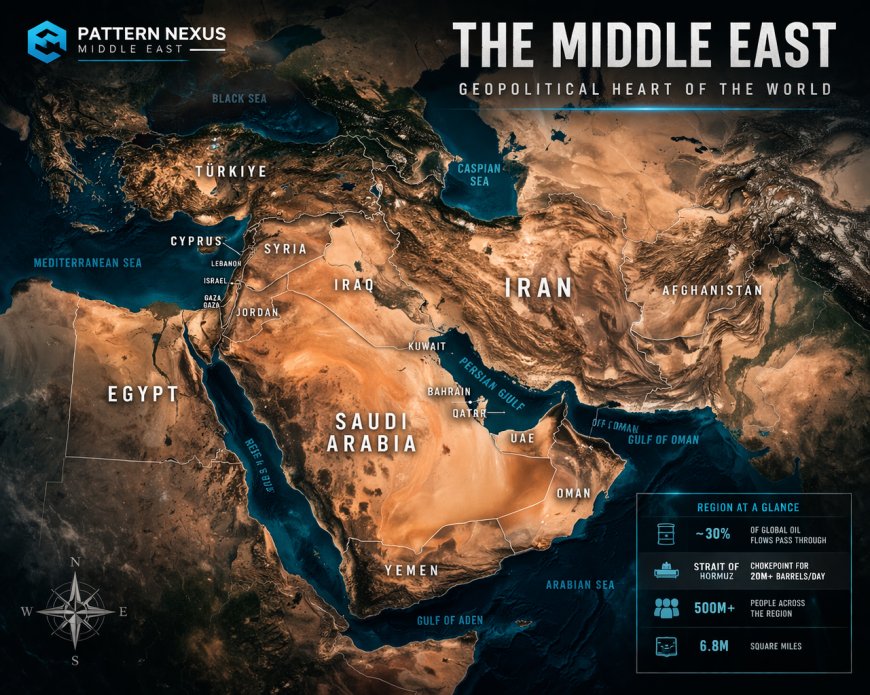

I am not saying Washington has already chosen this path. I am saying people are still looking at the wrong layer. Hormuz is not only a tanker problem. It is a control problem. If escorts and naval policing do not solve the disruption, the logic of the system starts pulling planners toward the coast, because the coast is where the persistent threat lives. That is where this theory comes from. Not “storm the beaches and march on Tehran.” Something slower, uglier, and more politically marketable than that. A protected strip. Local fighters as the visible face. Outside force carrying the shield, logistics, ISR, and escalation dominance. In public, it gets sold as stabilization, safe passage, humanitarian protection, or support for the Iranian people. In structure, it is the opening architecture of a much larger war.
The public story can stay “protect shipping” long after the real logic has shifted to “shape the shoreline.”
Mission creep is not a side effect here. It is the built-in logic of the theory.
A local Iranian face on the ground does not make it a local war. It changes optics. It does not change ownership.
What People Are Missing
Everybody wants to read Hormuz as a narrow story because narrow stories are easier to price, easier to narrate, and easier to sell. Tankers. Mines. Insurance. Escorts. Maybe some missile strikes. Maybe some convoy language. Fine. All of that is real. It is just not the whole structure. The whole structure is that one of the most important energy chokepoints on earth is sitting under a threat complex that lives on the Iranian side of the map. So the second maritime protection starts looking insufficient, the logic of the problem begins pushing toward the shoreline whether policymakers want to admit that or not.
That is the part people are still refusing to really sit with. The question is not just whether ships can get through for a few days under escort. The question is whether commercial confidence can be restored while the same coastline, same launch positions, same mine threat, same harassment capability, and same strategic leverage still exist intact. If the answer starts drifting toward no, then the water layer stops being the final answer. It becomes the first failed answer.
That is why this theory matters. Not because it is guaranteed. Not because somebody leaked an operational plan with that exact title on it. It matters because it follows the logic of the board. If the chokepoint cannot be stabilized at sea, the system starts looking for a land answer to a maritime problem. Once that happens, the mission is already half out of the box.
This theory is not really about seizing one island. It is about what happens when a chokepoint crisis starts dragging a naval mission toward a territorial answer and then toward regime pressure.
Start Here: What This Theory Actually Is
Before getting into the wider argument, the first thing that needs to be clear is what this theory is and what it is not. It is not saying somebody grabs one island and suddenly controls everything. It is not saying Hormuz Island by itself is the whole war. It is not saying this is already the confirmed plan. The theory is narrower than fantasy and bigger than the way the story is being framed.
The theory is this: if the current conflict keeps escalating and the water layer fails to stabilize the system, the strategic logic may start pulling away from pure shipping protection and toward the Iranian coast itself. In other words, the issue stops being only whether ships can be escorted through the Strait of Hormuz and starts becoming whether the threat system sitting on the Iranian side of that chokepoint has to be suppressed, contained, or displaced in a more durable way.
That is where Hormuz Island enters the conversation. Not because it is some magic key that automatically unlocks the whole strait, but because of where it sits. It is near the mouth of one of the most important energy chokepoints on earth, close to Bandar Abbas, close to the coastal geography that matters, and close to the line where a naval problem can start becoming a territorial problem. If a crisis at sea keeps forcing planners to look at the shore, then the island starts mattering as part of a wider position, not as a standalone trophy.
That is also why this article needs a basic map distinction that a lot of casual readers do not already have in their heads:
- Kharg Island is the oil-export island most people are talking about when they talk about strikes on Iranian energy infrastructure.
- Hormuz Island is the island near the mouth of the Strait of Hormuz, close to Bandar Abbas.
- The Strait of Hormuz is the narrow waterway itself, the corridor global shipping has to move through.
- Bandar Abbas is the nearby Iranian mainland hub that matters because ports, logistics, naval activity, and coastal launch threats do not exist in a vacuum.
That distinction matters because the article is not built around the mainstream Kharg conversation. It is built around a different possibility: that the more important long-duration question is not only “Can Iran’s oil exports be hit?” but also “What happens if the fight starts shifting toward control over the chokepoint and the coastline around it?” That is a much bigger question, and it leads to a much bigger war structure.
This theory is not “take one island and win.” It is “if the sea lane cannot be stabilized at sea, pressure starts moving toward the shoreline, and once that happens the mission can widen fast.”
Why Hormuz Has Been Fought Over Before
The reason this theory is not random is because the chokepoint itself has always mattered. Hormuz sits on one of the most important trade and energy corridors in the world. Today that means oil, LNG, insurance risk, naval pressure, and global macro spillover. In earlier centuries it meant commerce, taxation, empire, and sea-lane control. Different era, same underlying logic: whoever can dominate the bottleneck can shape movement through the bottleneck.
That is why the Portuguese precedent matters. Portugal controlled Hormuz for roughly a century, not because the island was inherently valuable in isolation, but because control over that point meant leverage over regional trade and maritime movement. That does not make the modern situation identical. Modern missiles, drones, satellites, instant market pricing, and energy-system interdependence make the current environment much more complex. But the historical lesson still matters because it shows that outside powers have looked at this exact geography before and understood that the real value was not the island as scenery. The real value was the choke point it sat inside.
For the average reader, that is the bridge into the current theory. The argument is not that history repeats in a clean copy-paste way. The argument is that the same geography keeps producing the same kind of strategic temptation. If a state believes a critical maritime corridor cannot be secured by policing the water alone, it starts looking at the land features, ports, islands, and coastal infrastructure that shape that corridor. That is the historical logic underneath the modern version.
So when this article talks about Hormuz Island, it is not doing it because the name sounds dramatic. It is doing it because the geography has always mattered, and chokepoints have a way of dragging powers toward bigger ambitions than the public story first admits.
Hormuz has been fought over before because chokepoints create leverage. The tools change. The strategic temptation does not.
The Strait Is Not the Island and the Island Is Not the Prize
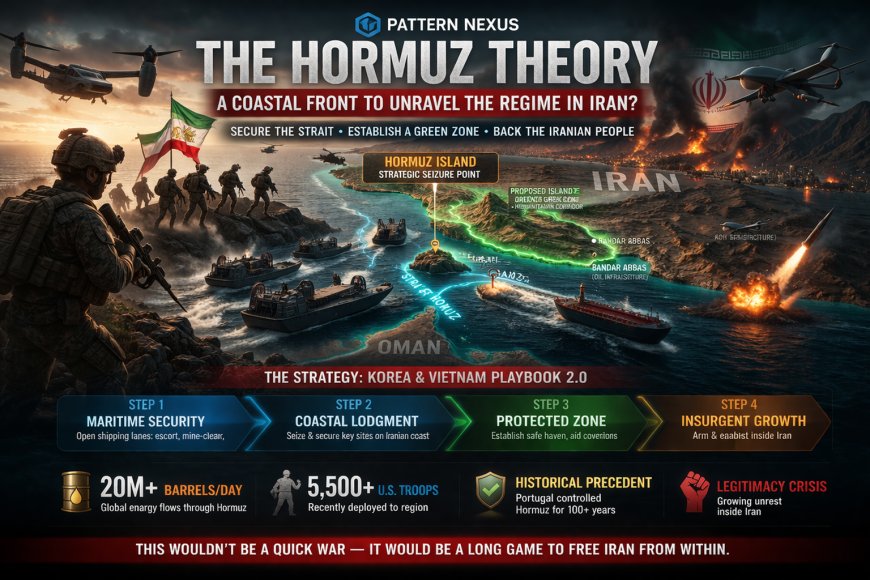
This is where the conversation usually gets sloppy. People hear Hormuz Island and think in symbolic terms. Plant a flag. Hold the rock. Control the strait. That is too simple. The island matters, but the island is not the whole problem. The shipping lanes sit mostly in Omani waters. Iran controls the north side. Oman controls the south side. Bandar Abbas sits right there. Nearby islands matter. The mainland matters. The missile envelope matters. Mining matters. Drones matter. Harassment matters. The island is a node inside a larger control system, not a magic switch that turns global energy flow on and off.
That is why the Portuguese analogy is useful but incomplete. Yes, they controlled Hormuz for about a century. Yes, outside powers have historically treated this chokepoint as something that can be dominated through fortified presence. But the modern environment is denser, faster, and nastier. ISR is constant. Markets react instantly. Anti-ship capability is not medieval artillery on a fort wall. So even if a force grabbed the island, that would not by itself equal durable command over the corridor. It would only make sense as part of a wider effort to suppress the surrounding threat complex.
That is the real pivot in the theory. The minute you admit that controlling the island does not solve the corridor by itself, you are already halfway into territorial logic. You are already asking what has to happen on the coast, not just on the water.
- Hormuz Island is important, but it is not self-executing.
- The strait is a corridor problem, not a single-capture problem.
- The shoreline is where the long-duration leverage sits.
What Our Theory Is Actually Saying
The theory is more specific than “the U.S. invades Iran” and more serious than “this is just another shipping flare-up.” It is saying that if the crisis keeps escalating and the water layer keeps failing to stabilize the system, the next move might not be a classic invasion at all. It could be something more politically manageable on the surface and much more dangerous underneath: seize or neutralize enough of the immediate geography around the mouth of the strait to create a protected coastal strip, then use that strip as the edge of a longer war inside Iran.
In that model, the Marines are not the romantic headline invasion force charging north. They are part of the backstop. They help create the survivable bubble. They help secure the perimeter, logistics, medevac, ISR, and escalation dominance. The visible local face becomes armed Iranian opposition, anti-regime elements, defectors, or whatever political-military structure can be assembled and sold as the Iranian people taking their country back. Publicly, that reads cleaner. Operationally, it is still a U.S.-backed war structure.
That matters because it gets closer to how this kind of thing would actually be sold. Nobody stands up and says, “We are starting a long, open-ended coastal war that will slowly convert into regime pressure.” They say they are protecting shipping. Then they say they are suppressing threats to shipping. Then they say they need secure access. Then they say civilians need protection. Then they say local forces are stepping up. Every step gets packaged as the minimum necessary expansion. Taken together, the sequence becomes the war.
That is why the theory does not need to be read as fantasy. It needs to be read as escalation architecture. The actual weak point is not whether outside support can make an insurgency more dangerous. History says it can. The weak point is whether internal Iranian anger can be converted into something organized, durable, and legitimate enough to front this kind of campaign without collapsing into fragmentation or looking like a foreign instrument. That is a real problem. But it is a different problem than saying the theory itself is ridiculous. It is not ridiculous. It is ugly.
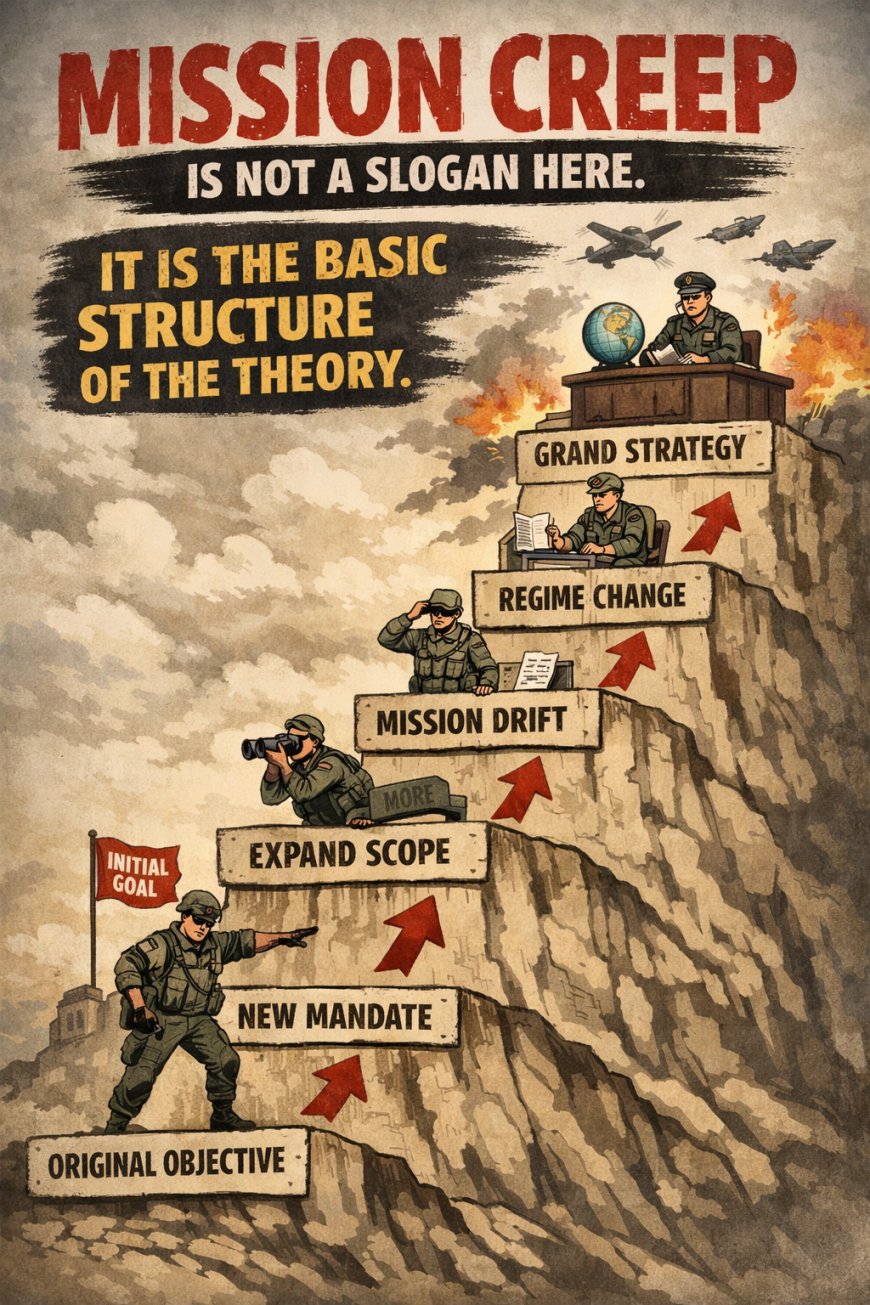
And once you hold territory, even indirectly, all the fantasy about a cleaner workaround starts dying. The second you create a safe zone, protected corridor, or liberated coastal strip, you inherit civilians, aid burdens, perimeter defense, propaganda fights, partner vetting, command problems, fragmentation risk, and the politics of everything that happens inside that zone. The second you hold land, you inherit the land. That is the part most people keep trying to skip.
The Stack: Why This Does Not Stay in the Gulf
Even if no coastal zone is ever attempted, the logic underneath this theory still matters because it shows the real structure of the conflict. Hormuz is not just a naval problem. It is an energy problem. An inflation problem. A rates problem. A credit problem. An alliance problem. A domestic-political problem. That is why headlines that reduce it to a shipping disruption keep missing the point. Shipping is the symptom people can see. The real issue is that the chokepoint sits at the physical base of a much larger cost stack.
The sequence is not complicated. First the ships stop, reroute, or move under much worse terms. Then oil and LNG flows get repriced or disrupted. Then spare capacity, repair timelines, and routing constraints start to matter in a way they did not before. Then inflation expectations begin to rise because energy is not some isolated sector off to the side. Then bond markets reprice because inflation, policy, and growth expectations do not stay politely separated. Then financial conditions tighten because yields, spreads, and uncertainty all feed back into funding conditions and risk appetite. Then the political story starts to crack because the supposedly limited operation is suddenly attached to a very visible cost structure that reaches far beyond the Gulf.
That is the stack. That is the whole point. The trigger may sit in the Gulf. The consequences do not stay there. They move outward through the rest of the system. That is why the story does not stay regional even when the map trigger is regional. Hormuz is a pressure multiplier. Break the base layer and the pressure starts climbing upward.
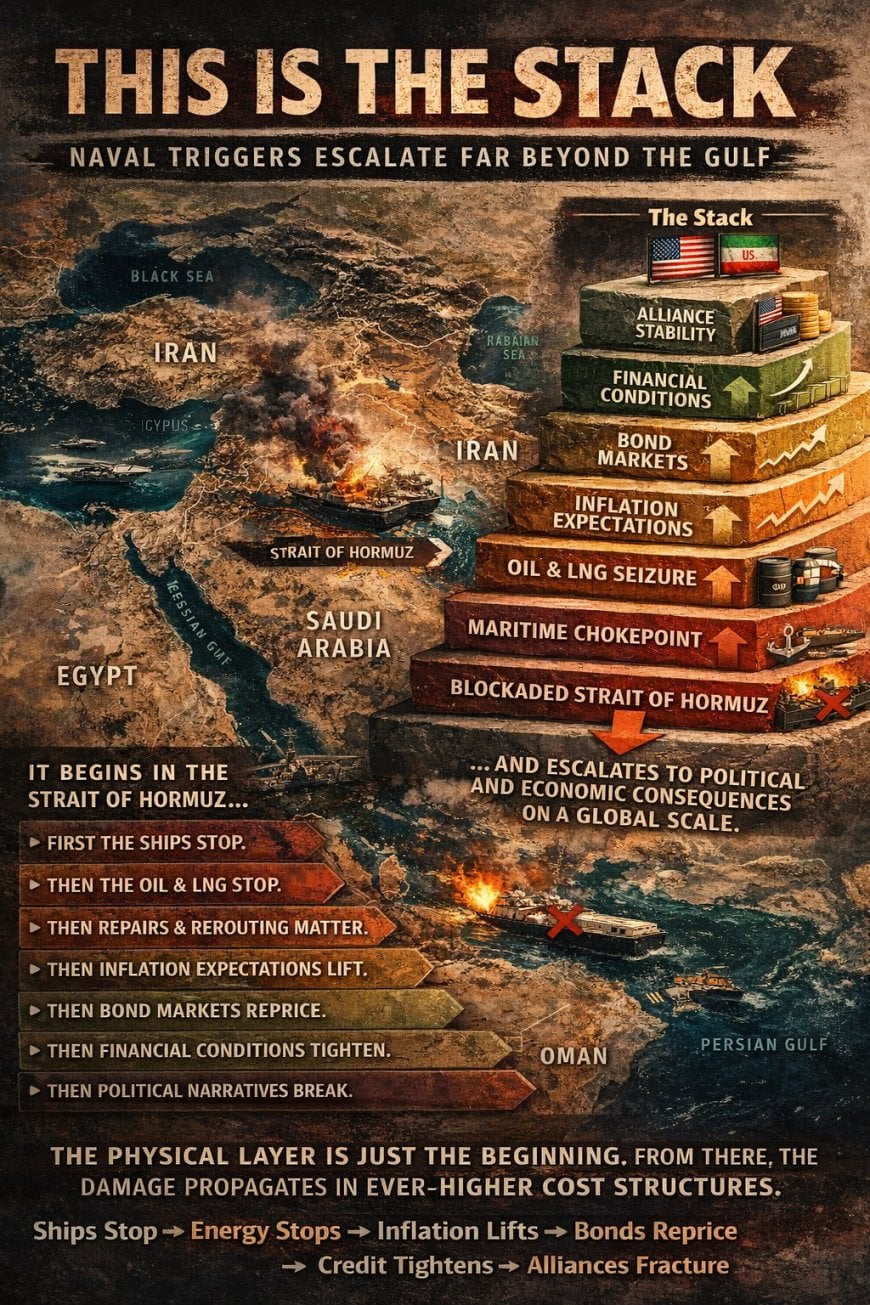
Ships stop. Energy tightens. Inflation lifts. Bonds reprice. Credit tightens. Politics starts breaking.
This is also why the article cannot just be a military explainer. The military angle matters, but it is only the first visible layer. The deeper story is how a disruption at a strategic permission node starts transmitting through energy, markets, alliance management, and domestic legitimacy all at once. That is the real Pattern Nexus frame here. The war story and the macro story are the same story sitting at different levels of the stack.
What Would Make This Theory More Real
A theory that cannot tell you what to watch for is not worth much. So here is what would make this more real. First, watch the language. If public messaging shifts from escorting ships and restoring navigation toward phrases like secure coastal access, protected corridor, stabilized zone, humanitarian access area, liberated administration, or support for local partners in secured areas, that matters. Language usually moves before the public fully understands what it is moving toward.
Second, watch the force posture. More ships by themselves do not prove much. A posture that starts looking like sustainment for a lodgment is different. Third, watch how the Iranian people are discussed versus the Iranian regime. The more aggressively that split is emphasized in official language, the more likely you are looking at narrative preparation for some kind of partner-backed architecture rather than just a one-off punitive operation.
What weakens the theory is just as important. If maritime policing actually restores durable confidence, if safe passage becomes real without pressure to move ashore, and if the public story stays tightly tied to transit rather than territory, then this stays where it belongs: as a plausible contingency, not a live trajectory. The point is not to emotionally marry the theory. The point is to understand the signals that would make it stronger or weaker.
Watch the language. Watch the posture. Watch whether the story stays maritime or starts quietly turning territorial.
Pattern Nexus Lens
The cleanest way to understand this is through the control-systems lens. Chokepoints are not just geography. They are permission nodes. Whoever can interrupt, guarantee, insure, price, or securitize movement through them can shape behavior far beyond the node itself. That is why Hormuz matters even before a single extra step is taken ashore. The map point is visible. The system leverage is bigger than the map point.
That is also why the shallow read fails. People keep reading Hormuz as a tanker lane with some military risk attached to it. That is backward. Hormuz is a strategic permission stack with tankers moving through it. Once permission through that node breaks, the pressure does not stay neat. It moves outward into energy, into bond markets, into credit, into alliance cohesion, into domestic politics, and eventually into arguments about whether the threat has to be solved at the shoreline instead of at sea.
So no, this is not just a story about whether one exact coastal operation happens. It is a story about how the system behaves when a vital node stops functioning cleanly. That is what people are missing. The Strait of Hormuz is not only a place. It is a mechanism.
The strait is the trigger, not the end state. Once the node breaks, the system starts reaching for bigger and uglier forms of control.
Sources
These sources support the troop posture, geometry, energy exposure, historical context, insurgency logic, and internal-Iran sections of this article.
- Reuters — U.S. expected to send thousands more soldiers to Middle East, sources say
- Reuters — U.S. sending Marines and amphibious assault ship to Middle East
- Reuters — European countries and Japan ready to help restore Hormuz navigation
- Reuters — Iran’s rulers face legitimacy crisis amid spreading unrest
- Reuters — Iran executes three individuals arrested over January protests
- AP — A wave of executions is feared in Iran after 3 young men were hanged
- EIA — Oil flow through the Strait of Hormuz averaged 20 million barrels per day in 2024
- EIA — About one-fifth of global LNG trade flowed through Hormuz in 2024
- IEA — Strait of Hormuz overview and rerouting constraints
- Britannica — Hormuz Island location and history
- Britannica — Strait shipping-lane geography and Omani waters
- Encyclopaedia Iranica — Portuguese control over Hormuz and the Gulf
- RAND — Trends in Outside Support for Insurgent Movements
- RAND — Paths to Victory: Lessons from Modern Insurgencies
واکنش شما چیست؟
 پسندیدن
0
پسندیدن
0
 نپسندیدن
0
نپسندیدن
0
 عشق
0
عشق
0
 خنده دار
0
خنده دار
0
 وای
0
وای
0
 ناراحت
0
ناراحت
0
 عصبانی
0
عصبانی
0

Founder of Pattern Nexus. I research markets, macro, geopolitics, AI, history, ancient systems, and the patterns most people overlook. I’m also building Market Radar, a trading scanner designed to read pressure, risk, confirmation, and setup quality before chasing a move. Pattern Nexus is where I connect the dots between data, history, technology, and the bigger system playing out around us.













نظرات (0)