
Iran at the Edge: Currency Collapse, Street Protests, and a Narrowing Margin for Error
Iran’s rial collapse has detonated nationwide protests, leadership churn, and a lethal-force risk spiral—now compounded by external signaling. A Pattern Nexus reconstruction of what’s verified, what’s not, and the outcomes that matter.

What we know (verified)
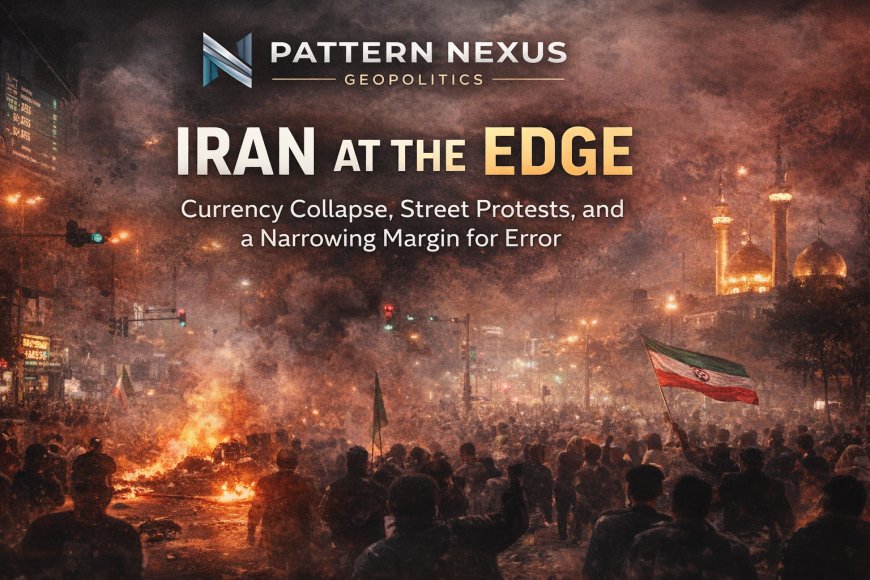
Iran is experiencing the largest wave of unrest in years, and the initial trigger is not complicated: purchasing power broke. The currency shock and inflation pressure are now visible at street level, not just in charts. Multiple outlets report that protests started after the rial fell to record lows and spread beyond Tehran into other provinces, with merchant closures and strikes acting as accelerant rather than side note. This matters because when bazaar and traders participate, you’re not looking at a narrow political demo. You’re looking at economic legitimacy cracking in public.
The leadership response has already signaled stress: Iran’s central bank chief resigned amid the currency plunge and the protests. That does not mean the central bank “collapsed,” but it does mean the state is searching for a pressure valve while the pressure is still rising. The resignation is not a stabilization mechanism. It’s a symptom. [Sources]
The security situation is deteriorating. Major reporting confirms that protests have turned deadly in multiple areas, with casualties reported among protesters and security forces. Exact numbers vary across reports because information is constrained and contested in real time, but the direction is clear: force is being used, and the death toll is non-zero. [Sources]
Iran’s Supreme Leader has publicly addressed the unrest, framing it as a mix of legitimate grievance and hostile agitation, while emphasizing suppression of “rioters.” This is an important tell: when the top leadership speaks, it means the issue is not contained at the operational layer. [Sources]
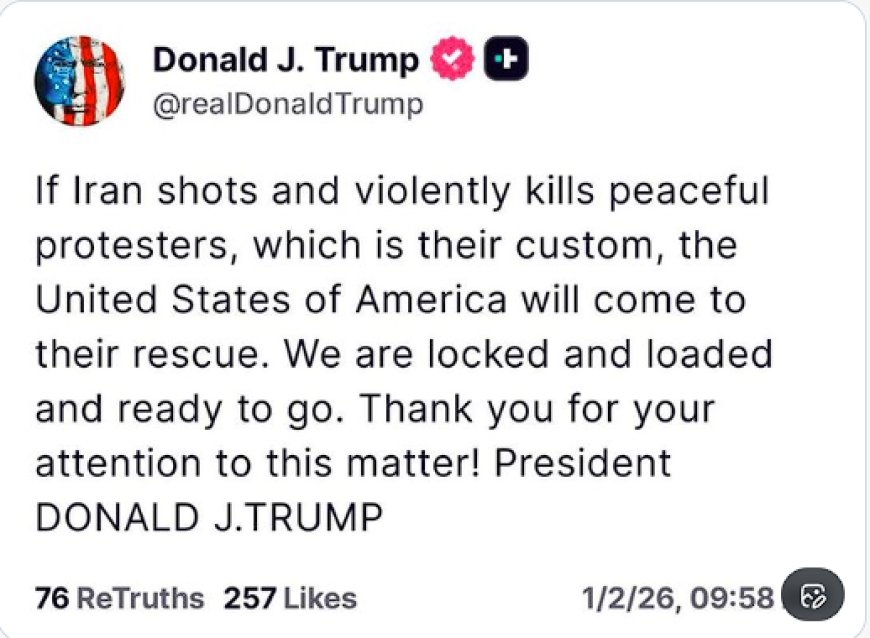
External signaling has entered the loop. U.S. President Donald Trump posted a public warning framing lethal repression of protesters as a red line, using language implying readiness to act. Whether or not any action follows is separate; the signaling itself changes incentives and increases miscalculation risk. [Sources]
What we do not know (yet)
Casualty totals, specific incident attribution, and the scale of arrests are all inherently unstable early in unrest cycles. Expect numbers to move. Expect propaganda. Expect edited clips. The correct posture is not “ignore it” and not “believe everything,” but to track converging confirmations.
We also do not have a clean public map of internal elite cohesion. The currency break and central bank churn suggest the regime is under strain, but strain does not automatically equal fracture. Fracture shows up later through inconsistent messaging, defections, or visible hesitation in enforcement.
Timeline reconstruction
Late December: currency stress accelerates and becomes socially visible. Merchant closures and strike behavior begin, which is often the first “real economy” indicator that the state has lost credibility with the commercial core. [Sources]
December 29–30 window: reporting confirms the central bank chief resignation amid the currency plunge and widening protest activity. [Sources]
Early January: protests widen geographically, clashes intensify, fatalities are reported, and leadership messaging hardens. [Sources]
External signaling escalates: Trump posts a public warning tied to lethal repression; state and international outlets amplify or contest narrative framing; the information environment becomes as important as the street environment. [Sources]
Why this one is dangerous
People keep trying to classify this as either “economic protests” or “political protests.” That’s the wrong frame. It’s a system-stress event where economics is the ignition, politics is the arena, and security is the bottleneck.
The real danger comes from the interaction of four layers: currency credibility failure, merchant-class participation, lethal-force normalization, and external red-line signaling. Once those stack, the system stops responding to intent and starts responding to momentum.
Here’s the pattern that repeats across history: money breaks, the street moves, the state clamps, external actors posture, someone misreads the other side, and the “domestic event” gets an international wrapper. Not always war, but always instability.
The other risk here is regional coupling. Iran does not get to have a purely internal crisis while the Middle East is already loaded with unresolved fronts and global energy sensitivity. Markets and states are already jittery. That increases reflexive responses.
Social media reality check
The thread that sparked this article is exactly what people are seeing right now: posts claiming “Iran is shooting civilians,” dramatic casualty numbers, “central bank collapse,” and geopolitics being stitched together in real time with screenshots.
Some of the underlying themes are real: protests are real, repression is real, currency collapse is real, leadership churn is real, external rhetoric is real. The problem is that social media compresses all of that into a single certainty narrative, usually with the least reliable details presented with the most confidence.
Specifically: calling the central bank “collapsed” is not supported by credible reporting; the governor resignation is supported. claiming precise casualty counts from viral images is unreliable; fatalities are supported, exact totals are moving. claiming direct causal chains like “Netanyahu visit → threat issued” is commentary unless backed by official confirmation and timelines.
Potential outcomes
1) Containment via force (most common)
The regime suppresses protests using arrests, curfews, intimidation, selective lethal force, and information control. This can restore surface order, but it does not repair currency credibility or living standards. It typically buys time while deepening long-term instability.
2) Concessions and managed relief (harder than it sounds)
Limited concessions, dialogue offers, selective scapegoating, leadership changes, or partial economic measures may reduce heat temporarily. The constraint is structural: if the rial is breaking because the system is boxed in, “dialogue” cannot print credibility. This path requires real stabilization capacity, not speeches. [Sources]
3) Internal fracture (high impact, lower probability early)
If segments of security services hesitate, refuse, or split, outcomes become unpredictable fast. Fracture often shows up as inconsistent enforcement, contradictory messaging, or localized defections. If it appears, the timeline compresses dramatically.
4) Externalization or proxy activation (the spillover path)
Under pressure, regimes often try to redirect the narrative outward: blaming foreign interference, escalating regional posture, or allowing proxy dynamics to heat up. This can shift attention, but it also multiplies tail risk and invites external responses.
5) A miscalculation spiral (the path nobody “chooses”)
This is the dangerous one because it does not require intent. It requires only compressed decision cycles, public red lines, and imperfect information. A single high-visibility incident can force responses that leaders privately did not want. That is why rhetoric matters. [Sources]
What to watch next
- Merchant participation: expanding closures and strikes are a credibility metric, not just “economic whining.”
- Security cohesion: do we see hesitation, inconsistency, or messaging splits between police, IRGC-related units, and political leadership.
- Fatality clustering: does lethal force remain sporadic, or become normalized across multiple provinces.
- Information control: internet throttling, platform disruptions, and narrative synchronization are tells of regime stress.
- External posture: do statements shift from general warnings to deadlines, capabilities, or conditional triggers.
- Energy sensitivity: any hint of disruption reverberates globally because the market is already primed for shock.
Pattern Nexus Lens
This is a control-systems problem. The regime’s control loop relies on three stabilizers: economic baseline, enforcement credibility, and narrative dominance. Right now, all three are under load.
The currency collapse is the economic stabilizer failing. Merchant closures are the social proof that failure is recognized broadly. Casualties are the enforcement stabilizer entering a higher-energy state. External red-line signaling increases the probability that the system gets pushed into an unplanned regime change attempt or a forced escalation posture.
In plain English: once your economy breaks and your street breaks, your leadership has two options—absorb the hit or externalize it. Externalization is how domestic pressure becomes geopolitical pressure. That’s why this matters outside Iran.
FAQ
Is Iran’s central bank actually collapsing?
No credible reporting supports “institutional collapse.” What is confirmed is leadership resignation amid currency panic and protests. That is serious, but it’s not the same as the financial system ceasing to function. [Sources]
Are protesters being shot?
Credible reporting confirms deaths and that the unrest has turned deadly. Reports also describe live ammunition being used in some cases. Exact counts and full attribution remain contested and fluid, which is normal in the early phase of a fast-moving unrest cycle. [Sources]
Does Trump’s “red line” mean the U.S. is about to intervene?
Not necessarily. It does mean the signaling environment has shifted. Signals can be deterrence, domestic politics, or coercion. They also increase miscalculation risk because they reduce ambiguity. [Sources]
Is media “not covering it” on purpose?
I’m not claiming coordinated suppression. I am saying attention is fragmented and the global news cycle is saturated. Some events get less headline oxygen than their risk profile deserves until a trigger forces it to the top. That is exactly how people get surprised.
Sources
واکنش شما چیست؟
 پسندیدن
0
پسندیدن
0
 نپسندیدن
0
نپسندیدن
0
 عشق
0
عشق
0
 خنده دار
0
خنده دار
0
 وای
0
وای
0
 ناراحت
0
ناراحت
0
 عصبانی
0
عصبانی
0

Founder of Pattern Nexus. I research markets, macro, geopolitics, AI, history, ancient systems, and the patterns most people overlook. I’m also building Market Radar, a trading scanner designed to read pressure, risk, confirmation, and setup quality before chasing a move. Pattern Nexus is where I connect the dots between data, history, technology, and the bigger system playing out around us.











نظرات (0)