
State Street and the Hidden Operating System of Modern Finance
State Street is not just another bank. It is one of the hidden infrastructure layers of modern finance, sitting inside custody, ETFs, asset servicing, securities lending, proxy mechanics, institutional data, and the next stage of tokenized finance. This Pattern Nexus report breaks down how State Street became one of the most important financial institutions most people never think about.
Quick read
State Street is not powerful because the public knows its name. It is powerful because institutions depend on its rails. It sits inside custody, fund administration, ETF infrastructure, collateral movement, securities lending, proxy mechanics, institutional data, and now tokenized-finance operations. As of March 31, 2026, State Street reported $54.5 trillion in assets under custody and/or administration and $5.6 trillion in assets under management. The Federal Reserve also continues to classify State Street as one of the U.S. global systemically important banks.[1][2]
That does not mean State Street owns $54.5 trillion. It does not. AUC/A is not ownership. It is operational surface area. It tells you how much capital depends on the firm’s systems to be held, accounted for, administered, reported, transferred, financed, reconciled, and made usable. That is a subtler kind of power than headline ownership, but in modern markets it may be the more durable form.
AUC/A is not ownership
State Street’s custody and administration scale should not be confused with balance-sheet wealth. It is a measure of dependency, not direct ownership.
Infrastructure beats spectacle
The firm’s power is not loud. It sits inside the workflows that make institutional markets function.
Passive power is real but contested
The Big Three debate matters, but serious analysis has to separate durable proxy influence from cartoon claims of total control.
Tokenization is not a pivot
For State Street, digital assets look less like a new identity and more like the next asset class to be absorbed into custody, reporting, and administration.
Executive summary
State Street is not best understood as a celebrity Wall Street institution or a consumer-facing bank. It is better understood as infrastructure: a company embedded in custody, settlement, fund administration, index implementation, exchange-traded funds, collateral, securities lending, proxy processing, institutional data, and increasingly the operational layer of tokenized finance.
The historical pattern is unusually coherent. State Street’s lineage reaches back to Union Bank in Boston in 1792, but the version that matters today was built through a slow migration away from ordinary banking and toward trust, safekeeping, accounting, and large-scale institutional servicing. It became custodian to the first U.S. open-end mutual fund in 1924, launched an institutional investment-management arm in 1978, helped create the first U.S. ETF in 1993, and then used selective acquisitions and platform-building to expand from a custody bank into something much closer to a market utility.[3][4][5]
My core view is simple: State Street reveals what modern capitalism looks like after power migrates from visible ownership to invisible administration. That does not mean every dramatic claim about the firm is automatically true. It does not mean State Street owns the assets it services. It does not mean common ownership is the same thing as direct command over corporate America. But it does mean the company sits at one of the deepest chokepoints in the financial system. That is precisely why its conduct failures, stewardship contradictions, and current push into digital-asset infrastructure deserve more scrutiny than they usually get.
The institution behind the institutions
The easiest way to misunderstand State Street is to talk about it like it belongs in the same bucket as the loudest banks on television. It does not. State Street is not primarily a story about consumer finance, splashy dealmaking, or the cult of a chief executive. It is a story about administrative power.
If I strip the brand away and look at the operating logic, what I see is a firm that spent more than two centuries moving closer and closer to the core machinery of capital markets: custody, accounting, servicing, fund infrastructure, benchmark access, proxy mechanics, data normalization, securities finance, collateral, and now digital-asset rails. That is why the company can sound obscure to the public while remaining indispensable to pension plans, sovereign funds, asset managers, insurers, banks, broker-dealers, and institutional allocators around the world.
State Street is one of those companies where the numbers are so large that they almost become useless unless you slow down and define what they actually mean. When the firm reports $54.5 trillion in assets under custody and/or administration, that does not mean it owns $54.5 trillion. It means that client assets flow through, sit on, or depend on its operational systems. That distinction matters. AUC/A is not a wealth claim. It is a dependency map.[1]
AUC/A is not ownership. It is operational surface area. It tells you how much of the institutional world depends on the pipes.
That is the real reason State Street matters. Modern finance is not only controlled through who owns the asset. It is also shaped by who holds the record, who processes the trade, who administers the fund, who handles the proxy, who runs the data, who manages the collateral, who provides the securities lending infrastructure, and who can make the whole thing legible to regulators, clients, and counterparties. State Street lives in that layer.
From Boston bank to trust machine
The historical arc matters because State Street did not arrive at its current role by accident. Its oldest lineage runs back to Union Bank, chartered in Boston in 1792 in the early American republic. That timing matters. This was the period in which banking, trade, public credit, and state formation were still deeply entangled. The United States was trying to build a national financial architecture, and Boston’s mercantile economy needed institutions capable of handling capital flows tied to shipping, trade, public credit, private wealth, and commerce.[3]
Over the nineteenth and early twentieth centuries, the line we now call State Street passed through national banking reforms, trust-company development, and corporate consolidation. State Street Deposit & Trust was founded in 1891, later renamed State Street Trust Company, and then merged with National Union in 1925 under the State Street name. The modern State Street Bank and Trust Company and the later holding-company structure were products of the mid-twentieth century, but the important point is not simply the legal sequence. The important point is directional: the franchise evolved away from ordinary local banking and toward trust, custody, and institutional servicing.[13]
That shift looks boring until you understand what was happening around it. The United States was moving from a bank-centered economy toward a capital-markets economy. Wealth was becoming pooled, securitized, intermediated, benchmarked, globalized, and administered through increasingly complex institutions. In that world, the most durable power does not always belong to the person making the loudest trade. It often belongs to the institution that keeps the books when everyone else is trading.
There is also a harder historical question here that should not be ignored. Reporting in 2024 on a State Street-commissioned historical study said researchers concluded that wealth connected to slavery and the slave trade helped seed the bank’s ancestor institutions and that several early founders and stakeholders benefited directly from slavery. Because the commissioned report itself does not appear to be fully public, I would not overstate conclusions that cannot be independently verified line by line. But I also think it would be naive to write about a Boston financial institution founded inside the Atlantic economy and pretend slavery is unrelated background noise. The caveat is real. So is the historical probability that the connection is not incidental.[14]
Why custody changes the story
The decisive shift in State Street’s history was not a single flashy merger or crisis rescue. It was the repeated decision to move deeper into custodial and administrative functions. That sounds boring only if you do not understand what custody means at scale.
A custodian is not merely a vault. At institutional scale, custody is the layer that helps hold assets, settle trades, reconcile records, process corporate actions, manage cash, support proxy workflows, maintain books across jurisdictions, track beneficial ownership, and make portfolios legible to the institutions that legally own them. If the market is a machine, custody is part of the gearbox.
State Street hit one of the most important inflection points in that business in 1924, when it became custodian to Massachusetts Investors Trust, widely recognized as the first U.S. open-end mutual fund. I do not think this milestone gets nearly enough attention. It placed State Street at the birth of modern pooled investing, long before passive investing became a cultural cliché.[4]
The point is larger than a commemorative anniversary. Mutual funds were the early industrialization of mass investment. They allowed individual capital to be pooled into professional vehicles. But a pooled vehicle needs more than a manager. It needs a custodian, an administrator, a pricing process, a recordkeeping system, and a trust layer that tells investors the assets are actually there. State Street positioned itself inside that infrastructure.
Pattern note
The public sees the fund name. The institution sees the custody agreement, accounting system, transfer process, daily valuation, corporate action workflow, and compliance file. That is where State Street lives.
That orientation toward the back office became more valuable as markets grew more complex. When the institutional-investing boom arrived through pensions, insurance assets, mutual funds, global custody networks, and cross-border mandates, State Street was positioned to benefit from the fact that the glamorous parts of finance are often the least durable. Lending cycles turn. Trading fashions turn. But the need to account for other people’s assets at scale only grows.
SPY, ETFs, and the productization of market access
If custody was the old empire, ETFs were the bridge into the new one. State Street’s investment-management arm was established in 1978, placing the firm early in the evolution of institutional indexing and benchmark-aware portfolio construction. Then came the 1993 launch of SPY, the first U.S. exchange-traded fund.[5]
This is where a lot of people tell the story too small. SPY was not just a hit product. It was a redesign of market access. It turned a broad market basket into something that could trade intraday like a stock, tying together creation-redemption mechanics, authorized participants, arbitrage, settlement, benchmark exposure, liquidity, custody, and fund administration in one architecture.
The crucial insight is that State Street did not merely benefit from the ETF boom as a brand owner. It benefited because ETFs expanded demand for exactly the kinds of institutional functions State Street was already built to provide. Fund administration, custody, asset servicing, cash management, collateral workflows, benchmark implementation, securities lending, and the larger data-and-reporting layer around pooled vehicles all became more important.
SPY mattered because it made benchmark exposure tradeable without removing the need for institutional plumbing. It actually made the plumbing more important.
That is why I treat SPY less as a product milestone than as an infrastructural hinge. It linked State Street’s trust-bank past to the passive-investing present. It showed the company could take the logic of pooled investment and turn it into exchange-traded market structure. That is the broader pattern: State Street keeps converting financial abstractions into operational systems.
The boring acquisitions were the real strategy
One of the reasons State Street is hard to read from the outside is that its most important moves often look boring. This is not a company whose strategic logic is best understood through splashy consumer campaigns. It is better understood through platform acquisitions, capability layering, and client-workflow control.
The 2003 acquisition of Deutsche Bank’s global securities-services businesses is a perfect example. State Street said the deal added roughly $2.2 trillion in assets under custody, deepened its presence in Europe, and increased its scale in the unglamorous but sticky business of cross-border securities servicing. That is not movie-script finance. It is more important than movie-script finance.[6]
The 2007 acquisition of Investors Financial Services deepened fund-servicing and alternative-servicing scale. The 2018 acquisition of Charles River Development for $2.6 billion was even more revealing because it pushed State Street up the stack into front-office investment software. That is the logic behind State Street Alpha: connect front office, middle office, back office, data, and servicing into a single operating environment instead of letting each layer live in a separate system.[15][16]
The failed BBH Investor Services acquisition matters for the same reason. State Street wanted more cross-border servicing, alternatives, and ETF infrastructure, but the deal was terminated in 2022 after it became clear approvals would not be secured. That failure did not negate the strategy. It exposed the strategy. State Street wants to be larger, deeper, and more embedded in the institutional operating layer. Regulators understand that scale in this layer is not ordinary scale.[17]
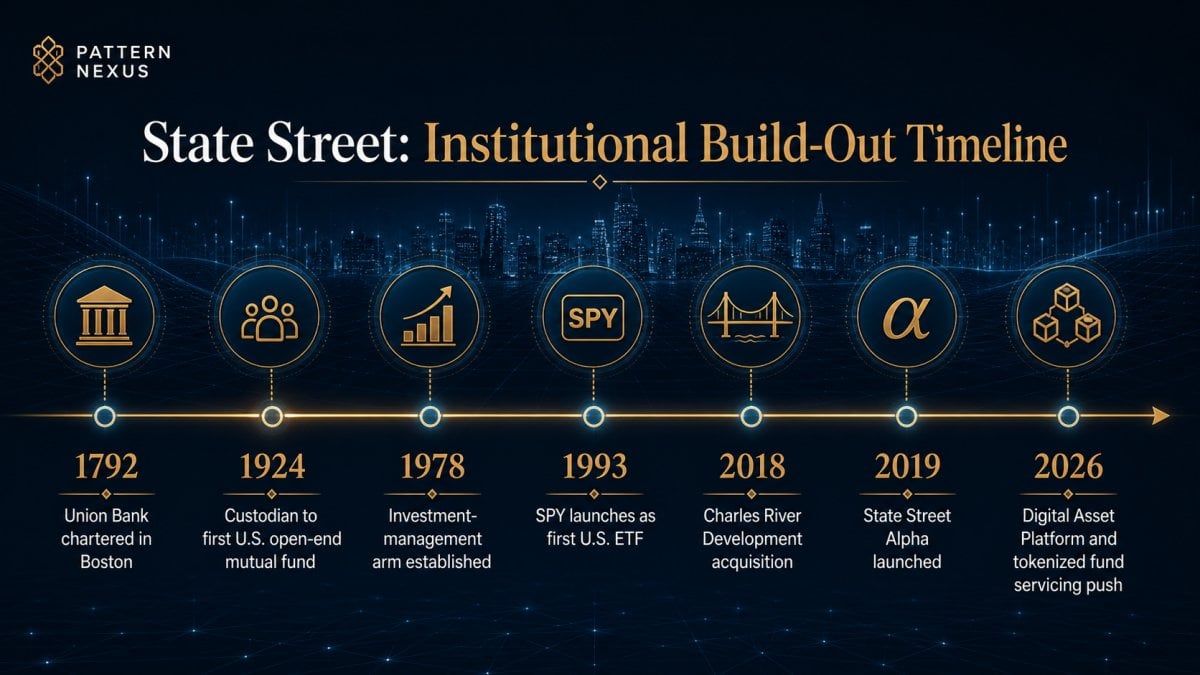
| Year | Move | Why it mattered |
|---|---|---|
| 1792 | Union Bank chartered in Boston | Established the early institutional lineage behind the modern company. |
| 1924 | Custodian to Massachusetts Investors Trust | Placed State Street at the birth of the U.S. open-end mutual-fund industry. |
| 1978 | Investment-management arm established | Created the base for indexing, institutional asset management, and the later ETF franchise. |
| 1993 | SPY launches | Helped create the U.S. ETF market and turned benchmark exposure into exchange-traded infrastructure. |
| 2003 | Deutsche Bank securities-services acquisition | Expanded cross-border custody and securities-servicing scale. |
| 2018 | Charles River Development acquisition | Moved State Street up the stack into front-office investment technology. |
| 2019 | State Street Alpha launched | Made the front-to-back operating-system strategy explicit. |
| 2026 | Digital Asset Platform and tokenized servicing push | Extended the same custody-and-administration logic into tokenized finance. |
The revenue stack
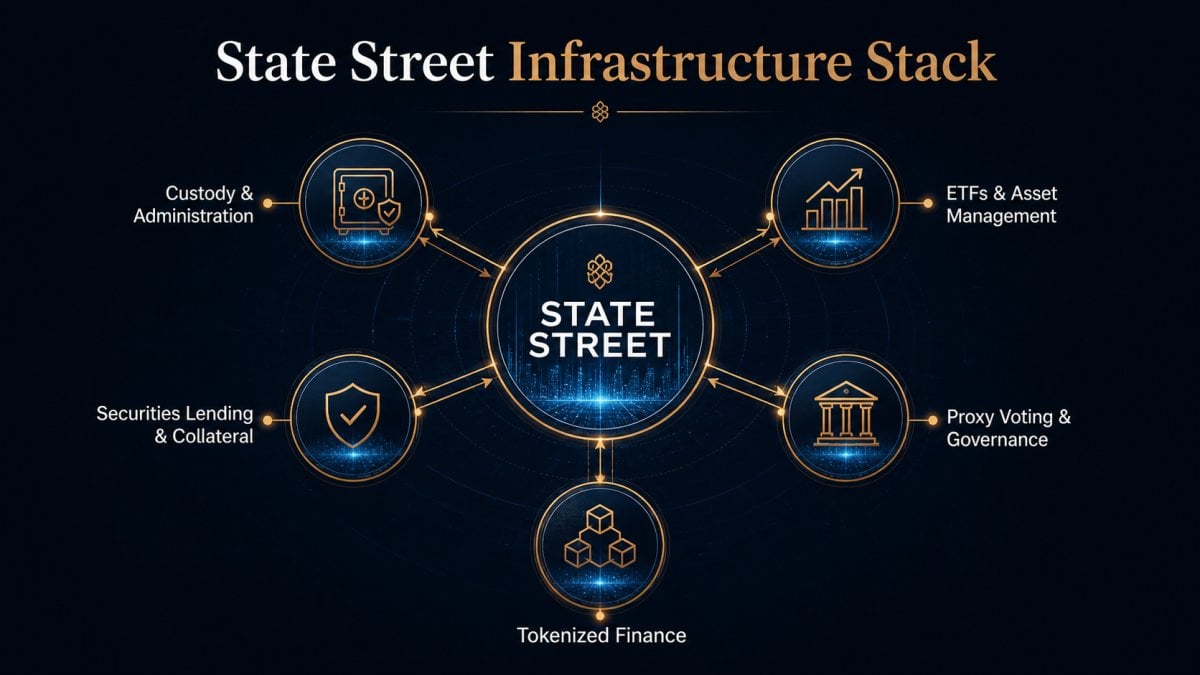
State Street’s business model only really makes sense when you stop separating the categories the way the market does. The company still reports distinct businesses, but strategically it has been trying to weld them into one institutional stack.
Investment Services
Investment Services is the center of gravity. This is custody, fund administration, accounting, transfer agency, middle-office support, private-markets servicing, and the broader operating layer clients rely on to run institutional portfolios. In 2025, State Street reported record AUC/A of $53.8 trillion, new AUC/A business wins of $2.1 trillion, and private-markets servicing fee revenue growth of 12 percent.[3]
Investment Management
State Street Investment Management is the public-facing asset-management pillar. It carries the SPDR ETF franchise, institutional strategies, cash, indexing, active systematic products, gold ETFs, and an increasingly broad product set. In 2025, State Street reported $5.7 trillion in AUM, $180 billion in net inflows, $2.4 billion in management fee revenue, and 134 new products launched.[3]
Markets, financing, collateral, and securities lending
The Markets business is easy to underrate because it sounds like a support function when it is actually a margin and workflow business. FX, securities finance, collateral management, research, alternative data, and financing tools are not side decorations. They are connective tissue. They make the custody relationship more useful, more profitable, and harder to replace.
Software, data, AI, and Alpha
This is where the future economics sit. State Street Alpha is the clearest expression of the platform strategy: front office, middle office, back office, data, and servicing organized as one cross-lifecycle environment. The more the client relies on State Street’s systems to manage workflow, the less State Street looks like a vendor and the more it looks like infrastructure.
| Layer | Function | Pattern Nexus read |
|---|---|---|
| Custody and administration | Safekeeping, fund accounting, reporting, asset servicing | The base layer. This is where institutional dependency starts. |
| Asset management and ETFs | SPDR, indexing, cash, institutional strategies | The product layer. It turns market exposure into scalable vehicles. |
| Markets and financing | FX, collateral, securities lending, research, financing | The liquidity layer. It monetizes workflow around the asset base. |
| Software and data | Charles River, Alpha, analytics, operational data | The control layer. It makes the client’s operating environment stickier. |
| Digital assets | Tokenized funds, wallet/custody infrastructure, digital servicing | The next rails. Not a break from the model, but the model applied to a new asset format. |
Passive ownership and governance power
This is the section where the rhetoric usually outruns the evidence, so I want to slow down and be careful. State Street matters not only because it services assets but also because, through its investment-management arm, it belongs to the Big Three passive-manager conversation alongside BlackRock and Vanguard.
A widely cited academic study found that the Big Three together were the largest shareholder in 88 percent of S&P 500 firms. That is a serious fact. It means ownership concentration in public markets has changed materially, and State Street is part of that change.[9]
But there is a difference between large and durable voting power and secret command over the entire corporate sector. Serious analysis should not collapse that distinction. The strongest version of the critique says common ownership and concentrated proxy power allow a small number of asset managers to shape incentives across corporate America in ways that are underappreciated, underregulated, and potentially distortive. The strongest counterargument is that parts of the passive-power critique are overstated and that the governance role of index managers is more constrained, fragmented, and contingent than alarmist accounts imply.[10]
My own view is that the maximalists on both sides miss the real pattern. State Street is neither a neutral pipe nor an all-powerful puppet master. It is something more historically specific: an administrator whose power grows because it is permanent. Index managers do not exit the way traditional active managers do. Custody relationships also tend to be sticky. That means State Street can accumulate influence without needing theatrical control.
The debate has also moved from academic papers into regulatory and legal posture. In 2025, the FTC and DOJ filed a statement of interest in an energy-collusion case involving BlackRock, State Street, and Vanguard. That does not prove liability, but it does prove the common-ownership question is no longer theoretical background noise. It is entering the legal architecture around market power.[12]
Why trust failures matter more here
This is why State Street’s conduct failures matter so much. A normal public-company scandal can be ugly without being existential to the business model. That is less true when your product is institutional trust.
In 2010, the SEC said State Street agreed to pay more than $300 million to settle charges that it misled investors about subprime-mortgage exposure in certain funds, on top of nearly $350 million it had already agreed to pay in private settlements. That was not just an ordinary enforcement action. It went directly to disclosure and trust during a period when investors were already learning how much hidden risk had been buried inside supposedly sophisticated products.[7]
In 2016, the SEC said State Street would pay more than $382 million for defrauding custody clients through hidden foreign-exchange markups. The DOJ later resolved transition-management fraud charges, and in 2021 State Street entered a deferred prosecution agreement and agreed to a $115 million criminal penalty over secret overcharges tied to custody expenses. These are not cosmetic problems. They strike at the center of the franchise.[8][18][19]
The broader lesson is worth stating plainly: the more invisible and infrastructural a financial institution becomes, the less room it has for trust failures. A consumer bank can survive by rebuilding customer relationships. A custody-and-administration franchise survives by persuading major institutions that the plumbing is reliable, neutral in execution, and operationally clean. Once a firm’s claim to value is that it safely administers the system, misconduct stops looking like a bad chapter and starts looking like a contradiction of purpose.
This also explains why State Street’s stewardship contradictions matter. The firm helped make board diversity part of its public governance identity through the Fearless Girl era, but Reuters reported in 2025 that the asset-management unit removed explicit targets for female and minority board representation from its proxy-voting guidance. The move came as the firm expanded voting-choice programs and tried to push more stewardship responsibility back to clients. That pivot does not erase the old posture. It shows how quickly governance rhetoric can change once the political and legal climate changes around it.[20]
The next frontier is not glamorous either
If I had to predict where State Street is headed, I would not use the language of disruption. I would use the language of absorption.
The company’s 2026 Digital Asset Platform announcement is revealing because it frames tokenized finance in terms State Street already understands: fund servicing, custody, reporting, workflow integration, wallet infrastructure, tokenized products, and institutional interoperability. This is exactly what a firm like State Street should do. It should not try to become a crypto meme stock with a bank charter. It should try to convert digital-asset novelty into regulated, enterprise-grade operational services. That is where its comparative advantage actually lives.[11]
The later announcement that State Street intended to launch tokenized fund servicing from Luxembourg fits the same pattern. Luxembourg is not being used here as a flashy crypto symbol. It is a fund jurisdiction, a servicing jurisdiction, a regulatory node, and an institutional distribution corridor. In other words, the move is not about escaping the old system. It is about making the new format administrable inside the old system’s most important pipes.[21]
And that, to me, is the enduring pattern. State Street keeps winning by turning whatever the market currently finds exciting into something administratively legible. Mutual funds became custody. ETFs became benchmark plumbing. Common ownership became governance infrastructure. Tokenization is now becoming another servicing layer. The public keeps looking for power in the wrong places because it prefers spectacle. State Street keeps acquiring power in the right places because it understands that once the spectacle passes, someone still has to run the books.
Pattern Nexus Lens
State Street is one of the clearest examples of how power changes form in a mature system. Early capitalism was easier to visualize because power looked like ownership, factories, railroads, ships, banks, land, and cash. Modern capitalism is harder to see because power increasingly lives in administration: who records the asset, who holds the collateral, who processes the vote, who values the fund, who normalizes the data, who settles the trade, who manages the reporting, and who can keep the system running when nobody else even understands the whole workflow.
That does not make State Street all-powerful. It makes it structurally important. That distinction is everything. The lazy version of the argument says State Street secretly owns everything. That is wrong. The equally lazy counterargument says State Street is just a service provider. That is also wrong. The more precise view is that State Street sits inside the permission stack of modern finance. It does not need to own the world to shape the rails the world depends on.
My conclusion is straightforward: State Street is not “the whole system,” and it is not some cartoon villain behind every market outcome. But it is one of the layers that makes the whole system function. That is exactly why it deserves to be treated as a primary subject, not a footnote.
Sources
- State Street Corporation, “First-Quarter 2026 Financial Results”.
- Federal Reserve Board, “Global Systemically Important Banks”.
- State Street, “2025 Annual Report”.
- State Street, “Mutual Funds at 100 Years”.
- State Street Investment Management, “Our History”.
- State Street, “Completes Acquisition of Deutsche Bank’s Global Securities Services Businesses”.
- U.S. Securities and Exchange Commission, “State Street to Pay More Than $300 Million to Settle Securities Fraud Charges”.
- U.S. Securities and Exchange Commission, “State Street to Pay More Than $382 Million for Defrauding Custody Clients”.
- Fichtner, Heemskerk, and Garcia-Bernardo, “Hidden Power of the Big Three?”.
- Fisch, Hamdani, and Davidoff Solomon, “The New Titans of Wall Street”.
- State Street, “Launches Digital Asset Platform to Power Tokenized Finance”.
- FTC and DOJ, “Statement of Interest in Energy Collusion Case Against BlackRock, State Street, and Vanguard”.
- State Street and the FDIC/Federal Reserve, “Resolution Plan Public Section”.
- GBH News, “State Street-Commissioned Report Details the Bank’s Roots in Slave Economy”.
- State Street Alpha.
- State Street, “State Street to Acquire Charles River Development for $2.6 Billion”.
- State Street, “Statement on Brown Brothers Harriman Investor Services Acquisition”.
- U.S. Department of Justice, “State Street Corporation Agrees to Pay More Than $64 Million to Resolve Fraud Charges”.
- U.S. Department of Justice, “State Street Corporation to Pay $115 Million Criminal Penalty and Enter Deferred Prosecution Agreement”.
- Reuters, “Fearless Girl Statue Sponsor State Street Drops Boardroom Diversity Targets”.
- State Street, “State Street to Launch Tokenized Fund Servicing from Luxembourg”.
Source note: This article intentionally keeps the AUC/A distinction clear. Assets under custody and/or administration are not treated as State Street-owned assets. Passive-ownership influence is also treated as a contested governance question, not as a cartoon claim of direct command.
Frequently Asked Questions
واکنش شما چیست؟
 پسندیدن
0
پسندیدن
0
 نپسندیدن
0
نپسندیدن
0
 عشق
0
عشق
0
 خنده دار
0
خنده دار
0
 وای
0
وای
0
 ناراحت
0
ناراحت
0
 عصبانی
0
عصبانی
0

Founder of Pattern Nexus. I research markets, macro, geopolitics, AI, history, ancient systems, and the patterns most people overlook. I’m also building Market Radar, a trading scanner designed to read pressure, risk, confirmation, and setup quality before chasing a move. Pattern Nexus is where I connect the dots between data, history, technology, and the bigger system playing out around us.




نظرات (0)