
The Command Line: How Cold War Compute, Early AI, and Silicon Valley’s Birth Turned Information Into Power (1956–1969)
From the Dartmouth AI workshop and the invention of the integrated circuit to ARPA, SAGE, and Fairchild Semiconductor, the late 1950s and 1960s quietly birthed the first compute–military–industry complex. This chapter tracks how information itself became a strategic asset — and why the AI boom of 2025–2035 is its direct descendant.
The Setup: From Dollar Fortress to Information Arms Race
By the mid-1950s, the monetary architecture of the postwar world was largely in place. The dollar was pegged to gold, allies were rebuilt and integrated via the Marshall Plan, and the IMF–World Bank complex gave Washington a toolkit for managing crises and loyalty.
But the Cold War changed the axis of competition. It wasn’t just about factories, shipyards, or even nuclear stockpiles. It was about who could:
- process more information, faster
- model complex systems more accurately
- coordinate military responses in real time
- automate decision-making at scale
The U.S. already had the dollar fortress. What it needed next was an information fortress — a way to turn data, signals, and computation into hard power.
That push birthed three interlinked revolutions:
- a conceptual revolution: the idea of “artificial intelligence”
- a hardware revolution: transistors and integrated circuits
- a systems revolution: real-time command networks like SAGE
None of these looked like mass consumer technologies at the time. They looked like esoteric research projects, black-budget defense contracts, or niche business tools. But together, they formed the original AI–industrial complex — the prototype of what we are rebuilding today with GPUs, hyperscale data centers, and AI models.
Dartmouth 1956: Naming Artificial Intelligence
In the summer of 1956, a small group of researchers gathered at Dartmouth College for what was officially called the “Dartmouth Summer Research Project on Artificial Intelligence.” The proposal, submitted in 1955, explicitly used and defined the term “artificial intelligence,” and the workshop is widely considered the founding event of AI as a field.
The core idea was almost shockingly ambitious for the time: with enough computing power and the right methods, aspects of human intelligence could be simulated by machines. They talked about logic, learning, problem-solving, and language — the same themes that still dominate AI research decades later.
The Dartmouth group had almost none of the hardware, data, or infrastructure that modern AI researchers take for granted. They had mainframes that filled rooms, slow memory, and very limited storage. But they had one critical thing:
A conceptual frame that intelligence itself was computable.
That frame would take decades to commercialize and industrialize. First, the machines themselves had to be rebuilt from the silicon up.
Hardware Revolution: Transistors, Integrated Circuits, and the Shrinking Machine
In 1947, Bell Labs had already demonstrated the transistor. But it was the late 1950s and early 1960s that turned transistors from lab curiosities into building blocks of a new industrial era.
The key leap was integration. In 1958, Jack Kilby at Texas Instruments assembled the first working integrated circuit prototype, showing that multiple electronic components could be combined into a single piece of semiconductor. Around the same time, Robert Noyce at Fairchild Semiconductor, building on the planar process, developed the first practical monolithic integrated circuit and the methods to scale it.
What this really meant in macro-terms:
- Computation could now be scaled like an industrial product, not handcrafted circuitry.
- Size, cost, and power consumption could fall orders of magnitude over time.
- The bottleneck would move from physics to capital, design, and manufacturing capacity.
Parallel to the IC came the MOSFET transistor — theorized by Mohamed Atalla and Dawon Kahng at Bell Labs around 1959 — which would eventually dominate digital electronics and make dense microprocessors possible.
The pattern is familiar: a frontier technology leaves the lab, gets tied to military and corporate demand, and then gets industrialized. In the late 1950s, compute was following the same script steel and electricity had followed a century earlier.
ARPA: Bureaucratic Shell, Strategic Supercharger
In 1957, the Soviet Union launched Sputnik, the first artificial satellite. It was a psychological and strategic shock to the United States. The response — beyond building rockets — was to create a new kind of research bureaucracy: the Advanced Research Projects Agency, or ARPA, founded in 1958 under the Department of Defense.
ARPA’s mandate was simple and incredibly broad: prevent technological surprise by being the one creating it. That meant funding high-risk, high-reward projects across computing, networking, materials, and more.
For our purposes, ARPA mattered because it:
- funded early AI and machine intelligence research at universities and labs
- pushed the development of interactive computing and time-sharing systems
- eventually backed ARPANET, the direct ancestor of the modern internet
ARPA didn’t build fabs or run data centers. It did something more leverageable: it pointed large sums of money and attention at frontier problems and gave researchers room to experiment. It was an early prototype of what today we might call a “sovereign AI and technology accelerator.”
SAGE and Real-Time Command: The First Compute Network
While AI researchers were sketching out theories and ARPA was getting off the ground, another project was quietly redefining what a computer network could be: SAGE, the Semi-Automatic Ground Environment.
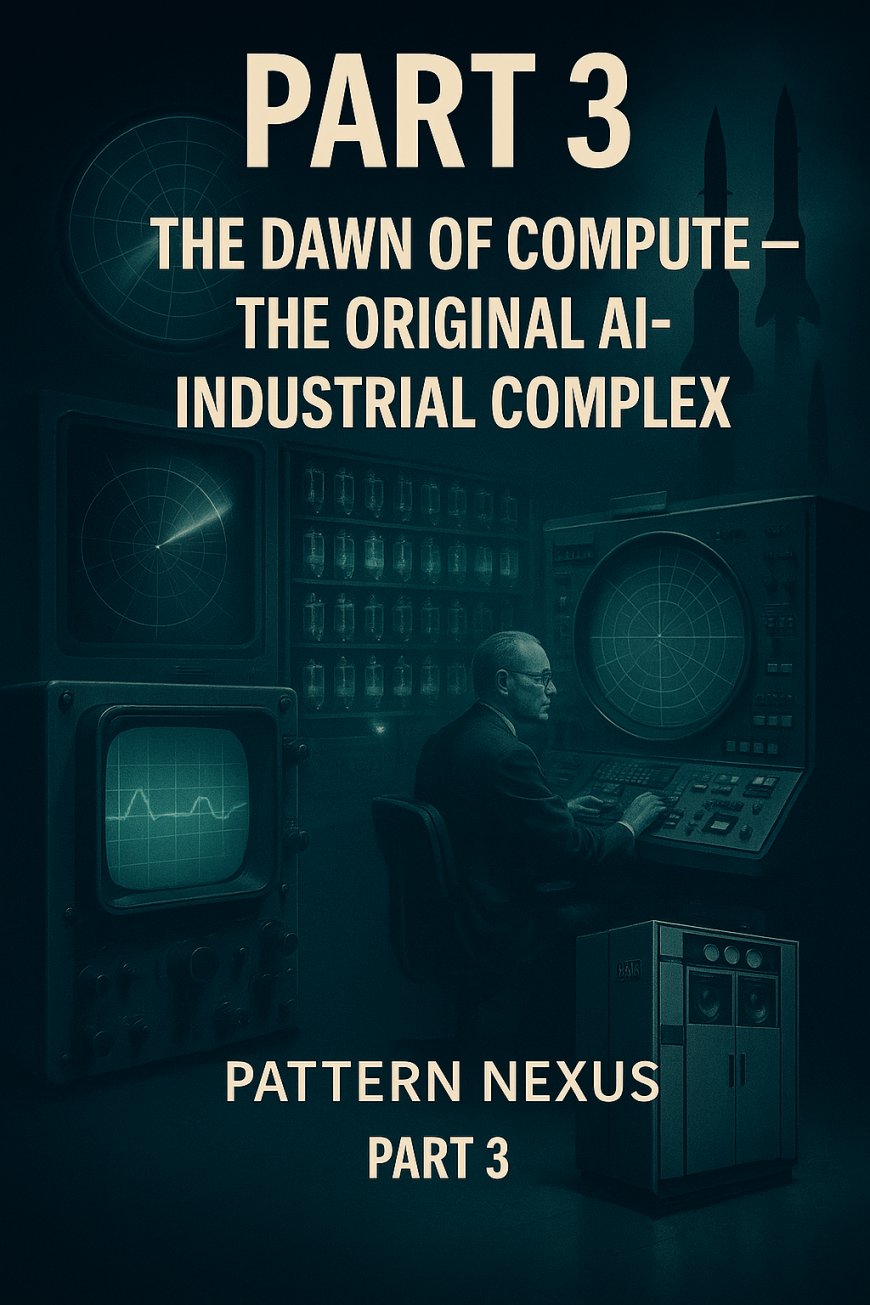
SAGE was a continental air-defense system built to monitor radar data and coordinate responses to potential Soviet bomber attacks. It linked dozens of radar stations to large centralized computers and command centers, creating one of the first large-scale, real-time, interactive computer systems in history.
Technically, SAGE pioneered:
- real-time data ingestion from distributed sensors
- digital communication over long distances using modems and dedicated lines
- graphical displays and interactive terminals for human operators
- a networked architecture rather than a single isolated computer
Strategically, SAGE demonstrated something even bigger:
Computation could be used to centralize perception and decision-making over an entire continent.
That’s the same logic as a modern AI-driven operations center, just implemented with vacuum tubes, miles of cable, and radar screens.
Shockley, Fairchild, and the Birth of Silicon Valley
On the other side of the country, another storyline was unfolding — one that would eventually make compute industrialization a private-sector game.
In the mid-1950s, transistor co-inventor William Shockley founded Shockley Semiconductor Laboratory in California. His management style was notoriously difficult, and in 1957 a group of eight key employees walked out and founded a new company: Fairchild Semiconductor.
Fairchild quickly became a pioneer in transistors and integrated circuits, commercializing planar processes and IC designs that could be scaled. From Fairchild’s alumni network — sometimes called the “Fairchildren” — came a whole forest of new companies, including Intel.
The geography mattered. Fairchild’s location near Stanford and a growing cluster of electronics firms helped solidify what would later be called “Silicon Valley.”
This region had:
- proximity to defense contracts and aerospace firms
- access to university research pipelines
- a culture of spinning out new firms instead of staying in one giant conglomerate
What became a world-defining ecosystem started as a handful of transistor engineers fleeing a bad boss.
IBM, Mainframes, and the Corporate Compute Stack
While the defense world experimented with command networks and Silicon Valley was bootstrapping chips, the corporate world was getting its own flavor of the compute revolution.
IBM emerged as the dominant supplier of mainframes — large, centralized machines used for accounting, logistics, payroll, inventory, and scientific computing. Systems like the IBM 1401 and IBM System/360 gave large organizations a standardized way to process data and run software.
This did a few critical things:
- It normalized the idea that serious organizations needed serious compute.
- It trained a generation of programmers, operators, and IT managers.
- It created demand for better chips, memory, and peripherals, reinforcing the hardware flywheel.
If SAGE was the military command layer and Fairchild was the chip-supply layer, IBM was the corporate interface. Together, they formed a vertically intertwined stack:
- chips and components
- mainframes and specialized systems
- networks and command centers
- early AI and software research on top
The structure will look familiar to anyone staring at the 2025 compute stack of fabs, GPU vendors, hyperscale clouds, and AI model labs.
Echoes in 2025–2035: The New AI–Defense–Cloud Complex
The late 1950s and 1960s did not deliver consumer smartphones, social media, or ChatGPT. What they did deliver was an architecture — a set of institutions, companies, and technical assumptions — about what compute is for and who controls it.
That architecture rhymes almost perfectly with where we are headed now.
Compute as Sovereign Infrastructure
Then, the national security state treated computing as a critical asset, tightly coupled to nuclear strategy and aerospace. Now, states treat AI compute capacity — GPUs, data centers, and specialized chips — as strategic infrastructure, complete with export controls, industrial policies, and security reviews.
Defense Agencies as Frontier Funders
Then, ARPA acted as a flexible funding vehicle for frontier computing, AI, and networking research, willing to write checks for weird ideas. Now, defense and security agencies are again emerging as key funders and anchor customers for AI models, autonomous systems, and resilient communication networks.
Industrial Clusters Around Compute
Then, Fairchild and its offspring turned lone labs into an industrial region, blending academic talent, venture capital, and defense money. Now, data-center corridors and chip clusters are forming around cheap power, fiber routes, and regulatory arbitrage — the new Silicon Valleys, but centered on energy and GPUs instead of just office parks and code.
Real-Time Command Rooms
Then, SAGE gave commanders a unified real-time view of the sky and a console where decisions could be centralized. Now, AI-enhanced operations centers digest video feeds, satellite imagery, network telemetry, and financial flows into dashboards where machine learning flags anomalies before humans see them.
Information as the Primary Battlespace
Then, the point of compute was to simulate, predict, and react faster than your adversary. Now, the same logic drives investment into AI agents, autonomous weapons, cyber-defense, and financial-market surveillance. Whoever can compress the loop from data to decision wins.
The main difference is not philosophical but physical: the transistor counts, data volumes, and energy requirements have gone exponential. We are replaying the same command-line story, but at planetary scale.
Pattern Nexus Framework: The Command Layer of the Megacycle
In the Pattern Nexus “Cycles of Power” megaseries, Part 1 showed how 1870–1914 built the industrial hardware of the modern world. Part 2 showed how 1947–1953 built the dollar fortress to manage that world. Part 3 explains how 1956–1969 built the command layer on top of both.
The key Pattern Nexus takeaways from this era:
- Compute is never “just technology.” From Dartmouth and ARPA to SAGE and IBM, computing power was tightly bound up with nuclear strategy, air defense, and systemic financial control.
- Hardware breakthroughs reshape power structures. The integrated circuit and MOSFET didn’t just make gadgets smaller; they shifted the cost curves and bottlenecks of intelligence and coordination.
- Industrial clusters act as multipliers. Fairchild’s spinoff ecosystem shows how one node of talent and capital can spin out dozens of firms that collectively rewire the global economy.
- Networks turn information into leverage. SAGE proved that real-time networks transform not just data flow but command hierarchies and political decision-making.
- The current AI–energy–liquidity cycle is not unprecedented. It is a higher-resolution rerun of the same structural story: states industrialize a new form of power, then build monetary and operational architectures around it.
In the megacycle map, this chapter is where the world learns that whoever controls the command line controls the system — whether that line is typed into a mainframe in 1962 or into a large-language-model console in 2025.
The later chapters — oil shocks, eurodollars, deregulation, and the full digitization of finance — will keep building on this foundation. But this is the hinge moment where industrial power, monetary power, and information power begin to merge into one stack.
FAQ: Quick Answers and “So What?”
Was the Dartmouth workshop really the “birth” of AI?
It wasn’t the first time people thought about machine intelligence, but it was the first time a formal research program gathered under the explicit label “artificial intelligence,” with a written proposal and an agenda. That naming and institutionalization matters — it created a field that could attract funding, students, and long-term projects.
Why are integrated circuits such a big deal in this story?
Integrated circuits collapsed the size, cost, and energy requirements of computation. They turned computers from one-off, room-sized machines into something that could eventually be mass-produced, embedded in devices, and scaled. Without ICs and later MOS technology, there is no modern AI, networking, or cloud infrastructure.
What made ARPA different from other government agencies?
ARPA was deliberately set up to be flexible, fast, and high-risk. It could fund small teams on unconventional projects without being crushed by normal procurement rules. That made it uniquely capable of backing early AI, networking, and interactive computing work that looked speculative at the time but became foundational later.
Was SAGE just a military curiosity or did it actually influence later tech?
SAGE was a prototype for modern distributed, real-time computing. Its work on interactive terminals, graphics, modems, and networked systems filtered into later commercial and research projects. Many people who worked on SAGE or similar systems carried that experience into the private sector and academia.
How does this help investors, builders, or policy people today?
Because the same patterns are replaying: state-backed frontier tech programs, strategic choke points in hardware and energy, formation of geographic tech clusters, and the use of information systems as command infrastructure. Understanding how the first compute–military–industry complex formed helps you spot where the next one is consolidating and where the leverage points really are.
Sources
- Dartmouth Summer Research Project on Artificial Intelligence and the coining of “AI”. Dartmouth Workshop
- Dartmouth College overview of the 1956 AI meeting. Artificial Intelligence Coined at Dartmouth
- Historical discussion of the Dartmouth project as the birth of AI. The Birth of Artificial Intelligence
- Background on the invention and early development of the integrated circuit. Invention of the Integrated Circuit
- Discussion of Jack Kilby’s integrated-circuit patent and its significance. 65 Years Integrated Circuit
- Overview of ARPA/DARPA’s founding in response to Sputnik. DARPA
- Additional detail on ARPA’s creation date and context. ARPA is Founded
- History of the SAGE air-defense system as an early real-time network. IBM – SAGE System
- Lincoln Laboratory overview of SAGE as the nation’s first air-defense system. MIT Lincoln Laboratory – SAGE
- Background on Fairchild Semiconductor and its role in early Silicon Valley. Spinoff: Fairchild & the Family Tree of Silicon Valley
- Additional history on Fairchild’s founding and the “fairchildren.” Fairchild Semiconductor
واکنش شما چیست؟
 پسندیدن
0
پسندیدن
0
 نپسندیدن
0
نپسندیدن
0
 عشق
0
عشق
0
 خنده دار
0
خنده دار
0
 وای
0
وای
0
 ناراحت
0
ناراحت
0
 عصبانی
0
عصبانی
0

Founder of Pattern Nexus. I research markets, macro, geopolitics, AI, history, ancient systems, and the patterns most people overlook. I’m also building Market Radar, a trading scanner designed to read pressure, risk, confirmation, and setup quality before chasing a move. Pattern Nexus is where I connect the dots between data, history, technology, and the bigger system playing out around us.












نظرات (0)