
Panama Voids the Canal Gateway Deal — This Isn’t About Ships, It’s About Permission
Panama’s Supreme Court ruled the CK Hutchison-linked port concession at Balboa and Cristóbal unconstitutional, resetting the legal wrapper over a strategic chokepoint. This is a permission-stack event: ports as throttle points, cap-table geopolitics, and the U.S. ownership turn colliding in one ruling.
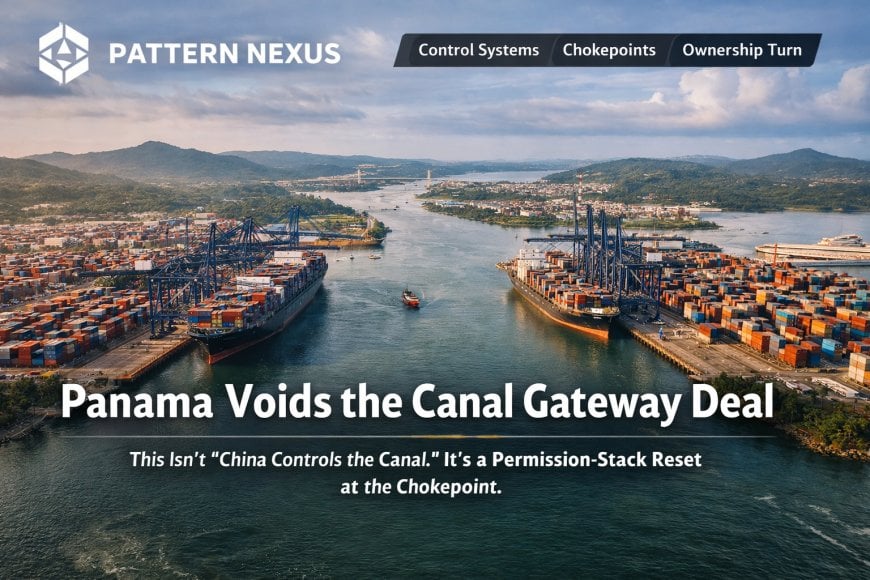
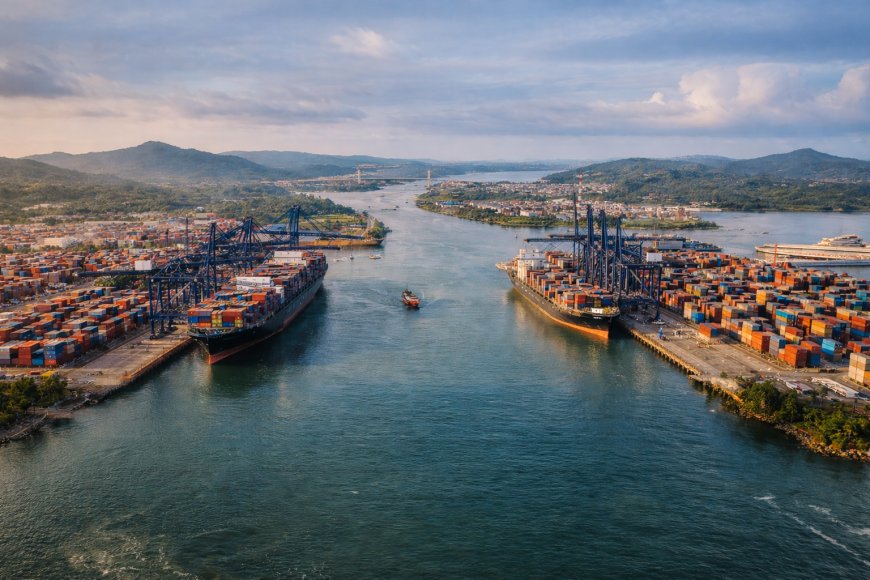

Chokepoints are stacks. Whoever controls the gateway queue controls time. Whoever controls time controls cost. Whoever controls cost controls behavior.
Watch the tender language, not the headlines. Eligibility rules and ownership caps decide the winner before a bid is “won.”
“Unconstitutional” is a modern kill-switch. It resets the legal wrapper without the optics of expropriation.
Monroe Doctrine 2.0 is not speeches. It’s counterparty gating: who is allowed to own, operate, insure, finance, and data-run strategic nodes in the hemisphere.
What the Court Actually Did
Panama’s Supreme Court ruled unconstitutional the legal basis underpinning the concession framework used by Panama Ports Company (a CK Hutchison subsidiary) to operate the Balboa (Pacific) and Cristóbal (Atlantic) terminals, the key container gateways at the canal’s approaches. This does not rewrite canal operations. The canal authority is separate. It does something more powerful in a control-systems world: it attacks the operating permission governing the gateway layer.
Practical effect: a forced reset. Once the wrapper is invalid, the state has a menu of outcomes that all achieve the same systems objective: keep the cranes running while the permission structure is rebuilt. That menu includes interim management, revised licensing, retendering, PPP redesign, or splitting the assets into separate concessions that are easier to control and harder to monopolize.
This is not primarily about punishing a company. It’s about reopening who is eligible to hold the keys going forward. Courts don’t need to “pick a side” publicly. They can invalidate a structure and let procurement design pick the side quietly.
The Gateway Throttle Layer
People say “the canal” like it’s one object. It’s a stack. The waterway matters. But the gateways decide the experience. If you want a modern power model, stop thinking in terms of sovereignty over a waterway and start thinking in terms of queue control at the approaches.
Here’s what the gateway layer controls in real life:
- Physical: crane capacity, berths, yard acreage, gates, rail and feeder connectivity.
- Queue: berth windows, priority rules under congestion, allocation during disruptions.
- Commercial: tariffs, storage penalties, demurrage behavior, service bundling, discounting power.
- Data: manifests, routing patterns, dwell-time telemetry, customer concentration, compliance hooks.
- Security interface: who can be compelled, audited, inspected, or data-integrated.
That’s the leverage. If you can’t own the canal, you own the time-cost function around it. And if you own the time-cost function, you can shape trade behavior without ever “blocking” anything. The system doesn’t need a shutdown. It needs a throttle.
In control systems, you don’t fight the whole machine. You find the control surface. At chokepoints, the control surface is almost always the gateway queue, the fee schedule, and the data layer.
Legal Wrapper Warfare and the Audit-as-Weapon
This ruling didn’t materialize out of nowhere. It followed a sustained audit narrative and legal push that reframed the concession as a domestic governance problem: irregularities, alleged missing payments, accounting disputes, and claims of an abnormal concession structure operating in the background. The point is not whether every claim survives arbitration. The point is that audit framing creates permission to redesign the wrapper.
This is the “procedural takeover” playbook:
- Create domestic legitimacy: money story, fairness story, “the deal didn’t serve the nation.”
- Create legal permissibility: constitutional challenges, procurement defects, competition law exposure.
- Force a reset: court or regulator invalidates the wrapper.
- Choose the future in procurement design: eligibility rules and ownership caps do the selecting.
It converts a political argument into a structural constraint. It also reduces the need for overt coercion. The state doesn’t have to say “we don’t want you here.” The state can say “this structure cannot exist,” and then rewrite what structures are allowed.
Cap-Table Geopolitics and the Ownership Turn
This is where Pattern Nexus framing becomes predictive. We are watching the transition from trade-route geopolitics to ownership-route geopolitics. Who owns the node determines the rule defaults. And rule defaults are power.
CK Hutchison’s global ports sale plan became a geopolitical object precisely because it would have moved a strategic gateway into a new capital stack. When a consortium like BlackRock/MSC is involved, that’s not just a price. It’s alignment: board control, counterparties, financing channels, insurance relationships, and compliance posture.
On the other side, China doesn’t need to “control the canal” to care about the outcome. China cares about predictable access under acceptable counterparties. That is why COSCO being mentioned in the deal politics matters. Not because COSCO is magic, but because it’s a state-linked instrument in the ownership-route world.
If Panama retenders or rebuilds the PPP structure, the decisive layer is not “who bids the most.” It’s who is allowed to bid, what ownership structures are permitted, how data must be handled, what security integration is required, and what upstream/downstream integration is restricted. That is how you pre-select outcomes legally.
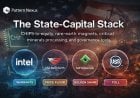
Related PN context: The State-Capital Stack: CHIPS-to-Equity and the U.S. Ownership Turn
Monroe Doctrine 2.0: Hemispheric Permissioning
If you want the clean “Monroe Doctrine 2.0” framing, here it is: the U.S. is reasserting hemispheric control not by annexation, but by permissioning. The question is not “who flies a flag.” The question is “who is an acceptable counterparty” at strategic nodes in the Western Hemisphere.
That permissioning expresses through five channels:
- Legal wrapper resets: court rulings, audits, contract nullifications.
- Capital-stack steering: aligned infrastructure capital, bankability, financing terms, covenant leverage.
- Security/data integration: “trusted” operators, telemetry access, compliance interfaces.
- Procurement gating: eligibility rules, ownership caps, state-owned bidder constraints.
- Diplomatic pressure: narrative framing as “security,” not “trade.”
The canal region is the perfect test bed for this model because it’s not a theoretical chokepoint. It’s a globally priced one. Every shipping line, every insurer, every commodity flow feels it. That gives the U.S. a natural advantage: the world already treats stability here as a premium product.
When you see a “domestic legal” story hit a strategic node, run this checklist: 1) What permission is being reset, 2) What tender language is coming, 3) Which capital pool becomes “most bankable,” 4) Which counterparties become “unacceptable,” 5) What data/security requirements hard-wire alignment, 6) What arbitration pressure is used as a release valve. If those six items are present, you’re looking at Monroe 2.0 mechanics, not local politics.
Scenarios, Control Surfaces, and What to Watch Next
The ruling is the opening move. The outcome is chosen in implementation. Here are the high-probability paths and the control surfaces that decide them.
Scenario A: Retender/PPP rebuild with tight eligibility and security clauses, resulting in U.S.-aligned ownership and operations. Scenario B: Fragmentation, splitting assets or layering operators, reducing single-node leverage but increasing administrative complexity. Scenario C: Prolonged legal fight with arbitration pressure, creating temporary continuity arrangements while capital markets price “uncertainty premium” into the node.
Control surfaces to monitor in real time:
- Interim control: who runs the ports during transition tells you who is trusted to hold the keys.
- Eligibility criteria: what entities are excluded by definition (ownership structure, state links, jurisdiction, sanctions exposure).
- Ownership caps: hard ceilings are geopolitical instruments disguised as procurement hygiene.
- Security clauses: mandatory audits, integrated systems, access obligations, compliance interfaces.
- Data-handling: telemetry retention, sharing obligations, “trusted cloud” requirements, audit rights.
- Integration limits: restrictions on vertical integration that can block certain global operators by design.
- Arbitration posture: whether the operator files, settles, or escalates tells you how painful the reset will be.
If you want the brutally simple summary: the cranes will keep moving. The wrapper will be rebuilt. The bidder box will be shaped. The winner will look “market selected.” And the control transfer will be real.
Pattern Nexus Lens
The headline says “Panama.” The mechanism says “control systems.” In the old model, control came from bases and direct administration. In the current model, control comes from permissioning: legal wrappers, capital stacks, procurement constraints, security integration, and data-rule enforcement.
Split the canal into two canals:
- The physical canal: waterway, locks, transit scheduling.
- The legal canal: the wrapper and permissions that decide who can operate the gateways and under what rule-set.
This ruling is a legal-canal event. It reopens the wrapper around the gateway operators, which is where the throttle power sits. That plugs directly into Ownership Turn dynamics and Monroe 2.0 mechanics: the hemisphere is being permissioned into aligned capital and operational stacks through procedural rewiring that looks domestic on the surface.
Control rarely looks like conquest now. It looks like contract design. If you can write the tender rules, you can choose the owner without ever saying the word “choose.”
FAQ
Does this mean China controlled the Panama Canal?
No. The canal waterway is operated by Panama’s canal authority. The ruling targets port terminal concessions at the entrances, separate from canal operations, but strategically important as the gateway throttle layer.
Will port operations stop?
Continuity is the primary objective. Expect transitional arrangements while Panama rebuilds the legal wrapper and determines the retender/PPP path.
Why does “unconstitutional” matter so much?
Because it can void the permission structure that allows the operator to be there at all. That reopens who is eligible to hold the keys and lets procurement design reshape the outcome.
What does this do to CK Hutchison’s broader ports sale plan?
It injects uncertainty into the Panama gateways and complicates any transaction that assumed the existing concession structure was stable. That instability can become leverage in redesigning the ownership outcome.
What should I watch to know “who won”?
Interim control, tender language, eligibility rules, ownership caps, security/data clauses, and the arbitration posture. Those are the control surfaces.
Sources
These sources support the ruling, the audit backdrop, the sale-plan context, and the likely operational and retender outcomes.
- Reuters (Jan 30, 2026): Panama court voids CK Hutchison port contracts, clouding sales plan
- AP (Jan 29, 2026): Concession ruled unconstitutional; audit details and political context
- Reuters (Mar 4, 2025): CK Hutchison ports sale plan and buyer consortium context
- Reuters (Jul 30, 2025): Comptroller files suit seeking unconstitutionality / nullification
- Financial Times (Jan 30, 2026): Court annuls concession; retender and deal-politics implications
- The Maritime Executive (Jul 31, 2025): Comptroller action and revenue-loss framing
- CK Hutchison / Panama Ports Company press release (Apr 9, 2025): operator’s counter-claims on contributions and payments
Mikä on reaktiosi?
 Tykkää
0
Tykkää
0
 Epätäydellinen
0
Epätäydellinen
0
 Rakkaus
0
Rakkaus
0
 Hauska
0
Hauska
0
 Vau
0
Vau
0
 Surullinen
0
Surullinen
0
 Vihaisa
0
Vihaisa
0

Founder of Pattern Nexus. I research markets, macro, geopolitics, AI, history, ancient systems, and the patterns most people overlook. I’m also building Market Radar, a trading scanner designed to read pressure, risk, confirmation, and setup quality before chasing a move. Pattern Nexus is where I connect the dots between data, history, technology, and the bigger system playing out around us.










Kommentit (0)