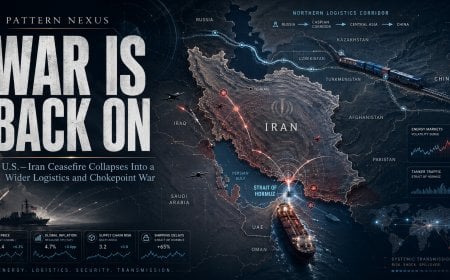
 Editor-written summary
The United States is striking Iranian military, port, power, transportation, and logistics infrastructure. Iran is retaliating against the American Gulf basing network. Israel is ready to reenter. The conflict is evolving from a Hormuz chokepoint war into a wider campaign over Iran’s maritime and Eurasian connections.
Inside this report
- The War Has Entered an Attritional Enforcement Phase
- What Has Happened Since the Original Article
- The Original Thesis Was Confirmed—but It Needs to Be Refined
 Editor-written summary
Humanity crossed another threshold. We are no longer only reading life or editing life. We are moving toward building life from defined parts, programming DNA as biological code, and combining synthetic cells with AI-designed proteins, automated labs, and synthetic genomes. This Pattern Nexus deep research article breaks down SpudCell, synthetic biology, programmable DNA, artificial species, biosecurity risks, mirror life, and where built biology could go next.
Inside this report
- The Synthetic Cell Threshold: Programmable DNA and the Beginning of Built Life
- Quick Read
- On This Page
 Editor-written summary
The June 16–17 FOMC minutes, released July 8, show a Fed that held rates steady but removed the easy easing bias. The deeper signal is that inflation pressure is now coming from multiple rails at once: tariffs, Middle East energy shock risk, AI infrastructure demand, Treasury term premium, and uneven consumer credit stress.
Inside this report
- Fed Minutes: Inflation Has More Than One Engine
- No Clean Cut Rail
- The Buyer Base Changed
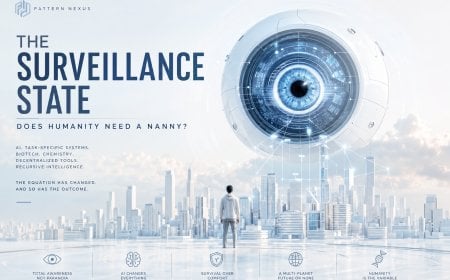 Editor-written summary
A Pattern Nexus article on the surveillance state after AI, asking whether humanity’s old fear of Orwellian control changes once artificial intelligence, task-specific systems, biotech, chemistry, and decentralized tools make individual actors far more dangerous than they were in the old world.
Inside this report
- The Surveillance State: Does Humanity Need a Nanny?
- The Orwellian Mindset
- The AI Lens
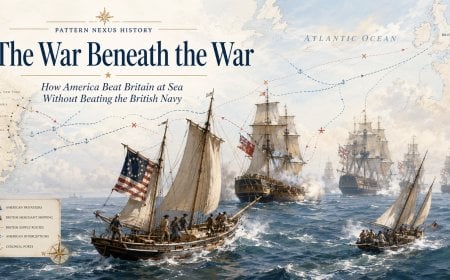 Editor-written summary
The American Revolution was not won at sea by matching Britain ship-for-ship. Britain had the dominant navy. America had small schooners, converted merchantmen, privateers, coastal raids, prize law, and one brutal strategic insight: you do not have to sink the empire’s battle fleet if you can break the logistics system feeding it.
Inside this report
- The War Beneath the War: How America Beat Britain at Sea Without Beating the British Navy
- Quick Read
- The Clean July 4th Story Is Not the Whole Story
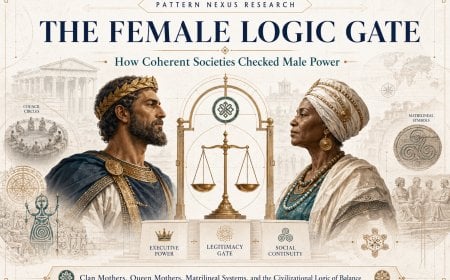 Editor-written summary
A Pattern Nexus research article on the forgotten civilizational structure behind stable societies: male executive power often existed beside a female legitimacy layer. Across Haudenosaunee, Palau, Asante, Igbo, Yoruba, Cherokee, Chaco, Minangkabau, Kush, Egypt, Rome, Sparta, Neolithic China, and Iron Age Britain, the pattern repeats. Men often held the public office, but women frequently controlled the deeper gate: clan, land, succession, property, market, ritual, household, and generational continuity.
Inside this report
- The Female Logic Gate: How Coherent Societies Checked Male Power
- The claim
- Why the modern framing gets this wrong
 Editor-written summary
Summary & Description:
Firefly Aerospace is no longer just a risky small-launch story. Blue Ghost already landed on the Moon, operated for more than 14 days, returned 119 GB of data, and now NASA has awarded Firefly another accelerated CLPS lunar mission. The deeper story is launch, landers, Elytra orbital vehicles, Ocula lunar imaging, Space-ng autonomous navigation, SciTec defense software, Esrange Europe launch expansion, Eclipse medium lift, and whether Firefly can turn Moon access into repeatable infrastructure.
Inside this report
- Firefly Already Landed on the Moon. Now NASA Is Paying for Repeat Access.
- Quick Read
- The Core Thesis
 Editor-written summary
Society is not one shared reality. It is a stack of disconnected mindsets layered by survival, class, power, wealth, ideology, and future access. The average person thinks about kids, bills, work, retirement, and survival. The elite think in systems, leverage, insulation, manipulation, and continuity of power. The elites above them think past humanity entirely. That fracture explains why the modern world feels insane: most people are arguing from human-centered values while the people shaping the system are not operating from the same mental map.
Inside this report
- Fragmented Society: The Elites Don’t Think Like You, and the Elites of the Elites Don’t Think Like Them
- Fragmented Society Is Not Just Economic. It Is Mental.
- Start With the Person Still Living Outside the Modern Assumption
https://www.ingersolllockwood.com/ What????
 Editor-written summary
A Pattern Nexus deep dive into Great Lakes ancient sites, underwater stone structures, Lake Mendota’s canoe field, Cahokia, Aztalan, Old Copper networks, early Chicago maps, DuSable, fringe Egyptian claims, buried artifacts, and the bigger question: how much older and more connected was North America than the public story admits? A deep Pattern Nexus article on ancient Great Lakes archaeology, underwater stone lines, Lake Michigan Stonehenge, Lake Huron hunting structures, Lake Mendota canoes, Cahokia, Aztalan, Old Copper trade, early Chicago maps, DuSable, Egyptian artifact claims, and disputed alternative history.
Inside this report
- The Great Lakes Were Not Empty
- Quick Read
- On This Page
 Editor-written summary
U.S.-Iran talks planned around June 19 at Switzerland’s Bürgenstock resort were postponed after Vice President JD Vance did not travel and Iranian officials also did not arrive as planned. Reporting from AP, Reuters and Axios tied the delay to both logistics and renewed fighting around Lebanon, while Swiss authorities had already prepared security and airspace restrictions for the meeting. The early breakdown shows that the interim deal’s implementation track depends on synchronized behavior across multiple theaters, not only on diplomatic intent.
Inside this report
- The Iran Deal Hits Its First Control Failure Before Talks Begin
- Quick Read
- Table of Contents
 Editor-written summary
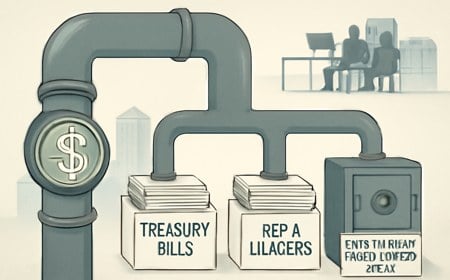
Fidelity has entered the stablecoin-reserve business with a money-market vehicle designed around GENIUS Act-eligible assets, according to SEC filings and Fidelity’s institutional fund table. The move follows State Street’s June 16 launch of a similar GENIUS Act-aligned government money-market fund, with State Street Bank and Anchorage Digital named as initial investors. The signal is that stablecoin backing is migrating from crypto balance sheets into traditional cash-management infrastructure controlled by large asset managers, banks, and federally regulated crypto institutions.
Inside this report
- Wall Street Turns Stablecoin Reserves Into a Money-Market Collateral Stack
- Quick Read
- Table of Contents

