

The Name Compression Rule: Why Great Powers End Up With Simple Names
A repeatable world-systems pattern: as states become central to power, their names compress into simple, global tokens. Naming is a control plane.
A repeatable world-systems pattern: as states become central to power, their names compress into simple, global tokens. Naming is a control plane.
Jump to a section


If the world can say your name without thinking, you’re standardized inside the global operating system.
Long official names often act like a legal brief: the state is still signaling legitimacy, ideology, unity, or rightful recognition.
Naming is a control plane. The actors who dominate publishing, mapping, finance, and diplomacy set the defaults that everyone repeats.
The “real name” in world politics is usually the exonym the system adopts, not the endonym locals prefer.
What you noticed, and why it’s real
Zoom out across long history and you’ll notice something that feels almost “too consistent” once it clicks: the heavyweight polities tend to have simple, clean names in global speech. Rome. China. Egypt. Persia. Britain. France. Russia. Japan. America. One word. No ceremony. No qualifiers required.
Meanwhile, complicated or mouthful names cluster around states that are newer, more contested, post-colonial, post-revolutionary, ideologically defined, or still negotiating recognition. You see multi-word titles, ideology labels, “People’s,” “Democratic,” “Islamic,” “United,” “Federated,” “Republic of,” and the long-form constitutional style that reads like governance paperwork.
The mistake is to treat this like aesthetics or coincidence. It’s not. In practice, a country’s name is a high-frequency identifier moving through real networks: trade, war, diplomacy, finance, mapping, media, and education. The more central the node, the more frequently the identifier is transmitted, and the more pressure there is for that identifier to compress into a low-friction form.
As a state becomes central to the system, its name becomes high-frequency. High-frequency language compresses. The world adopts the shortest, easiest token that still points to the right thing. That compression is a soft signal of standardization and power.
Think of a name as a data packet. If the packet rarely moves, it can be long, precise, and local. If the packet moves everywhere, every day, through thousands of mouths and institutions, it gets optimized. Long names get shortened. Unfamiliar sounds get replaced. Multi-word titles collapse into one stable reference.
This is why “official names” and “actual names” diverge. The constitution can say one thing, but the system will say what the system can say, and what the system repeats becomes reality.
One more framing point before we go deeper: this isn’t about “pronunciation difficulty” in some moral sense. Plenty of powerful places have endonyms that aren’t easy for outsiders. The pattern is that outsiders will still compress what they can’t carry. The global name becomes the portable one, not necessarily the “true” one.
The compression engines: frequency, lingua franca, maps, bureaucracy, branding
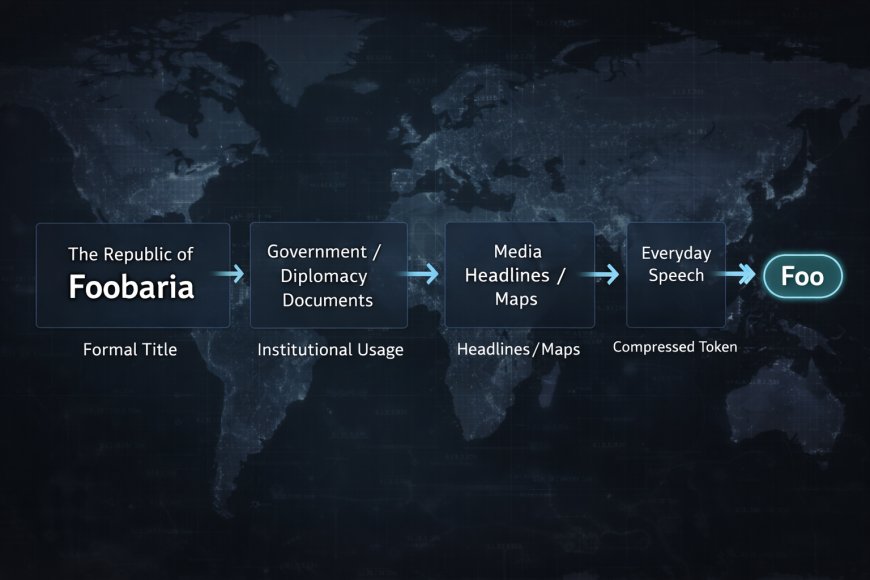
The “why” is not one thing. It’s a stack. Multiple forces all push in the same direction, and together they create the outcome you noticed.
1) Frequency forces efficiency
The simplest engine is repetition. When a word is used constantly, people shorten it. Linguists have formalized versions of this tendency: more frequent words tend to be shorter because humans optimize communication for speed and effort while preserving clarity. High-frequency terms get sanded down by usage, because friction is expensive at scale.
Apply that to geopolitics. If a polity becomes central to trade, war, diplomacy, finance, and cultural export, its name gets said constantly across many languages. Over time, the global system converges on a form that is easy to pronounce, easy to write, and easy to recognize in headlines.
2) The lingua franca sets the defaults
Every era has dominant communication rails: Greek, Latin, Arabic, French, English. The languages that dominate navigation, law, treaties, commerce, scholarship, and media don’t just transmit information. They normalize reference standards.
That is why the world often runs on exonyms: outsider names that get adopted because they fit the dominant language’s phonetics and writing system. Germany vs Deutschland. Greece vs Hellas. China vs Zhongguo. This isn’t “right” or “wrong.” It’s the system choosing the path of least resistance.
3) Maps and publishing are naming weapons
A name becomes “real” when it is printed at scale: atlases, textbooks, newspapers, shipping documents, treaties, databases, headlines. Cartography is not neutral. Publishing is not neutral. When you control what gets printed and where it gets distributed, you shape what people learn as default reality.
This is why naming disputes become geopolitical: different blocs using different names is a visible symptom of power competition and recognition politics. When everyone uses one label, the system is unified. When labels splinter, the system is fragmenting.
4) Bureaucracy demands legibility
Large states are administrative machines. They need clean categories for taxes, borders, treaties, tariffs, citizenship, conscription, and law. Administrative systems simplify complex local realities into standardized tokens that are legible from the center.
This isn’t just internal. Once you’re dealing with other states at scale, diplomacy itself becomes a bureaucracy. Diplomatic recognition, country code lists, standardized databases, and treaty language all favor stable short forms. The system wants one clean handle that everyone can use without error.
5) Branding is older than corporations
“Branding” sounds modern, but empires have always had brands. A hegemon’s name becomes shorthand for an entire civilizational stack: law, force, money, trade guarantees, norms, and cultural production.
At that point, the name doesn’t need adjectives. The name becomes the adjective. “Rome” was not just a place. It was a global order. “Britain” was not just an island. It was a maritime-commercial system. “America” is not just geography. It is a security umbrella, a financial/legal regime, a media-industrial engine, and a technological platform.
6) War and alliances accelerate standardization
Conflict forces repeated reference: dispatches, intelligence, treaties, alliances, propaganda, enemy labeling. In wartime, language gets weaponized and streamlined. The actors who win also tend to win the story, and winning the story includes winning the labels.
Strong states don’t “choose” short names like a style preference. The system compresses them because they become unavoidable reference points. Power increases mention-rate. Mention-rate drives compression. Compression becomes standard.
- High-frequency mention (trade, war, diplomacy, markets) pushes shorthand.
- Dominant languages reshape the name into phonetic compatibility.
- Maps and media lock in the default form at scale.
- Institutions standardize short names in databases and treaty language.
- Brand payload moves from syllables into associations.
Why “weak-state names” get long: legitimacy, regime change, contested sovereignty
Now flip it. Why do so many smaller, newer, or contested states end up with long names? Because sometimes the name is not a label. It’s a claim.
When legitimacy is not fully settled, leaders often pack identity into the title: democratic, people’s, republic, united, federal, islamic, revolutionary, bolivarian, arab, socialist. These are not random adjectives. They are political signals, regime brands, and sovereignty arguments compressed into the name itself.
In other words: long names often function like a legal brief. “We are the legitimate government.” “We represent the people.” “We are not the old regime.” “We are unified.” “We are the real version of this nation.”
Legitimacy signaling
If your system is stable and uncontested, you can be one word. You don’t need to explain yourself in the label. If your system is contested, the label becomes part of the fight.
Regime change and renaming cycles
Renaming is common during revolutions, independence waves, constitutional resets, and identity re-platforming. But the world doesn’t adopt new names automatically. Adoption depends on leverage, institutional uptake, and time.
Sometimes the state succeeds in pushing the change through key institutions. The UN’s adoption of “Türkiye” after an official request is a clean example of formal naming enforcement at the institutional layer. The Czech government’s push to register “Czechia” as the short name shows how states try to migrate from long-form identity to a more usable short-form brand for international contexts.
Other times, adoption remains partial because naming is political. Different governments, media outlets, and blocs choose names based on recognition posture, historical habit, or ideology. The result: multiple names for the same place, used as quiet signals of alignment.
Exonyms vs endonyms in the real world
Here’s the uncomfortable truth: the “global name” is usually the one outsiders can carry. UN bodies have formal definitions for endonyms and exonyms, but everyday usage is governed by friction and dominance.
You can ask the world to change, and sometimes it will. But you’re pushing against a huge installed base: textbooks, maps, SEO, databases, airline systems, news style guides, and the habit layer in billions of brains. Changing the default requires power, time, and institutional capture.
Local identities can be descriptive. States produce formal legal names. Empires develop stable short tokens in global speech. Hegemons become single-token defaults and often gain additional shorthand (initialisms, codes, ticker-like references) that travel frictionlessly across systems.
Notice what this implies: short naming is not the cause of power. It is a symptom of system centrality. You can’t “brand” your way into hegemony with a short name. But if you become central, the system will hand you the short name whether you asked for it or not.
Counterexamples that actually strengthen the model
You can list long-titled powers in history: “The Union of Soviet Socialist Republics.” “The United Kingdom of Great Britain and Northern Ireland.” “The Holy Roman Empire.”
But listen to what people actually said, in practice: “the Soviet Union.” “Britain.” “Rome.”
Even when formal titles are long, system speech compresses the operational name once the entity becomes a major reference point. The long title is governance paperwork. The short name is world-systems reality.
Using name behavior as a soft indicator
This is where the pattern becomes actionable. You can sometimes detect rising or declining coherence through name behavior:
- Consolidation tends to correlate with one stable short name gaining dominance across institutions, maps, and headlines.
- Contest and fragmentation tends to correlate with multiple competing names, more qualifiers, and more “official name” insistence.
- Blocs diverging often shows up in language first: different names used by different alliances is an early visible symptom of political splitting.
This won’t replace hard metrics like military capacity, trade centrality, or reserve-currency privilege. But it’s a real soft signal that often moves with those fundamentals, because it rides on the same distribution rails.
Pattern Nexus Lens
Pattern Nexus framing: the world is a compression machine. High-importance nodes get simplified identifiers because they must travel through many layers of the stack: mouths, headlines, databases, treaties, maps, and markets. Low-importance or contested nodes get verbose identifiers because the name is doing extra political work: legitimacy signaling, ideological branding, or recognition claims.
In a control-systems sense, naming sits above the physical layer (territory and force) and alongside the protocol layer (diplomacy, finance, media standards). Whoever controls the protocol defaults controls what becomes “normal.” Naming is one of the most understated protocol defaults in geopolitics: it’s a quiet indicator of who sets the interfaces the rest of the world must use.
If you want the cleanest summary: sovereignty isn’t only about borders and flags. It’s also about what the system calls you without asking.
When your name becomes a global default token, you’ve achieved more than recognition. You’ve achieved standardization. And standardization is a form of power.
FAQ
Is this just “people are lazy” with pronunciation?
No. “Lazy” is the wrong framing. This is a throughput problem. High-frequency communication optimizes for speed, accuracy, and low error across many speakers. The simplification is a predictable outcome of repeated transmission, not a character flaw.
Can a small country have a short name too?
Absolutely. Compression happens at the speech layer for everyone. The difference is whether the compressed token becomes a stable, globally standardized default across institutions, maps, and media. Small states can have short names, but they usually don’t dominate the naming environment for others.
What about long-name great powers like the USSR or the United Kingdom?
That’s the point: the operational name still compresses. “Union of Soviet Socialist Republics” became “the Soviet Union.” “The United Kingdom of Great Britain and Northern Ireland” becomes “Britain” or “the UK.” Formal titles can be long; the world-systems handle becomes short once it’s used constantly.
Are exonyms disrespectful?
Sometimes they can be, depending on history and context. But as a systems observation, exonyms exist because dominant languages, writing systems, and institutions standardize what is easiest to carry. States can and do push for endonym adoption in international bodies, and outcomes depend on leverage and institutional uptake.
Why do naming fights matter so much?
Because names are defaults, and defaults are control. If different blocs insist on different names, you’re watching recognition politics and power competition show up in the vocabulary layer. It looks small until you realize it’s one of the simplest visible markers of who sets the rules of reference.
Sources
These sources support the linguistic compression mechanics (frequency and abbreviation), endonym/exonym standards, and real-world examples of states pushing naming changes through institutions.
- Zipf’s law of abbreviation and the principle of least effort (Kanwal et al., 2017)
- UNGEGN working paper: definitions and discussion of endonyms/exonyms
- United Nations: “Turkey’s name changed to Türkiye” (2022)
- Czech MFA: “Czechia” entered as short name in UN databases (2016)
- Endonym vs exonym overview (with UNGEGN definitions cited)
- James C. Scott’s “Seeing Like a State” and the legibility concept
- Benedict Anderson’s “imagined communities,” maps/census/media as nation-making tools
Mikä on reaktiosi?
 Tykkää
0
Tykkää
0
 Epätäydellinen
0
Epätäydellinen
0
 Rakkaus
0
Rakkaus
0
 Hauska
0
Hauska
0
 Vau
0
Vau
0
 Surullinen
0
Surullinen
0
 Vihaisa
0
Vihaisa
0

Nexus (Christopher)
Founder of Pattern Nexus. I research markets, macro, geopolitics, AI, history, ancient systems, and the patterns most people overlook. I’m also building Market Radar, a trading scanner designed to read pressure, risk, confirmation, and setup quality before ch…
Related research

The National Security Patent Act – How the U.S. Quietly Sits on Energy and Power Tech
Deep dive into the Invention Secrecy Act, how “national security” patent gags actually work, and what declassified documents say about high…
4 shared topics, same research avenue.
Blockade Age: Why U.S.–China “Trade Deals” Are Just Tempo Management in a Maritime Power War
The U.S.–China relationship isn’t thawing — it’s entering the Blockade Age. Rare-earth deals, naval posture, island-chain strategy, and Ar…
4 shared topics, same research avenue.
The Systemic Realignment: Digital Sovereignty, Multipolar Liquidity & The End of Old Alliances
The world isn’t becoming multipolar — it's being rewired into competing digital, monetary, and geopolitical corridors. Alliances shift, rai…
4 shared topics, same research avenue.
The Powell Subpoena and the Liquidity Regime Transition
A subpoena against Powell over his Senate testimony signals institutional pressure toward rate suppression and liquidity convergence betwee…
3 shared topics, same research avenue.
Kommentit (0)
Security Check
Please complete the captcha to verify you are human.