

North Korea’s Nuclear Sub Build and the “Ursa Major” Reactor Claim: The Proliferation Pipeline You’re Not Supposed to Watch
North Korea is publicly signaling progress on a nuclear-powered submarine. Separately, a sanctioned Russian heavy-lift ship sank near Spain in Dec 2024 amid claims it carried undeclared naval reactor housings possibly destined for Pyongyang. What’s confirmed, what’s alleged, and what the strategic geometry implies.
North Korea is publicly signaling progress on a nuclear-powered submarine. Separately, a sanctioned Russian heavy-lift ship sank near Spain in Dec 2024 amid claims it carried undeclared naval reactor housings possibly destined for Pyongyang. What’s confirmed, what’s alleged, and what the strategic geometry implies.
Jump to a section
North Korea is now openly telegraphing a nuclear-powered submarine program. At the same time, a sanctioned Russian heavy-lift vessel sank off Spain in December 2024, and a Spanish-media-driven reporting chain claims it carried undeclared naval reactor housings potentially destined for Pyongyang. This is not one story. It is a pipeline — signaling, procurement, deniability, and the hard physics of what nuclear propulsion actually requires.
What’s Confirmed vs. What’s Claimed
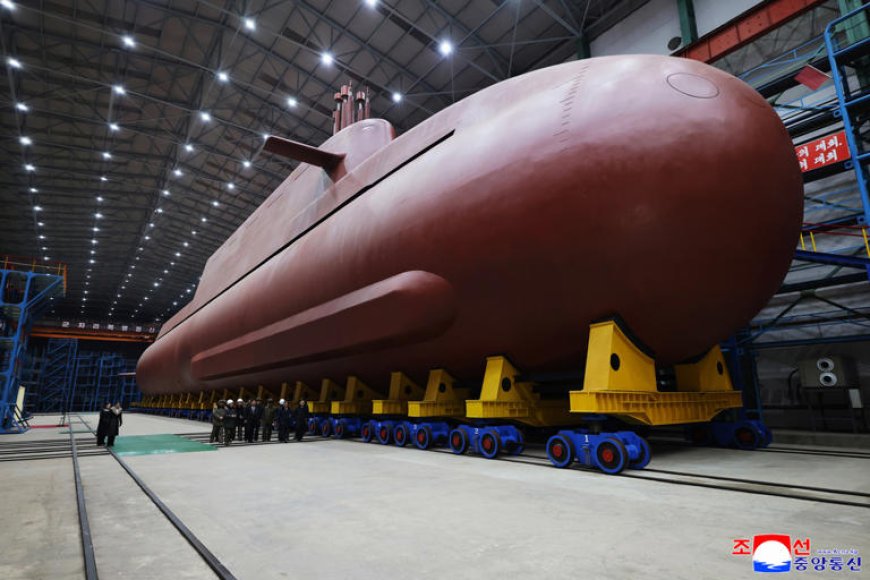
Confirmed (high confidence): North Korean state media has released imagery of a large submarine hull under construction, with Kim Jong Un personally inspecting the site and explicitly labeling the vessel as nuclear-powered. Separately, the Russian heavy-lift ship Ursa Major sank in the western Mediterranean in December 2024 following an onboard explosion, with survivors rescued by Spanish authorities.
Claimed (contested but sourced): A reporting chain originating in Spanish investigative media and echoed by multiple maritime and security outlets alleges Ursa Major was transporting undeclared naval reactor housings — often described as VM-4-series components — potentially destined for North Korea.
Not demonstrated in public evidence: That North Korea currently operates a functional naval reactor, that a reactor has been installed in the observed hull, or that any reactor shipment successfully reached North Korea. A visible hull is not an operational propulsion system.
North Korea’s Nuclear-Powered Submarine: What We Actually Know
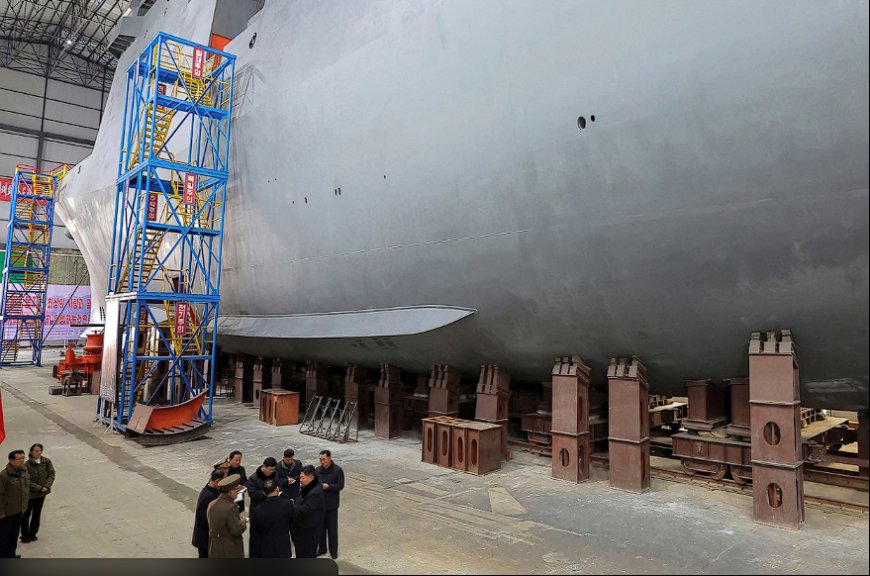
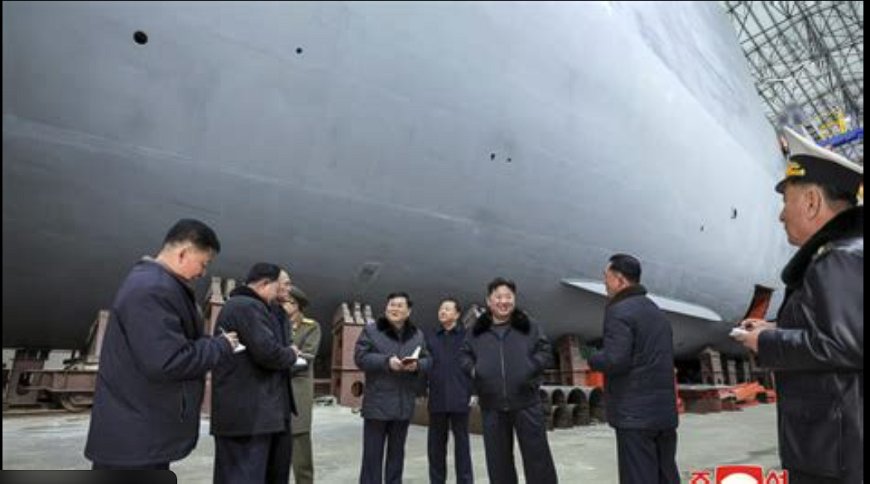
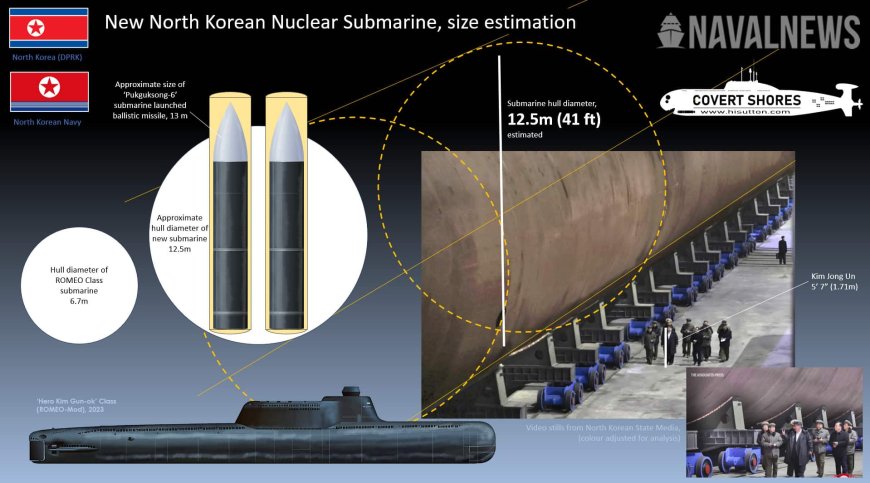
North Korea’s decision to publicly showcase a submarine hull — rather than keep the program opaque — is deliberate. The imagery shows a vessel far larger than the DPRK’s traditional coastal submarine fleet, paired with language describing a “strategic guided missile submarine powered by nuclear energy.”
What the imagery implies
- Hull-first development: The visible progress is structural, not systemic. This suggests parallel development tracks rather than an integrated, finished platform.
- Strategic messaging: The language is aimed outward. Even an incomplete platform forces adversaries to model worst-case outcomes.
- Missile intent: “Strategic” framing strongly implies nuclear-capable payloads, not conventional naval deterrence.
What remains unresolved
Naval nuclear propulsion is an engineering bottleneck, not a branding exercise. It requires a compact reactor core, vibration-tolerant control systems, heat exchange under dynamic load, radiation shielding compatible with crew survival, and a doctrine for refueling and spent fuel handling. None of these are observable in public imagery.
Critical distinction: Many states can build a large submarine hull. Very few can build, operate, and sustain a naval reactor at sea.
The Reactor Reality Check
Historically, nuclear submarine programs stall not at hull construction, but at reactor miniaturization, reliability, and safety certification. Even Russia, the UK, and early U.S. programs experienced multi-year delays between first hulls and credible patrol capability.
Open-source analysts note the absence of:
- Evidence of a land-based naval reactor prototype
- Dedicated nuclear-qualified shipyard infrastructure
- Training pipelines for nuclear propulsion officers
- Observable reactor fuel handling facilities
This does not mean North Korea cannot achieve propulsion. It means the program remains in a **pre-operational phase**, despite the strategic signaling.
The Ursa Major Sinking: The Reactor Cargo Allegation
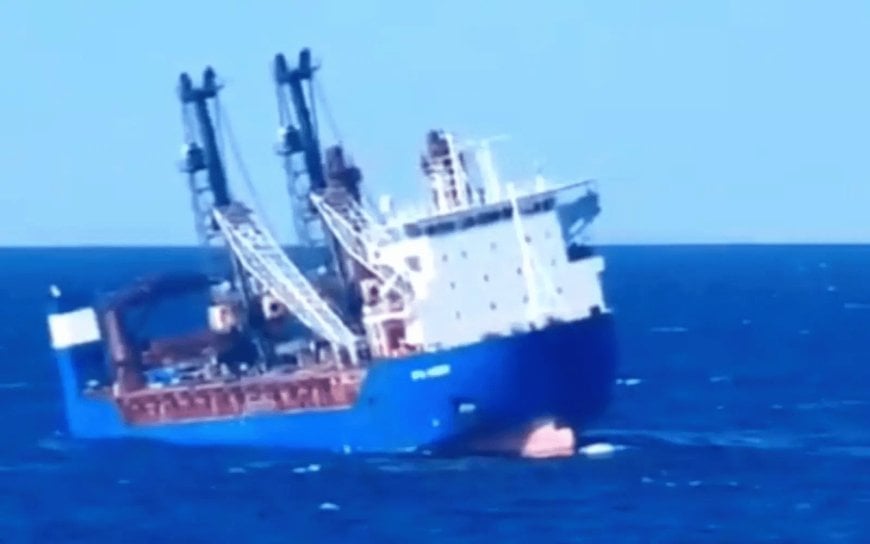
The event
- Date: December 2024
- Location: Western Mediterranean near Spain
- Incident: Explosion onboard; loss of propulsion; eventual sinking
- Response: Spanish maritime rescue; Russian diplomatic protest language followed
The reactor allegation
Subsequent reporting claimed Spanish investigators identified undeclared cargo inconsistent with the ship’s manifest, allegedly matching dimensions of naval reactor housings associated with Russian submarine propulsion systems.
Important constraint: The investigative findings cited are not fully public. The allegation rests on credible journalistic sourcing, not released technical inspection documents.
The Proliferation Pipeline
If the allegation is accurate, this incident matters less as a sunk ship and more as a glimpse into how sanctioned states attempt to move strategic hardware:
- Use of non-transparent logistics firms
- Heavy-lift vessels with ambiguous cargo manifests
- Routing outside traditional monitoring lanes
- Plausible deniability through “industrial equipment” labeling
Even unfueled reactor housings dramatically shorten development timelines by bypassing precision manufacturing constraints.
Why This Matters: Second-Strike Geometry
A nuclear-powered submarine is a survivability platform. Its value lies not in launch count, but in persistence and uncertainty.
- Endurance: Nuclear propulsion removes patrol duration constraints.
- Ambiguity: If location cannot be reliably known, preemption becomes implausible.
- ASW escalation: Regional actors must over-invest to compensate for uncertainty.
Structural shift: Even a partially credible at-sea deterrent forces strategic recalculation.
PN Lens: Capability Signaling vs. Operational Reality
Pattern Nexus views this as a dual-track system:
- Track one: Public signaling to force adversary planning
- Track two: Covert procurement to compress the development curve
Until reactor operation, sea trials, and patrol behavior are observable, this remains a high-impact program — not a deployed capability.
Timeline
- 2021: DPRK formally announces nuclear submarine ambitions
- Dec 2024: Ursa Major sinks after onboard explosion near Spain
- Mar 2025: DPRK releases imagery of large nuclear-labeled submarine hull
- Late 2025: Reactor-cargo allegations re-surface in international reporting
Bottom Line
North Korea is signaling intent, not completion. The hull matters because it changes planning. The Ursa Major allegation matters because it suggests procurement escalation.
A nuclear submarine exists only when propulsion is proven, crews are trained, and patrols are sustained. Until then, this is a strategic pressure system — not yet a deployed force.
Sources
- AP News – North Korea displays progress on nuclear-powered submarine
- Reuters – Kim oversees nuclear submarine construction
- 38 North – DPRK nuclear submarine assessment
- Financial Times – Ursa Major sinking and sanctions context
- Reuters – Russian cargo ship sinks in Mediterranean
- The Maritime Executive – Reactor cargo report
- TVP World – Spanish probe summary
- gCaptain – Ursa Major coverage
Menene Martaninka?
 Kamar
0
Kamar
0
 Karya
0
Karya
0
 Kauna
0
Kauna
0
 Ban dari
0
Ban dari
0
 Wao
0
Wao
0
 Bacin rai
0
Bacin rai
0
 Fushin
0
Fushin
0

Nexus (Christopher)
Founder of Pattern Nexus. I research markets, macro, geopolitics, AI, history, ancient systems, and the patterns most people overlook. I’m also building Market Radar, a trading scanner designed to read pressure, risk, confirmation, and setup quality before ch…
Related research
Taiwan–China Drill Spiral (Dec 2025): “Justice Mission 2025,” Taiwan’s Rapid-Response Posture, and the Blockade Geometry
China’s largest-to-date live-fire exercise around Taiwan (“Justice Mission 2025”) rehearsed blockade and strike sequencing. Taiwan answered…
4 shared topics, same research avenue.
The Peace Premium: Geneva Talks, Sanctions Enforcement, and Why Oil Is Still a Weapon
U.S.-mediated Geneva talks put territory back at the center of the Russia–Ukraine negotiation, while sanctions enforcement tightens on Russ…
3 shared topics, same research avenue.
The Thailand–Cambodia Flashpoint: Managed Instability Comes to Southeast Asia
The Thailand–Cambodia border conflict is not a local anomaly. It is a repeatable flashpoint where alliance hedging, great-power leverage, a…
3 shared topics, same research avenue.
Ukraine Is the Fault Line: NATO Expansion, Dollar Custody Warfare, and Russia’s Forced Pivot to China
Ukraine is not a regional war. It is the convergence point where NATO’s post-1991 security architecture, the U.S.-led financial control sta…
3 shared topics, same research avenue.
The New Monroe Doctrine: How the 2025 National Security Strategy Confirms the Western Hemisphere Pivot, Digital Dollar Realignment, and the Coming Global Reordering
The 2025 National Security Strategy marks the most dramatic U.S. strategic pivot in decades—re-centering the Western Hemisphere, reviving a…
3 shared topics, same research avenue.
Trump Orders Immediate Resumption of U.S. Nuclear Weapons Testing — I Didn’t See This Coming
President Donald Trump has directed the Pentagon to immediately resume U.S. nuclear weapons testing, citing Russia and China. What happened…
3 shared topics, same research avenue.
Accountability Over Immaturity: Budapest, History, and How Leaders Should Answer Fair Questions
Budapest isn’t just a backdrop. It symbolizes a promise — one where Ukraine gave up nuclear weapons in exchange for security assurances tha…
3 shared topics, same research avenue.
Sharhu (0)
Security Check
Please complete the captcha to verify you are human.