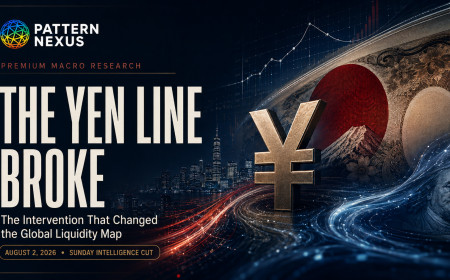
 Editor-written summary
yen-line-broke-us-japan-intervention-global-liquidity-map
Meta description: Pattern Nexus reconstructs the yen’s plunge to a 40-year low, the reported first U.S.–Japan joint intervention since 2011, the BOJ’s 1% policy trap, and the next carry-trade shock.
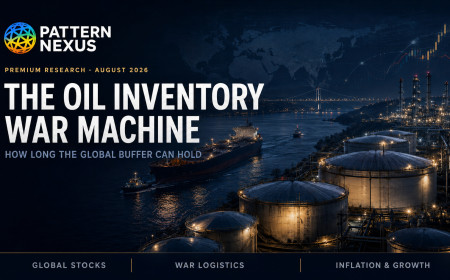 Editor-written summary
A full Pattern Nexus reconstruction of U.S. and global oil inventories from the 1970s through the 2026 war shock, including original regressions, depletion scenarios, strategic reserves, refinery constraints, inflation, growth, rates and the path forward.
Meta keywords: oil inventory, global oil stocks, U.S. crude inventories, Strategic Petroleum Reserve, SPR, Strait of Hormuz, Iran war, oil shock, petroleum products, diesel inventories, refinery capacity, inflation, CPI, recession, Treasury yields, liquidity, war economy, energy security, Pattern Nexus
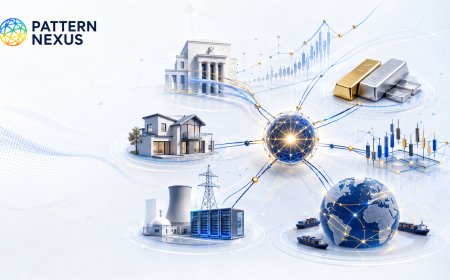 Editor-written summary
A guided public index of 328 timestamped Pattern Nexus articles covering Federal Reserve liquidity, interest rates, the dollar, gold and silver, housing, real estate, markets, debt, banking, energy, trade, industrial buildout, and geopolitical transmission. Each section explains what readers will find, what they will learn, and where to begin.
Inside this report
- Pattern Nexus Macro Archive
- What this page contains
- Why this archive exists
 Editor-written summary
Originally written by Christopher Grenke in 2022, this paper examines artificial intelligence, trust, ethics, human values, algorithmic bias, accountability, and the potential consequences of increasingly advanced A.I. systems. It is being published in its original form without updating its arguments or conclusions to reflect later developments.
Inside this report
- Why Artificial Intelligence needs an ethical approach.
- Table of Contents
- Abstract
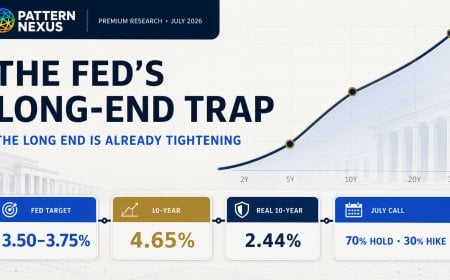 Editor-written summary
A full July 2026 data reconstruction of the Federal Reserve’s next policy path, showing how a 4.65% nominal 10-year, 2.44% real 10-year, Treasury supply, oil risk and uneven liquidity conditions create a hawkish-hold trap.
 Editor-written summary
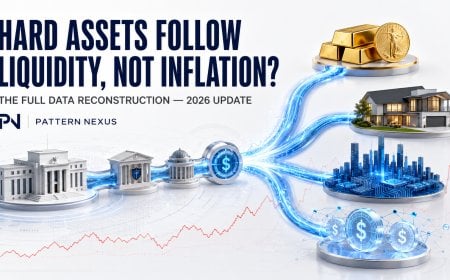
A 2003–2026 reconstruction of Fed liquidity, gold, housing and NASDAQ data, plus an experimental stablecoin-augmented liquidity index.
Meta tags: liquidity conditions index, hard assets, gold, Federal Reserve balance sheet, Treasury General Account, reverse repo, M2, stablecoins, tokenized Treasuries, housing, NASDAQ, PCA
 Editor-written summary
Read the complete 10-chapter digital edition of Pattern Nexus Worldview by Christopher Grenke. A systems-level examination of money, liquidity, markets, energy, AI, geopolitics, sovereignty, society, control systems, and the architecture shaping the modern world.
 Editor-written summary
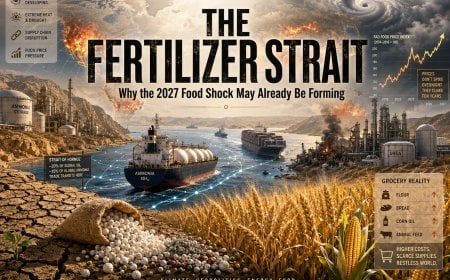
Fertilizer prices, Persian Gulf disruption, a potentially historic El Niño, expanding drought risks, weak currencies, and fragile food-import systems are converging ahead of the 2027 growing cycle. This extended Pattern Nexus analysis examines more than 50 years of population, grain production, fertilizer, energy, climate, inventory, and food-price data to determine whether the world is approaching another major food-inflation and political-instability cycle.
Inside this report
- The Thesis Is Directionally Correct, but the Causal Chain Must Be Precise
- The 50-Year Productivity Escape
- The Current Grain Balance Sheet Does Not Yet Show a Worldwide Physical Shortage
 Editor-written summary
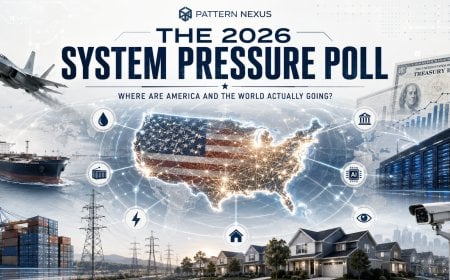
This is not another left-versus-right approval poll.
The Pattern Nexus System Pressure Poll examines the deeper structures shaping current events: war, energy, shipping corridors, debt, interest rates, tariffs, artificial intelligence, surveillance, housing, automation, institutional trust, and the emerging global order.
The daily headlines are downstream. The objective is to identify which systems people believe are actually driving events—and where those systems are taking the United States and the rest of the world.
 Editor-written summary
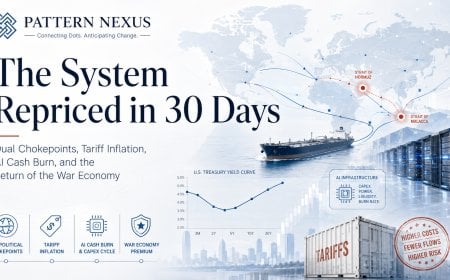
In thirty days, the operating assumptions underneath the global system changed. Two maritime chokepoints came under pressure, the United States expanded war financing and rebuilt its tariff architecture, inflation moved back upstream, long-term yields repriced, AI infrastructure crossed into cash-burn territory, strategic minerals became permissioned leverage, and political command structures began cracking. This Pattern Nexus analysis maps those events as one connected system rather than separate headlines.
 Editor-written summary
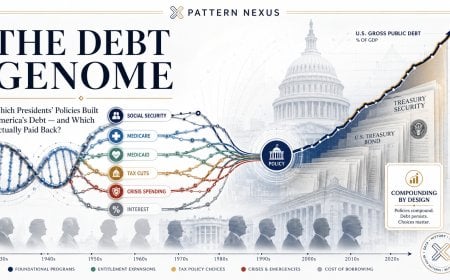
A 70-year counterfactual audit of presidential policy, inherited law, tax cuts, entitlements, crisis packages, and the compounding interest tail. The analysis separates who originated a policy from who expanded, extended, financed, or weakened it—and distinguishes Treasury cost from social return.
Inside this report
- The Debt Genome: Which Presidents’ Policies Built America’s Debt—and Which Actually Paid Back?
- The answer changes by debt mechanism
- Why This Is Premium
 Editor-written summary
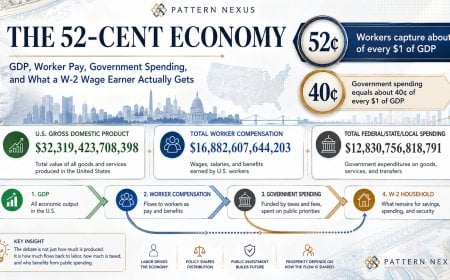
America produces nearly $32 trillion a year, but the median W-2 worker experiences only a fraction of the aggregate output. This Pattern Nexus report maps GDP, total employee compensation, cash wages, government purchases, total government current expenditures, taxes, transfers, and the after-tax worker-capture problem. It tests the claim that only 10 cents of each productivity dollar returns to the people producing the system—and replaces the slogan with a defensible multi-layer accounting model.
Inside this report
- The 52-Cent Economy: Where the American Output Dollar Actually Goes
- The Three Numbers and the First-Pass Math
- The Ratios Embedded in the Image

