

Tribalism as a Control System — From Rome and Pharaohs to 2026
Tribalism is not a modern glitch. It is an ancient control system—spectacle, hierarchy, narrative, and segmentation—updated for the algorithmic age.
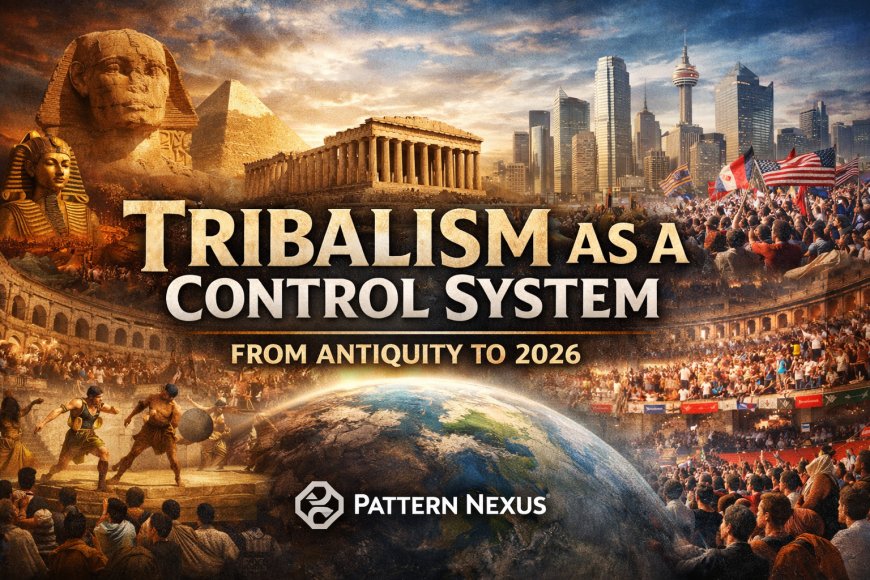
Tribalism is not a modern glitch. It is an ancient control system—spectacle, hierarchy, narrative, and segmentation—updated for the algorithmic age.
Jump to a section
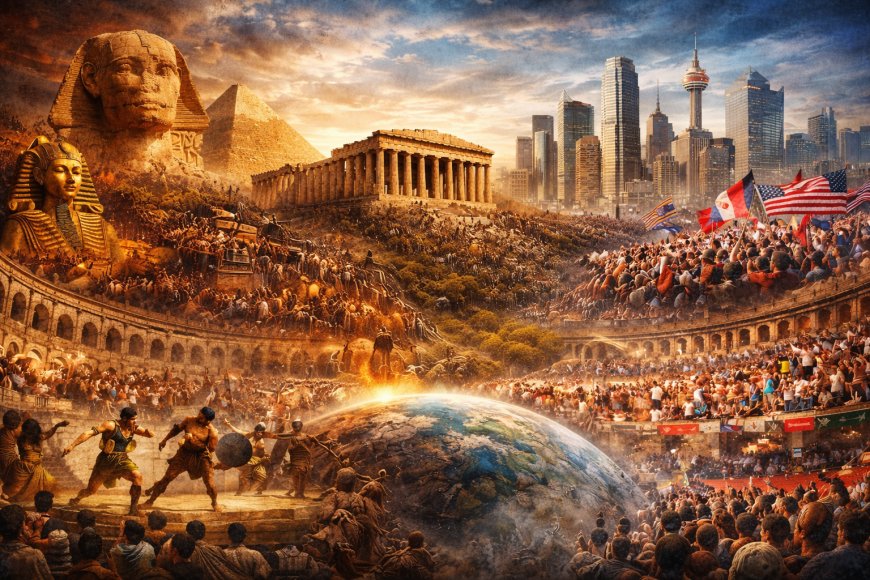

Tribalism is not a glitch in society. It is a feature of organized civilization: identity becomes a handle, and the handle becomes a lever.
Warning: once a narrative merges with identity, people will defend the narrative as “morality,” even when the narrative is incomplete, manipulated, or plainly false.
The modern upgrade is distribution: Rome had colosseums; 2026 has feeds. Same function, higher throughput.
The Ancient Operating System: Spectacle, Hierarchy, and Order
If you zoom all the way out past the current moment with its political memes, culture wars, and algorithmic outrage cycles, what you are looking at is not a new phenomenon. What gets labelled “tribalism” in comment sections today is one surface expression of a much older operating system. Every empire, every kingdom, every organized state that has existed since the Bronze Age has used division in some form to channel loyalty, obedience, energy, and hierarchy.
Start with Rome, because Rome is the cleanest “textbook” example of public spectacle as social control. The Colosseum was not just entertainment. It was a state-sponsored ritual of identity, loyalty, and hierarchy. You had “Romans” inside a story of civilization, order, and dominance. You had “others” outside that story, or beneath it. You had the crowd emotionally invested in winners and losers, with the state positioned as provider, referee, and ultimate authority.
The crowd didn’t just watch. They participated emotionally. Roman versus barbarian, patrician versus plebeian, slave versus citizen, gladiator versus gladiator. You cheered for your side, your faction, your victory. It kept the masses aligned, distracted, and invested in the system. The public loves spectacle because spectacle feels like meaning. The state loves spectacle because spectacle converts public energy into predictable channels.
Now go further back. Egypt did not need a colosseum because it had something even more powerful: divine kingship embedded in cosmic order. The Pharaoh was not merely “a ruler.” The Pharaoh was positioned as a stabilizing force between chaos and order. The system was religious, social, and political at the same time, which makes it exceptionally durable. When hierarchy is framed as sacred, disagreement becomes not just disobedience, but sacrilege. You don’t just question a policy; you threaten the balance of the universe.
Greek civilization adds another layer: identity through the city-state, and division through the polis concept itself. Athens and Sparta were not just different governments; they were different moral narratives. Even inside a single polis, identity was constantly subdivided: citizen vs non-citizen, free vs enslaved, insider vs outsider, “one of us” vs “not one of us.” The entire social fabric is built on who counts, who doesn’t, and what story is used to justify the boundary.
Later empires repeated the pattern with different costumes. The Persian Empire tolerated internal diversity but still operated with clear “center vs periphery” hierarchies. European colonial systems hard-coded “divide and rule,” manufacturing ethnic and religious splits, creating “loyal” and “disloyal” groups on purpose. Feudal orders across continents organized people into strata—lords, clergy, peasants—then wrapped those strata in stories about duty, honor, bloodlines, and divine will.
Look at it as code instead of history and a pattern emerges: organized civilizations repeatedly build the same toolkit. They formalize hierarchy. They create identity containers. They embed those containers into morality, religion, and law. They use spectacle, ritual, and public story-telling to reinforce belonging. And they punish deviation, not only by force, but by social exclusion and shame.
Most control systems do not rely on constant violence. They rely on constant structure. If identity is attached to the system, the system doesn’t have to force people to comply; people self-police to protect belonging and status.
From Clans to Empires: Why Humans Go Tribal
Long before Rome, Egypt, or Greece, humans lived in bands and clans. Small groups were a survival feature: you needed other people to hunt, protect, raise children, and share scarce resources. Inside that environment, the brain learned a simple rule set: loyalty to the group means safety; betrayal of the group means danger. That wiring never disappeared. Civilization just built institutions on top of it.
Anthropologists and psychologists will argue details, but they broadly agree on a few points: humans are intensely social; humans track reputation; humans remember “who is with us” and “who is against us.” There is a natural pull toward in-group preference and out-group suspicion. That does not make bigotry inevitable—but it does mean that if a system wants to create hostility, it has wetware to work with.
What empires and modern states discovered, consciously or not, is that you can steer that wiring. If you define the in-group (citizens, believers, patriots, party members, “true” followers) and define an out-group (barbarians, heretics, enemies, the unclean, the disloyal), you can channel deep survival instincts into political obedience. The stakes feel existential, even when the actual dispute is about tax policy or trade routes.
That is why tribalism is so hard to opt out of. It is not just an opinion. It is a combination of group survival code, social reward systems, and story. When you step back and look at your own society through that lens, much of what passes as “morality” or “values” is revealed as a repackaging of those instincts in modern language.
You are born into a pre-existing map of loyalties and divisions: nations, classes, religions, races, parties, generations. By the time you form opinions, the categories already exist. Most people never ask who drew the map or why.
How Division Gets Manufactured: Segmentation, Narrative, Rewards, Punishment
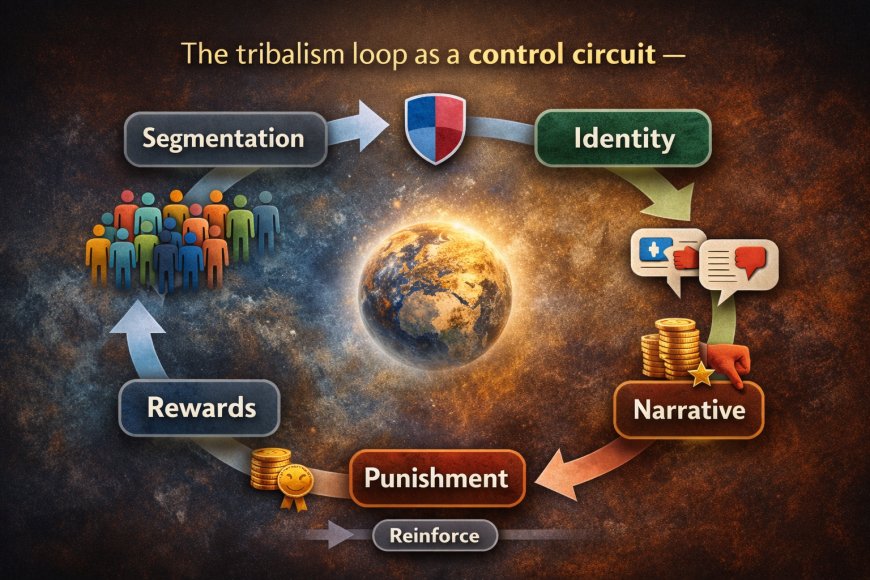
Tribalism is not simply “people having opinions.” It is a mechanism with predictable steps. If those steps are understood, the modern world becomes easier to interpret, because the same machinery is running everywhere at the same time.
Step one is segmentation: split the population into categories that are easy to recognize and emotionally attach to. Sometimes the categories are geographic (city, region, state, nation). Sometimes they’re ideological (political alignment, religious alignment). Sometimes they’re demographic (race, ethnicity, generation). Sometimes they are economic (class, status, lifestyle). Sometimes they’re cultural (sports teams, aesthetics, subcultures). Sometimes they’re institutional (school affiliations, workplaces, unions, communities).
Today you are divided by states, countries, ideologies, politics, religion, skin color, ethnic and religious beliefs. You are divided along generational lines—Boomers, Gen X, Millennials, Gen Z—as if birth year were a moral category. You are divided by whether you believe in organized religion or call yourself “spiritual,” by whether you are urban or rural, by whether you carry the “right” phone, drive the “right” car, or wear the “right” brand logo. That is the macro segmentation.
Zoom in and the micro-segmentation shows up: towns, high schools, cliques, friend groups, sports teams, hobby communities, local politics, neighborhoods, HOA boards, cheap seats vs box seats, dollar stores vs high-end grocery stores, the aesthetics you present, the music you listen to. Humans will subdivide endlessly if you let them, and power structures have always understood how useful that subdivision is. Tribalism keeps populations emotionally occupied, psychologically tribal, and fundamentally unable to coordinate at scale outside of their faction.
Step two is identity binding: make the segment feel like “self.” This is where tribalism becomes sticky. Once a person feels that a segment represents who they are, any challenge to the segment becomes a challenge to the person. Debate stops being about truth and becomes about defense. Evidence becomes secondary. The emotional goal becomes staying aligned with the tribe’s story.
Step three is narrative injection: provide a story that explains why the tribe is right, why the other tribe is wrong, and why the conflict matters. The narrative always includes moral framing, because moral framing is what turns participation into virtue. If a person believes their side represents “good,” then defending the side feels like defending goodness itself. That’s how propaganda becomes identity without needing to look like propaganda.
Step four is incentive design: reward loyalty, punish deviation. This does not have to be legal punishment. It can be as simple as social approval, status gains, career access, community belonging, or algorithmic visibility. The threat is equally powerful: shame, exclusion, ridicule, “cancellation,” loss of group safety. A person learns quickly which thoughts keep them inside the circle and which thoughts get them thrown out.
Step five is reinforcement: repeat the loop until it becomes invisible. At that point, people do not experience the system as control. They experience it as reality. They believe they are thinking freely, while their entire interpretive model is being framed by segmentation, incentives, and narrative boundaries.
This is why so many situations turn into a simplistic winner/loser story. The public is trained to pick a side, then retrofit morality around the side. Once “winner” and “loser” are assigned, most people stop auditing the process. They defend the outcome to protect their own emotional coherence: if the tribe won, the tribe must have been right; if the tribe lost, the tribe must have been cheated.
At scale, this creates a world where empires justify conquest, democracies justify neglect, revolutions justify violence, and ordinary people justify apathy. As long as their side is narratively framed as the hero, they can overlook almost anything. People will defend obviously flawed decisions, policies, or leaders because conceding error would mean conceding that their tribe is not what they believed—and that threatens their emotional anchor.
This is also why it’s normal to see people express sympathy for marginalized groups only when it is socially rewarded, and ignore them when it is not. People will “care” in symbolic ways that cost them nothing, but avoid material questions that would require structural sacrifice, coordination, or political risk. That is not a defect unique to one ideology. It is the predictable output of tribal incentive systems.
Now zoom out to global reality: billions of people still walk miles for water. Billions still live without reliable sanitation and plumbing. Entire populations endure preventable disease and contamination. If society actually cared in a material way, those problems would be attacked with the same intensity used to attack political rivals on social media. But most people do not want to coordinate outside the tribe. They want to win inside the tribe.
The uncomfortable truth is that empathy is tribalized. The emotional perimeter of concern often ends where group identity ends. That is why the world can contain extraordinary suffering while still being full of people who believe they are morally righteous. Morality becomes performance. Compassion becomes branding. Outrage becomes entertainment.
- Segmentation creates categories.
- Identity makes the category feel like “self.”
- Narrative supplies moral justification.
- Incentives reward loyalty and punish deviation.
- Repetition turns the whole loop into “common sense.”
Verification matters, but it is not the final step. Even true facts can be arranged into a misleading frame. The deeper audit is: what is being emphasized, what is being omitted, and what emotional response is being engineered by the arrangement?
The 2026 Interface: Algorithms, Lifestyle Castes, and Perpetual Conflict
To think that we are living in some enlightened, post-tribal era because we have smartphones, Wi-Fi, and electoral politics is a complete delusion. The control systems just scaled and abstracted. The segmentation updated its graphics card. The core mechanics stayed the same, but distribution became frictionless and continuous. Where Rome needed a physical arena, modern society can run the arena in your pocket, in your living room, and in your workplace, all day long.
Start with the most obvious segmentation: politics. People divide into camps, then treat camp membership like moral identity. A person is no longer someone who holds a view; they become “one of those.” That identity then determines which facts are allowed, which sources are trusted, which emotions are acceptable, and which doubts are forbidden. The result is not disagreement; it is parallel realities with hardened borders.
But politics is only one layer. Modern tribalism is multi-channel. It hits identity (race, religion, culture), ideology (belief systems), and class (status, income, lifestyle) at the same time. It then injects smaller tribes inside the larger tribes, because subdivision increases control. If a population can be split into ten competing factions, it becomes far less capable of unified action than if it is split into two.
States and nations are tribes. So are cities. So are neighborhoods. So are schools. So are sports teams. So are local sports teams. So are the aesthetic groups people perform online. So are the lifestyle markers: the stores you shop at, the brands you signal, the seats you can afford, the communities you can access. From the big to the small, everything is organized around division and segmentation.
Even seemingly neutral spaces advertise stratification. The grocery ecosystem itself is segmentation: discount stores versus high-end stores, different product lines, different “social normals,” different assumptions about what kind of person shops there. Stadiums and concerts show stratification in physical form: cheap seats, expensive seats, box seats, private balconies. Airports: general boarding, priority boarding, lounges. Society trains you to accept division as normal, then wonders why people behave tribally.
The Titanic made this visually obvious. First class exits first; steerage fights for scraps. People watch that scene and feel morally disturbed, yet participate in the equivalent structure every day without objection. Business class cabins, VIP access, “members only” spaces—modern stratification is marketed as choice and lifestyle rather than caste and inheritance, which makes it feel fair even when it isn’t.
Now add the algorithmic layer. The modern information environment does not merely deliver content; it shapes perception. People do not “see the world.” They see a curated slice of the world chosen for engagement, emotional response, and retention. That is why outrage spreads faster than nuance. That is why simplistic winner/loser narratives dominate. That is why people begin to think the loudest tribe is the biggest tribe. Distribution distorts reality, and distortion becomes belief.
You don’t just belong to a tribe; your feeds reinforce the tribe, your tribe reinforces your morality, and your morality justifies the tribe. That is the loop. Because most people never audit that loop, they mistake their tribal alignment for objective moral correctness. They choose a winner and a loser, a hero and a villain, and then rewrite the narrative to protect their own emotional self-concept. As long as they emerged on the side of the supposed moral victory, they do not interrogate whether the frame itself was legitimate.
The end result is predictable: most people become less objective, not more, even though they have more information than any human civilization ever had. Information abundance doesn’t produce wisdom when incentives punish curiosity and reward loyalty. When a person is trained to defend a tribe, they interpret all new information as ammunition, not as evidence.
That is why the most important skill in 2026 is not “having the right opinion.” It is having the ability to audit the frame. It is understanding that every side is presenting a narrative, and narratives are designed to recruit you into identity defense. “Verify” is required, but “verify” alone is not enough. The deeper step is to ask: what is the story trying to make you feel, what is it trying to make you ignore, and who benefits if you accept the framing?
When reality is viewed through that lens, society starts making sense in ways that are not flattering. It becomes obvious why political groups often ignore other marginalized groups outside their coalition. It becomes obvious why ideological movements cannibalize their own allies. It becomes obvious why symbolic caring replaces material action. It becomes obvious why the world can tolerate mass suffering while still being full of self-declared “good people.” The tribe provides identity. The narrative provides justification. The incentive system provides comfort.
The question that matters is not whether tribalism exists. The question is whether it owns you. If it owns you, you will pick a side, defend a story, and feel morally righteous while nothing materially improves. If it does not own you, you will still have values, but you will evaluate outcomes by what benefits the majority of people involved while also protecting minority groups from being crushed by the winner/loser machine. That is not “being in the middle.” That is refusing to be psychologically captured by a factional script.
If a narrative makes you feel instantly certain, instantly righteous, and instantly angry, there is a strong chance the narrative is doing its job. Certainty is not proof. It is often the first indicator that identity has been activated.
Pattern Nexus Lens
Tribalism is best understood as a control-layer that sits on top of every other system: governance, finance, media, education, religion, and culture. Control does not require that every actor is “coordinated.” Most control is emergent. If incentives reward faction loyalty, then faction loyalty will expand without central planning. If distribution rewards outrage, outrage will scale without a master conspirator. If hierarchy is normalized, hierarchy will reproduce itself automatically.
In control-systems terms, tribalism behaves like a stabilizer for institutions and a destabilizer for the public. It stabilizes institutions by preventing unified demand for structural change. It destabilizes the public by keeping people in a loop of conflict, identity defense, and moral performance. The loop absorbs energy that could have gone into coordination, infrastructure, or empathy beyond the tribe.
That lens also explains why the biggest real-world problems remain unsolved. Fixing water and sanitation at scale requires coordination, logistics, and multi-decade commitment. Winning a tribal conflict requires memes, outrage, and identity signaling. One is hard and slow; the other is easy and rewarding. Societies drift toward whatever the incentive structure rewards, and modern incentives reward tribal theater.
The practical move is not “be neutral” and not “be a centrist.” The practical move is to refuse capture. The goal is to objectify the situation, not from the left, not from the right, and not from some safe middle, but from the lens of: what actually benefits the majority of the people affected, and how do you protect the minority groups who would otherwise be crushed by the result? That is a different question than “Which side is my side?”
Critical thinking, in that sense, is not just “question authority.” It is “question the narrative architecture itself.” Never accept any story at face value, no matter which tribe it comes from. Verify the input. Audit the frame. Go find both sides of the information, then notice that the truth is almost never either side’s message. You stop asking “Which team am I supposed to be on?” and start asking “Whose interests does the game itself serve?”
- Verify facts, then verify framing.
- Read both sides, then look for what both sides omit.
- Track incentives: who gets paid, promoted, protected, or amplified by the story.
- Audit your own emotional response: outrage is often the hook.
- Measure outcomes by human impact, not by tribal victory.
The arena never ended. It just changed shape. If the arena is recognized as the system, the obsession with “teams” loses power, and reality gets easier to see.
FAQ
Is tribalism “natural,” or is it manufactured?
It is both. Humans have strong in-group/out-group tendencies, but modern institutions can dramatically amplify or dampen them. The manufactured part is how identity, narrative, and incentives get wired together to produce predictable behavior at scale.
Why do people defend obviously flawed narratives?
Because the narrative is rarely just “information.” It is often social belonging and personal identity. When belonging is on the line, people defend the tribe’s story as if it were self-defense.
How do algorithms change the tribalism dynamic?
Algorithms increase frequency, speed, and emotional intensity. They curate what people see, reward engagement over nuance, and repeatedly reinforce identity-aligned frames. The tribal loop becomes continuous rather than episodic.
What does “verify framing” mean in practice?
It means asking what is being emphasized, what is being omitted, what emotional response is being engineered, and what alternative interpretation could fit the same facts. Facts matter, but so does the story built out of them.
Is the goal to eliminate division?
No. Division will always exist because humans form groups. The goal is to avoid psychological capture: to remain capable of auditing narratives, seeing incentives, and evaluating outcomes by human impact rather than tribal victory.
What does this lens change for everyday life?
It changes how you consume news, how you interpret political drama, how you react to online fights, and how you judge people on “the other side.” Instead of asking whether you agree with a tribe, you ask what the structure is doing to your perception and to the people who have the least power inside it.
Sources
Background and primary references supporting the historical mechanisms (spectacle, hierarchy, “divide and rule”) and the modern psychology/information-layer (social identity, group limits, filter dynamics).
- Oxford Reference — “bread and circuses” (panem et circenses) as political diversion
- Spectacles in the Roman World Sourcebook — Imperial sponsorship and political function of public games
- Bryn Mawr Classical Review — Colosseum political messaging and imperial legitimacy context
- University of Chicago (ISAC) — Kingship and divine rulership models (Egypt and Near East)
- Ferguson — The ancient Egyptian concept of Maat (order, justice, social-cosmic stability) (PDF)
- Tajfel & Turner — Social Identity Theory (intergroup behavior) (PDF)
- JSTOR — “‘Divide and Rule’: The Impress of British Separation Policies” (A.J. Christopher, 1988)
- PMC — “‘Dunbar’s number’ deconstructed” (group-size constraints and debate)
- ACM Digital Library — “Filter bubble” concept and personalization isolation framing
Menene Martaninka?
 Kamar
0
Kamar
0
 Karya
0
Karya
0
 Kauna
0
Kauna
0
 Ban dari
0
Ban dari
0
 Wao
0
Wao
0
 Bacin rai
0
Bacin rai
0
 Fushin
0
Fushin
0

Nexus (Christopher)
Founder of Pattern Nexus. I research markets, macro, geopolitics, AI, history, ancient systems, and the patterns most people overlook. I’m also building Market Radar, a trading scanner designed to read pressure, risk, confirmation, and setup quality before ch…
Related research

Pattern Nexus Macro Archive: 328 Timestamped Articles, October 2025–July 2026
A guided public index of 328 timestamped Pattern Nexus articles covering Federal Reserve liquidity, interest rates, the dollar, gold and si…
3 shared topics.
March Ends With the System Showing Its Seams
A Pattern Nexus end-of-March 2026 master analysis on Hormuz, oil repricing, liquidity stress, inflation pressure, AI infrastructure, Moon B…
3 shared topics.
Week Ahead (Mar 16–20, 2026): Central Bank Cluster, War-Risk Premium, and a Market Trading Constraints
Week Ahead (Mar 16–20, 2026): This is a constraint week. Oil risk premium is back, DXY is parked near 100, yields are still restrictive, an…
3 shared topics.
Mar 12, 2026 Macro Wrap: Dollar at 100, Oil Shock Math, China’s Hormuz Exception, and the Credit Fault Lines
2026 is moving in whiplash mode. The dollar is pressing 100, yields are back in “you’re not supposed to be here” territory, oil is flirting…
3 shared topics.
Mar 2, 2026 Market Wrap (8:52 PM): Oil Risk Premium, VIX Wake-Up, and De-Escalation Getting Priced Too Early
Equities held together, but VIX jumped, oil stayed bid, and metals kept acting like uncertainty hedges. My read: the market is pricing fast…
3 shared topics.
Strait-Mode: Refineries Hit, B-2 Strikes, Europe Moves, and the Gulf Reprices Risk — March 2, 2026
Ras Tanura shuts after a drone strike, Erbil sees secondary explosions, B-2s reportedly hit hardened Iranian missile facilities, Europe sig…
3 shared topics.
Feb 26, 2026 Tape: Nvidia Blinks, Tariff Chaos Returns, and the Curve Quietly Flattens
Tech sold off even after Nvidia “beat,” VIX woke up, tariffs re-entered the equation, and the yield curve steepened. Here’s the systems-lev…
3 shared topics.
Feb 18, 2026 Tape: AI Bid, Oil Risk Premium
The Feb 18 tape was clean: tech/AI led equities higher, VIX bled, oil carried a visible geopolitical risk premium, and the UST curve steepe…
3 shared topics.
Sharhu (0)
Security Check
Please complete the captcha to verify you are human.