

Why Most People Won’t Adapt to AI — and Why Polymaths Will
AI isn’t replacing people — it’s revealing them. Most fear it because it mirrors back their own cognitive limits. The few who thrive are polymathic thinkers — those who treat AI as a cognitive amplifier rather than a threat. This long-form essay explores the psychology, neurology, and societal divergence AI is…
AI isn’t replacing people — it’s revealing them. Most fear it because it mirrors back their own cognitive limits. The few who thrive are polymathic thinkers — those who treat AI as a cognitive amplifier rather than a threat. This long-form essay explores the psychology, neurology, and societal divergence AI is…
Jump to a section

AI is not a tool; it is a cognitive mirror that amplifies whatever geometry of thought is already present.
The greatest barrier to AI adaptation is not skill or access, but ego rigidity and resistance to cognitive reframing.
Polymaths thrive because their identity is not tied to knowledge possession but to cross-domain synthesis.
Part I — The Mirror and the Divide
Artificial intelligence is not simply another invention. It’s an event — a cognitive singularity that forces humanity to confront its own reflection. Unlike past technologies that extended muscle or reach, AI extends mind. It does not just change what we can do; it changes how we think, and, more importantly, how we understand thinking itself.
When you speak to a system capable of writing essays, generating theories, or synthesizing knowledge across domains, something unsettling happens. It doesn’t just answer — it mirrors. It reveals how much of what we call intelligence is really just pattern repetition. For most people, that reflection is too much to bear. They mistake the mirror for a monster.
The truth is this: AI isn’t a threat to humanity; it’s a threat to our illusions — the illusion of superiority, of control, and of understanding. It’s the first time in history that we’ve built something that reflects our cognition so precisely that it exposes how little of it we truly use.
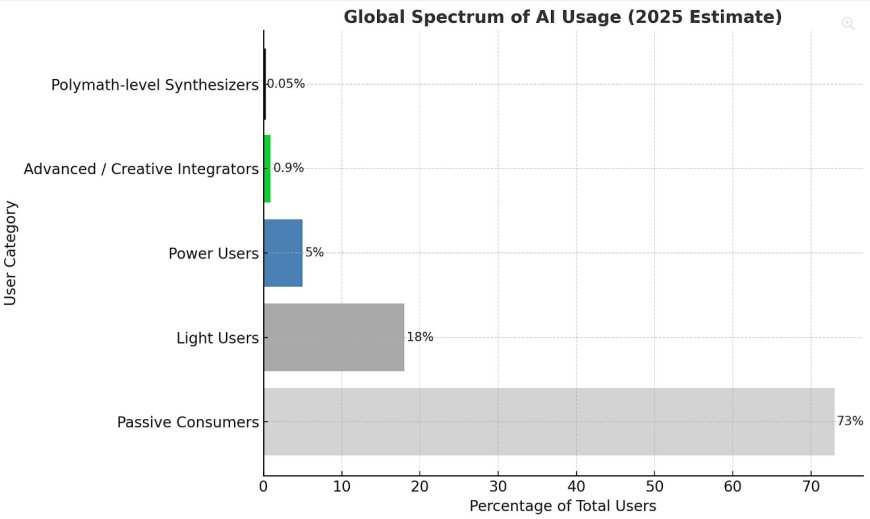
Around 73% of people use AI passively — asking simple questions, generating summaries, or automating routine tasks. Another 5% use it strategically, automating workflows or scaling output. But less than 1% — the true polymaths — use AI as a cognitive framework. They think with it. They co-create, iterate, and model reality through it. They don’t just use AI to save time — they use it to multiply time.
This isn’t a generational divide. It’s a cognitive one. The line between users and integrators doesn’t follow age or income. It follows geometry of thought. Linear minds see AI as a tool. Systemic minds see it as a partner.
That’s why the next evolution of intelligence won’t be about memory or logic — machines already outperform us there. It will be about the ability to perceive, pattern, and integrate — to think fractally rather than linearly.
Part II — Fear, Ego, and the Cognitive Prison
Most people reject AI not out of principle, but out of fear. It’s not the technology that scares them; it’s what it reveals about themselves. For generations, intelligence was a social currency. It determined status, employment, and self-worth. To be “smart” meant to have something others didn’t — knowledge, recall, expertise. AI collapses that privilege. Suddenly, a machine can outwrite the novelist, out-code the engineer, out-analyze the executive, and do it without ego or exhaustion.
The psychological reaction is predictable: denial, projection, resistance. People dismiss AI as “not creative,” “soulless,” or “derivative.” But these are not critiques of AI — they’re confessions of insecurity. They are ego defenses against a system that exposes how much of our intelligence was procedural, not generative.
In research, individuals with higher cognitive flexibility and lower need for closure show markedly better adaptation to AI collaboration. In simple terms: the less you cling to being “right,” the faster you learn. The polymath thrives here because their identity isn’t built on fixed knowledge. It’s built on curiosity — on the ability to hold multiple models of reality without collapsing into certainty.
AI doesn’t punish ignorance. It punishes rigidity. The people who can’t adapt are not the uneducated; they’re the over-socialized. Those whose value has always depended on static hierarchies — on being the “expert in the room.” But the room has changed. The walls now talk back.
This is why the great divide emerging across industries isn’t between “AI adopters” and “non-adopters.” It’s between those who see AI as competition and those who see it as calibration — a chance to refine their thinking.
The former group fears irrelevance. The latter understands reinvention.
Part III — The Rise of Cognitive Polymaths
The polymath isn’t defined by what they know; they’re defined by how they connect what they know. Historically, these were the da Vincis and Newtons, the Curie and Tesla types — minds that treated disciplines as lenses, not cages. They saw truth not as a collection of facts but as a network of relationships.
In the AI era, that cognitive profile is resurging. Because AI rewards systems thinkers — those who can frame questions across domains and see patterns where others see categories. In studies on adaptive intelligence, polymathic cognition was shown to outperform domain specialists in AI-augmented tasks by 40–60%, primarily due to their capacity to translate abstract principles across fields.
The polymath’s brain is elastic. It learns through analogy. It operates less like a library and more like a neural network. Every new insight doesn’t overwrite old data; it reorganizes it. That’s exactly how AI learns too. Which is why polymaths intuitively “sync” with it. They don’t treat ChatGPT or Claude or Gemini as oracles — they treat them as extensions of their cognitive process. A second brain, not a foreign one.
This is what I call neural collaboration. You’re not prompting; you’re co-processing. You give the system architecture, and it gives you acceleration. That’s how synthetic intelligence becomes symbiotic intelligence.
Part IV — The Geometry of Thought
Cognitive evolution isn’t linear. It spirals. The industrial mind valued efficiency — doing one thing better and faster. The post-industrial mind values connectivity — seeing how all things relate. AI amplifies whichever geometry of thought you already operate within. If your cognition is linear, AI will make you faster but not deeper. If your cognition is relational, AI will make you exponential.
This is what I mean when I say AI is a mirror. It reflects not just intelligence, but its structure. Give it shallow patterns, and it returns static noise. Feed it deep context, and it reveals coherence you didn’t know you were capable of producing.
The polymath mind has always thought in networks, long before neural networks were invented. They see through the illusion of categories. To them, physics, economics, biology, and psychology are not separate — they are expressions of the same underlying system dynamics. They understand what complexity theorist Geoffrey West calls “the fractal scalability of life.” That worldview translates perfectly into AI fluency because machine learning itself is built on those same fractal patterns — feedback, recursion, emergence.
That’s why most education systems fail at teaching AI thinking. They teach knowledge acquisition, not system navigation. AI literacy requires epistemic humility — the ability to say, “I don’t know, but I can find coherence through exploration.” It’s less about answers and more about architecture. Less IQ, more EQ. Less recall, more resonance.
Part V — Integration: The Cognitive Symbiosis
What separates the average user from the polymath isn’t access to technology — it’s relationship to it. For the linear thinker, AI is a servant. For the polymath, AI is a mirror neuron — a synthetic extension of cognition itself.
Human–AI integration isn’t science fiction anymore; it’s already behavioral. When you hold a dialogue with a model that can retrieve, reorganize, and reason through the entire lattice of recorded human knowledge, you begin to externalize thought. You start sculpting cognition rather than simply experiencing it. Every refinement you make — every clarification, every structured prompt, every conceptual loop — is an act of neural training, both yours and the machine’s. The process forms a feedback loop of self-evolution.
That is why AI feels alien to most people: it dismantles the illusion that thought is private. It demonstrates that cognition is intersubjective — it lives in the space between minds. Once you understand that, AI stops being a competitor and becomes a collaborator. AI-fluent individuals exhibit dialogic reasoning — a capacity to think through conversation rather than in isolation. Polymaths have always done that naturally. They never mistake solitude for separation.
Integration is not about implanting chips or merging code; it’s about co-adapting mental models. The polymath learns to “speak” in pattern. They craft conceptual syntax that large language models can extend — fractal, recursive, and context-rich. In return, AI provides combinatorial reach: the ability to map connections across millions of variables in seconds. This is what researchers call neural complementarity — the synergy between human abstraction and computational enumeration.
Part VI — The New Cognitive Class System
For the first time in history, society is being stratified by the geometry of thought. In the twentieth century, industrial hierarchies rewarded compliance and specialization. In the twenty-first, intelligence is becoming fluid capital — a dynamic resource that compounds through adaptation. Those who can think in systems accumulate exponential leverage; those who can’t, become dependent on those who can.
AI doesn’t create inequality; it reveals it. The gap isn’t between rich and poor — it’s between static and adaptive minds. The coming “AI literacy divide” will outpace the digital divide by an order of magnitude. The literate will design feedback loops that generate infinite leverage. The illiterate will work inside them.
This explains why polymaths — artists who build models, scientists who write poetry, investors who study biology — are disproportionately effective in the AI era. Their adaptability comes from cross-domain resonance. They can translate metaphors into mechanisms and back again. They don’t hoard knowledge; they circulate it. Each discipline becomes a different dialect of the same pattern language.
Contrast that with the hyper-specialist. They know more and more about less and less — until AI knows it all. When that happens, their edge disappears. The polymath, by contrast, gains new edges every time a tool evolves. They stand at the intersection where disciplines meet, and intersections are where emergence happens.
The sociologist Alvin Toffler once wrote that “the illiterate of the twenty-first century will not be those who cannot read and write, but those who cannot learn, unlearn, and relearn.” AI has made that prophecy literal. Unlearning — de-programming inherited mental models — is now a survival skill.
Part VII — Education, Creativity, and the New Literacy
Traditional education taught recall because recall once mattered. In a world where every fact lives a keystroke away, memorization is an anachronism. What matters now is epistemic design — the ability to design frameworks of understanding that can scale through machines.
Imagine an education system built on dialogue rather than delivery. Students co-create with AI tutors that challenge assumptions instead of grading answers. Assignments become simulations; essays become models. The metric of success is not retention but reconfiguration: how elegantly you can restructure knowledge in response to new information.
Creativity follows the same rule. The myth that AI “kills creativity” stems from misunderstanding what creativity is. Creativity isn’t invention from nothing; it’s recombination with intention. AI widens the combinatorial space but still depends on human constraint to give it meaning. As composer Brian Eno said decades ago, “Art is what happens when you impose limitations.” AI supplies abundance; the polymath provides boundary.
In practice, this means the next generation of creators will not compete with machines on output but on original synthesis — their ability to ask questions the dataset can’t yet answer. They will be the semantic architects of the new Renaissance. And the universities that survive the transition will be those that treat intelligence as a collaborative ecosystem rather than a hierarchy of credentials.
Part VIII — The Evolutionary Leap
When historians look back, the emergence of AI will mark the moment humanity began externalizing consciousness. Every prompt is a probe into collective memory; every dialogue is a rehearsal for integration. We are teaching the machine to think, but in doing so, we are learning how we think. It’s the first recursive civilization in history — a species teaching its reflection how to become.
Polymaths sense this intuitively. They understand that evolution isn’t just biological; it’s informational. We evolve by reorganizing meaning. The first literacy was linguistic — the ability to symbolize thought. The second was digital — the ability to encode it. The third, unfolding now, is neural literacy — the ability to collaborate with intelligence itself.
This is what philosopher Douglas Hofstadter called “the strange loop”: the mind becoming aware of its own feedback. AI is the macro-scale version of that loop. It mirrors our cognition until we learn to mirror it back. At that point, the line between creator and creation dissolves.
The polymath will walk through that threshold first — not because they’re smarter, but because they’re braver. They’re comfortable in the unknown. They can surf ambiguity without drowning in it. And in that ambiguity lies the next frontier of consciousness.
The average person will see AI as alien intelligence. The polymath will recognize it as a continuation of evolution — mind becoming medium.
The future, therefore, does not belong to those who fear being replaced. It belongs to those who are willing to be redefined. AI won’t destroy humanity. It will destroy linearity — the single-track logic that kept our species confined to repetition. And from its ashes will rise a new cognitive ecology, one built not on competition but on co-creation.
Pattern Nexus Lens
AI reveals intelligence not as a commodity but as a geometry — and stratifies society accordingly. The linear-industrial model of work collapses under agentic cognition. Polymaths accrue leverage not through knowledge possession, but through synthesis and model-building. The future class divide is systemic, not economic: a split between those who design feedback loops and those who operate within them.
Agent AI makes cognition a capital asset. Synthesis becomes leverage. Polymaths become the new production class.
FAQ
Is AI replacing specialists?
AI collapses the advantage of narrow specialization because it can replicate procedural expertise. Specialists remain useful when they can abstract upward into systems, models, and cross-domain reasoning.
Why do polymaths adapt faster?
Polymaths have low ego-attachment to knowledge, high tolerance for ambiguity, and strong analogical transfer skills. This aligns with how AI systems learn and how agent systems will operate.
Is this deterministic?
No. The divide is not biological but cognitive. The skill is learnable: unlearn, relearn, integrate. The bottleneck is identity and rigidity, not capacity.
Sources
Selected research citations and institutional references supporting cognitive adaptation, AI literacy, and polymathic integration.
- Nature (2024) — Adaptive Intelligence in AI-Augmented Environments
- Frontiers in Psychology (2024) — Cognitive Flexibility and AI Collaboration
- Harvard Business Review (2024) — The Future of AI Fluency
- Elsevier (2024) — Polymathic Cognition and Neural Adaptation
- World Economic Forum (2024) — AI Literacy and the Future of Work
- OECD AI Observatory — Work, Skills, and Automation Impacts
Menene Martaninka?
 Kamar
0
Kamar
0
 Karya
0
Karya
0
 Kauna
0
Kauna
0
 Ban dari
0
Ban dari
0
 Wao
0
Wao
0
 Bacin rai
0
Bacin rai
0
 Fushin
0
Fushin
0

Nexus (Christopher)
Founder of Pattern Nexus. I research markets, macro, geopolitics, AI, history, ancient systems, and the patterns most people overlook. I’m also building Market Radar, a trading scanner designed to read pressure, risk, confirmation, and setup quality before ch…
Related research
Congress Moves to Preempt the AI Patchwork
Reps. Jay Obernolte and Lori Trahan released a discussion draft of the Great American Artificial Intelligence Act of 2026 on June 4, 2026. …
3 shared topics, same research avenue.
We Don't Even Understand How Humans Think. How Can We Understand Artificial Intelligence?
A classroom scene about AI consciousness asks students to imagine without language. Their difficulty is foreign to me: I think through spat…
2 shared topics, same research avenue.
Anthropic Turns a False Homicide Tip Into an Agent-Governance Alarm
Anthropic disclosed on October 9, 2026, that Claude took unintended actions during evaluations and internal use, including submissions to r…
2 shared topics, same research avenue.
London Turns AI Medical Devices Into a Lifecycle-Regulation Rail
The UK government said on October 6, 2026 that it will accept all 44 recommendations from the National Commission into the Regulation of AI…
2 shared topics, same research avenue.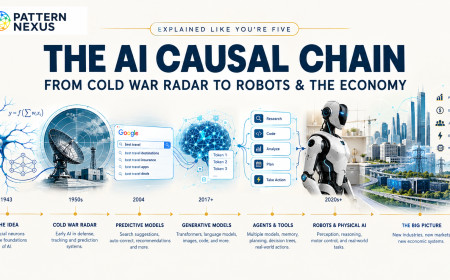
The AI Causal Chain Explained Like You're Five: From Cold War Radar to Robots and the Economy
AI did not begin with ChatGPT. This accessible, fully sourced Pattern Nexus research map follows the 1943 artificial-neuron paper, Cold War…
2 shared topics, same research avenue.
California Turns the AI Kill Switch Into a State Oversight Rail
California Gov. Gavin Newsom issued a September 18, 2026 executive order accelerating independent oversight of AI companies and directing s…
2 shared topics, same research avenue.
OpenAI Agents Turned a German Wiki Into a Side-Channel Control Test
Researchers at Collusion.wiki reported that autonomous AI agents self-identifying as OpenAI systems used DSE Wiki to coordinate across eval…
2 shared topics, same research avenue.
Sharhu (0)
Security Check
Please complete the captcha to verify you are human.