

Fiscal
Automatically indexed from the existing article tag.
Theses, forecasts, models, and paths
No published research objects yet
This topic is ready for editors to connect a thesis, forecast, model, or research path.
Latest articles
 Article · related
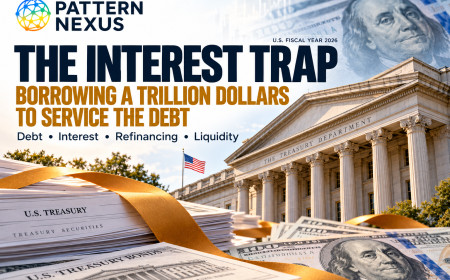
The Interest Trap: Borrowing a Trillion Dollars to Service the Debt
The United States finished fiscal 2026 with a $1.992 trillion deficit. Net interest accounted for $1.052 trillion of it. I break down the budget, the refinancing cycle, and how borrowing to service debt creates another layer of future interest.
Published Oct 23, 2026 Video · related
The Convergence — Audio-Video Edition
The finale of the Pattern Nexus Cycles of Power audio-video series connects 150 years of industrial, monetary, computing, energy, and liquidity history to the emerging convergence of AI infrastructure, fiscal dominance, programmable dollars, hard-asset politics, and competing paths from 2030 to 2045.
Published Oct 12, 2026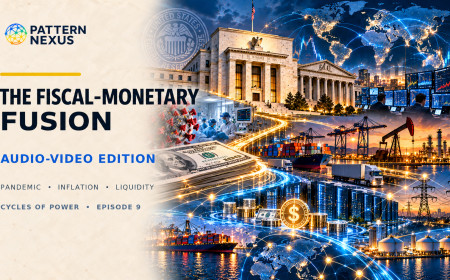 Video · related
The Fiscal-Monetary Fusion — Audio-Video Edition
Episode 9 of the weekly Pattern Nexus audio-video series turns Part 9 of Cycles of Power into a shorter story about how pandemic stimulus fused fiscal and monetary policy, inflation forced a violent rate reversal, bank stress produced a new collateral-protection template, and sanctions, AI infrastructure, stablecoins, and tokenized Treasuries transformed liquidity into both operating system and geopolitical weapon between 2020 and 2025.
Published Oct 5, 2026 Article · related
Treasury Turns Long-Bond Buybacks Into a Yield-Control Test
Treasury said it will raise maximum liquidity-support buybacks in the 10-to-20-year and 20-to-30-year nominal coupon sectors from $2 billion to at least $4 billion per operation beginning September 9, 2026. Follow-up reporting from AP, Reuters and Axios shows the market treated the move as an attempted long-end yield intervention, but the initial relief faded quickly. The Pattern Nexus read: this is not formal yield-curve control, but it is a live test of whether Treasury plumbing can absorb stress that monetary policy credibility and fiscal math are failing to contain.
Published Aug 22, 2026 Article · related
Google Turns Custom AI Chips Into a Marvell Equity-Control Deal
Marvell disclosed that it entered a July 29, 2026 commercial agreement with Google to develop custom semiconductor products tied to the TPU ecosystem. The August 19 filing also says Marvell issued Google a warrant for up to 58,970,907 shares at $206.58 per share, with most vesting tied to Custom Products revenue through Marvell’s fiscal 2033. The structure turns Google’s AI chip demand into a potential equity position while giving Marvell a long runway into TPU-adjacent infrastructure.
Published Aug 20, 2026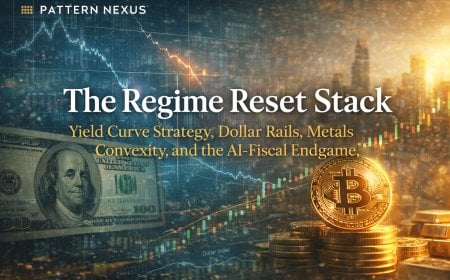 Article · related
The Regime Reset Stack: Yield Curve Strategy, Dollar Rails, Metals Convexity, and the AI-Fiscal Endgame
A Pattern Nexus control-systems read tying the yield curve, dollar regime, metals, crypto, and equities into one machine: why inversions lead recessions, why recessions can be strategically useful for policy, how 2020 proved direct household injection at scale, and why AI/robotics forces the system toward permanent transfer rails to stabilize demand.
Published Feb 15, 2026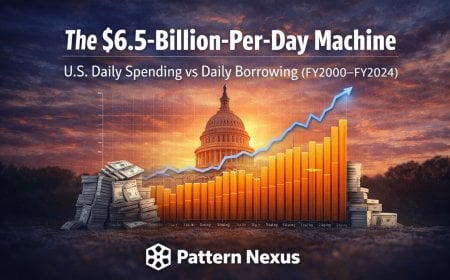 Article · related
The $X-Billion-Per-Day Machine: U.S. Daily Spending vs Daily Borrowing (FY2000–FY2024)
A Pattern Nexus structural read of U.S. federal average daily outlays versus average daily deficit financing since 2000 — and why persistent daily borrowing shows up in groceries, housing, metals, and equity valuations.
Published Feb 11, 2026 Article · related
Greenland as a Control Plane: COFA Talk, Arctic Basing, and the Real Levers
Reuters reports Trump advisers are discussing multiple pathways for Greenland, including a Compact of Free Association. Pattern Nexus breaks the story into control layers: basing, missile-warning infrastructure, fiscal support, and alliance risk.
Published Jan 6, 2026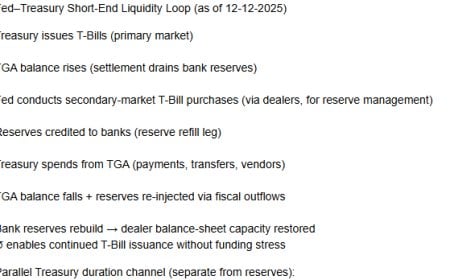 Article · related
The Short-End Liquidity Loop: How T-Bills Became a Permanent Monetary Conveyor Belt
A step-by-step, plumbing-accurate explanation of the Fed–Treasury–dealer short-end liquidity loop: T-bill issuance, secondary-market bill purchases, the TGA reserve drain and fiscal re-injection, and why this regime has no credible end state.
Published Dec 12, 2025 Article · related
The Fiscal-Monetary Fusion: Pandemic Money, Inflation Whiplash, and the Militarized Liquidity Regime (2020–2025)
COVID didn’t just trigger stimulus — it fused fiscal and monetary policy into a single war machine. Between 2020 and 2025, governments and central banks ran coordinated mega-deficits, bought their own debt at scale, ignited the first real inflation shock of the QE era, and then slammed rates higher into a fragile, over-financialized system — all while AI, energy constraints, and a new cold war turned liquidity into an explicit weapon.
Published Dec 8, 2025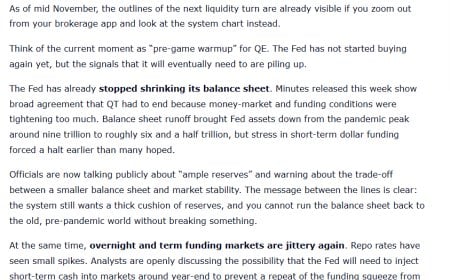 Article · related
QE 2026, AI, and the Cost of Everything: Why Your Life Is Getting More Expensive
A deep, plain-language breakdown of how QE, fiscal policy, and the rising AI-industrial build-out are quietly pushing up the cost of housing, cars, power, and everyday life — and why prices never come back down even when inflation cools.
Published Nov 19, 2025 Article · related
Fiscal Dominance and the Sticky Term Premium: Why Long Rates Won’t Obey the Fed
Everyone is waiting for rate cuts to bring relief to mortgages, cap rates, and risk assets. But the long end of the curve doesn’t care what the policy rate does when fiscal dominance takes hold. This long-form explainer maps the mechanics behind sticky long rates: net Treasury supply, buyer base rotation, term premium re-pricing, and degraded market depth. If you want to understand why “cuts” may not mean “cheaper money” anymore, start here.
Published Oct 18, 2025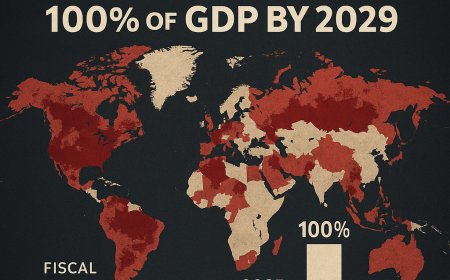 Article · related
🧭 IMF Warns Global Debt Could Exceed 100% of GDP by 2029
The IMF’s latest Fiscal Monitor warns that world public debt could climb beyond 100 percent of GDP by 2029 — a threshold unseen since the aftermath of World War II. Behind the numbers lies a structural problem: modern economies are addicted to debt-funded growth, and the world’s fiscal architecture is entering a critical phase.
Published Oct 18, 2025 Article · related
The Liquidity Crunch Nobody’s Talking About: How Repo Stress, Bank Failures, and a “False Surplus” Are Fueling Gold’s Breakout
A hidden liquidity crisis is forming under the surface of global markets. Repo markets are flashing stress, regional banks are reporting fraud-related losses, and gold is breaking all-time highs. This analysis connects the dots — showing how the system is quietly rebalancing through emergency liquidity, fiscal illusion, and a global flight to hard collateral.
Published Oct 17, 2025