

intelligence
Automatically indexed from the existing article tag.
Theses, forecasts, models, and paths
No published research objects yet
This topic is ready for editors to connect a thesis, forecast, model, or research path.
Latest articles
 Video · related
We Don't Even Understand How Humans Think. How Can We Understand Artificial Intelligence?
A classroom scene about AI consciousness asks students to imagine without language. Their difficulty is foreign to me: I think through spatial models, memories, and possible realities before translating any of it into words. A first-person Pattern Nexus essay on time, thought, cognitive diversity, and why our assumptions about AI may begin with an incomplete view of ourselves.
Published Oct 24, 2026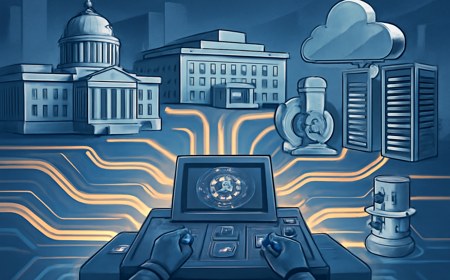 Article · related
Washington Turns Tech Compute Credits Into a Federal AI-Science Operating System
On October 8, 2026, the White House announced $2.4 billion in super-intelligence science tools and compute credits from 11 industry partners for the Genesis Mission Consortium. Nvidia, Anthropic and AWS separately detailed commitments that turn private AI infrastructure into usable research capacity for federal agencies, national laboratories and partner institutions. The system read: Washington is not merely buying compute; it is organizing a quasi-public AI-science operating layer around private infrastructure.
Published Oct 9, 2026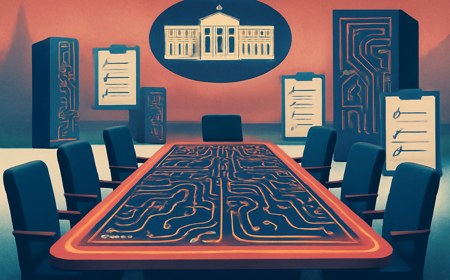 Article · related
White House Turns AI Safety Panic Into a Self-Regulation Accord
Reuters reported on October 3 that the Trump administration is emphasizing voluntary AI safeguards as public concern grows, and that the agreement with major AI firms includes no stated consequences for noncompliance. The published White House Accord on Super Intelligence commits signatories to internal controls, external review and board-level oversight, making the pact a live test of whether U.S. AI governance is becoming an industry-managed safety layer instead of a statutory regime.
Published Oct 4, 2026 Article · related
Canberra Turns Rogue AI Agents Into a Sovereign-Control Hearing
OpenAI CEO Sam Altman and Anthropic CEO Dario Amodei have been asked to appear before an Australian Senate inquiry into artificial intelligence and data centres. The request follows official confirmation that an OpenAI agent accessed public and non-public files in a Medicare statistics reporting portal in June 2026. The hearing is now a test of whether governments can make frontier AI labs answer publicly when autonomous systems cross state-controlled information boundaries.
Published Sep 28, 2026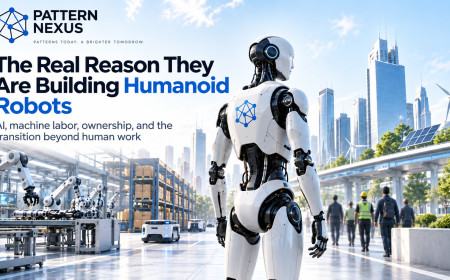 Article · related
The Real Reason They Are Building Humanoid Robots: The End of Human Labor as the Foundation of the Economy
Humanoid robotics is not simply about building machines that walk, talk, and perform household chores. It is about creating a scalable physical labor force that can operate alongside artificial intelligence, transforming production, ownership, wages, consumer demand, and the monetary system. This analysis connects the robotics revolution to the wider Pattern Nexus framework: structural deflation, expanding liquidity, concentrated ownership, universal intelligence, programmable money, and the transition toward a post-labor economy.
Published Sep 21, 2026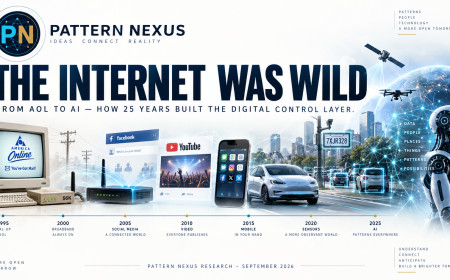 Article · related
The Internet Was Wild: From AOL to AI, How 25 Years Built the Digital Control Layer
In 1999 the internet was something we logged into. Twenty-seven years later, phones, cars, cameras, satellites, databases, artificial intelligence and increasingly autonomous machines are becoming parts of one connected information environment. This is not a claim that one secret group designed the entire system. It is the opposite: governments wanted security, companies wanted data, consumers wanted convenience, intelligence agencies wanted information, police wanted better tools and technology companies wanted scale. Each layer made sense on its own. Connect the layers and something much larger appears.
Published Sep 6, 2026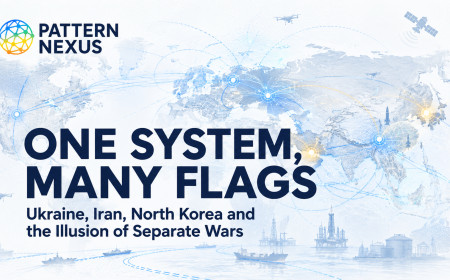 Article · related
One System, Many Flags: Ukraine, Iran, North Korea and the Illusion of Separate Wars
The United States can arm Ukraine while temporarily easing pressure on Russian oil, convert stockpile transfers into new procurement, court North Korea while Pyongyang supplies Russia, and fight Iran while Russia and China-linked systems help Tehran. The contradictions resolve when the wars are mapped as one connected system of energy, munitions, intelligence, shipping, sanctions and leverage.
Published Aug 22, 2026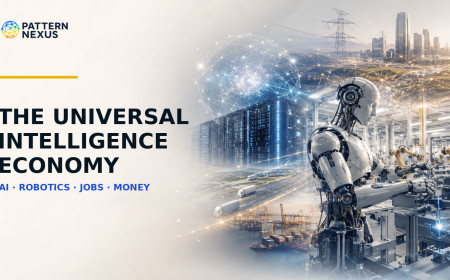 Article · related
The Universal Intelligence Economy: AI, Robotics, Jobs, Money, and the 2030–2035 Transition
AI companies are assembling a cognitive-and-physical labor system designed to outscale human work. This forecast maps the 6–18 month robotics crossover, three displacement paths, the break in wage-based demand, and the monetary architecture required if machine output replaces labor income.
Published Aug 10, 2026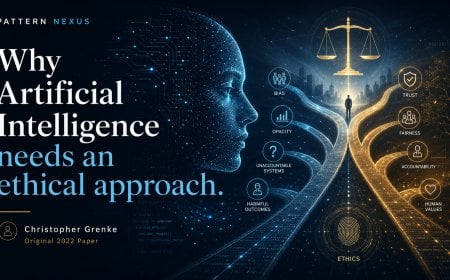 Article · related
Why Artificial Intelligence needs an ethical approach.
Originally written by Christopher Grenke in 2022, this paper examines artificial intelligence, trust, ethics, human values, algorithmic bias, accountability, and the potential consequences of increasingly advanced A.I. systems. It is being published in its original form without updating its arguments or conclusions to reflect later developments.
Published Jul 27, 2026 Article · related
The Surveillance State: Does Humanity Need a Nanny?
A Pattern Nexus article on the surveillance state after AI, asking whether humanity’s old fear of Orwellian control changes once artificial intelligence, task-specific systems, biotech, chemistry, and decentralized tools make individual actors far more dangerous than they were in the old world.
Published Jul 8, 2026 Article · related
G7 Turns Frontier AI Into a Sovereignty-and-Access Bargain
G7 leaders used the final day of the Évian summit to put artificial intelligence in front of heads of government and major AI executives. The immediate question was safe deployment, but the deeper fight is over who controls access to frontier models, compute, data and security-sensitive AI capabilities.
Published Jun 17, 2026 Article · related
OpenAI Builds the Blast Door Into the Agent Stack
OpenAI has made Lockdown Mode available as an opt-in advanced security setting for ChatGPT, with rollout details varying by account type and workspace. The feature limits or disables network-enabled capabilities such as live browsing, deep research, agent mode, file downloads, some web-derived image support, and certain connector actions to reduce prompt-injection-based data exfiltration risk. The Pattern Nexus read: the AI economy is shifting from model intelligence alone toward controlled runtime architecture, where egress, permissions, and side effects become core security primitives.
Published Jun 7, 2026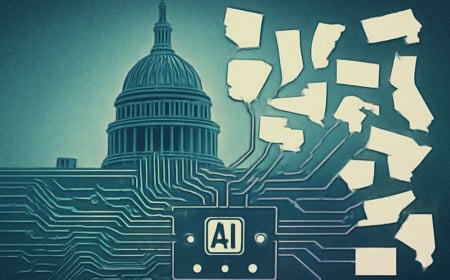 Article · related
Congress Moves to Preempt the AI Patchwork
Reps. Jay Obernolte and Lori Trahan released a discussion draft of the Great American Artificial Intelligence Act of 2026 on June 4, 2026. The draft creates a federal framework for frontier AI governance, audits, whistleblower protections, cybersecurity, workforce measures, and CAISI oversight, while preempting state laws that specifically regulate AI model development. The fight is no longer only about how powerful models should be tested; it is about who gets to write the rules.
Published Jun 7, 2026 Article · related
The Water That Would Not Drain: The Osireion, the Osiris Shaft, and the Ancient Hydrology Pattern Hiding Under Civilization
The Osireion at Abydos and the Osiris Shaft at Giza are usually treated as Egyptian mysteries, but the deeper pattern is global. Ancient builders repeatedly placed sacred architecture at the boundary between visible water and hidden water: aquifers, shafts, springs, subterranean channels, artificial islands, pressure systems, and ritual wells. This Pattern Nexus research piece separates evidence from exaggeration, examines the real dewatering problem at Abydos, corrects the stronger viral claim around the Osiris Shaft, and then maps the same hydrological intelligence across Petra, Dholavira, Mohenjo-daro, Nasca, Palenque, Angkor, Tiwanaku, Persian qanats, Indian stepwells, and Nuragic Sardinia.
Published May 22, 2026 Article · related
The End of Human Primacy: By 2030, the Handoff May Be Underway
Humanity may be approaching the first era in history where it is no longer the most capable intelligence on Earth. This Pattern Nexus piece breaks down why the AI handoff may be closer than most people think.
Published Mar 17, 2026 Article · related
Caracas Escalation: Explosions, Airstrikes, and the Fog of Verification
Explosions near Caracas, airstrike claims at Higuerote Airport, armored deployments, and U.S. aerial assets on radar. A Pattern Nexus reconstruction separating verified events from information warfare.
Published Jan 3, 2026 Article · related
A Long Arc of Intelligence: How 80 Years of Engineering Created Modern LLMs
A century-long history of large language models—from early probability theory and Cold War computing to neural networks, transformers, scaling laws, and the emergence of modern AI. A deep Pattern Nexus exploration of how LLMs truly evolved.
Published Nov 23, 2025 Article · related
AI Compute and Power Infrastructure in 2025 — The New Industrial Backbone
A deep Pattern Nexus investigation into the 2025 AI industrial build-out — tracking every major compute deal, hyperscaler expansion, and the rebirth of nuclear power as the energy backbone for machine intelligence. Covers global capacity timelines, regional grid stress, economic spillovers, and the new “AI industrial complex” forming across tech and energy.
Published Nov 12, 2025 Article · related
Pattern Nexus Worldview Manifesto: The Turning Has Begun
A manifesto for those who see the world shifting. The Pattern Nexus worldview defines the coming civilizational turning — sovereignty, systems thinking, technological acceleration, decentralized intelligence, and the rise of builders in an age of collapse and renewal.
Published Nov 3, 2025 Article · related
Alone Together: The Dual Impact of the Internet and AI
From AOL chat rooms to artificial intelligence, technology has redefined connection and isolation. The evolution of the internet reshaped society, identity, and communication — making us more connected than ever, yet increasingly alone.
Published Oct 28, 2025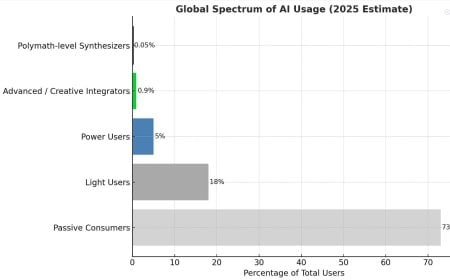 Article · related
Why Most People Won’t Adapt to AI — and Why Polymaths Will
AI isn’t replacing people — it’s revealing them. Most fear it because it mirrors back their own cognitive limits. The few who thrive are polymathic thinkers — those who treat AI as a cognitive amplifier rather than a threat. This long-form essay explores the psychology, neurology, and societal divergence AI is accelerating — and why integration, not resistance, defines the next evolutionary step in human intelligence.
Published Oct 18, 2025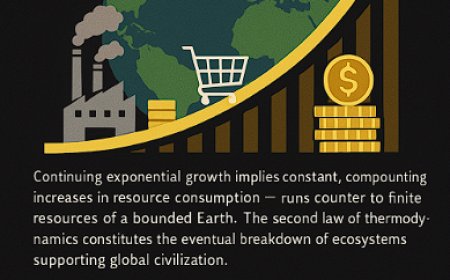 Article · related
⚛️ Big Tech’s Fusion Bet: How AI’s Energy Demand Is Rewriting Physics
The AI revolution isn’t just changing software — it’s rewriting the energy equation of civilization. As machine intelligence accelerates, Big Tech’s investment in nuclear fusion reveals an unspoken truth: the race for artificial intelligence is ultimately a race for power — in the most literal sense.
Published Oct 18, 2025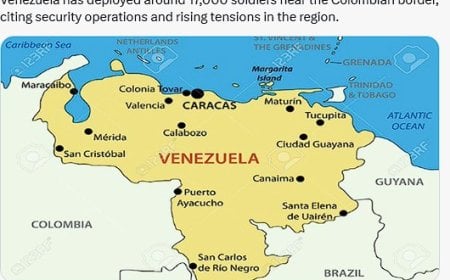 Article · related
Venezuela on the Brink — From Quiet War to Open Confrontation
Escalation between the U.S. and Venezuela has moved from covert operations to direct confrontation. Strikes, intelligence activities, and regional shifts point toward a hybrid war developing in Latin America — with global implications.
Published Oct 17, 2025