
The Script, the Circus, and the Rails
A Pattern Nexus control-lens article on how crisis, spectacle, media concentration, digital money, identity systems, AI, and machine integration fit into the same architecture of control.
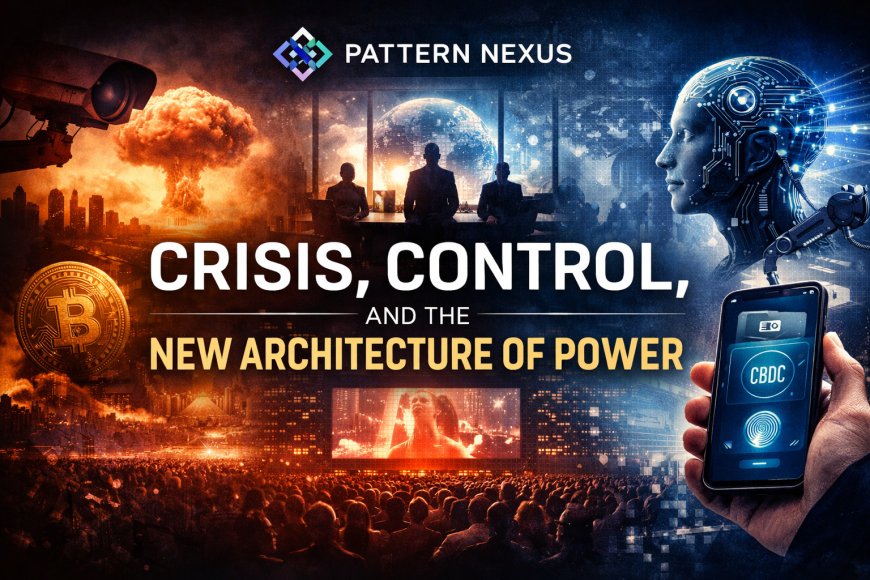
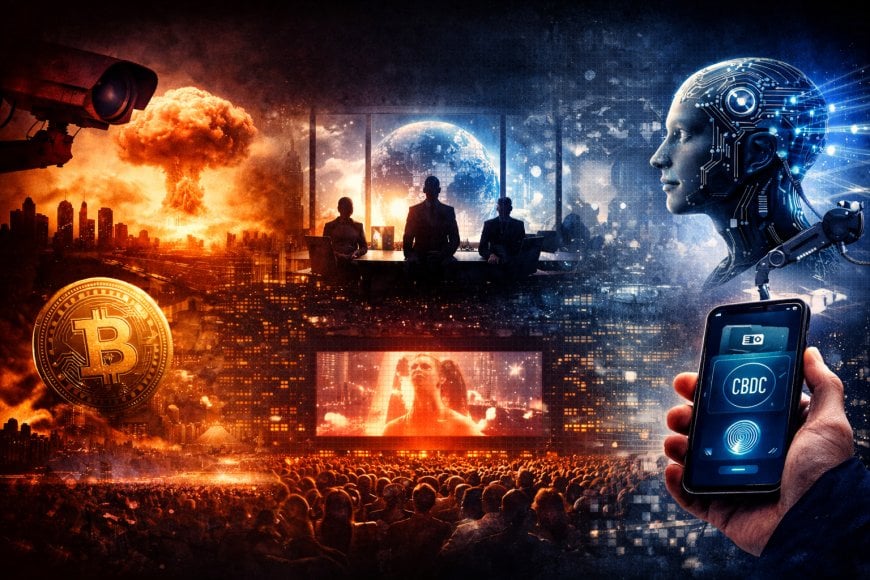

This piece starts with a Bill Cooper clip, but it does not live or die by that clip. I am not asking anyone to accept every claim in the video, and I am not pretending every dramatic old warning automatically translates into a clean modern explanation. That is not the point. The point is that buried inside a lot of the noise is a real control structure that people still do not want to look at directly. Crisis is used to compress dissent. Narrative is used to pre-shape interpretation. Media and platform concentration narrow what becomes socially legible. Sports, entertainment, celebrity culture, and infinite digital feeds function as bandwidth sinks that pull emotional energy into spectacle instead of structure. That does not make sports evil. It means sports can function as a societal distraction layer when people build their emotional world around the game while the actual rules of power keep moving somewhere else. At the same time, digital money, digital identity, compliance systems, AI, and machine integration are converging into a deeper permission architecture. This is the Pattern Nexus read: the world is not divided into separate topics. It is stacked in layers, and the layers are increasingly being welded into one operational system.
The strongest control systems do not begin with chains. They begin with interpretation. If you can shape how a population explains events to itself, you can steer policy tolerance before the public even sees the machine.
I am not saying sports are inherently bad. I am saying they can function as a mass social distraction structure when the game becomes more emotionally real to people than the systems governing their lives.
The real story is not one secret meeting. The real story is that narrative, attention, finance, identity, and compute are converging into one stack.
The Video Is a Trigger, Not a Belief Test
A lot of people still handle material like this in the dumbest possible way. They either swallow it whole because it sounds bold, or they reject all of it because parts of it sound overreaching. Both responses miss the point. I do not support everything in this video. I do not think every historical or theological claim inside it should be treated as settled fact. I am not using it as doctrine. I am using it as a trigger point because it touches a live pattern most people still refuse to look at directly.
That distinction matters. There is a difference between endorsing a speaker and recognizing a structure. There is a difference between saying, “this man explained everything,” and saying, “this clip points at a real control architecture that has only become more visible over time.” My interest is not in turning Bill Cooper into some kind of prophet. My interest is in the architecture: how populations are shaped, where attention gets redirected, how crisis gets operationalized, how narrative pre-frames reaction, and how modern power is migrating out of obvious political language and into technical systems that most people barely notice until they are already locked in.
That is why the video still lands. Not because every word in it is right, but because it is circling several real themes at the same time: apocalyptic scripting, bread-and-circuses dynamics, media concentration, war as a forcing mechanism, digital transaction control, and the machine horizon where human life becomes increasingly routed through technical systems. Those are not fringe subjects anymore. Those are now live infrastructure, policy, capital, and governance subjects.
So read this article correctly. This is not me signing off on everything in the video. This is me saying there is enough signal in the pattern to use it as an entry point. The real argument is bigger than the clip. The clip just helps reveal the shape of it.
I am not endorsing every claim in the video. I am saying the video points toward a real pattern: crisis, distraction, concentrated narrative, and technical dependency are increasingly fused into one control environment.
The Script: Crisis, Prophecy, and Sovereignty Compression
The opening structure of the video matters even if you are skeptical of its framing. It ties Israel, prophecy, Armageddon, and catastrophic war to a larger push toward dissolving sovereignty into a more centralized order. Whether a reader treats the prophetic element literally, symbolically, or strategically, the control logic is still there. Crisis does not just destroy. Crisis reorganizes. It lowers resistance. It speeds up consent. It creates the emotional condition where things that were once politically impossible suddenly become acceptable because fear reorders the public mind faster than reason can.
That is one of the oldest tricks in power and still one of the most effective. Centralization rarely sells itself by saying, “we would like more control.” It arrives wearing emergency language. Security. Stability. Counter-terror. Anti-fraud. Misinformation prevention. Continuity. Resilience. Interoperability. Temporary emergency coordination. Every individual layer can be argued for. Some of those arguments are even legitimate at the surface. But stack enough of them together and you do not end up with a free society that just got a little more organized. You end up inside a permission structure.
The prophecy piece matters here because belief systems can be operationalized. That is the point. If enough people can be taught that a coming sequence of war and catastrophe is inevitable, or even divinely ordained, resistance can be neutralized before the machinery is fully visible. Some people step back because they think it must happen. Others exploit that passivity because they know it works. I am not arguing theology in this article. I am making a systems point. If a script can shape interpretation upstream of events, then that script becomes part of the control layer whether it is metaphysically true or not.
This is also why the Middle East remains such a useful crisis theater. It is not just about oil. It is not just about religion. It is not just about military posture. It is the overlap of all of them. It is geography plus theology plus chokepoints plus energy plus symbolic civilizational value. That makes it uniquely effective as a narrative accelerator. When tensions spike there, the public is not just reacting to troop movements or missile exchanges. It is reacting to centuries of layered meaning stacked on top of the event itself. That is what gives the theater so much leverage.
And once a system is trained to solve every major shock with more monitoring, more integration, more standardization, and more technical control, sovereignty starts shrinking in practice even if the public still talks as if it lives in a world of independent choices. That is how real compression works. Not one giant speech. Not one obvious coup. A long sequence of emergency-justified narrowing until the rails themselves become the law.
The same logic scales beyond war. Financial instability can justify tighter payment visibility. Migration stress can justify tighter identity enforcement. Child safety can justify age-verification rails. Platform abuse can justify speech narrowing. Fraud can justify persistent transaction monitoring. Public health can justify continuity systems. Every one of those has a surface case. The deeper question is what gets built underneath the case, what becomes permanent, and whether the public notices when temporary logic hardens into durable architecture.
- War compresses dissent and widens tolerance for exceptional powers.
- Prophecy and ideology can both function as interpretation rails.
- Emergency governance normalizes structural changes under time pressure.
The Circus: Sports, Entertainment, and Managed Attention
This is the part I want to make absolutely clear because people always flatten the point. I am not saying sports are evil. I am not saying people should never enjoy a game. I am not saying athletic achievement has no value. That would be stupid. What I am saying is that sports absolutely can function as a societal distraction structure, and in the modern era they often do. That is not an attack on athletes or fans. It is a recognition of how mass attention gets organized.
The “Roman circus” point survives because the underlying mechanism never went away. It evolved. In old societies, rulers used spectacle, ritual, and public entertainment to direct mass emotion away from structural questions. In modern societies, that function is far more advanced. Sports are not just games now. They are media ecosystems, identity systems, betting markets, city-level religion, algorithmic content engines, advertiser magnets, and emotional time sinks. They create recurring rituals that millions of people organize their week around. Again, that does not make them inherently wrong. It means they are operationally powerful.
And that is the real point. A society tells you what it values by where it puts its energy, money, emotional intensity, and daily bandwidth. If people know every trade, every stat line, every injury report, every coaching rumor, every playoff scenario, but have no idea what changed in financial regulation, digital identity policy, platform governance, AI deployment, or defense posture, then yes, the circus is functioning exactly as a control structure. The issue is not that sports exist. The issue is imbalance. The game becomes emotionally central while actual power remains abstract, boring, and ignored.
This is why I do not frame sports as some moral evil. I frame them as a bandwidth capture layer. They take attention that could have gone toward understanding systems and redirect it into repeatable emotional loops that feel meaningful but rarely translate into actual civic or structural awareness. People build communities around teams. They build schedules around seasons. They build identities around outcomes they do not control. They pour outrage, joy, grief, and tribal energy into the arena while the underlying rules of money, media, technology, and governance keep shifting elsewhere.
That same logic now extends far beyond sports. Celebrity culture, influencer culture, outrage cycles, short-form video, streaming addiction, endless content churn, and even politics-as-entertainment all function similarly. The point is not that every form of entertainment is bad. The point is that a civilization can become easier to manage when its emotional metabolism is constantly consumed by spectacle. As long as people are cheering, scrolling, debating highlights, and living inside recurring entertainment loops, they have less time, less patience, and less structured energy left for the systems actually shaping their lives.
So yes, I agree with that part of the video 100%. Sports as circus, as a control structure, as a social distraction layer? Absolutely. Not because sports themselves are satanic or forbidden nonsense. Because in practical terms they help absorb public focus. They help convert attention into entertainment rather than analysis. They help keep the emotional center of society anchored in ritual competition while structural power continues to move in the background.
And once you see that, you stop asking whether the circus is “allowed” and start asking what function it serves. That is a much smarter question.
The Rails: Media, Money, Identity, AI, and Machine Governance
The circus is only one layer. The deeper issue is the rails under the circus. That is where the system gets serious. Media concentration shapes what becomes narratively visible. Platforms determine reach. Advertisers shape incentives. Recommendation systems shape attention. Payment infrastructure determines what clears. Identity infrastructure determines who can access what. Compliance layers determine what gets flagged, throttled, delayed, frozen, or denied. Once you understand that, you stop thinking in separate boxes. You realize narrative, money, access, and identity are increasingly parts of the same environment.
This is why digital money matters. Not just because of currency competition or payment modernization, but because programmable rails create the possibility of conditional economic life. This is why digital identity matters. Not just because of convenience, but because identity becomes the linkable permission key between platforms, services, transactions, communications, and access systems. This is why AI matters. Not just because it is impressive, but because it becomes the enforcement and interpretation layer that can sit on top of the stack, sorting, flagging, predicting, scoring, and optimizing at a scale no human bureaucracy ever could.
That is also why people need to stop talking about these subjects like they are separate future topics. They are converging now. Money is becoming more digital, trackable, and interface-driven. Identity is becoming more portable and standardized. Platform governance is becoming more assertive. Age verification and online safety arguments are increasingly being used to push stronger access gates. AI systems are rapidly being integrated into everything from search and moderation to customer service, enterprise decisioning, fraud detection, and state capacity. Brain-computer interfaces and neuroprosthetics are moving out of pure science fiction and into active deployment. Longevity research and machine-assisted continuity thinking are no longer fringe obsessions either. You can call those breakthroughs, risks, or both. But you cannot call them isolated anymore.
And this is where the old “man becoming god through technology” framing starts to map onto something more concrete. Not in some movie-villain sense. In a civilizational sense. A society that increasingly routes cognition, communication, movement, exchange, memory, and identity through machine systems is no longer just a technological society. It is a stack-governed society. The meaning of rights, autonomy, and even personhood begins to shift when the practical ability to act depends on interoperating with systems you do not control and barely understand.
That is the actual Pattern Nexus connection. The world is not divided into neat categories. The control architecture does not think in categories. It thinks in integration. It thinks in chokepoints. It thinks in standards. It thinks in enforceable rails. It thinks in optimizing behavior across systems. And once enough of those layers lock together, you do not need some old-school visible tyranny to reduce sovereignty. You just need a civilization willing to trade friction for convenience, privacy for safety, and independent judgment for prepackaged interfaces.
That is the shift. Not one conspiracy. A stack.
Pattern Nexus Lens
The cleanest way to read all of this is not “the video was right about everything” and not “none of this matters because some of it sounds dramatic.” The clean read is that the clip is pointing at a real pattern, but the stronger version of that pattern has to be updated, clarified, and grounded in present systems. My position is simple. I do not endorse everything in the video. I do not need to. The bigger structure is visible without doing that. Crisis is used to transfer tolerance. Prophecy, ideology, and narrative all function as upstream interpretation systems. Sports and spectacle absorb bandwidth. Media concentration shapes legibility. Payment and identity rails become practical sovereignty systems. AI and machine interfaces push more and more of life into managed environments. Once enough of those layers interlock, control no longer has to look like one obvious authoritarian event. It looks like convenience, optimization, entertainment, safety language, and systems the public slowly becomes too dependent to refuse.
The point is not that the world is run by one cartoon villain club. The point is that populations can be moved through crisis, spectacle, concentrated narrative, sports-as-circus, digital rails, and machine dependency into surrendering sovereignty one layer at a time.
FAQ
Are you endorsing everything in the video?
No. I am explicitly not doing that. I am saying the video contains a real pattern worth examining, but the article stands on a broader and more current control-systems argument than the clip itself.
Are you saying sports are bad?
No. I am saying sports can function as a societal distraction and control structure when they absorb more emotional and cognitive energy than the real systems governing people’s lives. That is a systems critique, not a moral panic.
What should people actually watch going forward?
Watch the rails. Watch digital money, digital identity, age verification, platform speech controls, standards bodies, AI rollout, BCI normalization, and any crisis being used to justify “temporary” integration that somehow never goes away.
Sources
These sources support the article’s current factual framing on digital currency, digital identity, Davos 2026, media consolidation, BCIs, and AGI positioning.
- Atlantic Council CBDC Tracker
- ECB: Progress on the digital euro
- ECB: Digital euro pilot FAQ
- European Commission: European Digital Identity
- European Commission: EU Digital Identity Wallet Home
- World Economic Forum Annual Meeting 2026
- Pew Research: News Platform Fact Sheet
- Reuters: National TV ownership cap debate
- Reuters: FCC approves Nexstar-Tegna combination
- Reuters: Warner Bros Discovery shareholder vote on Paramount deal
- Neuralink: Two Years of Telepathy
- NIH: Brain-computer interface restores natural speech
- NEJM: Speech neuroprosthesis study
- OpenAI Charter
- Google DeepMind: Taking a responsible path to AGI
- Nature Communications: Partial reprogramming and biological age review
Apa Reaksi Anda?
 Suka
0
Suka
0
 Tidak Suka
0
Tidak Suka
0
 Cinta
0
Cinta
0
 Lucu
0
Lucu
0
 Wow
0
Wow
0
 Sedih
0
Sedih
0
 Marah
0
Marah
0

Founder of Pattern Nexus. I research markets, macro, geopolitics, AI, history, ancient systems, and the patterns most people overlook. I’m also building Market Radar, a trading scanner designed to read pressure, risk, confirmation, and setup quality before chasing a move. Pattern Nexus is where I connect the dots between data, history, technology, and the bigger system playing out around us.















Komentar (0)