
Parking Full in Orbit: The Day the ISS Used All Eight Docking Ports
For the first time in history, the International Space Station reached full capacity with eight spacecraft docked simultaneously. A milestone in orbital logistics that signals the next era of human spaceflight."
The Day the ISS Filled Every Port
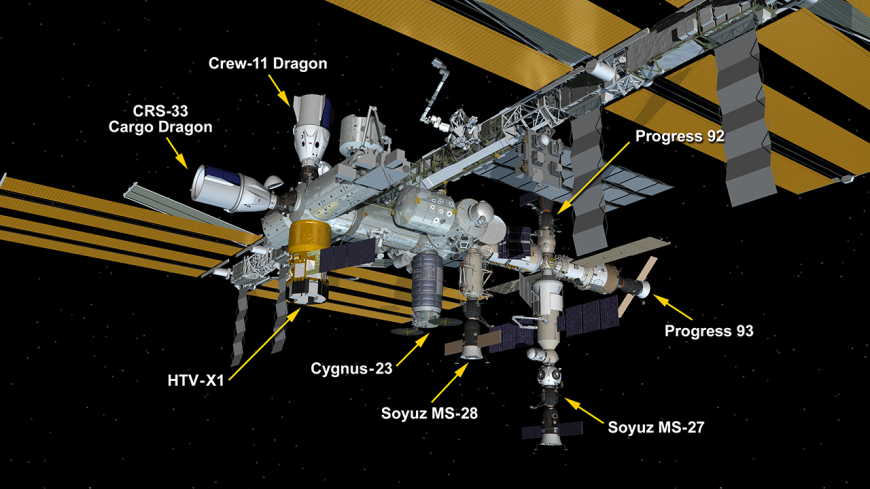
On December 1, 2025, the International Space Station quietly crossed a logistical threshold: all eight of its visiting-vehicle ports were occupied at the same time. The milestone became official when a Cygnus XL cargo spacecraft was reinstalled on the Earth-facing port of the Unity module, snapping the final piece into place on an already busy outpost.
In practical terms, this means the ISS hit maximum “parking capacity” for visiting vehicles: crew transports, cargo ships, and international logistics craft all attached at once. In symbolic terms, it’s a snapshot of where human spaceflight is right now: crowded, multi-polar, commercially integrated, and still anchored to a 25-year-old orbital platform.
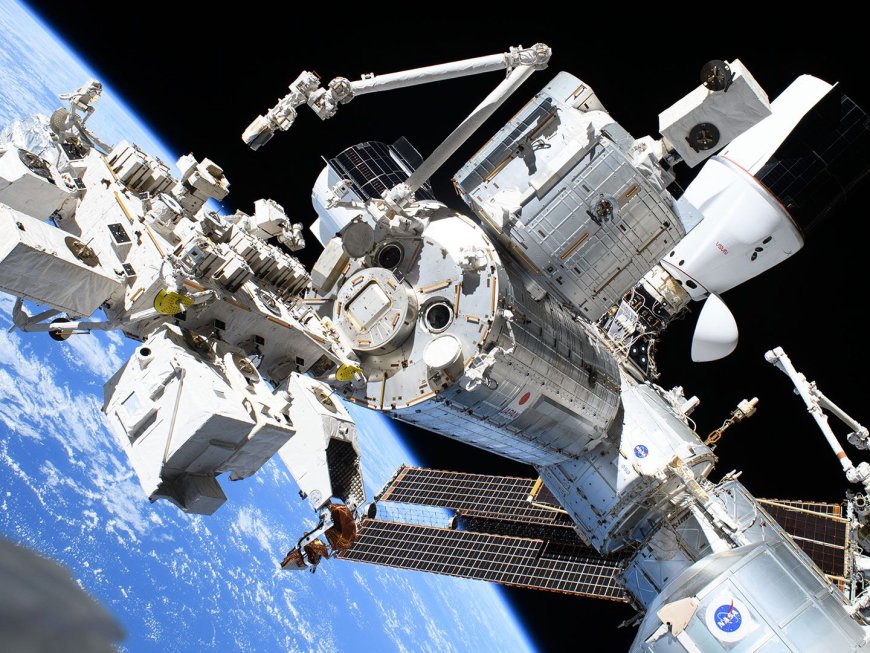
In one frame, you have U.S. commercial spacecraft, Japanese cargo logistics, and Russian crew and supply ships all plugged into the same station. It’s not just a photo-op. It’s the real operational mesh of modern space infrastructure.
Who’s Parked at the Station?
The configuration behind the “eight spacecraft” headline is a mix of crewed vehicles and automated cargo haulers. At full occupancy, the visiting stack looks like this:
- Two SpaceX Dragon spacecraft (crew and/or cargo variants) on the U.S. segment
- One Cygnus XL cargo ship attached to the Unity module’s Earth-facing port
- One HTV-X1 cargo spacecraft from Japan’s space agency, JAXA
- Two Soyuz crew vehicles on the Russian segment
- Two Progress cargo resupply ships, also on the Russian segment
Each of these vehicles has its own job: bringing up people, food, propellant, water, science hardware, spare parts, and eventually carrying trash or returning experiments and crew back down to Earth. The mix of vehicles also shows how the ISS has evolved from state-only operations into a hybrid ecosystem of national programs and private contractors.
Why This Configuration Matters
Filling every docking and berthing port is more than a trivia milestone. It’s a stress test of the station’s role as a high-throughput logistics hub in low-Earth orbit.
To run at “all ports full” you need:
- Precise traffic choreography so arriving and departing vehicles don’t conflict
- Enough life support, power, and thermal margin to support ten or more people plus docked spacecraft
- Tight coordination between multiple control centers and agencies spread across the U.S., Europe, Russia, and Japan
- Scheduling discipline to thread crew rotations, cargo swaps, and station maintenance into the same narrow windows
On paper, the ISS has had eight visiting-vehicle ports for years. In practice, using all of them at once required the right alignment of crew rotations, cargo missions, and new vehicle types like Cygnus XL and HTV-X1. This alignment is what made December 1, 2025, a “first.”
When all your ports are full, you’re not just “doing science in space” — you’re running an orbital railyard. The ISS becomes the switching node between Earth’s launch pads and a future network of stations and depots that doesn’t exist yet, but is already implied by this kind of traffic.
What This Tells Us About the Next Space Era
A fully occupied ISS isn’t the end state of human spaceflight — it’s a transition signal. The station is operating near the limits of its original architecture at the same time that commercial and national players are gearing up for new stations, lunar missions, and deep-space infrastructure.
Eight docked spacecraft at once tells you a few things:
- Launch cadence is high enough to keep multiple vehicles cycling through low-Earth orbit simultaneously.
- Commercial cargo and crew providers are now structurally embedded in how the orbital supply chain works.
- The ISS is being used as a full-tilt testbed for future logistics patterns: how you move people and mass through space efficiently.
- We’re approaching the point where one station is no longer enough; traffic patterns are starting to look like the precursor to a network.
The photo of eight spacecraft docked to a single station looks like a novelty now. In hindsight, it may read more like a timestamp: the moment when low-Earth orbit stopped being a frontier and quietly turned into infrastructure.
Sources
Qual è la tua reazione?
 Mi piace
0
Mi piace
0
 Non mi piace
0
Non mi piace
0
 Amore
0
Amore
0
 Divertente
0
Divertente
0
 Wow
0
Wow
0
 Triste
0
Triste
0
 Arrabbiato
0
Arrabbiato
0

Founder of Pattern Nexus. I research markets, macro, geopolitics, AI, history, ancient systems, and the patterns most people overlook. I’m also building Market Radar, a trading scanner designed to read pressure, risk, confirmation, and setup quality before chasing a move. Pattern Nexus is where I connect the dots between data, history, technology, and the bigger system playing out around us.













Commenti (0)