The Space Infrastructure Race Just Escalated: PALLAS-1, Orbital Warfare, and NASA’s Mars Network
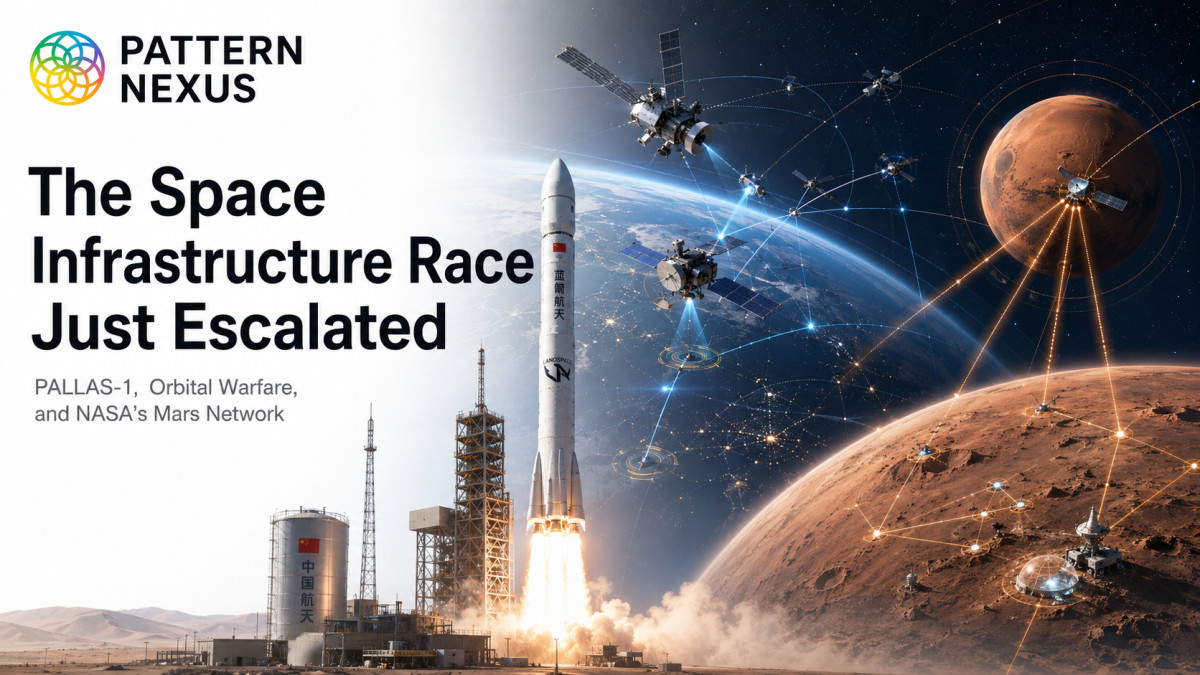
Three developments in the first days of September 2026 pushed the space-infrastructure thesis forward again. China’s Galactic Energy successfully launched PALLAS-1, a reusable medium-lift rocket designed for repeated flights and constellation deployment. Reuters documented a rapidly advancing U.S.-China contest around maneuverable satellites, autonomous pursuit, refueling, jamming, and spacecraft capable of approaching or interfering with other satellites. At the same time, NASA awarded Blue Origin up to roughly $700 million to build a dedicated Mars Telecommunications Network intended to provide high-bandwidth communications and navigation services at Mars by 2030. These are not separate stories. They show the space economy dividing into three increasingly mature layers: cheaper access, contested orbital control, and permanent interplanetary infrastructure.
 Pattern Nexus Research
The Space Infrastructure Race Just Escalated: PALLAS-1, Orbital Warfare, and NASA’s Mars Network
Three developments in three days pushed the same thesis forward from completely different directions: China added another serious reusable-launch platform, the U.S.-China military competition moved deeper into autonomous orbital maneuvering and servicing technologies, and NASA began building a dedicated communications layer around Mars.
The stack is extending outward and becoming contested at the same time.
- China’s Galactic Energy successfully launched PALLAS-1 on September 1. The 52-meter, two-stage liquid rocket reached its planned orbit on its first flight. Galactic Energy designed the first stage for vertical recovery and at least 25 uses, although no recovery was attempted on the maiden mission.[1][2]
- PALLAS-1 matters because China is no longer converging on reuse through one company. LandSpace’s Zhuque-3 recovered a booster in August, while Galactic Energy and multiple other Chinese firms are pursuing partially reusable systems.[2]
- The military-space competition is moving into the same capabilities commercial orbital infrastructure requires. Reuters reported expanding U.S. and Chinese work involving maneuverable satellites, autonomous pursuit, satellite refueling, jamming, proximity operations, spaceplanes and systems capable of approaching or potentially disabling other spacecraft.[3]
- That creates a dual-use problem. Rendezvous, autonomous navigation, robotic capture and refueling can extend the life of commercial spacecraft. The same capabilities can also inspect, shadow, interfere with or capture another nation’s satellite.
- NASA has now pushed infrastructure beyond the Earth-Moon system. On September 1 NASA awarded Blue Origin a contract worth up to roughly $700 million to develop the Mars Telecommunications Network, with a high-performance Mars communications orbiter due to NASA by the end of 2028 and network operations expected at Mars by 2030.[4]
- Blue Origin says the Mars Telecommunications Orbiter will be built on Blue Ring. The architecture is intended to provide high-bandwidth communications and navigation services for spacecraft operating on and around Mars, with a design intended to grow as robotic and eventually human activity increases.[5]
- Europe is seeing the same demand signal from the transportation side. ESA is considering increasing Ariane 6 and Vega-C capacity because expected satellite demand may exceed currently planned launch rates around the end of the decade.[6]
- The Pattern Nexus thesis is getting harder to separate into civilian, commercial and military categories. The same underlying technologies—cheap launch, maneuverability, autonomy, communications, refueling, servicing and navigation—are becoming the operating layer for commerce, science and war.
This is a direct follow-up to Space Is Becoming Infrastructure: The Two Weeks That Exposed the New Orbital Operating System. That article mapped launch, reuse, communications, autonomous navigation, servicing, maintenance, lunar resources and deep-space communications as one emerging stack. The first days of September added three important extensions almost immediately.
The system moved again almost immediately
I had barely finished the last space-infrastructure article before the next three developments arrived.
China successfully flew another reusable-class commercial rocket.
A major investigation documented how autonomous orbital maneuvering, proximity operations, refueling and spacecraft capture are becoming central to the U.S.-China military competition.
Then NASA awarded a contract to build a dedicated telecommunications network at Mars.
Those sound like three unrelated headlines.
They are not.
The first is about lowering the cost and increasing the frequency of access.
The second is about controlling what happens after spacecraft arrive in orbit.
The third is about extending the communications and navigation backbone beyond Earth and the Moon to another planet.
Launch.
Control.
Network.
That is the operating stack.
China just added another serious vehicle to the reuse race
At 10 a.m. Beijing time on September 1, Galactic Energy launched PALLAS-1 Y1 from the Dongfeng commercial space zone at Jiuquan.
The maiden mission successfully entered its planned orbit and completed its test objectives.[1]
PALLAS-1 is not a tiny experimental launcher.
It is a 52-meter liquid-fueled medium-lift vehicle with a core diameter of 3.35 meters, a liftoff mass around 283 metric tons and the ability to carry roughly five to seven metric tons to low Earth orbit.[1]
The first stage uses seven CQ-50 liquid-oxygen/kerosene engines.
Galactic Energy designed that stage around vertical recovery and a reuse target of at least 25 flights.[2]
But the qualification is important:
PALLAS-1 did not attempt a landing on its first mission.
The maiden flight proved the launch vehicle could reach orbit.
It did not prove recovery.
It did not prove refurbishment.
And it definitely did not prove 25-flight reuse.
Those are future milestones.
Still, getting a reusable-class medium launcher through its first orbital flight matters because the difficult path toward reuse begins with a functioning orbital transport system.
Galactic Energy says PALLAS-1 is intended for large satellite constellations and commercial satellite deployment.
That tells us why the architecture exists.
The reusable rocket is not being developed in isolation.
It is being built around anticipated mass demand.
The more important change is that China’s reuse program is becoming competitive internally
Two weeks ago, LandSpace’s Zhuque-3 booster recovery looked like the headline.
It still matters.
But PALLAS-1 changes the shape of the story.
China is not waiting for one state program or one private company to reproduce Falcon 9.
Multiple firms are now pursuing reusable or partially reusable orbital launch systems.
That matters because competition accelerates learning.
One company solves engine throttling.
Another solves guidance.
Another develops a lower-cost manufacturing process.
Another wins a constellation contract that provides flight volume.
People often treat SpaceX’s advantage as a rocket-design advantage.
It is also an ecosystem advantage.
Falcon 9 benefited from internal demand through Starlink, government contracts, commercial launches, frequent flight opportunities, recovered hardware and years of operational feedback.
China is now constructing its own version of that feedback loop through GuoWang, commercial constellations, Earth observation, state demand and a growing private launch sector.
The structural shift is not “China has a reusable rocket.” The structural shift is that China is beginning to have a reusable-launch market.
The operating layer is becoming the battlefield
The second development is far more consequential than another missile test.
Reuters reported on September 2 that the United States and China are accelerating work on spacecraft capable of maneuvering around other satellites, refueling, conducting proximity operations, jamming systems and potentially capturing or disabling spacecraft.[3]
A recent Chinese spaceplane mission reportedly deployed a smaller satellite that then performed orbital maneuvers.
Chinese researchers are also studying autonomous pursuit and fuel-efficient approaches to other spacecraft.
The United States and United Kingdom have conducted coordinated operations near a suspected Chinese reconnaissance satellite.
Meanwhile, both sides continue developing ground-based and space-based counterspace systems.
This changes what “space warfare” means.
The old image is a missile blowing up a satellite.
That remains possible.
But destroying spacecraft kinetically creates debris and can damage the orbital environment everyone uses.
A more sophisticated contest is emerging around reversible or controllable effects:
Jam the link.
Blind the sensor.
Approach the spacecraft.
Inspect it.
Shadow it.
Move it.
Refuel your own platform.
Potentially interfere with the other one without creating a giant debris cloud.
That is a fundamentally different battlefield.
It is also technically much closer to the commercial space economy than most people realize.
The same technology that repairs a satellite can become a weapon
This is where the earlier Pattern Nexus article becomes more important.
I wrote about NASA’s Starling satellites demonstrating GPS-independent navigation.
I wrote about Katalyst Space trying to rendezvous with Swift and demonstrate commercial servicing.
I wrote about optical networking, autonomous systems and orbital maintenance.
All of those technologies have peaceful and commercial uses.
They also create military capability.
| Capability | Commercial / civil use | Military use |
|---|---|---|
| Autonomous navigation | Formation flying, swarms, collision avoidance | Autonomous pursuit and tracking |
| Rendezvous | Inspection and servicing | Close approach to another state’s spacecraft |
| Robotic capture | Repair, relocation, debris removal | Potential interference or seizure |
| Refueling | Extend spacecraft life | Increase endurance and maneuver freedom |
| Optical / RF systems | High-bandwidth networking | Tracking, jamming, dazzling and sensing |
This does not mean every servicing satellite is secretly a weapon.
It means capability is dual-use.
The difference between a servicing spacecraft and a counterspace spacecraft can be mission software, command authority, sensors, payload configuration and intent.
That makes the orbital economy structurally similar to maritime infrastructure.
A tugboat can move a disabled vessel.
A navy can also maneuver another vessel.
The tool is not the strategy.
The capability changes the strategy.
NASA is no longer treating Mars communications as an accessory to individual missions
On September 1, NASA selected Blue Origin to develop the Mars Telecommunications Network.[4]
The firm-fixed-price contract has a maximum potential value of approximately $700 million.
Blue Origin is responsible for designing, developing, integrating, launching and operating a high-performance Mars telecommunications spacecraft.
NASA requires delivery by December 31, 2028.
The agency expects the network to be operational at Mars by 2030.[4]
This is a major conceptual transition.
Historically, Mars missions have depended on a mixture of direct-to-Earth communications and relay services provided by science orbiters that happened to already be there.
That works when missions are intermittent.
It becomes a bottleneck when activity grows.
More rovers mean more data.
More orbiters mean more scheduling conflicts.
Higher-resolution cameras mean larger files.
Autonomous aircraft, surface stations and eventually human crews require communications and navigation capacity that cannot be treated as leftover bandwidth.
NASA is therefore moving toward a dedicated service layer.
That is exactly what happened around Earth.
First every application builds its own communications solution.
Then enough demand accumulates that a network becomes more efficient than bespoke infrastructure.
Mars is entering that transition.
This is the moment Mars starts getting telecom infrastructure instead of simply getting missions.
Blue Origin’s orbital platform is becoming an interplanetary utility
Blue Origin says the Mars Telecommunications Orbiter will be based on Blue Ring, its maneuverable multi-mission spacecraft platform.[5]
The Mars version is planned around hybrid solar-electric and chemical propulsion.
Blue Origin describes it as a high-capacity communications system capable of providing near-continuous links between Mars assets and controllers on Earth.
The spacecraft is expected to transmit science data, imagery, navigation information and mission-critical communications for machines operating on and around Mars.[5]
That matters beyond this one NASA contract.
Blue Ring was already being positioned as an orbital transfer, hosting and infrastructure platform.
Now the same basic architecture is being extended toward Mars.
That is what platformization looks like.
Instead of designing a completely unique spacecraft for every mission, a common bus accumulates manufacturing volume, software, propulsion experience, ground support and operational history.
One platform can then host communications.
Another version can move payloads.
Another can support military sensing.
Another can operate in deep space.
This is the same industrial logic we have seen in launch vehicles.
Standardize the platform.
Increase production.
Spread development cost across more missions.
Learn faster.
Europe is already asking whether current launch capacity is enough
A secondary development from the same period strengthens the demand side of the story.
Reuters reported that ESA is considering whether Ariane 6 and Vega-C launch capacity needs to rise because expected European satellite demand could exceed currently planned launch rates around 2030.[6]
Arianespace is targeting as many as ten Ariane 6 launches per year beginning in 2027.
Even that may not be sufficient if major constellation deployments accelerate.
This is important because launch economics are ultimately demand economics.
You can build a reusable vehicle.
You can build a bigger factory.
You can build another launch pad.
But the system only becomes self-reinforcing if enough payload demand exists to fill the manifest.
China’s constellations create that demand.
Starlink created it for SpaceX.
European broadband, weather, navigation, Earth-observation and defense programs are beginning to create their own version.
Access, control and network
| Layer | Current development | Strategic meaning |
|---|---|---|
| Access | PALLAS-1 reaches orbit; Chinese reuse competition expands | Lower-cost, higher-cadence movement of mass |
| Control | Autonomous pursuit, proximity operations, refueling and maneuverable military spacecraft | Ability to defend, inspect, shadow, service or interfere with orbital assets |
| Network | NASA Mars Telecommunications Network | Persistent communications and navigation beyond Earth-Moon space |
These three layers reinforce one another.
Cheaper access puts more spacecraft into the system.
More spacecraft create more need for communications, tracking and servicing.
More dependence on orbital systems makes them more strategically valuable.
Higher strategic value drives military investment.
Military investment accelerates autonomy, maneuverability and resilient networking.
Those capabilities then spill back into commercial space.
This is the flywheel.
It is also why the civilian-versus-military distinction is becoming increasingly difficult to use as the primary analytical frame.
The same infrastructure serves both.
The orbital operating-system thesis now extends to Mars
The August article mapped the infrastructure stack this way:
Launch access.
Reuse.
Orbital networks.
Observation.
Autonomous navigation.
Servicing.
Maintenance.
Lunar logistics.
Deep-space communications.
Disposal.
The September developments add two important changes.
First, the operating layer is becoming openly contested.
The same autonomy and maneuverability needed to make orbital infrastructure useful also determines who can defend or threaten that infrastructure.
Second, the network is no longer stopping at the Moon.
NASA’s Mars Telecommunications Network takes the same logic we already use around Earth—shared communications and navigation infrastructure—and begins exporting it to another planet.
That is the threshold I care about.
A civilization does not become interplanetary because it lands one object on Mars.
It becomes interplanetary when there are enough objects there that building shared infrastructure becomes more efficient than treating each one as a standalone mission.
Mars is beginning to move from a destination to a network endpoint.
The next milestones will tell us whether these architectures are real at scale
PALLAS-1 recovery. The maiden flight reached orbit. The next major threshold is whether Galactic Energy can demonstrate controlled booster recovery and then actual reflight.
Zhuque-3 reflight. LandSpace already recovered a booster. Reflying recovered hardware will be far more important than the landing itself.
Chinese constellation cadence. Reuse becomes economically powerful when launch demand stays high enough to keep recovered boosters moving.
Orbital refueling demonstrations. Refueling changes the maneuver budget and usable lifetime of both commercial and military spacecraft.
Autonomous proximity operations. The more spacecraft can rendezvous without constant ground intervention, the more both servicing and counterspace operations change.
Blue Origin MTN milestones. The contract requires delivery of the Mars telecommunications spacecraft by the end of 2028. Watch hardware, launch assignment, production and whether NASA expands the architecture beyond a single high-capacity orbiter.
Blue Ring production. Blue Origin says multiple Blue Ring spacecraft are already in production. Platform production rate will determine whether the spacecraft becomes a repeatable infrastructure product or remains primarily mission-specific.
European launch capacity. If ESA decides that Ariane 6 production needs to exceed current planning, that will be another clear confirmation that payload demand is outrunning the launch architecture built for the previous era.
The overall direction is becoming very difficult to miss.
The first space age was exploration.
The second is infrastructure.
And infrastructure eventually becomes strategic terrain.
FAQ
Did PALLAS-1 land its booster on the first flight?
No. PALLAS-1 successfully reached orbit on its maiden mission, but Galactic Energy did not attempt first-stage recovery. The vehicle is designed for vertical recovery and repeated reuse, but those capabilities still have to be demonstrated in flight.
How much can PALLAS-1 carry?
Galactic Energy lists a maximum low-Earth-orbit payload capacity of about seven metric tons, with five to seven tons covering the company’s target constellation-deployment market.
Why does PALLAS-1 matter if Zhuque-3 already landed?
Because it shows China’s reusable-launch development broadening across multiple competing companies. A competitive ecosystem can produce more flight opportunities, different technical solutions and faster iteration than relying on one vehicle.
What are “hunter satellites”?
The term generally refers to highly maneuverable spacecraft capable of approaching, tracking or interacting with other satellites. The same rendezvous and proximity-operation technologies can support inspection, servicing or refueling, while military configurations could potentially interfere with adversary spacecraft.
Does satellite servicing automatically mean space weapons?
No. Servicing has legitimate civil and commercial uses, including inspection, life extension, relocation and debris removal. The important systems issue is that many of the underlying capabilities are inherently dual-use.
What is NASA’s Mars Telecommunications Network?
It is a planned dedicated communications and navigation infrastructure layer for Mars. NASA selected Blue Origin to develop a high-performance telecommunications orbiter intended to relay data, imagery, navigation information and mission communications for spacecraft operating on and around Mars.
When is the Mars network supposed to operate?
NASA requires delivery of the telecommunications spacecraft by December 31, 2028 and expects the network to be operational at Mars by 2030.
Why is the Mars contract important?
Because it moves Mars communications from an incidental capability provided by individual missions toward dedicated shared infrastructure. That is a key step in moving from occasional exploration toward sustained operations.
What is the Pattern Nexus conclusion?
The space infrastructure race now has three visible layers: access, control and network. Reusable launch lowers the cost of reaching space, autonomous and maneuverable spacecraft determine what can be done once there, and dedicated communications networks allow the system to extend farther from Earth.
September 2026 primary and current sources
- [1] Galactic Energy, PALLAS-1 Y1 Successfully Completes Maiden Orbital Flight, September 2, 2026.
- [2] Galactic Energy, PALLAS-1 — Medium Reusable Liquid Launch Vehicle; Space.com, China’s Private, Reusable PALLAS-1 Rocket Aces Debut Launch, September 2, 2026.
- [3] Reuters, U.S., China Arm for Space Warfare: Hunter Satellites and Orbital Weapons, September 2, 2026.
- [4] NASA, NASA Selects Blue Origin as Mars Telecommunications Network Provider, September 1, 2026.
- [5] Blue Origin, Blue Origin Selected by NASA to Help Build America’s Mars Telecommunications Network, September 2, 2026.
- [6] Reuters, Europe May Accelerate Space Launches to Meet Satellite Demand, September 2, 2026.
- [7] Pattern Nexus, Space Is Becoming Infrastructure: The Two Weeks That Exposed the New Orbital Operating System, August 2026.
The first days of September added three pieces to the same map. China is developing multiple vehicles intended to attack launch cost through reuse. The United States and China are building spacecraft that can maneuver, rendezvous, refuel and operate around other satellites, turning the orbital operating layer itself into strategic terrain. NASA is now exporting the shared-network model beyond Earth and the Moon by funding dedicated communications infrastructure at Mars. This is the progression I have been tracking: first access, then infrastructure, then dependency, then competition over the infrastructure. Space is becoming an operating system, and operating systems eventually become something nations fight to control.
Qual è la tua reazione?
 Mi piace
0
Mi piace
0
 Non mi piace
0
Non mi piace
0
 Amore
0
Amore
0
 Divertente
0
Divertente
0
 Wow
0
Wow
0
 Triste
0
Triste
0
 Arrabbiato
0
Arrabbiato
0

Founder of Pattern Nexus. I research markets, macro, geopolitics, AI, history, ancient systems, and the patterns most people overlook. I’m also building Market Radar, a trading scanner designed to read pressure, risk, confirmation, and setup quality before chasing a move. Pattern Nexus is where I connect the dots between data, history, technology, and the bigger system playing out around us.



Commenti (0)