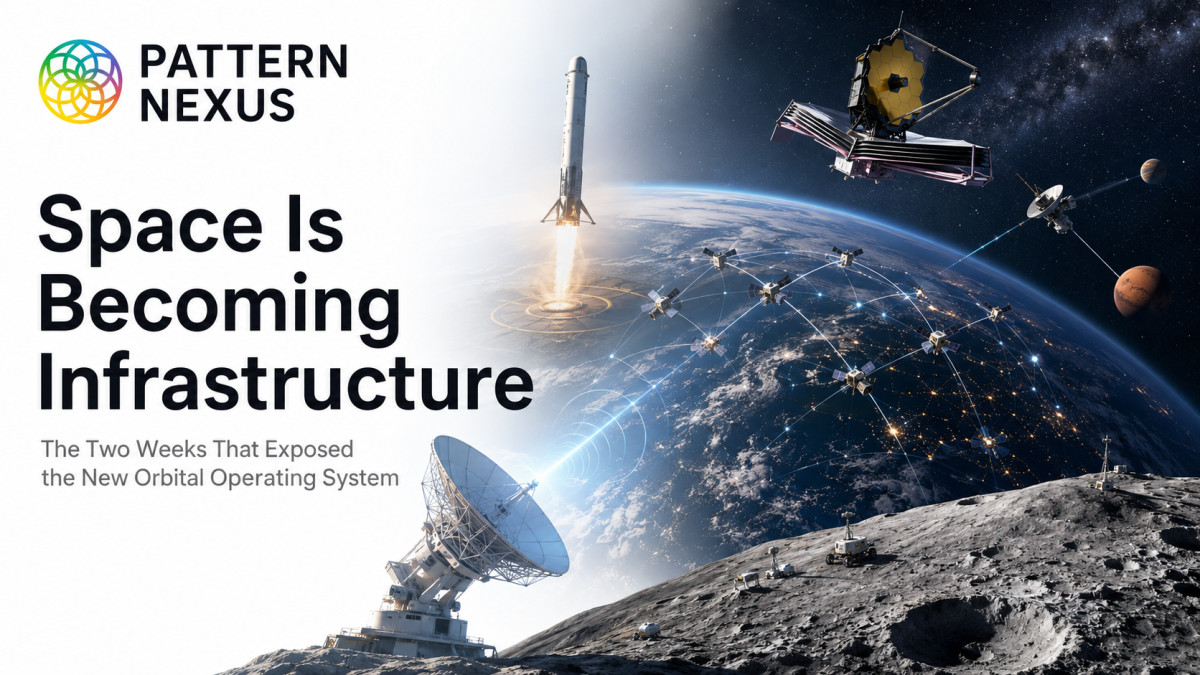
Space Is Becoming Infrastructure: The Two Weeks That Exposed the New Orbital Operating System
Roman launched, Falcon 9 hit 100 flights, China landed Zhuque-3, NASA expanded the Deep Space Network and autonomous spacecraft navigation, and orbital infrastructure accelerated.
 Pattern Nexus Research
Space Is Becoming Infrastructure: The Two Weeks That Exposed the New Orbital Operating System
The final two weeks of August were not just busy. They exposed almost every layer of a permanent space economy moving at once: launch cadence, reuse, broadband constellations, autonomous navigation, satellite servicing, deep-space communications, lunar resources, military networking, orbital maintenance, planetary exploration, astronomy and debris disposal.
The real story is not one rocket. It is the stack becoming continuous.
- NASA launched Roman on August 30. The observatory is now headed toward Sun-Earth L2, where it will conduct wide-field infrared surveys of galaxies, dark matter, dark energy and exoplanets.[1]
- NASA also expanded the Deep Space Network. Deep Space Station 23, a new 34-meter multifrequency antenna at Goldstone, came online to increase communications capacity for more than 40 deep-space missions.[2]
- NASA's Starling swarm demonstrated GPS-independent navigation. Its FALCON experiment used optical observations of other spacecraft and debris to determine Starling's own orbit and improve orbital estimates for hundreds of other objects without ground intervention.[3]
- A commercial satellite-servicing demonstration partially failed but still crossed an important threshold. Katalyst Space's LINK vehicle will no longer capture and raise NASA's Swift observatory because of an attitude-control issue, but NASA still plans proximity operations to demonstrate future servicing capabilities.[4]
- SpaceX's mature system hit numbers that make reuse look like transportation rather than experimentation. During the period Falcon 9 reached its 100th launch of 2026 while booster B1067 flew for the 37th time, another reuse record.[5]
- SpaceX is simultaneously trying to replace that mature Falcon system with Starship. A 33-engine Super Heavy static fire advanced Flight 14 preparations while the proposed Starbase Louisiana project showed how much physical infrastructure is being designed around future Starship cadence.[6][7]
- China moved on multiple fronts. It launched another nine-satellite GuoWang/SatNet broadband batch, launched an Earth-observation satellite, and LandSpace successfully recovered a Zhuque-3 first stage after an orbital mission.[8][9][10]
- China's Chang'e-7 lunar south-pole mission was delayed, not abandoned. The mission remains centered on orbital, surface and hopping-probe exploration of the south-polar environment and water-ice resources.[11]
- Globalstar launched eight replacement satellites. The replenishment mission strengthened another direct communications layer in LEO, and the spacecraft buses are tied into the broader MDA/Rocket Lab manufacturing chain.[12]
- Rocket Lab kept expanding beyond launch. During this same window it was involved in direct-to-device satellite manufacturing, a military GEO spacecraft, Space Force test infrastructure, optical networking, and its 93rd Electron mission.[13][14][15][16][17]
- Europe strengthened multiple infrastructure layers. Ariane 6 flew its first GTO mission with MTG-I2, BepiColombo entered its Mercury arrival sequence, and ESA prepared the last Cluster satellites for deliberately targeted reentries designed to improve future zero-debris spacecraft engineering.[18][19][20]
- The ISS and Crew-13 supplied the maintenance lesson. Astronauts needed two EVAs to replace a failed high-speed antenna, while a Dragon oxidizer leak delayed Crew-13.[21][22][23]
- Curiosity quietly reached a one-kilometer elevation gain on Mount Sharp. Fourteen years after landing, the rover is still functioning as durable planetary infrastructure rather than a short-lived demonstration.[24]
The exact research window is August 16 through August 30, 2026. August 31 is used only to verify outcomes. Roman launched. Zhuque-3 landed. DSS-23 went online. The Globalstar and GuoWang batches reached orbit. Starling completed its autonomy demonstration. Ariane 6 flew. The ISS antenna was replaced. Starship Flight 14 has not flown yet. Chang'e-7 was postponed. BepiColombo has not entered Mercury orbit yet. Crew-13 remains pending after a propulsion-system issue. Keeping those categories separate is critical.
I initially thought this was a launch story. It is much bigger than that.
If you read space news one headline at a time, the last two weeks look chaotic.
A telescope launches. A Chinese booster lands. Another lunar mission gets delayed. A weather satellite goes up. Astronauts change an antenna. A commercial servicing spacecraft develops an attitude-control problem. NASA turns on a new ground antenna. A four-satellite swarm navigates without GPS. SpaceX launches another pile of Starlinks. Globalstar replenishes its constellation. Rocket Lab signs another defense deal.
Individually, none of those stories explains what is happening.
The connection appears when you stop sorting space by mission and start sorting it by infrastructure function.
Transportation.
Reuse.
Navigation.
Communications.
Observation.
Servicing.
Maintenance.
Autonomy.
Power.
Surface logistics.
Military command networks.
Debris disposal.
Institutional capacity.
The same fourteen-day window touched almost every layer.
Fourteen days of system movement
| Date | Development | Infrastructure function |
|---|---|---|
| Aug. 16 | Eight Globalstar replacement satellites launch; China launches nine more GuoWang/SatNet LEO broadband satellites; Falcon 9 launches USSF-366. | Communications / sovereign broadband / military orbit |
| Aug. 17 | NASA announces Starling's FALCON GPS-independent navigation results; China launches an SEO Earth-observation satellite; Rocket Lab adds Space Force and GEO roles. | Autonomy / Earth observation / defense systems |
| Aug. 18–19 | LandSpace recovers Zhuque-3 first stage; NASA/Katalyst revise Swift servicing demo after LINK attitude-control problem; first ISS antenna EVA. | Reuse / servicing / maintenance |
| Aug. 20–21 | Rocket Lab flies Electron mission 93; Falcon 9 continues Starlink deployment at extreme cadence. | Dedicated launch / radar imaging / broadband |
| Aug. 24–25 | Chang'e-7 launch postponed; NASA cuts ribbon on DSS-23; ISS replacement antenna completed; SpaceX announces Starbase Louisiana. | Lunar logistics / deep-space comms / maintenance / industrial geography |
| Aug. 25–26 | Falcon 9 reaches its 100th 2026 mission and booster B1067's 37th flight; more Starlink launches continue from both coasts. | Mature reuse / cadence |
| Aug. 27–28 | Ariane 6 launches MTG-I2 to GTO; ESA announces BepiColombo arrival sequence; Cluster targeted-reentry observation campaign is readied. | European access / planetary navigation / debris engineering |
| Aug. 29–30 | Crew-13 delayed by Dragon oxidizer leak; Super Heavy static fire advances Flight 14; Roman launches toward L2. | Reliability / heavy lift / cosmic observation |
This is why the period matters. The developments were not concentrated in one company, one country or one mission type. They spanned the entire operating stack.
Roman turns the sky into a survey dataset
NASA's Nancy Grace Roman Space Telescope launched August 30 aboard Falcon Heavy and began its roughly three-month, million-mile journey to Sun-Earth L2.[1]
Roman's real contribution is scale. It combines Hubble-class resolution with a vastly larger field of view and is designed to survey huge areas of the infrared sky repeatedly. It will map billions of galaxies, investigate dark matter and dark energy, and perform a statistical census of exoplanets.
That is important to the infrastructure thesis because science itself is becoming a data pipeline. Instead of one astronomer requesting one narrow observation, Roman will create enormous standardized archives that can be mined continuously by thousands of researchers and increasingly by machine-learning systems.
The telescope becomes part of an information layer: observe, transmit, archive, classify, compare, and discover.
This may be one of the most important stories I missed the first time: NASA just added another Deep Space Network antenna
On August 25 NASA marked completion of Deep Space Station 23 at Goldstone in California.[2]
DSS-23 is a new 34-meter multifrequency beam-waveguide antenna. NASA says the Deep Space Network already supports more than 40 spacecraft, including Mars Reconnaissance Orbiter, Psyche, Juno and Voyager 1.
This is exactly the kind of infrastructure that almost never gets the attention of a launch.
But a spacecraft billions of miles away is useless if you cannot reliably command it or receive its data.
The DSN is the communications backbone behind interplanetary exploration. Goldstone, Madrid and Canberra are positioned so Earth rotation can hand spacecraft from one ground complex to another.
Adding DSS-23 increases capacity at the same time the number of lunar and deep-space missions is expected to rise.
That matters because communications time is itself a constrained resource.
NASA's Starling swarm just demonstrated a capability the Moon and Mars will eventually require
NASA announced on August 17 that the Starling small-satellite swarm had successfully tested FALCON, a system for GPS-independent orbital navigation.[3]
Instead of asking GPS or a ground station where it was, the spacecraft used optical cameras, an onboard catalog of known objects, and observations of other satellites and debris to solve for its own orbit.
NASA says FALCON also improved predicted orbits for more than 200 observed objects during a three-day test without ground intervention.
This is much more important than a CubeSat technology demo sounds.
GPS is an Earth-orbit utility. It cannot simply be assumed everywhere humanity wants to operate.
Lunar swarms, Mars spacecraft, distributed science constellations and deep-space logistics need systems that can know where they are, know where nearby vehicles are, coordinate, avoid collisions and keep operating even when the ground network is unavailable or too delayed.
The more crowded space becomes, the more navigation moves from ground control into the spacecraft themselves.
That is the shift from remotely piloted satellites toward autonomous orbital traffic.
The Swift boost attempt did not go to plan, but the experiment is still a major threshold
NASA and Katalyst Space had planned for the commercial LINK spacecraft to rendezvous with, capture and boost the Neil Gehrels Swift Observatory into a higher orbit.[4]
On August 19 NASA announced that an ongoing attitude-control issue aboard LINK meant the capture and boost would no longer be attempted.
The company still plans rendezvous and proximity operations around Swift to demonstrate parts of the servicing architecture.
At first glance, that sounds like a failed mission.
From an infrastructure standpoint, it is the beginning of a new category.
Satellites were historically designed as disposable machines. Launch them. Use them. Lose them.
A servicing economy changes the math.
If a spacecraft can be inspected, moved, refueled, repaired, upgraded or deorbited by another vehicle, orbital hardware begins to look less like ammunition and more like capital equipment.
The first attempts will fail sometimes.
The important thing is that NASA is now willing to use an active science spacecraft as the target of a commercial life-extension experiment.
That is a change in operating philosophy.
Falcon 9 is no longer proving reuse. It is proving what reuse does to cadence.
During this window SpaceX reached its 100th Falcon 9 mission of 2026. The booster used on the August 25 Starlink flight completed its 37th mission, setting another reuse record.[5]
That number is more important than another landing.
A reusable rocket stops being experimental when reuse becomes boring.
Booster recovery is now embedded in SpaceX's normal production system. Hardware is inspected, turned around, flown again and inserted back into a launch schedule already operating at a cadence almost impossible to imagine a decade ago.
The Falcon system is now the control case for everyone else.
This is what China is trying to reproduce with Zhuque-3.
This is what Starship is trying to exceed by orders of magnitude.
This is what every competing launch company eventually has to answer economically, whether or not it copies SpaceX technically.
Reusable hardware creates a compounding learning loop: the same physical machine comes back carrying data about what happened to it.
That is an enormous advantage over throwing the evidence into the ocean.
Starship is not just a rocket-development program anymore
SpaceX completed a full-duration 33-engine Super Heavy static fire as it prepared the booster assigned to Flight 14.[6]
The flight has not happened yet.
At the same time, SpaceX announced plans for Starbase Louisiana, a proposed launch and industrial complex at Pecan Island covering roughly 125,000 acres and carrying a projected investment figure of about $100 billion.[7]
Plans include launch operations, vehicle processing, methane production, power generation, deep-water access and potentially airport infrastructure.
That is not a launch pad.
That is industrial geography built around a transportation architecture.
When a rocket program starts creating fuel plants, ports, factories, power systems, road networks and specialized towns around itself, the physical system begins to matter more than any single vehicle test.
Starship can still fail repeatedly.
The buildout shows that SpaceX is designing for a world where those vehicles eventually move mass at a completely different rate.
China was doing much more than landing one booster
On August 16 a Long March 12 launched another nine satellites for China's SatNet/GuoWang low-Earth-orbit communications network.[8]
The next day, a Long March 2C launched an SEO Earth-observation satellite from Taiyuan.[9]
These launches matter because they show the same two-layer architecture we see in the United States: communications plus observation.
GuoWang is a sovereign broadband constellation intended to provide communications capacity at global scale. Earth-observation spacecraft provide another form of strategic visibility.
China therefore is not only trying to reproduce reusable launch.
It is simultaneously building the demand side that reusable launch would serve.
That is the correct systems view.
You do not build lower-cost rockets in a vacuum. You build them because constellations, reconnaissance systems, scientific missions and cislunar logistics create a continuous queue of mass that needs to move.
China crossed the landing threshold. Now comes the harder part: reuse.
LandSpace successfully landed Zhuque-3's first stage following an orbital launch during the period.[10]
That was a historic milestone for China's commercial launch industry.
But landing is only step one.
The important questions are now inspection time, hardware damage, refurbishment cost, engine life, turnaround time and actual reflight.
SpaceX's advantage is not that a booster can stand upright after flight.
The advantage is that a booster can return to the manifest again and again.
If LandSpace turns Zhuque-3 recovery into routine reuse, China begins compressing one of the biggest remaining structural gaps in launch economics.
Chang'e-7 slipped. The strategic target did not move.
China postponed the planned Chang'e-7 launch after determining the mission did not meet required launch conditions.[11]
The mission is built around an orbiter, lander, rover and hopping probe intended to investigate the lunar south-polar environment and resources, including water ice.
The delay matters operationally.
It does not change why the south pole matters.
If accessible water ice can be extracted, it potentially becomes life-support material and feedstock for oxygen and hydrogen production.
That makes the south pole part geology, part energy, part logistics and part strategic geography.
Pattern Nexus has already framed the Moon as a future infrastructure node rather than a destination. Chang'e-7 fits directly into that map.
The mission is effectively reconnaissance for an operating environment.
Globalstar's launch is what orbital infrastructure looks like after the first generation ages
Globalstar launched eight HIBLEO-4 replacement satellites on August 16 and established command and control with all eight spacecraft after deployment.[12]
This is easy to overlook next to Roman or Starship.
But replacement launches may be more representative of the mature orbital economy.
Constellations do not get launched once.
They age.
Satellites fail.
Capacity requirements rise.
Standards change.
The network survives by replenishing itself continuously.
The Globalstar satellites also tie back into the vertical-integration story: MDA contracted the replacement spacecraft, with Rocket Lab involved in satellite buses and dispensers.
The same company can therefore appear in another company's communications network without launching the satellites itself.
That is how a supply chain starts replacing a collection of bespoke programs.
Rocket Lab appeared almost everywhere in the stack
Within days, Rocket Lab had meaningful developments in constellation satellite manufacturing, military GEO spacecraft, Space Force test infrastructure, optical communications and dedicated launch.[13][14][15][16][17]
Its 93rd Electron mission deployed another synthetic-aperture-radar satellite for iQPS.
Its satellite platforms were already reaching orbit for Globalstar's direct communications network.
It was selected to build a maneuverable GEO platform for a protected Space Force communications mission.
It joined a Space Force test-and-training procurement vehicle.
It entered the Space Data Network Consortium and received demonstration orders for secure optical networking.
The point is not that Rocket Lab dominates all of these markets.
The point is that one supplier can now generate revenue from multiple layers of the same orbital architecture.
Launch.
Buses.
Components.
Networking.
Defense.
Mission operations.
That is how space starts to look like an industrial sector instead of a rocket business.
Ariane 6 is rebuilding independent European orbital access
Ariane 6 successfully launched MTG-I2 on August 27, marking the vehicle's first mission to geostationary transfer orbit.[18]
MTG-I2 strengthens Europe's severe-weather observation network.
But the launcher itself is the larger strategic story.
Europe went through a period in which the retirement of Ariane 5, delays to Ariane 6 and the loss of Russian launch access exposed how dependent a region can become when transport capacity disappears.
Every successful Ariane 6 mission therefore rebuilds not only launch cadence but sovereignty.
A weather satellite and an independent launcher belong in the same systems category: one provides information, the other provides access.
BepiColombo is entering Mercury arrival after eight years in transit
ESA announced on August 27 that BepiColombo was entering its Mercury Arrival Phase.[19]
The transfer module is scheduled to separate in early September, with orbital insertion scheduled for November.
BepiColombo is useful in this article because it shows the other end of the infrastructure continuum.
Better launch access does not make planetary navigation easy.
Mercury remains an extraordinarily difficult destination because a spacecraft has to shed enormous heliocentric orbital energy to be captured.
But the systems around those missions are becoming more reusable intellectually: standard propulsion technologies, tracking networks, autonomy, deep-space antennas, flight software and international science operations.
Each mission adds another layer of institutional memory.
ESA is turning the death of Cluster into a controlled reentry experiment
The final two Cluster satellites, Samba and Tango, were prepared for targeted reentries over a remote part of the South Pacific on August 31 and September 1.[20]
ESA deliberately adjusted their trajectories months earlier so the spacecraft would reenter in a controlled geographic corridor.
An aircraft observation campaign was organized to watch the spacecraft break apart and collect rare data on atmospheric reentry.
That matters because the future orbital economy has a garbage problem.
Thousands of new spacecraft can be launched only if old spacecraft can be removed without creating unacceptable collision risk or uncontrolled ground risk.
Design-for-demise, targeted reentry, active debris removal and autonomous collision avoidance therefore belong in the infrastructure discussion just as much as rockets do.
The mature version of spaceflight is not simply getting things up.
It is knowing how to bring them down.
The ISS and Crew-13 show what permanent operations actually look like
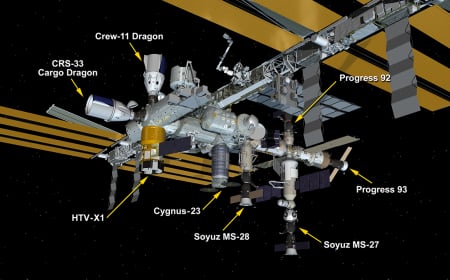
NASA and ESA astronauts needed two spacewalks to replace a failed high-speed communications antenna on the International Space Station.[21][22]
The first EVA removed the failed unit but ran long. The second completed installation and testing of the replacement.
At the same time, NASA and SpaceX delayed Crew-13 after an oxidizer leak was discovered in Dragon's propulsion system during prelaunch processing.[23]
Neither story is glamorous.
Both are exactly what mature infrastructure looks like.
Airliners are maintained.
Bridges are inspected.
Power plants are repaired.
Fiber networks lose hardware.
Space systems will be no different.
The great filter for permanent lunar or orbital habitation may not be whether we can land there.
It may be whether a broken pump, antenna, valve or seal becomes a routine maintenance job instead of a mission-ending event.
Curiosity quietly crossed a one-kilometer climb after fourteen years on Mars
NASA announced that Curiosity reached a cumulative elevation gain of one kilometer on August 26 as it continued climbing Mount Sharp inside Gale Crater.[24]
This is not the biggest scientific discovery of the month.
It belongs here because of endurance.
Curiosity landed in 2012.
Fourteen years later it is still moving, imaging, drilling and returning data.
That is a form of planetary infrastructure.
A rover designed for a limited mission became a persistent field station.
The longer machines survive off Earth, the more the economics change. Every extra year turns fixed launch and development costs into additional science and operating experience.
Durability is an underappreciated form of cost reduction.
The orbital operating stack is now visible
| Layer | August signal | What it enables |
|---|---|---|
| 1. Launch access | Falcon 9, Electron, Ariane 6, Long March, Zhuque-3 | Movement of mass into orbit |
| 2. Reuse | Falcon 9 flight 37; Zhuque-3 recovery | Cadence and lower replacement cost |
| 3. Communications | Globalstar, GuoWang, Starlink, Space Data Network | Persistent orbital connectivity |
| 4. Navigation | Starling/FALCON | GPS-independent autonomous operations |
| 5. Ground backbone | DSS-23 | Control and data return from deep space |
| 6. Observation | Roman, MTG-I2, SEO, QPS-SAR | Earth and universe become searchable datasets |
| 7. Servicing | LINK/Swift rendezvous demo | Life extension and capital reuse |
| 8. Maintenance | ISS antenna replacement | Long-duration survivability |
| 9. Surface resources | Chang'e-7 | Lunar water, power and logistics mapping |
| 10. Disposal | Cluster targeted reentries | Sustainable orbital turnover |
| 11. Deep-space continuity | BepiColombo, Curiosity, Voyager support through DSN | Persistent operations beyond Earth |
| 12. Industrial geography | Starbase Louisiana proposal | Ports, fuel, power, factories and launch cadence |
That is the architecture.
Once all of those layers exist simultaneously, space stops behaving like a destination and starts behaving like another domain of infrastructure.
The key transition is from missions to continuity. A mission succeeds once. Infrastructure keeps operating after something breaks.
This directly extends the existing Pattern Nexus Moon and deep-space thesis
Pattern Nexus has already framed Artemis II as the reopening of a deep-space logistics chain, the Moon as an infrastructure and resource node, and SpaceX's industrial expansion as more important than any one booster failure.
The last two weeks add several layers that make that model stronger.
The Moon thesis gains autonomous navigation, larger communications capacity and servicing.
The launch thesis gains China's first commercial orbital-class booster recovery and Falcon 9's extreme reuse record.
The communications thesis gains Globalstar replenishment, GuoWang expansion and the Space Data Network.
The permanence thesis gains real maintenance and disposal examples.
The deep-space thesis gains another DSN antenna and BepiColombo's arrival sequence.
That is exactly what I would expect if the system is moving from exploration toward continuous operations.
The next milestones matter because each tests a different layer
Starship Flight 14: Does the static-fire success translate into vehicle performance, and how fast can SpaceX turn the data into another flight?
Zhuque-3: When does recovered hardware actually fly again? Reflight matters more than landing.
Chang'e-7: What is the replacement launch date, and does the delay alter China's sequencing toward the south pole?
Roman: Deployment, communications, calibration and the start of survey operations at L2.
BepiColombo: Separation of the transfer stage and final Mercury orbital insertion.
Swift servicing: How close can LINK safely approach Swift, and what portions of the commercial servicing stack are still demonstrated despite losing the boost objective?
Starling: NASA plans additional swarm work in which spacecraft share tracking data and refine positions collectively.
DSS-23 and DSN modernization: Whether expanded ground capacity keeps pace with a rapidly growing lunar and interplanetary mission queue.
Cluster reentry data: How the breakup observations feed into design-for-demise and zero-debris standards.
Falcon/Starship transition: The critical question is not whether Starship eventually flies. It is whether it can inherit the incredible operational cadence Falcon 9 already demonstrated without sacrificing reliability.
My read: The space race is no longer principally about who plants a flag first. It is becoming a contest over who controls the deepest, cheapest and most resilient operating stack.
FAQ
What was the biggest space development in the final two weeks of August 2026?
There was no single development that captures the period. Roman was the largest science launch, but the deeper story was simultaneous movement across reusable launch, communications, autonomous navigation, satellite servicing, deep-space ground infrastructure, lunar logistics, military networking and orbital sustainability.
What is DSS-23?
DSS-23 is NASA's new 34-meter multifrequency Deep Space Network antenna at Goldstone, California. It expands NASA's ability to command, track and receive data from deep-space spacecraft.
Why is Starling's FALCON experiment important?
It demonstrated that a spacecraft can use optical observations of known objects to determine its own orbit without relying on GPS or continuous ground navigation. This is directly relevant to autonomous lunar, Martian and distributed satellite operations.
Did NASA successfully boost Swift?
No. Katalyst Space's LINK spacecraft developed an attitude-control issue, so the planned capture and orbital boost of Swift was canceled. NASA still intends proximity operations to demonstrate parts of the commercial servicing architecture.
Did China reuse Zhuque-3?
China successfully recovered the first stage. Recovery is not yet routine reuse. The next critical milestone is inspection, refurbishment and reflight of the recovered hardware.
Why do Globalstar replacement satellites matter?
They illustrate the replacement cycle of mature orbital infrastructure. Constellations must be replenished continuously as satellites age and capacity requirements change.
Why include the Cluster reentries?
Because a mature space economy needs disposal infrastructure as much as launch infrastructure. ESA deliberately targeted the final Cluster reentries and planned airborne observations to improve models of spacecraft breakup and future zero-debris design.
What is the central Pattern Nexus conclusion?
Space is moving from mission-based exploration toward continuous operations. The decisive competition will increasingly be over access, cadence, communications, autonomy, servicing, maintenance, resources, disposal and institutional depth.
Primary and current record
- [1] NASA — NASA's Dark Universe-Seeking Nancy Grace Roman Space Telescope Launches, Aug. 30, 2026. https://www.nasa.gov/news-release/nasas-dark-universe-seeking-nancy-grace-roman-space-telescope-launches/
- [2] NASA/JPL — New Next-Gen Dish Adds Muscle to NASA's Deep Space Network, Aug. 25, 2026. https://www.nasa.gov/technology/space-comms/deep-space-network/new-next-gen-dish-adds-muscle-to-nasas-deep-space-network/
- [3] NASA — NASA's Starling Mission Opens New Frontiers in Space Navigation, Aug. 17, 2026. https://www.nasa.gov/blogs/smallsatellites/2026/08/17/nasas-starling-mission-opens-new-frontiers-in-space-navigation/
- [4] NASA — NASA Updates Next Steps for Commercial Swift Boost Mission, Aug. 19, 2026. https://www.nasa.gov/news-release/nasa-updates-next-steps-for-commercial-swift-boost-mission/
- [5] Space.com — SpaceX sets rocket-reuse record on 100th Falcon 9 launch of the year, Aug. 25, 2026. https://www.space.com/space-exploration/launches-spacecraft/spacex-starship-record-37th-booster-flight-100-falcon-9-launches
- [6] Space.com — SpaceX test-fires Starship Super Heavy booster ahead of Flight 14, Aug. 2026. https://www.space.com/space-exploration/launches-spacecraft/spacex-test-fires-starship-super-heavy-booster-ahead-of-key-test-flight
- [7] Reuters — SpaceX to build $100 billion Starship rocket complex in Louisiana, Aug. 25, 2026. https://www.reuters.com/business/media-telecom/spacex-build-starship-spaceport-louisiana-2026-08-25/
- [8] National Space Facilities Control and Test Center / launch tracking record — SatNet LEO Group 24, Aug. 16, 2026. https://spacecenter.gov.ua/novyny/informacijna-dovidka-shhodo-zapusku-ka-satnet-leo-group-24.html
- [9] Xinhua — China launches new SEO satellite, Aug. 17, 2026. https://english.news.cn/20260817/cca9004a32fd4f7ab6ea35d3137f9bc3/c.html
- [10] Reuters — LandSpace nails rocket booster landing, Aug. 18–19, 2026. https://www.reuters.com/science/landspace-nails-rocket-booster-landing-first-chinas-private-launchers-2026-08-18/
- [11] Associated Press — China postpones Chang'e-7 lunar mission, Aug. 2026. https://apnews.com/article/ae23e66a64dadfdea1c7baadcc1f4da8
- [12] Globalstar — Globalstar Confirms Successful Launch of All 8 HIBLEO-4 Replacement Satellites, Aug. 16, 2026. https://investors.globalstar.com/news-releases/news-release-details/globalstar-confirms-successful-launch-all-8-hibleo-4-replacement
- [13] Rocket Lab — Satellite Platforms Built for MDA Space Reach Orbit Supporting Globalstar Direct-to-Device Communications, Aug. 16, 2026. https://rocketlabcorp.com/updates/rocket-lab-satellite-platforms-built-for-mda-space-successfully-reach-orbit-supporting-globalstar-direct-to-device-communications-services/
- [14] Rocket Lab / Viasat — Viasat Selects Rocket Lab to Build GEO Satellite for U.S. Space Force, Aug. 17, 2026. https://investors.rocketlabcorp.com/news-releases/news-release-details/viasat-selects-rocket-lab-build-geo-satellite-us-space-forces
- [15] Rocket Lab — Rocket Lab Onboarded to U.S. Space Force's $981M NITE-STAR Program, Aug. 17, 2026. https://investors.rocketlabcorp.com/news-releases/news-release-details/rocket-lab-onboarded-us-space-forces-981m-nite-star-program
- [16] Rocket Lab — Space Force Selects Rocket Lab for Space Data Network Consortium, Aug. 18, 2026. https://investors.rocketlabcorp.com/news-releases/news-release-details/space-force-selects-rocket-lab-space-data-network-consortium
- [17] Rocket Lab — Mission Success: Rocket Lab Launches 93rd Electron Mission, Aug. 20, 2026. https://investors.rocketlabcorp.com/news-releases/news-release-details/mission-success-rocket-lab-launches-93rd-electron-mission
- [18] Arianespace — Ariane 6 Launches MTG-I2 on First Mission to GTO, Aug. 27, 2026. https://newsroom.arianespace.com/arianespace-successfully-launches-weather-satellite-mtg-i2-on-ariane-6s-first-mission-to-geostationary-orbit/?lang=eng
- [19] ESA — BepiColombo begins its arrival at Mercury, Aug. 27, 2026. https://www.esa.int/Enabling_Support/Operations/Watch_live_BepiColombo_begins_its_arrival_at_Mercury
- [20] ESA — Observing Samba and Tango's reentries, Aug. 28, 2026. https://www.esa.int/Space_Safety/Space_Debris/Observing_Samba_and_Tango_s_reentries
- [21] NASA — NASA, ESA Astronauts Wrap Up Station Spacewalk, Aug. 18, 2026. https://www.nasa.gov/blogs/spacestation/2026/08/18/nasa-esa-astronauts-wrap-up-station-spacewalk/
- [22] NASA — NASA, ESA Spacewalkers Finish Installing High-Speed Antenna, Aug. 25, 2026. https://www.nasa.gov/blogs/spacestation/2026/08/25/nasa-esa-spacewalkers-finish-installing-high-speed-antenna/
- [23] NASA — NASA, SpaceX Adjust Crew-13 Launch Date, Aug. 29, 2026. https://www.nasa.gov/blogs/spacestation/2026/08/29/nasa-spacex-adjust-crew-13-launch-date/
- [24] NASA — Curiosity Reaches 1-Kilometer Elevation Gain, Aug. 26, 2026. https://science.nasa.gov/mars/curiosity-reaches-1-kilometer-elevation-gain/
- [25] NASA — LRO Images Falcon 9 Crater on Moon, Learns New Details, Aug. 18, 2026. https://science.nasa.gov/solar-system/moon/nasas-lro-images-falcon-9-crater-on-moon-learns-new-details/
- [26] ESA — Final Cluster reentries, Aug. 24, 2026. https://blogs.esa.int/rocketscience/2026/08/24/final-cluster-reentries-31-aug-1-sept-2026/
The important thing about the final two weeks of August was not that space was busy. Space has been busy before. What changed is how many infrastructure functions moved together. Reusable launch is becoming routine. Competitors are beginning to copy it. Communications constellations are entering replacement cycles. Spacecraft are learning to navigate without GPS. Commercial companies are trying to service existing satellites instead of treating them as disposable. NASA is expanding the ground network required to control a growing deep-space fleet. The Moon is being mapped as a resource environment. Orbital networks are being integrated for military use. Old spacecraft are being deliberately disposed of to learn how future spacecraft should die. Astronauts are performing routine maintenance while fourteen-year-old robots continue climbing mountains on Mars. That is not one space race. It is an operating system taking shape.
Qual è la tua reazione?
 Mi piace
0
Mi piace
0
 Non mi piace
0
Non mi piace
0
 Amore
0
Amore
0
 Divertente
0
Divertente
0
 Wow
0
Wow
0
 Triste
0
Triste
0
 Arrabbiato
0
Arrabbiato
0

Founder of Pattern Nexus. I research markets, macro, geopolitics, AI, history, ancient systems, and the patterns most people overlook. I’m also building Market Radar, a trading scanner designed to read pressure, risk, confirmation, and setup quality before chasing a move. Pattern Nexus is where I connect the dots between data, history, technology, and the bigger system playing out around us.















Commenti (0)