
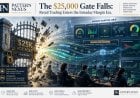
The “Empty” Tanker That Needed a Submarine
An “empty” Venezuelan tanker drew U.S. Coast Guard pursuit, Russian diplomatic pressure, and reported naval and submarine escort. Pattern Nexus breaks down what’s confirmed, what’s claimed, and why this isn’t about oil.
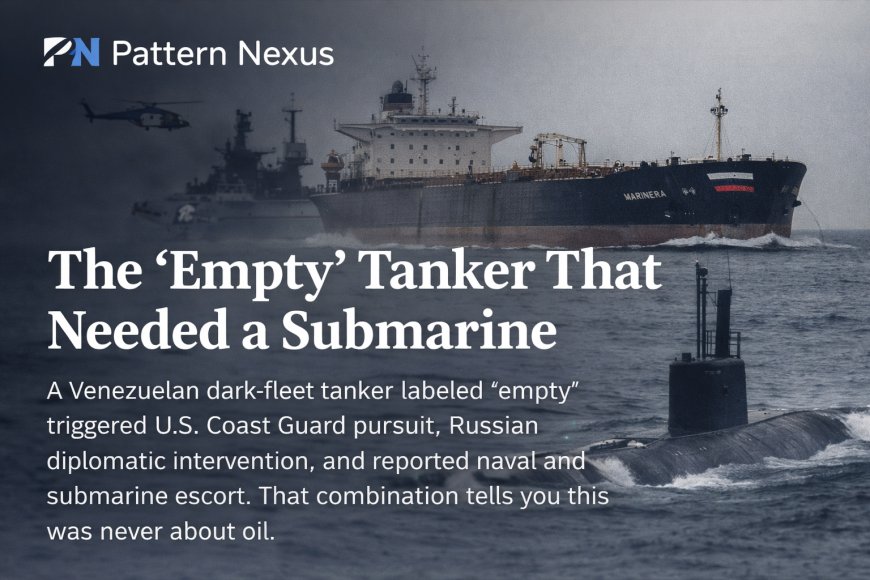
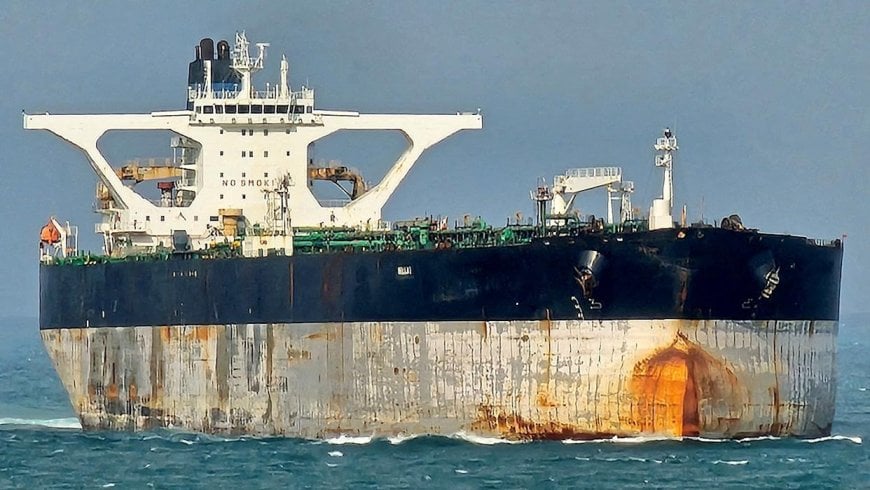

The United States, with confirmed operational support from the United Kingdom, has now seized the tanker widely reported as Bella 1 / Marinera in international waters. This is no longer a pursuit or tracking story. It is a completed interdiction involving allied coordination.
That seizure followed a sequence that matters more than any single tactical detail. The vessel previously refused U.S. Coast Guard boarding near Venezuela in December, departed without loading crude, altered its identity and flag while transiting the Atlantic, and became the subject of formal diplomatic engagement between Washington and Moscow.
Russia has now officially responded. Moscow has accused the United States of violating international maritime law and has framed the seizure as unlawful, while demanding protections for the crew and asserting sovereign rights. That response alone confirms this event crossed into the state-to-state layer. Governments do not issue formal protests over low-stakes shipping misunderstandings.
Earlier reporting established that Russia asked the United States to halt pursuit. Subsequent reporting described Russian naval involvement in proximity to the vessel. While precise operational details beyond that remain undisclosed and tightly controlled, the strategic signal is clear: Russia attempted to elevate this tanker into a protected category by forcing enforcement into a political and legal confrontation.
It is important to be precise about language. “Empty” in reporting refers to cargo status at the time — not to strategic relevance. An empty tanker can still be sanctions-critical as a logistics node, legally significant as a precedent, or financially relevant through ownership, insurance, documentation, and future loading rights. The level of response from both sides makes that clear.
This action also fits into a broader pattern already documented. Separate reporting confirms multiple Venezuela-linked tankers are now sailing without flags or safety documentation. The shadow fleet is not disengaging under pressure; it is adapting by running in increasingly degraded and risky compliance states.
How this fits the larger picture:
This is Monroe Doctrine logic updated for a networked, financialized world. There is no invasion, no occupation, no declaration of war. Control is exercised by denying conversion — denying the ability to turn regional resources into global leverage through shipping corridors, registry legitimacy, insurance markets, port access, and settlement rails.
From that perspective, this was never primarily an oil story. It was an enforcement test. Could a gray-zone logistics node be wrapped in enough diplomatic or military risk to deter interdiction? In this case, the attempt was made. The outcome suggests it did not hold.
This is why I continue to frame the moment as an undeclared currency and control war. Hard assets, trade flows, sanctions enforcement, and monetary credibility are now one system. When a tanker carrying no crude triggers allied seizure, formal diplomatic protest, and competing legal claims, you are not watching a commodity dispute. You are watching competing rulesets collide in real time.
Gold and silver don’t need speculative narratives to respond to this environment. They respond to visible stress in corridor control, enforcement credibility, and sovereign friction. That stress is now openly visible.
“Empty” in maritime reporting typically means no crude cargo loaded, not “no strategic value.”
Reuters reports the submarine escort claim as WSJ-sourced and explicitly says it could not independently verify the submarine detail.
Even without a submarine, diplomatic pressure alone is a signal: this is enforcement friction at the state layer.
What We Know for Certain
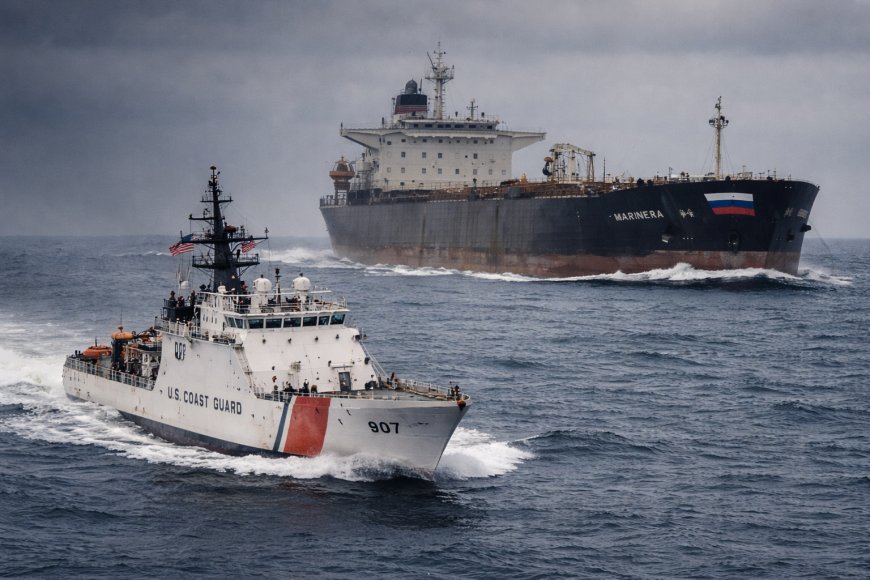
Start with the cleanest core. Reuters reported the U.S. Coast Guard pursued the tanker Bella 1 in international waters near Venezuela after it refused boarding attempts. The ship was described as approaching Venezuela “empty,” meaning it had not loaded crude (yet).
Reuters then reported that Russia asked the U.S. to stop the pursuit, citing a New York Times report based on people with direct knowledge.
Separately, Reuters reported that other tankers have been departing Venezuela without flags or safety documents per shipping data, reinforcing the context: the dark-fleet channel is still active and adapting.
On the vessel identity side, multiple outlets describe the ship as having rebranded and re-flagged, with reporting that it displayed a Russian flag and used the name Marinera. The Financial Times described U.S. tracking of Marinera off the UK coast, linking it to Venezuela, Russia, and Iran, and describing prior false-flag history.
USCG pursuit and denied boarding near Venezuela; vessel described as “empty” at the time; Russia asked the U.S. to stop; broader Venezuela tanker traffic is still moving under degraded documentation; the ship’s identity shifted in reporting from Bella 1 to Marinera with Russian linkage.
Timeline: How an “Empty” Tanker Became a State Test
The easiest way to see the structure is chronological. Not because every detail is confirmed to the molecule, but because the escalation pattern is the story.
- Dec 21, 2025 (Reuters): Reuters reported the U.S. was pursuing a tanker believed to be Bella 1 near Venezuela, noting it was the third interception effort in under two weeks and that Bella 1 was “approaching Venezuela empty,” likely to load.
- Dec 24, 2025 (Reuters): Reuters reported the Coast Guard lacked forces for large-scale tanker seizures and that boarding of Bella 1 could fall to an elite unit, adding practical constraints to the enforcement picture.
- Jan 1, 2026 (Reuters via NYT): Reuters reported Russia asked the U.S. to stop the pursuit, citing the New York Times.
- Jan 5, 2026 (Reuters): Reuters reported tankers departing Venezuela without flags or safety documents, indicating the pipeline persists and is willing to run “ugly.”
- Jan 6, 2026 (CBS): CBS reported U.S. plans to interdict a tanker involved in Venezuelan oil trade, adding additional color on the enforcement posture and public framing.
- Jan 7, 2026 (WSJ, carried by Reuters): Reuters summarized WSJ reporting that Russia sent a submarine and other naval vessels to escort the tanker. Reuters explicitly stated it could not independently verify the WSJ report.
- Jan 7, 2026 (FT): FT reported the U.S. tracking Marinera off the UK coast and described the ship’s history, route behavior, and the broader geopolitical linkages being implied in the monitoring posture.
There are two escalations here: the enforcement escalation (USCG boarding attempt, interdiction posture) and the state-layer escalation (Russia asking the U.S. to stop, plus the reported escort move). Put together, it’s not “a ship story.” It’s an enforcement boundary test.
The “Empty Tanker” Problem
The word “empty” is doing a lot of narrative work. In the Reuters reporting, “empty” is operational: approaching Venezuela to load or failing to load.
But “empty” does not mean irrelevant. A vessel can still be:
- Sanctions-critical as a node in an export chain (even if it failed to load this time)
- Legally significant as a precedent-setting interdiction target
- Financially significant as collateral in an off-ledger arrangement (ship ownership, insurance, counterparties, routing, documentation)
The paradox is the point: if this were truly nothing, nobody would burn political capital asking the pursuit to stop. Russia asking the U.S. to halt pursuit is the strongest “this matters” signal in the package.
Then you layer the WSJ claim (via Reuters) about escort assets, including a submarine, and the question becomes less “what’s on it” and more “what rule is being challenged.” Reuters says it could not independently verify the submarine detail, and that matters because the operational specifics are not fully public.
Dark Fleet Tactics: How Ships Disappear in Plain Sight
The modern shadow fleet isn’t a single trick. It’s an operating system. The Financial Times describes Marinera as having prior false-flag history and ties to sanctioned flows, and Reuters describes a broader pattern of degraded documentation (no flag, no safety documents) on ships departing Venezuela.
The tactics cluster into a few buckets:
- Identity games: re-flagging, renaming, and documentation shifts that complicate jurisdiction and enforcement timing
- Opacity: low-quality paper trails, missing compliance artifacts, and routing choices that avoid normal “clean” lanes
- Operational friction: refusal to allow boarding and running the legal clock while assets reposition
- State cover: once a major power’s flag becomes part of the story, interdiction becomes escalation-sensitive
If you want a single sentence: the dark fleet’s defense is not stealth. It’s bureaucracy plus risk.
Why This Escalated: The Precedent Russia Is Trying to Lock In
Here’s the structural read: the U.S. isn’t only trying to stop a barrel. It’s trying to make interdiction a repeatable template. Reuters reporting around the Coast Guard’s resource constraints is important because it shows why “one high-profile seizure” matters so much. If you can’t scale, you can still set precedent.
Russia’s counter is also not only about a barrel. It’s about preventing a “new normal” where U.S. interdictions expand into gray shipping with escalating tempo. The request to stop pursuit is a diplomatic tripwire: it forces Washington to either accept a boundary or contest it.
Then comes the escort narrative. If a submarine escort occurred as reported by WSJ and carried by Reuters (again: Reuters says it couldn’t independently verify), it serves a control purpose even if the boat never surfaces in a photo. It says: “This ship is now under state risk cover.”
In control terms, the payload is not in the tanks. The payload is the precedent: can the U.S. board and seize in this gray zone without getting dragged into a state-to-state escalation ladder?
What to Watch Next
If you’re tracking this like a systems problem instead of a headline, the next signals are straightforward:
- Flag and registry stability: does the ship remain under the reported identity and flag, or does it mutate again under pressure?
- Enforcement posture: do U.S. interdictions stay episodic or become a sustained “corridor pressure” campaign?
- Allied positioning: the FT’s reporting about tracking off the UK coast hints at a multinational monitoring picture; what matters is whether that becomes operational cooperation or simply observation.
- Shadow fleet response: Reuters’ reporting on ships sailing without flags or safety documents is effectively the system saying: “We will run degraded rather than stop.”
- Escalation messaging: if escorts are normalized (whether real-time or narrative), enforcement becomes more expensive and more political
The market angle is secondary but real: the more the dark fleet is pressured, the more Venezuelan exports become operationally brittle, which forces either price concessions, more complex blending/rerouting, or production throttles when storage backs up. Reuters has explicitly flagged concern that enforcement could affect Venezuelan exports and revenue.
Pattern Nexus Lens
There are two different maps in play. The public map says: “a suspicious tanker.” The control map says: “a test of enforceability.”
The enforcement layer is about jurisdiction, boarding consent, and capability. The state layer is about who can wrap a gray-zone logistics node in enough risk that enforcement becomes politically unprofitable.
That’s why the headline “empty tanker” is almost a tell. It tries to make you think this is irrational. It isn’t. If Russia can normalize “protection status” for dark-fleet nodes, it raises the cost of interdiction across the whole system. If the U.S. can normalize interdiction templates, it degrades the whole system even without perfect scale.
When an “empty” ship triggers diplomats, trackers, and reported escorts, you’re not watching oil. You’re watching the ruleset.
FAQ
Was there really a Russian submarine?
Reuters reported the claim as coming from a Wall Street Journal report citing a U.S. official, and Reuters explicitly said it could not independently verify the report. Treat “reported escort” as real at the narrative level, and treat “submarine specifics” as unconfirmed unless further evidence emerges.
Was the tanker actually empty?
Reuters described the ship as approaching Venezuela empty and reporting later described it as having failed to load. “Empty” in that context is about crude cargo status, not about strategic value or sanctions significance.
Why does Russia asking the U.S. to stop matter?
Because it is the cleanest indicator of stakes. If this were a routine shipping misunderstanding, it does not escalate into a formal request to halt pursuit.
Is this only about Venezuela?
No. The FT explicitly frames the ship as linked to Venezuela, Russia, and Iran, and Reuters reporting frames the broader tanker traffic as sanctions-evasion behavior. The structure is a network problem, not a single-country problem.
Sources
Primary reporting supporting the timeline, the pursuit details, the broader Venezuela tanker pattern, and the reported escort claims.
- Reuters (Dec 21, 2025) — U.S. pursuing tanker near Venezuela; “approaching empty” and boarding attempt context
- Reuters (Dec 24, 2025) — Coast Guard resource constraints and elite boarding discussion
- Reuters (Jan 1, 2026) — Russia asks U.S. to stop pursuit (via NYT)
- Reuters (Jan 5, 2026) — Tankers leaving Venezuela without flag/safety documents
- Reuters (Jan 7, 2026) — WSJ claim: Russia sends submarine and naval vessels; Reuters cannot independently verify
- Financial Times (Jan 2026) — U.S. tracking “Marinera” off UK coast; vessel history and linkage framing
- CBS News (Jan 6, 2026) — U.S. interdiction posture and public framing
あなたの反応は?
 いいね
0
いいね
0
 嫌い
0
嫌い
0
 愛
0
愛
0
 面白い
0
面白い
0
 ワオ
0
ワオ
0
 悲しい
0
悲しい
0
 怒っている
0
怒っている
0

Founder of Pattern Nexus. I research markets, macro, geopolitics, AI, history, ancient systems, and the patterns most people overlook. I’m also building Market Radar, a trading scanner designed to read pressure, risk, confirmation, and setup quality before chasing a move. Pattern Nexus is where I connect the dots between data, history, technology, and the bigger system playing out around us.











コメント (0)