
Gold Isn’t Breaking Out — It’s Absorbing Policy Failure
Gold’s long-term rise is not a speculative breakout or inflation panic. It reflects repeated policy constraint, failed normalization, and the permanent reintroduction of liquidity to preserve funding stability. This report explains why gold has become system infrastructure inside the modern liquidity regime.
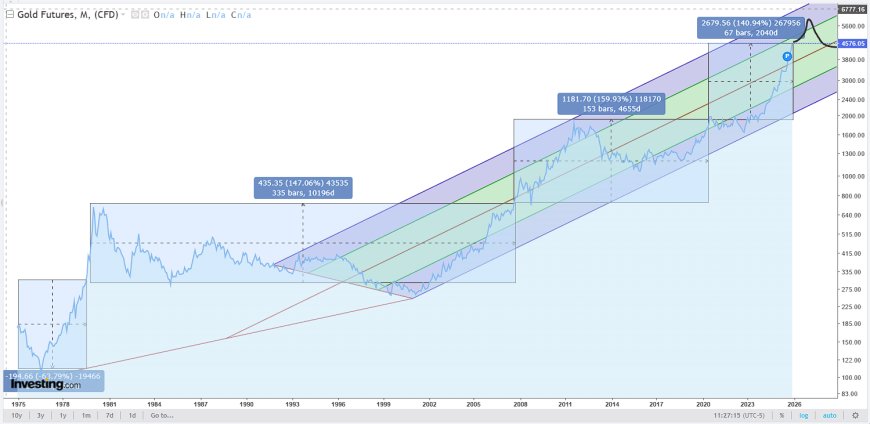
Gold’s long-term advance is not a speculative breakout and not an inflation panic. It is a structural repricing inside a multi-decade system corridor that reflects repeated policy constraint, credibility erosion, and the permanent reintroduction of liquidity whenever funding stability is threatened.
Executive Summary
This chart is not forecasting excitement. It is documenting constraint.
Gold is holding altitude because the modern system has reached a point where normalization repeatedly collides with funding stress, fiscal math, and political limits. Each time that collision occurs, liquidity is reintroduced under a different name. Gold reprices not on headlines, but on that repetition.
- The long-duration channel reflects cumulative credibility decay, not speculative demand
- The boxed periods represent balance-sheet digestion, not resolution
- The current regime is defined by policy support becoming structural rather than episodic
- Gold is transitioning from hedge to infrastructure
What the Chart Is Actually Measuring
At surface level, the chart shows gold rising over decades. Inside the Pattern Nexus framework, it measures something more specific: the frequency and inevitability of policy intervention required to preserve system coherence.
The persistence of the channel across radically different macro eras is the signal. Volcker-era discipline, globalization, credit expansion, crisis response, post-crisis repression, pandemic shock, and the post-QT period all occur inside the same structural corridor.
That tells us gold is not responding to any single variable. It is responding to the system’s revealed preference: when forced to choose between discipline and stability, stability wins.
The Channel Is the Regime
This channel survives because it reflects a governing reality:
- Debt levels cannot be materially reduced without destabilization
- Growth is insufficient to outpace interest costs indefinitely
- Funding markets are highly sensitive to reserve scarcity
- Political systems reject prolonged austerity
Each tightening cycle pushes the system toward stress. Each stress episode forces some form of liquidity accommodation. The baseline ratchets higher. Gold tracks that ratchet.
If this were speculative, the channel would fail. It does not fail because the underlying constraints do not change.
Balance-Sheet Phases, Not Consolidations
The large boxed regions on the chart correspond to periods where pressure was successfully displaced, not eliminated.
Disinflation Era: credibility was earned by tolerating economic pain. Gold stabilized because discipline was politically acceptable.
Credit Expansion Era: growth was substituted with leverage. Gold repriced when the substitution failed.
Financial Repression Era: stress was warehoused in inequality, housing affordability, and asset valuations. Gold moved sideways because suppression worked temporarily.
Post-2020 Era: fiscal dominance becomes explicit. Balance-sheet support becomes normal. Gold stops acting like a trade and starts acting like a reserve anchor.
The Midline as System Equilibrium
The channel midline represents equilibrium under managed stress.
- Below the midline, stress is exported into households, labor, and affordability
- Near the midline, the system appears stable but unresolved
- Above the midline, suppression fails and credibility erosion becomes visible
Gold’s persistence in the upper half of the channel indicates that the system no longer sustains credibility for long without renewed support.
Gold Inside the Liquidity Plumbing
Gold responds to liquidity when liquidity becomes structural.
Modern liquidity is not defined solely by headline QE. It includes reserve management, Treasury market support, collateral backstops, repo stability operations, and balance-sheet actions taken to preserve market function.
When those tools move from emergency use to routine use, gold reprices accordingly.
This is not fear-driven buying. It is balance-sheet positioning by institutions that understand the policy reaction function.
Why QT Became Constrained
Quantitative tightening did not end because inflation was “defeated.” It became constrained because reserve scarcity increasingly threatened market function.
As tightening intersected with heavy Treasury issuance, dealer balance-sheet limits, and funding sensitivity, the system reverted to accommodation through operational channels.
The label matters less than the effect. The effect is recurring liquidity re-entry whenever stress approaches systemic thresholds.
What the Framework Implies Next
The framework does not point to a singular event. It points to continuation.
- Liquidity support remains biased toward re-entry
- Risk assets absorb adjustment through valuation and earnings, not collapse
- Housing adjusts via affordability rather than nominal reset
- Fiscal dominance deepens quietly
- Gold maintains altitude
Gold does not need a parabolic move to validate this regime. Stability at elevated levels is the signal.
Policy Constraint and the Liquidity Ratchet
The relevant question is not “how much will be printed,” but “what forces liquidity back into the system.”
As long as debt rollover, political constraint, and funding sensitivity remain binding, liquidity expansion becomes mandatory rather than discretionary.
Each attempt at withdrawal raises stress faster than credibility can be rebuilt. Each reversal sets a higher baseline. That ratchet is the channel.
Pattern Nexus Lens
Gold is not predicting collapse. It is recording unresolved stress.
In this regime, policy does not remove instability. It redistributes it. Gold holds the residue.
This is not bullishness. It is diagnosis.
FAQ
Is this just inflation?
No. Inflation is a surface symptom. The driver is policy constraint and repeated accommodation.
Does this require a crisis?
No. The modern system prefers drift, not shock.
What would invalidate the channel?
A sustained willingness to tolerate defaults, fiscal restraint, and funding volatility. There is no evidence of that preference.
Qual é a sua reação?
 Curtir
0
Curtir
0
 Não gostei
0
Não gostei
0
 Amor
0
Amor
0
 Engraçado
0
Engraçado
0
 Uau
0
Uau
0
 Triste
0
Triste
0
 Bravo
0
Bravo
0

Founder of Pattern Nexus. I research markets, macro, geopolitics, AI, history, ancient systems, and the patterns most people overlook. I’m also building Market Radar, a trading scanner designed to read pressure, risk, confirmation, and setup quality before chasing a move. Pattern Nexus is where I connect the dots between data, history, technology, and the bigger system playing out around us.















Comentários (0)