

continuity
Automatically classified from article content.
Theses, forecasts, models, and paths
No published research objects yet
This topic is ready for editors to connect a thesis, forecast, model, or research path.
Latest articles
 Article · related
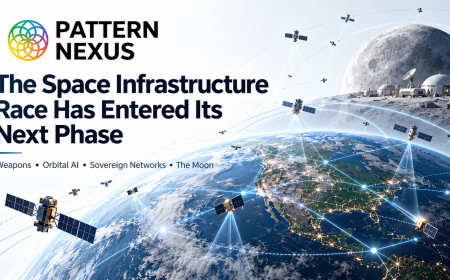
The Space Infrastructure Race Has Entered Its Next Phase: Weapons, Orbital AI, Sovereign Networks, and the Moon
From September 4–23, space infrastructure accelerated on almost every front. Isar Aerospace reached orbit from continental Europe. India positioned EOS-05 for geosynchronous imaging. Stoke raised $1 billion toward fully reusable launch. China launched four rockets in roughly 45 hours and put a spacecraft with 5G, AI, and planned 100-Gbps optical communications into orbit. Europe allocated major IRIS² and OneWeb production contracts while Planet expanded satellite manufacturing in Germany. The U.S. acknowledged on-orbit space-control weapons, practiced multi-orbit maneuver operations, and funded new target-tracking architectures; Britain created a space-effects squadron. NASA and ESA delivered new lunar, planetary, and Earth-observation science while commercial downmass and crew-transport contracts extended the orbital logistics chain. The Pattern Nexus conclusion: space is becoming an industrial, computational, and contested operating system, and continuity is its critical threshold.
Published Sep 23, 2026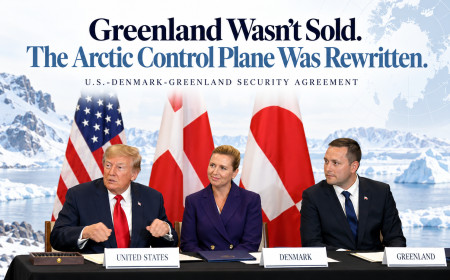 Article · related
Greenland Wasn't Sold. The Arctic Control Plane Was Rewritten.
Greenland wasn't sold or annexed. The September 22, 2026 U.S.–Denmark–Greenland security agreement expands Pituffik, provides for defense areas at Narsarsuaq and Mestersvig, establishes broad U.S. military access, limits non-NATO military presence and sensitive foreign investments, and seeks continuity even if Greenland becomes independent. Pattern Nexus places the signed treaty inside its earlier Monroe Doctrine and Arctic control-plane coverage—and separates what was signed from what remains to be approved, funded and built.
Published Sep 22, 2026 Article · related
The AI Is the Same. The System Isn’t: How Long-Term Use Creates a Shared Language
After a conversation moved from a media headline to political age limits, documented forecasts, cognitive bias, simulation theory, and finally language itself, a stranger system became visible: the AI was preserving continuity across ideas that were no longer fully restated in each message. This Pattern Nexus essay argues that sustained AI use can produce an emergent human–AI relationship that cannot be reduced to the base model alone. It separates contextual reconstruction from mind reading, interactional change from model retraining, and documented observation from metaphysical speculation. It also examines coadaptation, authorship, confirmation lock, dependency, platform control, and the social divide between transactional AI use and long-term system formation—while intentionally withholding the private shorthand and operating structure inside the author’s own system.
Published Sep 11, 2026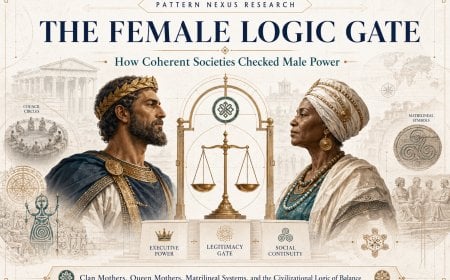 Article · related
The Female Logic Gate: How Coherent Societies Checked Male Power
A Pattern Nexus research article on the forgotten civilizational structure behind stable societies: male executive power often existed beside a female legitimacy layer. Across Haudenosaunee, Palau, Asante, Igbo, Yoruba, Cherokee, Chaco, Minangkabau, Kush, Egypt, Rome, Sparta, Neolithic China, and Iron Age Britain, the pattern repeats. Men often held the public office, but women frequently controlled the deeper gate: clan, land, succession, property, market, ritual, household, and generational continuity.
Published Jul 3, 2026 Article · related
Fragmented Society: The Elites Don’t Think Like You, and the Elites of the Elites Don’t Think Like Them
Society is not one shared reality. It is a stack of disconnected mindsets layered by survival, class, power, wealth, ideology, and future access. The average person thinks about kids, bills, work, retirement, and survival. The elite think in systems, leverage, insulation, manipulation, and continuity of power. The elites above them think past humanity entirely. That fracture explains why the modern world feels insane: most people are arguing from human-centered values while the people shaping the system are not operating from the same mental map.
Published Jun 27, 2026 Article · related
The Scientist Layer Is Getting Fragile: Amy Eskridge, Missing Researchers, China’s Strategic Death Cluster, and the Knowledge Bottleneck Beneath Modern Power
A growing list of dead and missing scientists, aerospace personnel, nuclear-linked workers, military AI researchers, hypersonic specialists, and exotic propulsion figures has forced a darker question into public view: what happens when civilization’s most sensitive knowledge is concentrated inside a thin layer of human nodes? This is not only a UFO story. It is a knowledge-continuity story, a national-security story, and a Pattern Nexus control-stack story.
Published May 17, 2026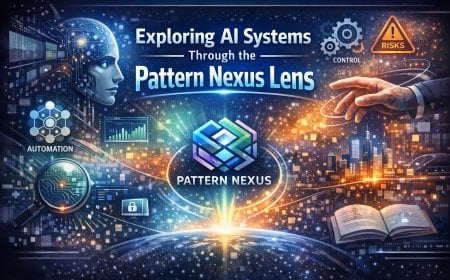 Article · related
The Permission Stack: Narrative, Rails, Standards, Identity, and Continuity in the Age of Control Systems
A full Pattern Nexus systems paper on how narrative, money rails, standards, compute, and digital identity converge into a permission layer—while infrastructure fragility and tail risks force civilizations to choose between resilience and legitimacy.
Published Jan 24, 2026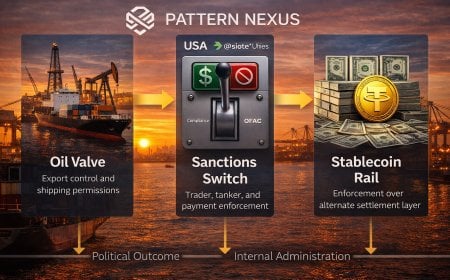 Article · related
Venezuela: Control Claims, the Oil Valve, and the Stablecoin Rail
Trump and Washington are signaling U.S. “control” after Maduro’s detention, while Venezuelan institutions rally behind continuity under Delcy Rodríguez. Pattern Nexus breaks down the real control layers: oil export permission, sanctions plumbing, and stablecoin settlement rails.
Published Jan 4, 2026 Article · related
The Weight of Time: On Building Something That Lasts
Legacy isn’t about memory — it’s about momentum. In an age obsessed with immediacy, this essay explores the deeper architecture of endurance: how systems, people, and civilizations preserve meaning through adaptability. Drawing from philosophy, science, and lived experience, it examines how we build for permanence in a world designed for change.
Published Oct 18, 2025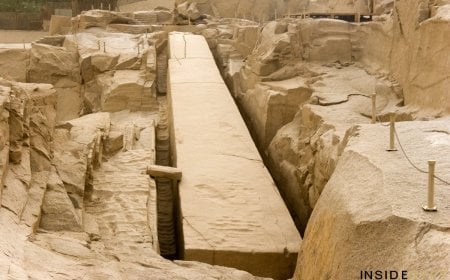 Article · related
Echoes of the Builder: What We Leave Behind
This piece explores the architecture of legacy — not as wealth or fame, but as continuity of thought, creation, and impact. It examines how every system we build, from homes to ideas to businesses, becomes a mirror of our values and a container for future lives. It ties construction, resilience, and philosophy into one continuum — how a person’s blueprint extends beyond their lifetime through what they shape and the principles they leave embedded in their work.
Published Oct 18, 2025