
Voyager at the Helopause: Mapping the True Edge of the Solar System
Voyager 1 and 2 did more than visit the outer planets. By crossing the heliopause, they turned the edge of the solar system from a theoretical line into a measured magnetic boundary, revealing how our Sun’s protective bubble interacts with the Milky Way.
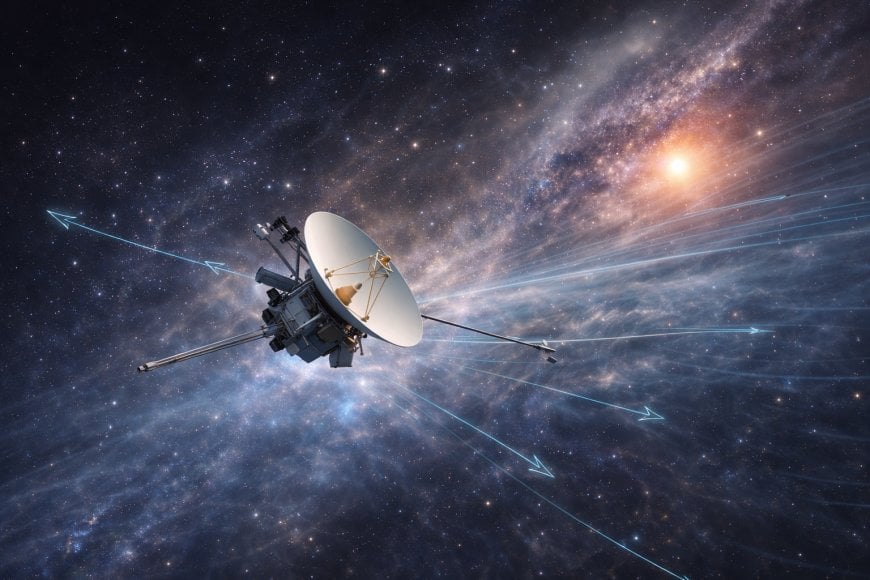

The “edge of the solar system” is not a distant planet but a thin magnetic boundary—the heliopause—where the Sun’s plasma and the Milky Way’s interstellar medium negotiate a hard border.
The heliosphere’s shielding power depends on where the Sun is in the galaxy. If we enter a denser, more magnetized region, the heliopause could shrink, exposing the inner planets to higher radiation for geological timescales.
Voyager’s 40-year-old instruments still found a scientifically rich region beyond the helopause. A dedicated interstellar probe with modern sensors could turn this narrow crossing into a full 3D map of the local galactic environment.
Voyager at the Magnetic Edge
Voyager 1 and Voyager 2 launched in 1977 as part of a now-classic “grand tour” of the outer planets. They delivered historic images of Jupiter’s storms, Saturn’s rings, Uranus, and Neptune. But the most important part of their mission came long after the last planetary flyby, when both spacecraft reached the outer limits of the Sun’s direct influence and pushed into interstellar space.
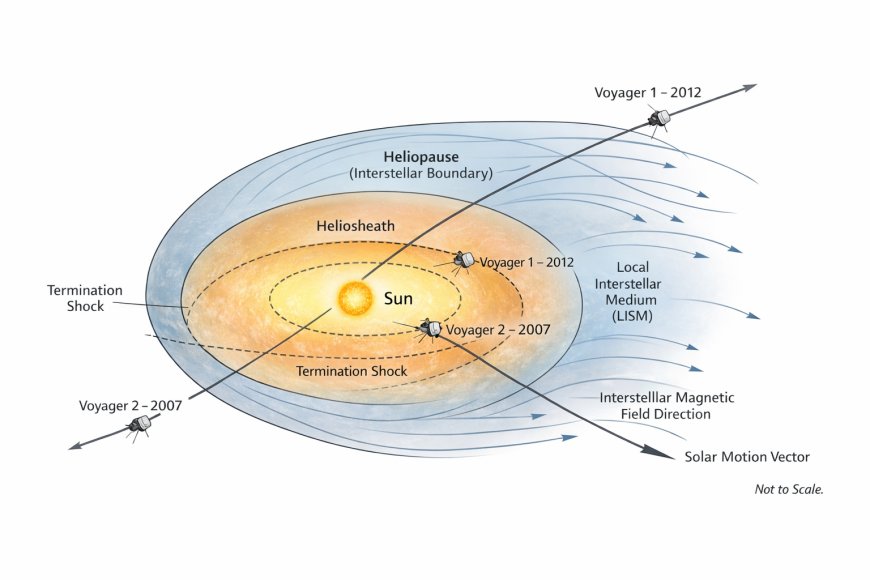
As the Voyagers traveled outward, they left the relatively calm environment of the inner solar system and entered a region where the flow of charged particles from the Sun—the solar wind—slowly loses its dominance. This outward flow inflates the heliosphere, a vast plasma bubble carved into the surrounding interstellar medium. The outer boundary of this bubble is the heliopause: the place where the pressure from the solar wind and the pressure from the Milky Way’s local gas and magnetic fields balance.
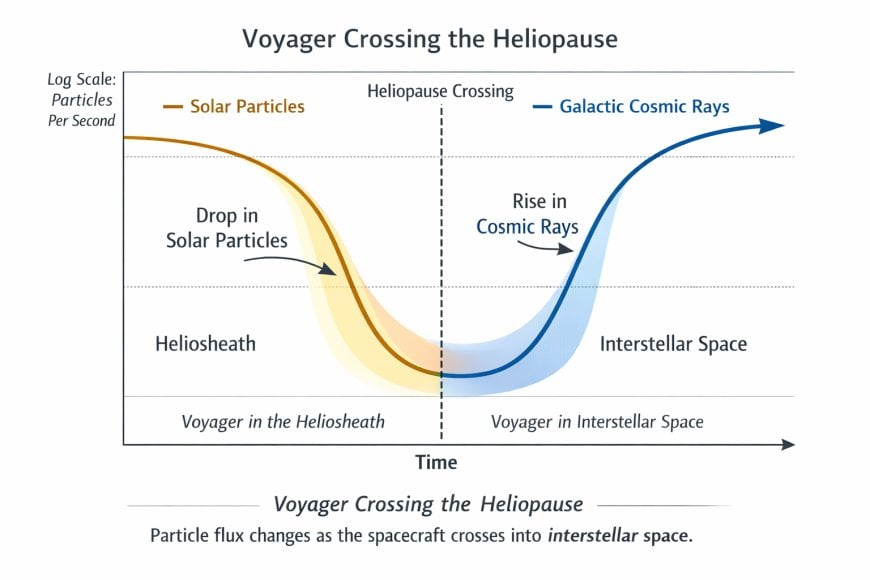
In August 2012, at roughly 121 astronomical units from the Sun, Voyager 1 crossed this boundary. Instruments recorded a sudden drop in particles originating from the Sun and a sharp increase in high-energy galactic cosmic rays. Years later, in November 2018, Voyager 2 crossed the heliopause from a different direction at around 119 astronomical units, providing a second independent set of measurements and confirming that this was not a one-off anomaly but a global feature of the heliosphere.
The key surprise was not just that the crossings occurred, but how abrupt they were. The expectation had been a broad, chaotic transition region where solar and interstellar plasmas mixed gradually. Instead, both spacecraft saw a relatively narrow zone where conditions changed decisively over a short distance: on one side, plasma and magnetic fields dominated by the Sun; on the other, a regime controlled by the Milky Way.
Just inside the helopause, Voyager detected a region where solar particles slow down, compress, and heat up, forming a layer of high-energy plasma. Temperatures and densities in this layer exceeded model predictions, indicating that the interaction between the solar wind and the interstellar medium is more energetic and structured than we thought. The helopause is no longer just a concept drawn on a diagram—it is a physical object with thickness, temperature, and magnetic behavior that can be measured.
Before Voyager, the outer solar system’s boundary was a sketch on a whiteboard. After Voyager, it is a real, measured interface—one where particle fluxes, magnetic alignment, and plasma densities can be quantified instead of guessed.
A Structured Radiation Shield, Not a Fuzzy Bubble
The heliosphere is not just a bubble of gas—it is a radiation shield. Galactic cosmic rays, produced by distant supernovae and other high-energy events, fill interstellar space and travel at nearly the speed of light. Many of these particles never reach the inner planets because they are scattered, slowed, or deflected by the Sun’s magnetic field and solar wind.
As Voyager crossed the heliopause, the count of galactic cosmic rays rose quickly while the flux of solar particles almost vanished. This confirmed that the heliopause operates as a sharp filter: one side dominated by solar-origin particles, the other by particles from the rest of the galaxy. The transition was far steeper than early models suggested, which imagined a large mixing region where different particle populations would gradually blend.
The magnetic field behavior at the boundary added another twist. Models had predicted that the Sun’s magnetic field and the galaxy’s magnetic field would meet at significantly different angles, creating tangled regions of turbulence. Instead, Voyager found that the direction of the magnetic field on both sides of the boundary was more similar than expected, implying that magnetic field lines may be connecting or reconfiguring themselves in ways not yet fully understood by current theories.
Plasma wave measurements showed that the density of the interstellar medium outside the heliosphere was higher than many estimates had assumed. A denser interstellar medium means greater external pressure on the heliosphere, helping explain why the Sun’s bubble is not a simple sphere. It is compressed in some directions, stretched in others, and responds to both solar activity and the structure of the galaxy around it.
- Sharp radiation gradient: Cosmic ray intensities jumped and solar particles declined rapidly at the boundary, demonstrating that the heliopause acts as a relatively thin, effective filter.
- Magnetic alignment surprise: Field directions on both sides of the boundary were closer than predicted, hinting at magnetic reconnection or structural coupling between the heliosphere and the Milky Way’s field.
- Higher external pressure: A denser interstellar medium and stronger magnetic field exert more pressure on the heliosphere, constraining its expansion and shaping its geometry.
Why the Helopause Matters for Our Future
Understanding the heliopause is not just an academic exercise in mapping the outskirts of the solar system. It has direct implications for how we design missions, evaluate long-term planetary risk, and think about our place in the galaxy.
First, there is the human factor. Once astronauts leave Earth’s magnetic field and the bulk of the heliosphere’s shielding, they are exposed to significantly higher levels of radiation. Missions to the Moon, Mars, and beyond need reliable models of how cosmic rays are modulated by the heliosphere, how that modulation changes across the solar cycle, and how much protection spacecraft and habitats must provide. Voyager’s measurements give modelers a hard boundary condition instead of a guess.
Second, there is the long-term history of the solar system. The Sun does not stay in one region of the Milky Way forever. It slowly orbits the galactic center and passes through areas of varying gas density and magnetic activity. If the Sun enters a denser interstellar cloud or a region with stronger magnetic fields, the heliosphere could shrink, allowing more galactic cosmic rays to penetrate the inner solar system. Over millions of years, these shifts may leave fingerprints in planetary atmospheres, climate records, or even biological evolution.
Third, Voyager’s crossings have strengthened the case for a dedicated interstellar probe. Voyager 1 and 2 were built with 1970s technology and instruments designed primarily for planetary flybys. Even so, they discovered that the region beyond the heliopause is rich in structure: changing plasma densities, complex magnetic geometries, and subtle variations in cosmic ray populations. A modern probe could map these properties over hundreds of astronomical units instead of at just two crossing points, building a genuine 3D picture of the local interstellar environment.
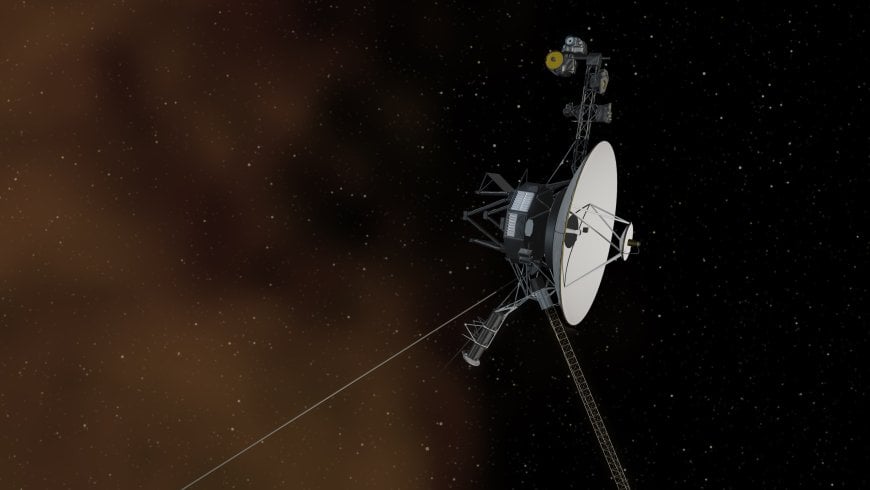
For now, Voyager continues its journey. Engineers are gradually shutting down non-essential systems to conserve power, trying to keep at least some instruments running for as long as possible. Each new data packet that arrives from beyond the heliopause adds another thread to humanity’s first direct map of the space between stars.
The true edge of the solar system is a magnetic and plasma structure, not a rock you can land on. On one side is the Sun’s domain; on the other, the Milky Way. With Voyager’s help, we have crossed that boundary once. The next step is to go there on purpose.
Pattern Nexus Lens
The heliopause is a natural control boundary. It regulates flows of energy and information in the form of particles and magnetic fields, shaping the environment in which planets and life evolve. Inside, the Sun’s field and solar wind dominate the rules of the game. Outside, the Milky Way’s field, density, and turbulence take over. Voyager’s crossings are effectively a real-time audit of how that control boundary is implemented in physics.
Viewed through this lens, the heliosphere is not a static bubble but a dynamic risk envelope. Its size and structure depend on solar activity, local galactic pressure, and the alignment of large-scale magnetic fields. As those inputs change, the boundary moves, the radiation environment shifts, and the “operating system” for everything inside—climate, atmospheres, biological mutation rates—can be subtly reparameterized over long timescales.
Most of our space policy and mission planning still assumes an Earth-centric radiation context. Voyager’s data is a reminder that we live inside a moving shield whose configuration is set by systems far beyond Earth’s orbit. As we push further out—to Mars, asteroid habitats, and eventually interstellar missions—the heliopause will stop being an abstract diagram and become a practical line item in mission design, risk modeling, and perhaps even civilizational planning.
Voyager didn’t just escape the solar system; it benchmarked our first crossing of a large-scale cosmic control boundary. The next generation of probes will not just visit that boundary—they will be designed around it.
FAQ
Did Voyager really leave the solar system?
Voyager 1 and 2 crossed the heliopause, which is the edge of the Sun’s plasma and magnetic bubble. In that sense, they have left the region of space dominated by the Sun’s wind and entered the interstellar medium. However, they are still gravitationally bound to the Sun and far inside the Oort Cloud—the distant shell of comets that may extend out to tens of thousands of astronomical units. So dynamically, they are still in the Sun’s gravitational domain, but magnetically and plasma-wise, they are in interstellar space.
How far away is the heliopause, and does it move?
Voyager 1 crossed the heliopause at about 121 astronomical units from the Sun, and Voyager 2 crossed at roughly 119 astronomical units. Those distances are not fixed. The heliopause can move inward or outward as the solar wind pressure changes over the 11-year solar cycle and as the Sun travels through regions of different density and magnetic pressure in the galaxy. It “breathes” over short timescales and evolves more slowly over millions of years.
How long will the Voyagers keep sending data?
The Voyagers are powered by radioisotope thermoelectric generators (RTGs) whose output decreases over time. Engineers have been shutting down instruments and systems to conserve power and prioritize key measurements. While exact timelines depend on power management decisions, the expectation is that meaningful scientific data will eventually cease as power levels fall below instrument thresholds. Even after they go silent, the spacecraft will continue to drift silently through the interstellar medium for billions of years.
Sources
The discussion in this article is grounded in Voyager mission data, peer-reviewed analyses of the heliopause and interstellar medium, and official releases from NASA and collaborating institutions.
- NASA – Voyager Interstellar Mission overview
- NASA – Voyager 2 probe enters interstellar space (heliopause crossing)
- JPL – Voyager 2 illuminates the boundary of interstellar space
- Croswell, K. (2021) – Voyager density and magnetic field measurements in interstellar space
- Richardson, J.D. et al. (2019) – Voyager 2 plasma observations at the heliopause
Care este reacția ta?
 Îmi place
0
Îmi place
0
 Dezaprobat
0
Dezaprobat
0
 Iubire
0
Iubire
0
 Amuzant
0
Amuzant
0
 Wow
0
Wow
0
 Tristețe
0
Tristețe
0
 Înfuriați
0
Înfuriați
0

Founder of Pattern Nexus. I research markets, macro, geopolitics, AI, history, ancient systems, and the patterns most people overlook. I’m also building Market Radar, a trading scanner designed to read pressure, risk, confirmation, and setup quality before chasing a move. Pattern Nexus is where I connect the dots between data, history, technology, and the bigger system playing out around us.












Comentarii (0)