
Ancient China Was Not Isolated: Megaliths, Mercury Rivers, Quantum Pigments, and the Pattern Layer Nobody Wants to Connect
This article uses a full video transcript on ancient Chinese mysteries as the starting point, then breaks each site and artifact through the Pattern Nexus lens. Yangshan Quarry, Longyou Caves, Forbidden City, Fanjingshan, Qin Shi Huang’s mausoleum, the Terracotta Army, Han purple, Chinese magic mirrors, elongated skulls, guardian lions, Nüwa and Fuxi, and the pyramid/mound complexes around Xi’an are not treated as isolated curiosities. The mainstream explanation can describe each object individually: quarry, cave, tomb, palace, pigment, mirror, ritual object, burial custom. Pattern Nexus asks the larger question: why do so many of these features point back to the same themes of geometry, order, threshold, afterlife engineering, material transformation, sky-ground alignment, and controlled access to hidden layers of reality?
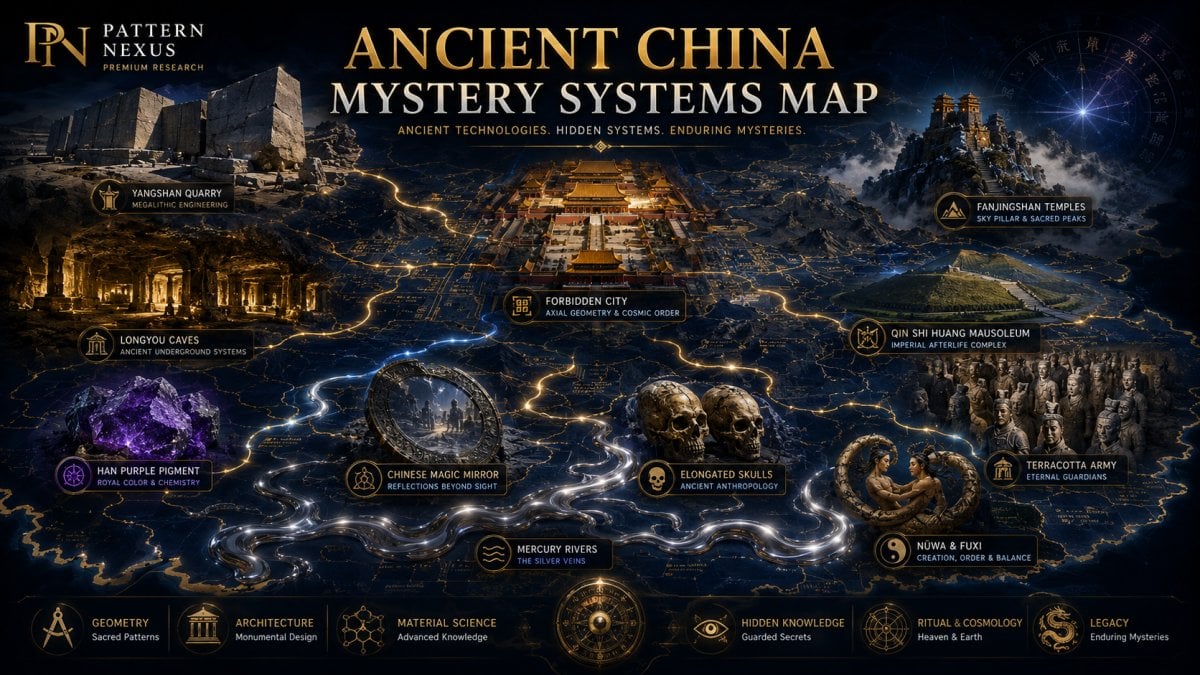
Ancient China is normally presented as its own sealed historical world: dynasties, emperors, bronze, silk, writing, bureaucracy, walls, palaces, and armies. That story is true, but it is incomplete. When you start putting the anomaly layer next to the mainstream layer, China stops looking isolated and starts looking like one of the largest surviving fragments of a much older global pattern.
The transcript behind this article moves through a long list of sites and artifacts: Yangshan Quarry, Longyou Caves, ancient timber architecture, the Forbidden City, guardian lions, Nüwa and Fuxi, Chinese pyramid mounds, Qin Shi Huang’s mausoleum, mercury rivers, the Terracotta Army, Han purple, Chinese magic mirrors, crystal or jade ritual weapons, Chinese puzzle balls, and elongated skulls at Houtaomuga. The mainstream can explain many of these individually. Pattern Nexus is asking why the same motifs keep clustering together.
The deeper pattern is not “aliens built China” or “every mainstream explanation is wrong.” That is too cheap. The deeper pattern is that ancient China encoded order into matter. Stone, wood, bronze, pigment, mercury, skulls, mountains, palaces, tombs, caves, and mirrors were not neutral objects. They were interfaces between human order, imperial power, cosmic order, afterlife continuity, and hidden reality.
The normal way to handle these subjects is to break them into disconnected academic boxes. Yangshan becomes quarrying. Longyou becomes excavation. Forbidden City becomes palace architecture. Fanjingshan becomes sacred landscape. Qin Shi Huang becomes imperial burial. Han purple becomes pigment chemistry. Magic mirrors become optics. Houtaomuga becomes cranial modification. Each box gets explained separately, and the pattern layer disappears.
That is not how ancient systems worked. Ancient civilizations did not separate engineering, ritual, astronomy, kingship, material science, symbolism, burial, geometry, and consciousness the way modern institutions separate them. A palace could be a political machine, a cosmological diagram, a social filter, and a ritual pathway at the same time. A tomb could be a burial site, a replica of the empire, a protective system, and an afterlife interface at the same time.
This article keeps the hard facts separate from the interpretation. The evidence layer is grounded in archaeology, UNESCO descriptions, museum research, historical sources, and scientific papers. The Pattern Nexus layer then asks what the pattern means when the evidence is placed back together instead of separated into sterile containers.
Ancient China should not be read as a sealed civilizational exception. It should be read as a major node in the same ancient pattern layer visible across Egypt, Mesoamerica, Mesopotamia, India, the Andes, and the broader megalithic world: geometry as order, architecture as cosmology, material as interface, body as symbol, tomb as transition machine, mountain as threshold, and ruler as mediator between visible society and invisible structure.
The strongest argument is not one artifact. It is the stack. Yangshan shows impossible-scale imperial stone ambition. Longyou shows artificial underground volume without a clean modern purpose. Chinese timber architecture shows force distribution through flexibility. Forbidden City shows axial order and controlled access. Fanjingshan shows vertical sacred geography. Qin Shi Huang’s mausoleum shows an afterlife empire. Mercury shows dangerous reflective liquid metal placed inside tomb logic. Magic mirrors show hidden image revealed by light. Han purple shows synthetic material with modern quantum-interesting properties. Houtaomuga shows the body itself shaped into symbolic identity.
Pattern Nexus read: the mystery is not that ancient China had strange objects. The mystery is that the strange objects keep pointing back to the same deeper operating system.
This article is built in three versions. Start with the version that fits how deep you want to go, then move down if you want the full system-level breakdown.
Reader-Friendly Version
Ancient China is already impressive if you only read the standard history: dynasties, emperors, bronze, silk, writing, bureaucracy, palaces, armies, walls, and some of the most advanced state systems in the ancient world. But the outer edges of that story are where the pattern starts getting strange.
You have Yangshan Quarry, where unfinished stone pieces were cut at a scale that almost breaks ordinary explanation. You have Longyou Caves, a manmade underground cave system with no clean accepted purpose. You have timber architecture that survived by flexing instead of resisting. You have the Forbidden City, which is not just a palace but a giant access-control map. You have Fanjingshan, where temples sit on a mountain peak like a literal bridge between earth and sky.
Then the tomb and artifact layer gets even stranger: Qin Shi Huang’s mausoleum, the Terracotta Army, mercury, Han purple, magic mirrors, elongated skulls, guardian lions, Nüwa and Fuxi, and pyramid-shaped imperial burial mounds. Pattern Nexus reads this as one civilizational stack: ancient China was not just building objects. It was encoding a worldview into matter.
The Simple Pattern
The simple pattern is this: ancient China keeps producing places and artifacts that are hard to understand if we treat them only as decoration, superstition, tombs, political theater, or ordinary monuments.
That does not mean every mystery needs an extreme answer. Yangshan really was a quarry site. Longyou really is an artificial cave complex. The Forbidden City really was an imperial palace. Qin Shi Huang’s mausoleum really was a tomb. Han purple really was a pigment. Magic mirrors really are optical objects. The mainstream explanation is useful at the object level.
But Pattern Nexus does not stop at the object level. It asks what happens when those objects are placed next to each other. Stone, cave, palace, mountain, tomb, mercury, pigment, mirror, skull, lion, serpent, and burial mound all point back to a civilization that saw matter as meaningful. They were not just making things. They were turning physical space into symbolic order.
The mainstream explains the object. Pattern Nexus asks why the objects keep clustering around the same deeper themes: order, threshold, transformation, afterlife, hidden image, cosmic structure, and matter shaped into meaning.
Yangshan Quarry: Stone at Impossible Scale
Yangshan Quarry is one of the cleanest entry points because you do not need to believe anything strange to see the problem. The stone is there. The cuts are there. The unfinished pieces are there. The scale is absurd.
The site is commonly linked to a Ming-era imperial stele project associated with the Yongle Emperor. The unfinished components are estimated in the thousands of tons, with the largest component commonly cited above 16,000 metric tons. That does not mean the builders had hidden anti-gravity. It means the project entered a scale where the act of planning itself becomes part of the mystery.
What kind of power system even attempts that? What kind of labor system can be commanded into that? What kind of ruler thinks mountain-scale stone should be cut, shaped, moved, and turned into memory?
PN read: Yangshan is the collision point between imperial command and physical reality. The emperor can command labor. The state can command bodies. But the mountain still has mass. At Yangshan, the monument is unfinished, but the message remains: power tried to impose itself on stone at a scale where stone pushed back.

Longyou Caves: The Underground Question
Longyou Caves are the inverse of Yangshan. Yangshan is about moving or shaping stone. Longyou is about removing stone and creating void.
The caves were rediscovered after ponds were drained in 1992. They are artificial sandstone caverns, and the commonly cited number is 24 caves. The scale implies planning, labor, and a reason. The problem is that the reason is still not clean.
If they were only quarries, why are the interiors so deliberately worked? If they were storage spaces, why build them in a way that interacts so awkwardly with water? If they were reservoirs, why is the hydraulic logic not obvious? If they were ritual spaces, why is the material evidence not clearer?
That is why Longyou matters. It is not “just a cave.” It is an artificial underground system whose purpose does not fit neatly inside modern categories.

Chinese Architecture: Surviving by Flexing
One of the most underrated parts of ancient China is timber architecture. People often assume stone is the strongest ancient building material because stone feels permanent. But ancient Chinese builders did something different: they built wooden systems that could move, absorb, and distribute force.
This matters in earthquake country. Instead of making everything rigid, Chinese timber systems used joinery, bracket sets, roof weight, columns, and layered connections to let structures move without immediately failing. The logic is pure Pattern Nexus: survival does not always come from resisting force directly. Survival often comes from routing force through the system.
The Yingxian Wooden Pagoda, also known as the Sakyamuni Pagoda of Fogong Temple, is one of the clearest examples. Built in 1056 during the Liao dynasty, it remains one of the great surviving wooden structures of the world. The structure matters because it proves the system was not theory. It worked in material reality.
Zhang Heng’s seismoscope belongs in the same force layer. The device is traditionally dated to AD 132 and described as translating invisible earth movement into directional signal. Whether every later reconstruction is perfect or not, the idea is still remarkable: hidden force enters the system, the system reads it, and the invisible becomes visible.

Forbidden City: A Palace That Routes Power
The Forbidden City is famous, but most people underread it. Yes, it was an imperial palace. Yes, it was the political center of Ming and Qing power. Yes, it is beautiful and historically important. But it is also a spatial control system.
Everything about the layout matters: the central axis, gates, courtyards, halls, thresholds, colors, hierarchy, direction of movement, and separation between outer and inner space. It is not random. It is power turned into a path.
This is where the circuit-board comparison becomes useful if handled correctly. The Forbidden City is not literally a computer chip. But organized systems tend to route things. A circuit board routes current. A palace routes bodies, attention, hierarchy, permission, ritual access, and proximity to power.
Guardian lions at thresholds fit directly into this. The male lion with a patterned sphere and the female lion with a cub are not just decorations. They mark the boundary. The outside is disorder. The inside is protected order. One side holds authority over patterned space. The other side protects continuity and interior life.
_Aerial_view_of_Forbidden_City_(38884882275).jpg)

Fanjingshan: Mountain as Threshold
Fanjingshan makes the symbolic layer obvious. The temples on Red Clouds Golden Summit sit on a narrow rock peak connected by a bridge, high above the landscape. Even if you ignore every mystical reading, the physical message is impossible to miss.
This is not normal everyday architecture. This is ascent architecture. You climb, narrow, rise, cross, and arrive. The mountain becomes the ritual path. The building is not only on the mountain. The building uses the mountain as part of the meaning.
PN read: Fanjingshan is sacred geography. It turns land into threshold. Earth below, sky above, human body in between, temple at the crossing point. That is the same logic that appears in pyramids, towers, ziggurats, sacred mountains, stepped temples, and cave sanctuaries around the world.

Qin Shi Huang: Tomb as Afterlife Empire
Qin Shi Huang’s mausoleum is not just a tomb. It is an underground imperial system. The Terracotta Army alone proves that. Thousands of life-sized figures were arranged as a military force to accompany and protect the emperor beyond death. That is not casual burial custom. That is empire projected into the afterlife.
The mausoleum complex is often described as modeled after the capital and imperial order. That is the key. The tomb was not just a grave. It was a world model. The emperor did not simply die. His order was extended underground.
This is where the pyramid-mound layer matters. The Chinese pyramid mounds around Xi’an are mostly imperial burial mounds, not Egyptian-style stone pyramids. But the geometric form still matters. A mound is a landscape object. A pyramid-like mound is authority made into terrain.

Mercury and the Strange Material Choice
The mercury part is one of the strangest pieces of the whole story. Ancient accounts describe rivers and seas of mercury inside the First Emperor’s tomb, and modern mercury anomaly studies support unusual mercury concentrations associated with the mound area.
The central tomb itself remains unexcavated, so we do not know exactly what is inside. That matters. But the mercury tradition cannot be dismissed as random nonsense either. Mercury is part of the story, and the material choice matters.
Mercury is not normal. It is liquid metal. It reflects. It moves. It is toxic. It is difficult to process and dangerous to handle. If a civilization places mercury inside a tomb-world system, that deserves more than “they thought it looked cool.”
The conservative PN read is not that mercury automatically proves lost electrical technology. The stronger read is that mercury was a boundary material: water-like, metal-like, reflective, dangerous, rare, and symbolically appropriate for a tomb that was not merely storing a corpse, but staging an afterlife environment.
PN read: mercury is the material that refuses a simple category. It behaves like liquid, reads like metal, reflects like mirror, poisons like threshold, and sits inside the tomb-world as controlled danger.
Terracotta Army: Individualized Afterlife Infrastructure
The Terracotta Army is usually described as funerary art, but that wording is too small. It is afterlife infrastructure.
Rows of warriors, horses, chariots, armor, rank, weapons, and formation were placed into the ground as if the emperor’s political-military order needed to continue beyond death. The figures are not just generic copies. Their faces, hair, armor, posture, and roles create the impression of a structured living force translated into clay.
PN read: the Terracotta Army is not only representation. It is administrative imagination. The same state that organized the living empire created an underground extension of that order. Death did not end the system. Death moved the system below ground.

Han Purple and Magic Mirrors
Han purple is a synthetic ancient Chinese pigment. On one level, it is color. But modern physics has found that the compound associated with Han purple, BaCuSi₂O₆, has unusual quantum magnetic behavior under extreme laboratory conditions. That does not mean ancient Chinese artisans knew modern quantum theory. It means they created a material that modern science still finds interesting.
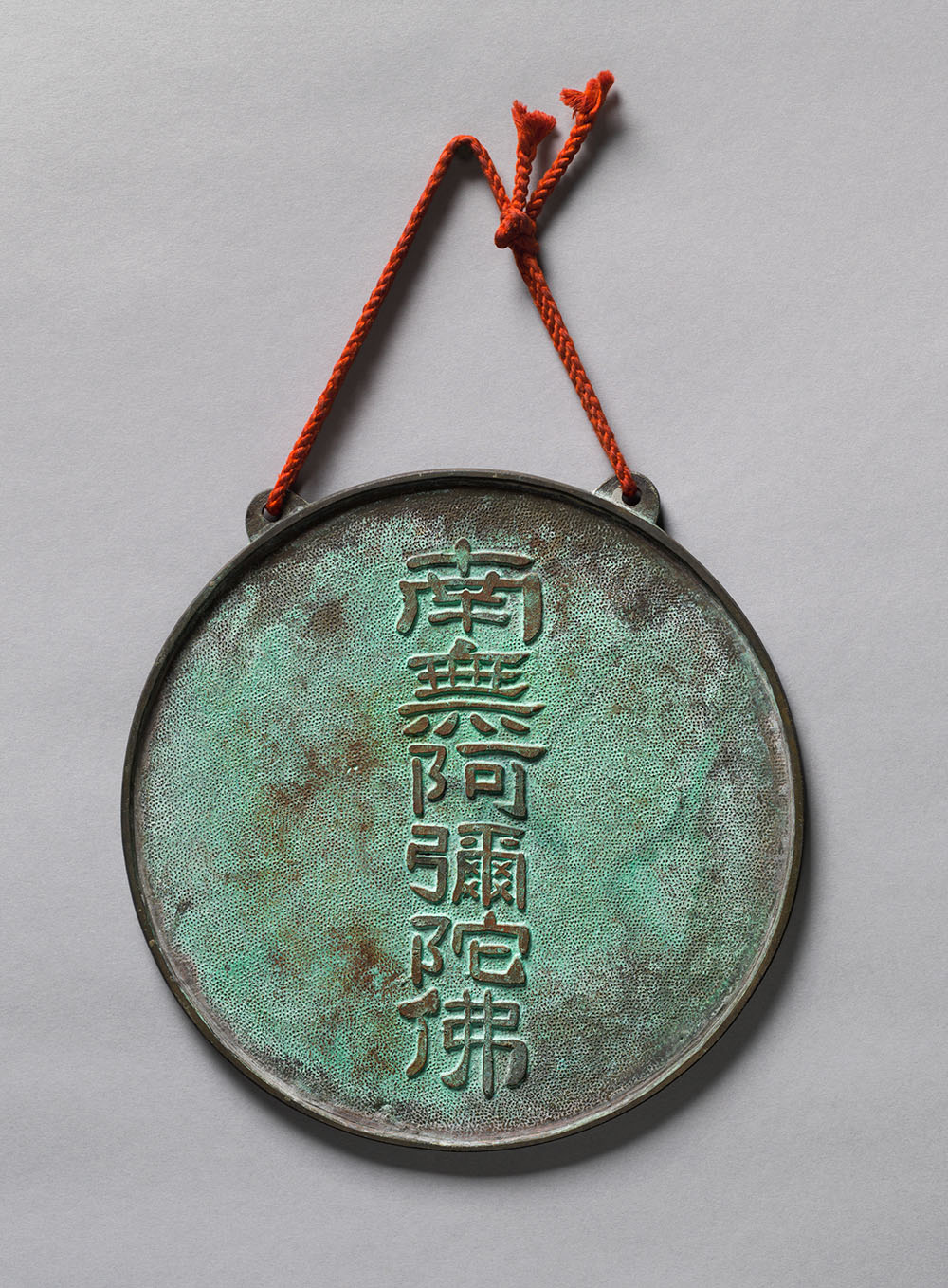
Chinese magic mirrors are just as important. These are bronze mirrors that can project a hidden image when light reflects from them. The object looks normal until the right light reveals what is hidden in the structure.
That is the perfect metaphor for this entire article. Ancient China’s mystery layer is not always visible from the front. But when you shine the right light on it, a hidden pattern appears.

Elongated Skulls and Body Symbolism
The elongated skull discussion has to be handled carefully because it is one of those topics that gets weird fast. The grounded version is still interesting enough: Houtaomuga in northeast China produced evidence of intentional cranial modification across a long time window.
That means the body itself was being shaped into a symbol. Whether the reason was elite identity, beauty, group membership, ancestor imitation, spiritual meaning, or some combination, the core fact remains: the human skull was not treated as neutral biology. It was treated as form that could carry meaning.
This matters because it places the body inside the same pattern as the architecture and artifacts. The palace is shaped. The tomb is shaped. The mirror is shaped. The pigment is made. The mountain is turned into a threshold. The skull is shaped too. Ancient China was not just building outside the body. It was encoding meaning into the body itself.
The Final PN Read
The big point is not that every mystery has one answer. The point is that ancient China keeps pointing toward the same hidden layer.
Yangshan is mass. Longyou is void. Timber architecture is force. Zhang Heng’s seismoscope is invisible motion turned into signal. Forbidden City is order. Guardian lions are threshold. Fanjingshan is ascent. Qin Shi Huang’s mausoleum is afterlife empire. Mercury is material transformation. Terracotta warriors are political order in clay. Han purple is synthetic pigment. Magic mirrors are hidden image. Houtaomuga skulls are body symbolism. Nüwa and Fuxi are cosmic polarity.
All of those belong to one operating system: matter shaped into order.
That is why ancient China was not isolated. It was one of the largest expressions of the same ancient global pattern: build the world as a mirror of the hidden world, and use stone, wood, body, pigment, light, metal, mountain, and tomb as the interface.

Sources
- Wikimedia Commons, Full View of Yangshan Quarry 02 2011-12.jpg — Embedded Yangshan Quarry image and visual scale reference.
- Yangshan Quarry overview — Supports common historical framing and stele component estimates. Replace with a stronger official/local source if you want to avoid Wikipedia in final publication.
- Wikimedia Commons, Longyou Grottoes Banner.jpg — Embedded Longyou Caves image, credited to Dcpeets.
- Heritage Daily, The Mystery of the Longyou Caves — Supports Longyou as an artificial cave complex rediscovered after ponds were drained in 1992.
- Wikimedia Commons, The Fugong Temple Wooden Pagoda.jpg — Embedded Yingxian/Fogong Wooden Pagoda image, credited to Gisling.
- UNESCO Tentative List, Wooden Structures of Liao Dynasty — Supports the wooden-architecture context, including Yingxian/Fogong Pagoda.
- USGS, earliest seismoscope — Supports Zhang Heng’s AD 132 seismoscope description.
- Wikimedia Commons, Buddhist temple on Red Clouds Golden Summit, Mount Fanjing — Embedded Fanjingshan image.
- UNESCO, Fanjingshan — Supports Fanjingshan’s World Heritage and sacred-landscape context.
- Wikimedia Commons, Views of the Forbidden City — Image source category for Forbidden City aerial/view imagery.
- UNESCO, Imperial Palaces of the Ming and Qing Dynasties — Supports Forbidden City construction, layout, hierarchy, and palace significance.
- Wikimedia Commons, Forbidden City Imperial Guardian Lions.jpg — Embedded guardian lion image, credited to Allen Timothy Chang.
- Wikimedia Commons, Anonymous-Fuxi and Nüwa3.jpg — Public-domain image of Fuxi and Nüwa with compass/square and celestial symbols.
- Wikimedia Commons, Tomb of Emperor Qin Shi Huang.jpg — Embedded Qin mausoleum mound image, credited to wit.
- UNESCO, Mausoleum of the First Qin Emperor — Supports the Qin mausoleum and Terracotta Army World Heritage context.
- Application of mercury survey technique over the Mausoleum of Emperor Qin Shi Huang — Supports mercury anomaly evidence over the Qin mausoleum mound.
- Scientific Reports, atmospheric mercury above Emperor Qin’s tomb mound — Supports modern mercury measurement context around the Qin tomb mound.
- Wikimedia Commons, Terracotta Army, View of Pit 1.jpg — Embedded Terracotta Army image.
- Heritage Science, measurement and analysis of Terracotta Army facial features — Supports facial-feature variability and individualization discussion.
- American Journal of Physical Anthropology, intentional cranial modification from Houtaomuga — Supports Houtaomuga cranial modification evidence.
- Science News, East Asians may have been reshaping their skulls 12,000 years ago — Supports public reporting on Houtaomuga skull modification and dating debate.
- Cincinnati Art Museum, A New Discovery in CAM: A Magic Mirror — Supports the magic mirror explanation and provides embedded mirror image credit.
- Asian Art Museum, Han Purple — Supports Han purple as an early man-made pigment, its use on Terracotta Army artifacts, and its high-temperature barium copper silicate production.
- Nature / PubMed, Dimensional reduction at a quantum critical point — Supports BaCuSi₂O₆ / Han purple dimensional-reduction behavior at a quantum critical point.
- Wikimedia Commons, Eastern Han Luoyang Mural of Liubo players.jpg — Embedded Han blue/Han purple mural image reference.
Methodology Note
This article uses the supplied video transcript as the source spine, then separates claims into three layers: documented evidence, interpretive uncertainty, and Pattern Nexus synthesis. Documented evidence includes archaeological sites, UNESCO descriptions, museum documentation, historical accounts, image-source pages, and scientific papers. Interpretive uncertainty is kept visible where the purpose of a site or artifact remains debated, such as Longyou Caves, the exact interior of Qin Shi Huang’s unopened tomb, or the social meaning of Houtaomuga cranial modification. Pattern Nexus synthesis then maps the relationship between these categories without forcing every artifact into one single theory. The goal is not to flatten the evidence into either mainstream dismissal or fantasy speculation. The goal is to show the operating pattern that appears when architecture, tombs, pigments, mirrors, mountains, skulls, mercury, and imperial layouts are read together.
Pattern Nexus Note: The world is not divided into topics. It is divided into layers. Ancient China is not just dynasties, palaces, tombs, caves, pigments, mirrors, skulls, mountains, and myths. It is a layered operating system of mass, void, force, order, threshold, cosmos, afterlife, matter, and body. The mainstream explains the pieces. Pattern Nexus asks why the pieces keep pointing back to the same hidden architecture of reality.
Frequently Asked Questions
Какова ваша реакция?
 Нравится
0
Нравится
0
 Не нравится
0
Не нравится
0
 Любовь
0
Любовь
0
 Смешно
0
Смешно
0
 Вау
0
Вау
0
 Грусть
0
Грусть
0
 Сердитый
0
Сердитый
0
Founder of Pattern Nexus. I research markets, macro, geopolitics, AI, history, ancient systems, and the patterns most people overlook. I’m also building Market Radar, a trading scanner designed to read pressure, risk, confirmation, and setup quality before chasing a move. Pattern Nexus is where I connect the dots between data, history, technology, and the bigger system playing out around us.

Комментарии (0)