
NASA Confirms a Private U.S. Spacecraft Landed on the Moon — Why Blue Ghost Matters
Firefly’s Blue Ghost Mission 1 stuck the landing in Mare Crisium with 10 NASA payloads. The milestone is bigger than a touchdown: it’s about procurement rails, navigation standards, and the early shape of a lunar economy.
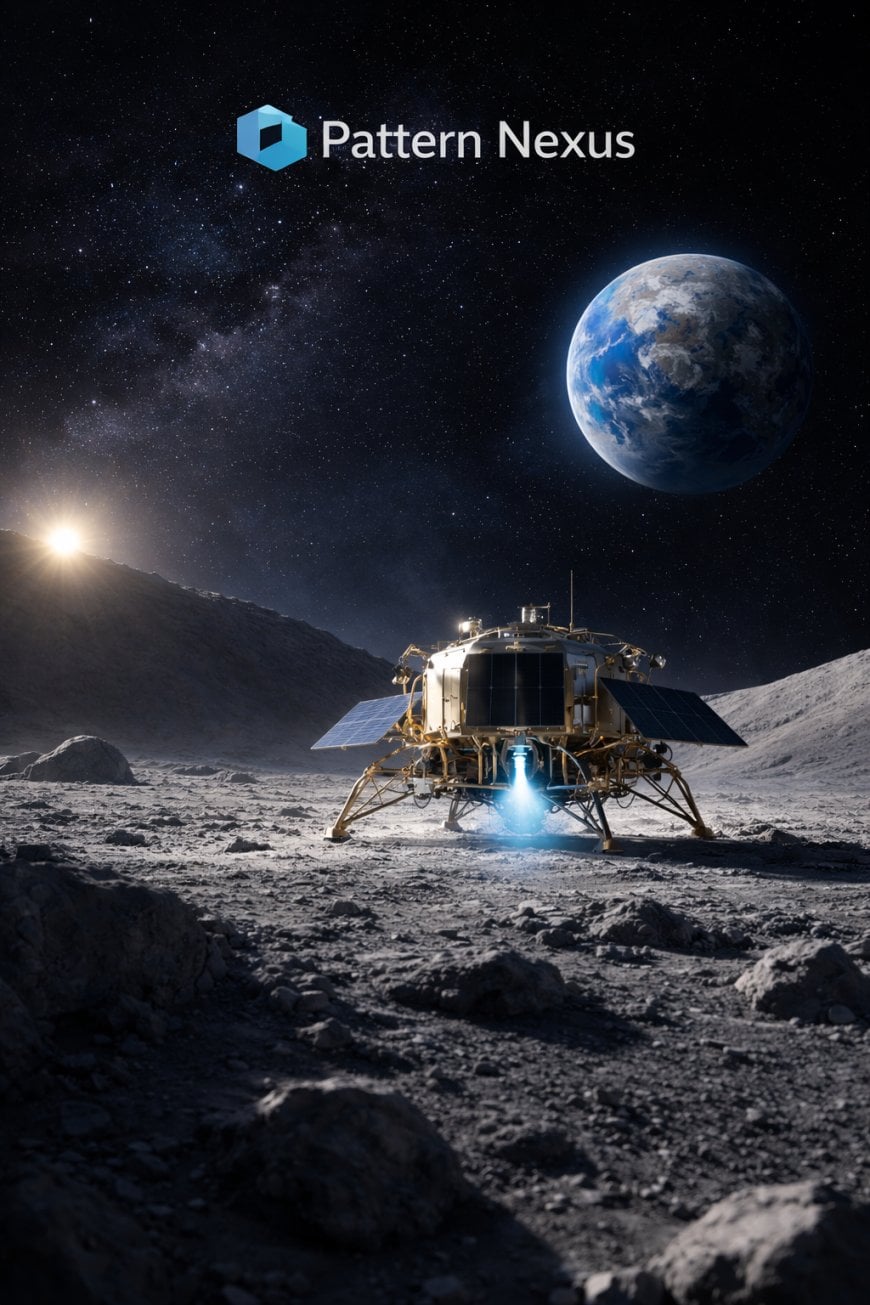
![[HERO_IMAGE_ALT: Blue Ghost on lunar surface / mission render / surface photo]](https://patternnexus.com/uploads/images/202601/image_870x_69759e8bc6ba8.jpg)

The milestone is not “private spacecraft touched the Moon.” The milestone is “upright, stable, power-positive, data-producing platform for a full lunar day.” That is the minimum viable threshold for repeatable surface ops.
Risk signal: lunar landings are still a reliability filter. “Touchdown” is easy to headline; “operated as designed for two weeks” is the real bar. The ecosystem will be defined by who clears the reliability curve, not who posts renders.
LuGRE + NGLR is the quiet infrastructure layer: lunar positioning, navigation, timing, and reference frames. When the coordinate stack gets standardized, “access” stops being a national miracle and becomes a routable service.
What NASA actually confirmed
NASA’s confirmation is specific, operational, and (importantly) repeatable: Firefly Aerospace’s Blue Ghost Mission 1 successfully landed at 3:34 a.m. EST on March 2, 2025 near Mons Latreille within Mare Crisium—an impact basin more than 300 miles wide in the Moon’s northeast near-side quadrant. NASA emphasized that the lander is in an upright and stable configuration and that 10 NASA science and technology instruments were expected to operate for about one lunar day, roughly 14 Earth days.
“A private American spacecraft landed on the Moon” reads like a one-off achievement. NASA’s own language frames it as a delivery within a program (CLPS), within a campaign (Artemis), with instruments designed to validate the next layer of operations: navigation, dust mitigation, drilling/sample handling, plume physics, and magnetosphere sensing.
![[IMAGE_1_ALT: First post-landing image from Blue Ghost / surface confirmation]](https://patternnexus.com/uploads/images/202601/image_870x_6975a395e6d67.jpg)
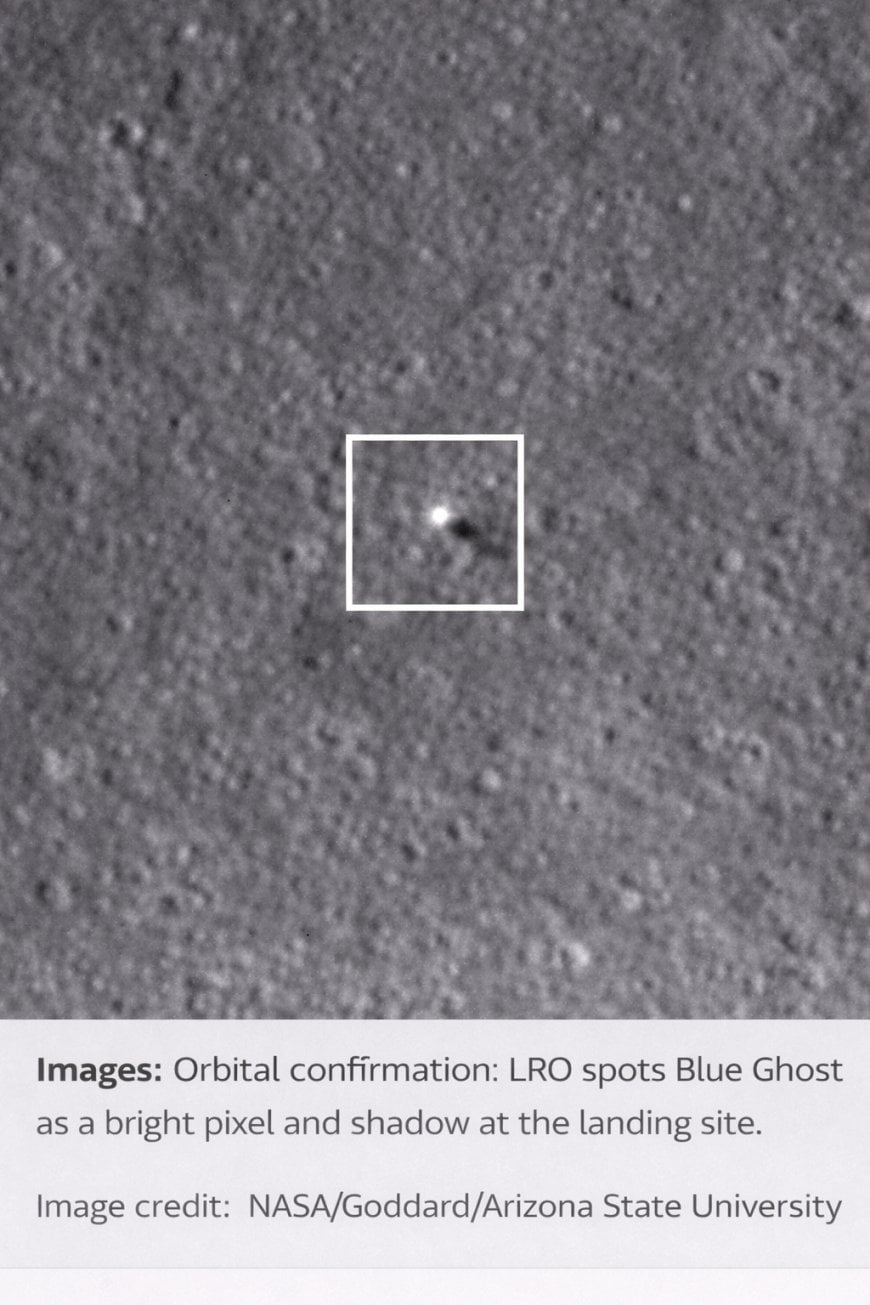
“A private American spacecraft landed on the Moon”
- reads like a one-off achievement. NASA’s framing is different: this was a delivery inside
a procurement rail (CLPS), inside a broader campaign (Artemis), using a payload stack designed to harden the next operating layer on the lunar surface.
The instruments are not “random science.” They’re a systems-validation bundle: navigation and reference frames (so landings can be repeatable and coordinates can be trusted), dust interaction and mitigation (so hardware survives and stays optically/thermally functional), plume physics (so future landings don’t sandblast each other or destroy prepared sites), subsurface thermal and sampling mechanics (so “presence” has engineering reality), and EM/radiation environment characterization (so the compute and sensor layer can be hardened).
In other words: the milestone isn’t a touchdown clip. The milestone is the conversion of lunar access into a scheduleable service with a measurable reliability curve, standardized interfaces, and data products that feed the next task order.
That’s why the first surface image matters more than the headline. It’s the proof the platform is usable. Once it’s usable, CLPS becomes less about “can we do it” and more about “how often can we do it, with what payload mix, and with what level of autonomy and precision.”
NASA also documented the transit-phase performance: after launching Jan. 15, 2025 from Kennedy Space Center, Blue Ghost traveled more than 2.8 million miles, downlinked more than 27 GB of data, and supported several science operations. The most infrastructure-relevant detail: GNSS signal tracking at a record distance of about 246,000 miles via LuGRE—explicitly signaling intent to reuse Earth navigation constellations at lunar distances.
CLPS: the procurement rail behind the headline
If you want the real “why,” ignore the touchdown clip and look at the contracting structure. Blue Ghost is a delivery under NASA’s Commercial Lunar Payload Services (CLPS)—an indefinite delivery / indefinite quantity (IDIQ) contracting approach designed to buy end-to-end commercial payload delivery services: integration, mission operations, launch, and landing.
- CLPS is built for cadence: NASA frames CLPS as a multi-award IDIQ with a combined maximum value of $2.6B through November 2028.
- CLPS is built for vendor competition: NASA states it has awarded 11 lunar deliveries to five vendors to carry more than 50 payloads to the Moon (as of NASA’s CLPS overview page).
- CLPS is built for Artemis relevance: NASA consistently positions these deliveries as de-risking technology and science needed for future crewed missions and long-term presence.
![[IMAGE_2_ALT: Map of Mare Crisium / landing region near Mons Latreille]](https://patternnexus.com/uploads/images/202601/image_870x_6975a3a82a206.jpg)
| Step | Stage | What actually happens | “Enforcement” output |
|---|---|---|---|
| 1 | NASA objectives | Science/tech gaps defined as measurable needs. | Requirements + success criteria. |
| 2 | CLPS task order | Specs + price + schedule become contractual reality. | Contract terms + delivery date (the rail). |
| 3 | Vendor selection | Capability, risk posture, and execution history matter. | Winners become trusted rails. |
| 4 | Integration | Payload interfaces, power, data, thermal, mass constraints locked. | Standards harden (interfaces + procedures). |
| 5 | Launch + transit ops | Navigation, comm, autonomy, fault handling in real conditions. | Reliability curve gets measured. |
| 6 | Precision landing | Hazards, illumination window, comm geometry, plume effects. | Site rules emerge (where/how you can land). |
| 7 | Surface ops window | Power, thermal balance, pointing, dust management over ~14 days. | Operating envelopes defined. |
| 8 | Data return | Telemetry → datasets → validated results. | Data products become the “commodity.” |
| 9 | Performance scoring | Did it meet spec? Did it hit schedule? What failed? | Future awards favor proven execution. |
| 10 | Standards update | Lessons folded into interfaces, procedures, reference frames. | The ruleset evolves without speeches. |
| 11 | Next task order | Same rail, higher ambition. | Cadence becomes infrastructure. |
| 12 | Persistent services | Far side, poles, relay-dependence, longer-duration ops. | “Lunar access” becomes schedulable. |
![[IMAGE_3_ALT: CLPS program rail infographic / vendor cadence timeline]](https://patternnexus.com/uploads/images/202601/image_870x_6975a61f71899.jpg)
The 10 payloads: what they were really validating
NASA’s TO19D payload set (delivered by Blue Ghost 1 to Mare Crisium) is not “random science.” It is an infrastructure-oriented bundle targeting four bottlenecks: navigation and coordinate frames, dust and surface interactions, subsurface access and thermal profiling, and electromagnetic environment characterization.
![[IMAGE_4_ALT: Payload stack diagram with icons for NGLR, LuGRE, RAC, EDS, RadPC, LMS, LEXI, LPV, LISTER, SCALPSS]](https://patternnexus.com/uploads/images/202601/image_870x_6975a42386f59.jpg)
- NGLR (Next Generation Lunar Retroreflector): laser ranging target to improve lunar coordinate frameworks and high-precision Earth–Moon distance measurements.
- LuGRE (Lunar GNSS Receiver Experiment): GNSS-based navigation demonstration at the Moon, leveraging GPS + Galileo signals to reduce dependence on ground networks for PNT.
- RAC (Regolith Adherence Characterization): measures how lunar dust adheres to materials across a lunar day and quantifies accumulation from landing and operations.
- EDS (Electrodynamic Dust Shield): active dust mitigation using electric fields to move dust off surfaces and prevent accumulation, demonstrated on the lunar surface.
- RadPC (Radiation Tolerant Computer System): radiation-tolerant computing demo focused on fault mitigation strategies and ionizing radiation measurement with dosimeters.
- LMS (Lunar Magnetotelluric Sounder): uses natural time-varying electric and magnetic fields to infer the Moon’s interior conductivity profile and thermal structure.
- LEXI (Lunar Environment Heliospheric X-ray Imager): wide field-of-view soft X-ray imaging of Earth’s magnetosheath/magnetopause to study solar wind coupling and space weather drivers.
- LPV (Lunar PlanetVac): pneumatic regolith sample acquisition and delivery system using pressurized gas jets to capture and transfer regolith (up to ~1 cm) into a sample container.
- LISTER: subsurface thermal probe designed to penetrate ~2–3 m and quantify heat flow via thermal gradient and thermal conductivity measurements.
- SCALPSS 1.1: stereo camera suite imaging plume-surface interactions during descent and landing to validate models for future landers and repeated site use.
This is not “Moon rocks for curiosity.” This is an ops stack: coordinate reference frames (NGLR), navigation signals (LuGRE), dust survival (RAC/EDS), surface and subsurface handling (LPV/LISTER), plume physics for traffic (SCALPSS), and radiation + EM characterization (RadPC/LMS/LEXI).
![[IMAGE_5_ALT: GNSS-at-the-Moon concept diagram / PNT stack from Earth constellations]](https://patternnexus.com/uploads/images/202601/image_870x_6975a82b30a74.jpg)
Why Blue Ghost matters beyond “we landed”
“Commercial lunar landing” is often narrated as a prestige story. In practice it is a reliability story. Reuters framed Blue Ghost as the first “fully successful” private soft landing, contrasting it with earlier commercial attempts that landed with orientation issues. That distinction matters because science output and technology validation require stable power, comm geometry, thermal control, and predictable operations windows.
NASA’s own press release points to a deliberate industrialization path: use commercial providers to deliver NASA instruments, learn lessons, and build a “growing lunar economy.” That phrase is not marketing fluff. It implies a repeatable service market anchored by public procurement, evolving standards, and an expanding vendor ecosystem that competes on reliability and capability.
![[IMAGE_6_ALT: Plume-surface interaction imagery / dust plume concept / SCALPSS camera view]](https://patternnexus.com/uploads/images/202601/image_870x_6975a82578f65.jpg)
- Navigation normalization: LuGRE is a step toward operational PNT around the Moon using existing GNSS signals—an autonomy multiplier and a standardization seed.
- Dust is an enemy system: RAC + EDS are about survivability and lifecycle cost (optics, seals, thermal radiators, suits, habitats, sensors).
- Subsurface access is a gating function: LPV + LISTER are early proofs for sample handling and thermal/resource characterization—the practical substrate behind “presence.”
- Cadence forces standardization: when deliveries repeat, interfaces harden, procedures converge, reference frames become enforceable, and “who can operate” becomes a function of compliance.
Pattern Nexus Lens
Treat the Moon as a surface where control systems will emerge the same way they emerge everywhere else: through routing, reference frames, and trusted rails. CLPS is the rail. Navigation and coordinates are the reference frame. Dust mitigation and plume physics are the reliability layer. Once those layers stabilize, “lunar access” becomes schedulable—and schedulable access is the prerequisite for governance, standards, and enforceable operating rules.
Routing: who can deliver payloads to specific coordinates under contract and on schedule?
Pricing: how does “cost to surface” change when reliability and cadence are priced in?
Eligibility: which vendors become trusted rails, and which payloads get prioritized?
Redundancy: how many parallel vendors, launch options, comm relays, and landing sites exist?
Legitimacy: how often does “science” function as the public wrapper for strategic infrastructure buildout?
Touchdown is not the end state. Touchdown is the proof that the rail works. The rail is what scales. The rail is what standardizes. And standardization is how control systems arrive without anyone announcing them.
FAQ
When did the landing actually happen?
Blue Ghost Mission 1 landed March 2, 2025 at 3:34 a.m. EST near Mons Latreille in Mare Crisium on the Moon’s near side, per NASA’s release.
Why is “upright and stable” such a big deal?
Because payloads need power, thermal balance, comm geometry, and predictable orientation to execute. A tipped or unstable lander can still be “a landing,” but it may not be a functioning science platform.
What was the most important “infrastructure” demo onboard?
LuGRE + NGLR. Navigation and reference frames are the substrate for precision landings, repeat operations, and ultimately any scalable surface economy.
What is CLPS in one sentence?
CLPS is NASA’s multi-vendor commercial delivery contracting approach to buy end-to-end payload delivery to the Moon, with a combined maximum contract value of $2.6B through November 2028.
Did Blue Ghost operate for the full two weeks?
NASA stated surface operations were expected to last about one lunar day (~14 Earth days) with some hours of post-sunset operation. AP reported the lander fell silent after sunset when solar power ended—an expected constraint for solar-powered landers in this class.
Sources
Primary NASA confirmation, official payload list, CLPS contract structure, and corroborating reporting for context and framing.
- NASA — “Touchdown! Carrying NASA Science, Firefly’s Blue Ghost Lands on Moon” (Mar 2, 2025)
- NASA Science — TO19D Science Payloads (Blue Ghost 1 / Mare Crisium)
- NASA — Commercial Lunar Payload Services overview (deliveries, vendors, contract framing)
- NASA — CLPS reference page (IDIQ and $2.6B max through 2028)
- Firefly Aerospace — Blue Ghost Mission 1 overview
- Reuters — Firefly scores its first moon landing with Blue Ghost (Mar 2, 2025)
- AP — Blue Ghost concludes mission after lunar sunset (Mar 2025)
Какова ваша реакция?
 Нравится
0
Нравится
0
 Не нравится
0
Не нравится
0
 Любовь
0
Любовь
0
 Смешно
0
Смешно
0
 Вау
0
Вау
0
 Грусть
0
Грусть
0
 Сердитый
0
Сердитый
0

Founder of Pattern Nexus. I research markets, macro, geopolitics, AI, history, ancient systems, and the patterns most people overlook. I’m also building Market Radar, a trading scanner designed to read pressure, risk, confirmation, and setup quality before chasing a move. Pattern Nexus is where I connect the dots between data, history, technology, and the bigger system playing out around us.













Комментарии (0)