
Sunset on Mars: The Blue Hour That Shows What Happened to a World
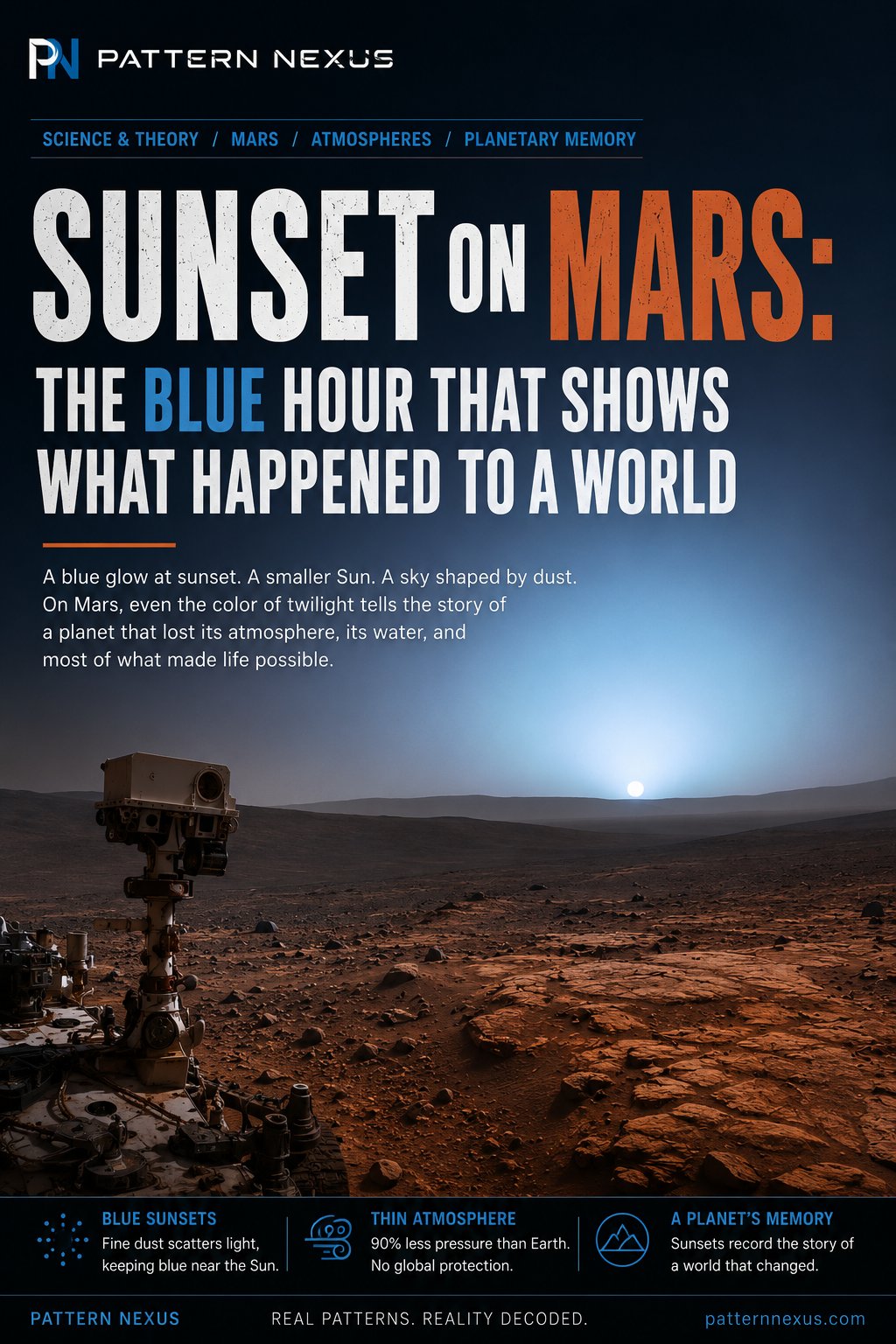
A sunset on Mars is not just a beautiful image from another planet. It is a physics lesson, an atmospheric fossil, and a reminder that Mars is not simply “the Red Planet.” Martian sunsets often appear blue because fine dust in the thin atmosphere scatters light differently than Earth’s atmosphere does. The blue glow around the Sun is not just scenery. It is the visible signature of a planet that lost most of its atmosphere, dried out, and became a cold, exposed world where light itself tells the story of planetary failure.

Science & Theory / Mars / Atmospheres / Planetary Memory
Sunset on Mars: The Blue Hour That Shows What Happened to a World
A sunset on Mars is not just a pretty rover image. It is light passing through the remains of a broken atmosphere. It is dust, distance, scattering, planetary loss, and time compressed into one blue glow around a smaller Sun.
Quick Read
Sunsets on Mars often look blue, which feels wrong at first because Mars is supposed to be the Red Planet. That is what makes the image so powerful. The planet that looks red from Earth gives you a blue sunset from the ground, and that inversion is not just visual trivia. It is a direct consequence of how sunlight moves through a thin, dusty atmosphere that no longer works like Earth’s.
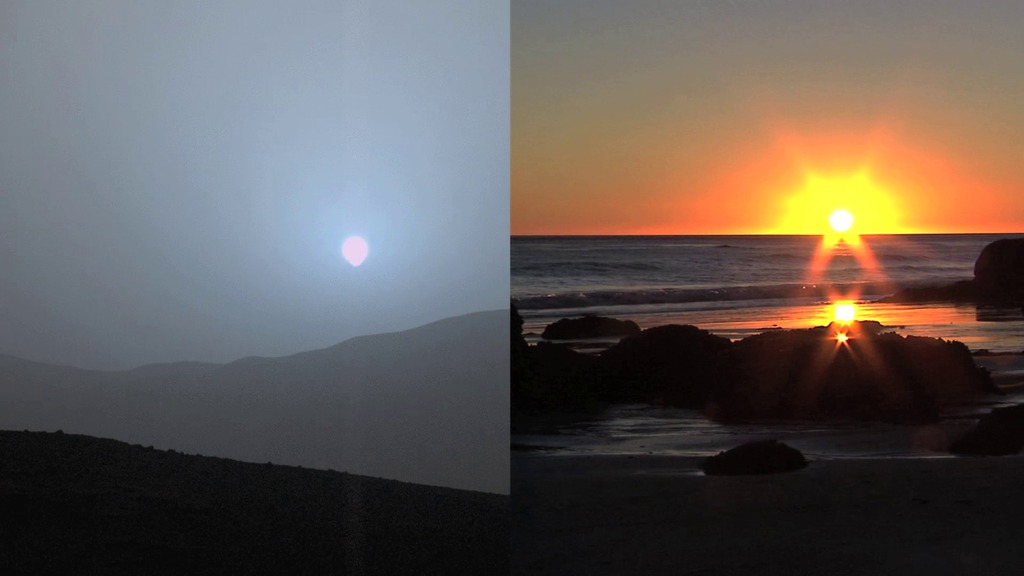
On Earth, sunsets turn red and orange because sunlight passes through a longer path in the atmosphere near the horizon, and the shorter blue wavelengths get scattered away by gas molecules. On Mars, the atmosphere is much thinner and filled with fine dust. NASA explains that the fine dust particles let blue light penetrate the atmosphere more efficiently and keep that blue light closer to the Sun’s direction, while red and yellow light scatters more broadly through the sky.
That means a Martian sunset is not just beautiful. It is diagnostic. Rover sunset images help scientists study dust, haze, clouds, and how high into the atmosphere those particles extend. They also remind us that Mars is not a dead rock because nothing ever happened there. Mars is a world where something did happen: atmosphere was lost, water disappeared from the surface, climate collapsed, and now even the color of sunset carries the memory of that loss.
-
Inside This Article
The Wrong Image of Mars - Why Is a Martian Sunset Blue?
- Earth’s Red Sunset vs. Mars’ Blue Sunset
- Dust Is the Atmospheric Code
- The Thin-Air Problem
- What the Rovers Actually Saw
- Curiosity’s Blue Sunset in Gale Crater
- Perseverance and the More Muted Sunset
- Spirit’s Sunset at Gusev Crater
- Mars Has a Long Twilight
- The Sunset as Atmospheric Memory
- What a Human Would Feel Standing There
- Pattern Nexus Lens
- My Read
- Related Pattern Nexus Reading
- Sources
Planet
- Mars, the Red Planet, where the ground is rust-colored but many sunsets glow blue near the Sun.
Main Cause
- Fine Martian dust scatters sunlight differently than Earth’s gas-rich atmosphere.
What It Reveals
- Sunset images help scientists study dust, haze, clouds, and atmospheric structure.
Real Lesson
- A Martian sunset is not just scenery. It is the visible signature of a planet that lost its climate.
The Wrong Image of Mars
Most people carry the wrong image of Mars in their head. They imagine a red world under a red sky, with red rocks, red dust, red horizons, and some kind of endless desert apocalypse. That image is not completely false, but it is incomplete in the way most simple images of reality are incomplete. Mars is red from orbit because of iron oxide in the soil, but the sky and the light do not behave like a poster.
Mars can give you a blue sunset.
That one fact should stop people for a second because it tells you something deeper about how planets work. Color is not just color. Color is physics filtered through atmosphere. What you see at the horizon is not simply the Sun going down. It is a whole planetary system revealing how it handles light.
On Earth, sunset feels warm because our atmosphere turns the horizon red, orange, and gold. On Mars, the same moment can feel colder, thinner, stranger, almost reversed. The planet is called red, but the Sun sets into blue. That is not a contradiction. That is the system exposing itself.
This is why a sunset on Mars deserves more than a caption. It is one of the simplest images people can understand emotionally, but under it is a whole structure of dust, pressure, light scattering, atmosphere loss, planetary history, and future human survival.

Why Is a Martian Sunset Blue?
The simple answer is dust. The better answer is that Mars has the wrong atmosphere for an Earth-style sunset and exactly the right dust for a blue glow near the Sun.
On Earth, the atmosphere is thick, gas-rich, and dominated by molecules that scatter shorter blue wavelengths very efficiently. During the day, that scattered blue light fills the sky. At sunset, sunlight travels through a much longer atmospheric path, and much of the blue light is scattered away before it reaches your eye. What remains near the horizon is richer in red, orange, and yellow, which is why Earth sunsets feel warm.
Mars does not run that same atmospheric machine. Mars has a very thin atmosphere, and that atmosphere carries fine dust. Those dust particles are not just background dirt floating in the air. They control how sunlight is filtered. NASA explains that the dust particles are the right size to let blue light penetrate the atmosphere slightly more efficiently, keeping blue light closer to the direction of the Sun while yellow and red light scatter more broadly through the sky.
That is the counterintuitive part. On Earth, blue light is scattered all over the daytime sky. On Mars, the blue light can stay concentrated closer to the Sun during sunset, creating that eerie blue halo. The rest of the sky may still carry muted yellows, grays, oranges, or rusty tones depending on dust conditions, but near the Sun, the blue becomes the signature.
This is why the most important part of the image is not just the color itself. It is what the color means. The sunset is a visual readout of particle size, atmospheric thickness, dust loading, solar angle, and the path of light through the air. It is atmospheric data disguised as beauty.
Earth’s Red Sunset vs. Mars’ Blue Sunset
The contrast between Earth and Mars is almost too perfect. Earth has a blue daytime sky and red-orange sunsets. Mars has a rusty daytime world and blue-tinged sunsets. The colors are inverted because the atmospheric systems are different.
On Earth, our atmosphere is thick enough to turn sunlight into a full sky experience. The blue sky is everywhere because gas molecules scatter shorter wavelengths broadly. At sunset, the longer atmospheric path filters the light and leaves the horizon glowing red and orange.
On Mars, the atmosphere is too thin to behave like Earth’s, and dust becomes the dominant visible actor. The air is mostly carbon dioxide, but it is the suspended dust that gives Martian sky color its strange behavior. The dust is fine enough and optically important enough to shape the way sunlight moves near the horizon.
That is the part people miss when they talk about Mars as a dead desert. Deserts on Earth still sit under Earth’s atmospheric system. Mars does not. Mars is not just a dry version of Earth. It is a different optical, chemical, climatic, and geological regime.
The sunset proves that in one image. You do not need a climate model to feel the difference. You can see it. The Sun is smaller because Mars is farther from the Sun. The light is colder. The atmosphere is thinner. The dust is doing the work. The whole planet is telling you that it is not Earth.
Dust Is the Atmospheric Code
Mars dust is not just scenery. It is one of the main control layers of the planet.
On Earth, dust can change sunsets after volcanic eruptions, wildfires, deserts, and storms, but it is not usually the core identity of the sky. On Mars, dust is everywhere. It covers the ground, rides the wind, loads the atmosphere, dims the Sun, changes sky color, affects rover power, influences surface temperature, and helps define what the planet looks like from both orbit and the ground.
That is why sunset observations matter scientifically. A rover taking a sunset image is not just sending home a postcard. It is helping researchers understand how dust is distributed vertically in the atmosphere. Is the dust close to the ground? Is it suspended high above the surface? How does it change between seasons? How does it behave between dust storms? How does it affect the way heat and light move through the atmosphere?
NASA’s Curiosity team specifically used sunset observations to study the vertical distribution of dust after images were taken between dust storms, when some dust still remained suspended high in the atmosphere. That detail matters because Mars is not static. The sky changes. The dust changes. The atmosphere responds.
A Martian sunset is therefore not just an optical effect. It is a dust measurement. It is atmospheric structure made visible.
The Thin-Air Problem
The blue sunset only makes sense when you remember how thin Mars’ atmosphere is compared with Earth’s. Mars does have an atmosphere, but it is not an Earth-like atmosphere in any protective or breathable sense. It is thin, cold, dry, mostly carbon dioxide, and unable to support stable surface liquid water under normal present-day conditions.
This thinness changes everything. It changes sound. It changes weather. It changes heat transfer. It changes radiation exposure. It changes how dust moves. It changes how sunlight is scattered. It changes what a sunset can be.
On Earth, the atmosphere acts like a massive buffer. It redistributes heat, supports pressure cycles, shields the surface, carries water vapor, builds clouds, powers weather, and makes life possible at the surface. On Mars, that buffer is mostly gone. The atmosphere is still there, but it is a remnant layer compared with what Mars likely had in its warmer, wetter past.
That is why a sunset on Mars can feel beautiful and tragic at the same time. The blue glow is not only a trick of dust. It is happening inside the remains of a planetary system that could not hold on to what Earth kept.
What the Rovers Actually Saw
Mars sunsets have been recorded by multiple missions, and each one adds a different layer to the story. Viking saw sunrise from the surface in the 1970s. Spirit captured a famous sunset over Gusev Crater in 2005. Opportunity made a long blue sunset movie in 2010. Curiosity recorded its first color sunset in Gale Crater in 2015. Perseverance later captured a more muted sunset in Jezero Crater in 2021.
Each of these images is more than an isolated view. Together, they form a record of how Mars’ atmosphere behaves from different locations, seasons, cameras, and mission eras.
That matters because Mars is not one image. Mars is a changing system. Dust storms rise and fade. Clouds appear. Twilight lingers. The amount of dust in the atmosphere shifts. The sky changes based on what the air is carrying at that moment.
So when people ask what a sunset on Mars looks like, the honest answer is that it depends. It often has a blue glow near the Sun, but the exact color and intensity depend on dust, haze, clouds, season, and the way the image is processed. The famous blue sunset is real, but Mars is not a static Instagram filter. It is a planet with weather, atmosphere, and variability.
Curiosity’s Blue Sunset in Gale Crater
Curiosity’s April 15, 2015 sunset in Gale Crater became one of the most recognizable Mars sunset images because it captured the emotional contradiction so cleanly: a pale Sun dropping behind dark Martian hills under a blue-gray glow.
NASA says this was Curiosity’s first sunset observed in color. The rover used its Mastcam, and the image was calibrated and white-balanced to remove camera artifacts. That calibration point matters because people often assume rover images are raw reality. They are not exactly raw human vision, but they are scientifically processed to remove instrument bias and approximate what the scene would look like under defined conditions.
The image was taken after dust storms, when some dust was still suspended high in the atmosphere. That makes it even more useful because the image is not just showing the horizon. It is showing how dust changes the color and structure of twilight.
Curiosity’s sunset is the kind of image that can make Mars feel close for a moment. You can imagine standing there. The hills are dark. The Sun is small. The sky is muted. The blue glow is quiet. But the science behind it says the opposite of comfort. It says the atmosphere is thin, dusty, exposed, and not built for us.
Perseverance and the More Muted Sunset
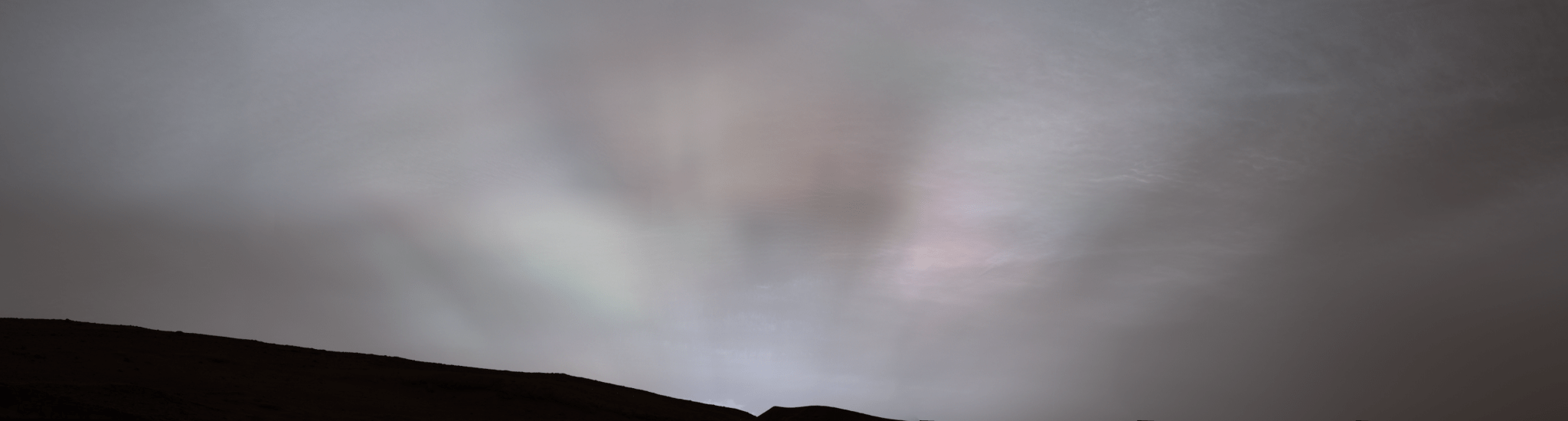
Perseverance captured a sunset in Jezero Crater on Nov. 9, 2021, using Mastcam-Z. NASA notes that this sunset looked different because there was less dust in the atmosphere, resulting in a more muted color than average.
That is important because it proves the blue sunset is not just a permanent paint layer over Mars. It is an atmospheric condition. More dust, less dust, high dust, low dust, clouds, ice particles, local season, and camera calibration all matter.
This is where Mars becomes more real. It is not just a dead red ball. It has changing skies. It has suspended dust. It has clouds. It has sunrises, sunsets, twilight, seasonal cycles, and a planet-wide atmosphere that is thin but still active.
The irony is that Mars feels more alive when you understand the atmosphere, even though the atmosphere also tells you how hostile the planet is. There is motion. There is light. There are changing skies. But there is no Earth-like protection underneath it.
Spirit’s Sunset at Gusev Crater
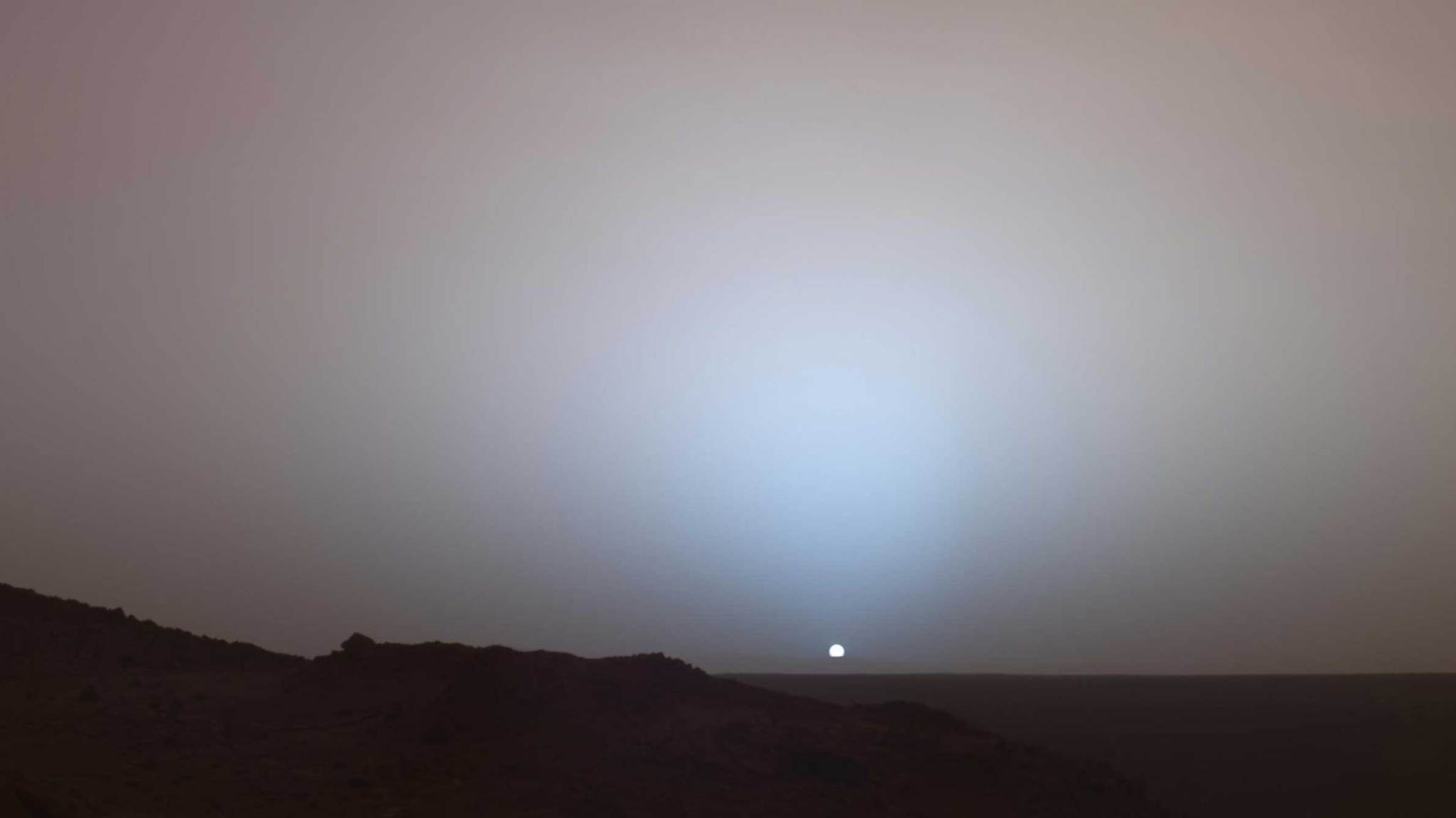
Spirit’s 2005 sunset over Gusev Crater is one of the classic Martian horizon images. The Sun appears small, dropping behind the distant crater rim, with a bluish glow above it and a darker landscape below.
NASA explains that the bluish glow above the Sun would be visible to a human observer, though the specific Pancam filter combination exaggerated some redness farther from the sunset compared with normal daytime colors. That is an important correction because Mars images always live between instrument data and human perception.
Still, the blue is not fake. It is part of the Martian sky system. It is the way the atmosphere handles sunlight at low angles.
Spirit’s image matters because it gave the public one of the first emotionally powerful looks at sunset from another world. Not an artist painting. Not a simulation. A rover sitting on Mars, looking toward the horizon, watching the Sun sink behind a crater rim.
Mars Has a Long Twilight
One of the more interesting parts of the Mars sunset story is that twilight can last longer than people expect. NASA notes that images have shown twilight glow visible, though increasingly faint, for up to two hours before sunrise or after sunset. That long twilight is caused by sunlight scattering around to the night side of the planet through high-altitude dust.
That detail changes the emotional image of Mars. We often imagine the planet as harsh, abrupt, and dead, but the light does not simply shut off. It lingers. The sky carries the Sun’s memory around the curve of the planet through dust.
That is beautiful, but again, the beauty is also a system. The twilight is not magic. It is scattering. It is high-altitude dust. It is the geometry of a thin atmosphere spreading light beyond the direct path of the Sun.
On Earth, long twilight can happen after volcanic eruptions when tiny particles high in the atmosphere scatter sunlight. Mars has that kind of dust influence as a more normal part of its identity. Its sky is always telling you what is suspended in it.
The Sunset as Atmospheric Memory
This is where the sunset becomes more than optics.
Mars was not always the planet we see now. The surface evidence says water once flowed there. Rivers carved channels. Lakes filled basins. Minerals formed in the presence of water. Ancient Mars had a very different environmental story than modern Mars.
But Mars lost much of the atmosphere that would have helped support that world. NASA’s MAVEN mission has shown that solar wind and atmospheric escape helped strip gases from Mars over time. The details are still studied and debated, but the larger picture is clear enough: Mars was transformed from a more active, wetter world into the cold, dry, thin-atmosphere planet we see now.
That means the modern Martian sunset is not only a present-day optical effect. It is also a trace of planetary history. The blue glow happens because of the atmosphere Mars has now, and the atmosphere Mars has now is the remnant of a world that lost the ability to protect its surface the way Earth does.
When you look at a sunset on Mars, you are looking at light passing through what remains.
What a Human Would Feel Standing There
Imagine standing on Mars at sunset, not as a rover, not as a camera, but as a person inside a pressure suit. The Sun would look smaller than it does from Earth because Mars is farther away. The ground would be cold and rust-colored. The air would be too thin to breathe. The sky near the Sun would glow blue, and the surrounding horizon might fade into gray, yellow, orange, or brown depending on dust conditions.
It would be beautiful, but not in the same way an Earth sunset is beautiful.
An Earth sunset feels like atmosphere wrapping around you. A Mars sunset would feel like atmosphere failing to wrap around you. On Earth, the sky is a blanket. On Mars, the sky is a trace.
That is the human part of this. Future astronauts may one day watch this with their own eyes, but they will not be standing there casually. They will be inside technology, inside pressure, inside habitat logistics, inside radiation risk, inside all the artificial systems required to survive on a planet that lost its natural ones.
The sunset would be stunning because it is alien. It would be sobering because it is a warning.
Pattern Nexus Lens
A sunset on Mars is a layered system pretending to be a simple image.
At the first layer, there is light: sunlight traveling farther from the Sun to Mars than it does to Earth, arriving weaker and showing a smaller solar disk in the Martian sky.
At the second layer, there is atmosphere: thin, mostly carbon dioxide, unable to provide Earth-like pressure, weather, heat transport, or biological protection.
At the third layer, there is dust: fine particles suspended in the atmosphere, controlling how blue, red, and yellow wavelengths scatter near the horizon.
At the fourth layer, there is history: Mars once carried more water and likely a thicker atmosphere, but atmospheric escape and climate loss changed the planet’s surface destiny.
At the fifth layer, there is instrumentation: rover cameras, filters, calibration, white balance, image processing, and the constant translation problem between instrument data and human perception.
At the sixth layer, there is science communication: the public sees a beautiful blue sunset and treats it like a space postcard, while the data underneath is about dust height, atmospheric opacity, particle scattering, and planetary loss.
At the seventh layer, there is the human layer: the emotional shock of realizing another world has sunsets too, but those sunsets happen under a sky that cannot protect life the way ours does.
That is why this matters. A Martian sunset is not just Mars looking pretty. It is Mars explaining itself through light.
My Read
My read is that the blue sunset on Mars is one of the simplest ways to understand the entire planet.
It is beautiful, yes, but the beauty is almost the least important part. The blue glow is the visible edge of a much deeper story. Mars is showing us what happens when a planet still has an atmosphere, but not enough of one to be a home. It still has weather, dust, clouds, sky color, sunrise, sunset, twilight, and seasonal change. It still has planetary behavior. But it does not have the layered protection that made Earth stable enough for life to build a biosphere.
That is why the sunset feels strange. It is familiar enough to connect with emotionally and alien enough to break the comparison.
On Earth, sunset makes you feel held by the atmosphere. On Mars, sunset makes you notice the atmosphere is missing.
That is the Pattern Nexus point. This is not just a color fact. This is a systems fact. The color comes from dust. The dust is controlled by atmosphere. The atmosphere is the remnant of planetary history. The planetary history connects to water loss, climate failure, solar wind, and the difference between a world that stayed alive and a world that became a fossil.
A blue sunset on Mars is not just another cool NASA image. It is a reminder that planets can almost look familiar and still be fundamentally broken as living systems.
And maybe that is why it hits so hard. It is not the alienness that makes Mars haunting. It is the almost-familiar part. The hills. The horizon. The Sun going down. The quiet sky. The moment that feels like it should belong to Earth, except everything underneath it says this world lost the conditions that would have made that sunset safe to watch without a machine between you and death.
Mars still has sunsets. That does not mean Mars is alive. It means even a failed world can still be beautiful.
Sources
- NASA Science: What Do Sunrises and Sunsets Look Like on Mars?
- NASA Science: Sunset in Mars’ Gale Crater
- NASA/JPL: NASA’s Curiosity Rover Views Serene Sundown on Mars
- NASA SVS: NASA’s Curiosity Sees Blue Sunset on Mars
- NASA MAVEN: Atmospheric Escape and Sputtering at Mars
- NASA SVS: NASA Solves Mars Mystery of Lost Atmosphere
- The Planetary Society: A Blue Sunset on Mars
Pattern Nexus is not just tracking the image. It is tracking the system inside the image: sunlight, dust, atmosphere, loss, memory, and the difference between a planet that still has sunsets and a planet that can still hold life.
Frequently Asked Questions
Какова ваша реакция?
 Нравится
0
Нравится
0
 Не нравится
0
Не нравится
0
 Любовь
0
Любовь
0
 Смешно
0
Смешно
0
 Вау
0
Вау
0
 Грусть
0
Грусть
0
 Сердитый
0
Сердитый
0

Founder of Pattern Nexus. I research markets, macro, geopolitics, AI, history, ancient systems, and the patterns most people overlook. I’m also building Market Radar, a trading scanner designed to read pressure, risk, confirmation, and setup quality before chasing a move. Pattern Nexus is where I connect the dots between data, history, technology, and the bigger system playing out around us.














Комментарии (0)