
The Thailand–Cambodia Flashpoint: Managed Instability Comes to Southeast Asia
The Thailand–Cambodia border conflict is not a local anomaly. It is a repeatable flashpoint where alliance hedging, great-power leverage, and managed instability intersect. A Pattern Nexus systems-level analysis.
Published: December 16, 2025
By: Pattern Nexus
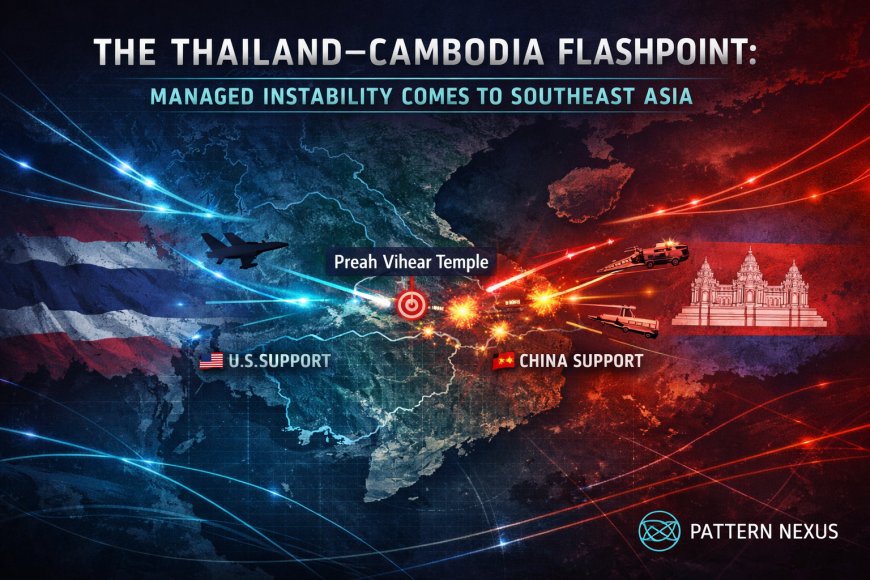
The Thailand–Cambodia border escalation is not “just a temple dispute” and it is not random. It is a repeatable ignition source inside a region built on hedging, where great powers can gain leverage without formally picking sides. What looks local becomes a controlled pressure test: alliance elasticity, escalation thresholds, and who becomes the broker when the system rewards managed instability.
Current Snapshot
This border dispute is old, but the current escalation is real. Reports describe artillery and rocket exchanges, Thai air activity, major crossing disruptions, and significant civilian displacement. Both sides claim the other initiated attacks. In practical terms, that tells you two things: the local political layer is now fused to the military layer, and the information layer will be contested as hard as the terrain.
PN bubble: When both sides race to narrate first-contact, the goal is not simply “truth.” The goal is external positioning. If you can frame yourself as the restrained actor, you attract diplomatic cover, matériel options, and mediation leverage.
What is visible
- Fighting concentrated along contested frontier sectors with spillover risk across multiple points
- Mutual accusations over initiating fire, strikes, and explosive incidents
- Border closures and mobility restrictions impacting trade and civilians
- International calls for de-escalation, ceasefire, and negotiations
What is structurally true
- The dispute sits on unresolved demarcation plus symbolic national terrain
- Domestic politics can turn a local skirmish into a national pride test
- Outside powers can shape escalation thresholds without overt intervention
- ASEAN’s consensus model is weak under high-emotion sovereignty disputes
Historical Substrate
Thailand–Cambodia border tension is not a new invention. It sits on colonial-era mapping ambiguity, post-independence boundary disputes, and specific symbolic flashpoints around temple complexes and adjacent high ground. Over decades, the pattern has repeated: localized incidents, nationalist heat, limited military engagement, followed by externally encouraged restraint and a temporary normalization that never resolves the underlying map problem.
The important point is not the archaeology. The important point is repeatability. This is a dispute that can be reignited because the underlying conditions remain intact: contested lines, contested identity, and the political utility of “defending sovereignty” in moments of domestic stress.
PN bubble: Repeatable flashpoints are valuable assets in a competitive international system. They allow power to be exercised indirectly, under the cover of “local history,” while alignment shifts occur quietly in the background.
Recent escalation path in 2025
- Spring–summer deterioration: border incidents increase and tensions harden
- Mid-year fighting: a ceasefire/truce is reportedly arranged but remains fragile
- Late-year accelerant: landmine allegations and blame narratives raise the political temperature
- December collapse: truce fails, fighting expands, crossings close, civilians displace
Military Asymmetry
This is not a balanced contest. Thailand is the conventionally stronger power, with superior air capability and deeper logistics. Cambodia is weaker conventionally and is therefore incentivized to fight differently: political internationalization, denial tools, and area-fire weapons that impose costs without requiring symmetrical force structure.
When you see a strong power and a weaker power collide, escalation behaves differently than in peer conflict. The stronger actor believes it can impose terms quickly. The weaker actor believes it can widen the political cost field and wait. That is exactly the kind of structural setup that outside powers can exploit without firing a shot.
PN bubble: Asymmetry is what makes “managed influence” feasible. You do not need to flood the theater with weapons. You only need to adjust one or two constraints: diplomacy, intelligence, air defense, munitions flow, or the credibility of ceasefire enforcement.
Why asymmetry attracts external leverage
- Small inputs can change the weaker side’s survivability and bargaining position
- Diplomatic cover can blunt consequences for the stronger side’s use of force
- Information operations can shape “legitimacy” and therefore foreign involvement
- Mediation channels become strategic access channels in disguise
Thailand: U.S. Ally, Hedge State
Thailand is formally a U.S. treaty ally, but it is not a passive extension of U.S. strategy. Over the last decade, Bangkok has operated like a classic hedge state: maintaining U.S. military ties while expanding defense relationships with China. That is not ideological conversion. It is strategic survival under conditions where U.S. commitments are perceived as more transactional and where China is geographically permanent.
In a conflict like this, Thailand does not require overt backing to act. It requires assurance that escalation will not isolate it diplomatically and that external pressure will remain manageable. A hedge state can seek that assurance from multiple poles simultaneously, which makes it harder for any one sponsor to control outcomes.
PN bubble: Treaty ally does not mean proxy. The new model is “formally aligned, strategically independent.” That is the Southeast Asia baseline, not the exception.
Cambodia: Weak Power, High Leverage
Cambodia’s military weakness does not make it strategically irrelevant. In fact, weakness can create leverage if the country sits at the junction of great-power competition. Cambodia has long been viewed as China-leaning, with persistent controversy around Chinese influence and access questions. Yet in 2025, the United States moved to reopen military engagement channels, including policy shifts that reduce friction in defense relations.
That does not automatically mean the U.S. is “backing Cambodia against Thailand.” Those are different claims. What is more defensible is this: the United States has incentives to prevent Cambodia from becoming an exclusive Chinese client. Selective re-engagement is a containment-of-lock-in strategy, not an endorsement of Cambodia’s internal governance and not necessarily a military commitment.
PN bubble: In the modern era, “pivot” rarely means treaty. It often means optionality. The U.S. can reopen channels with Cambodia to prevent total PRC capture without ever turning Cambodia into an instrument against Thailand.
China: Hedge, Not Choose
The simplistic story is “China backs Thailand.” The more realistic story is “China hedges both sides and benefits from being needed.” Beijing has meaningful ties with Thailand and deep equities in Cambodia. It does not need to choose a winner. It needs relevance, access, and influence preservation across the board.
A contained regional conflict creates opportunities for China: mediator positioning, diplomatic gravity, and the ability to shape regional narratives about who can deliver stability. That is leverage. Not tanks. Not slogans. Leverage.
PN bubble: The objective is not conquest. The objective is indispensability. If both sides believe you can turn the temperature down, you own a piece of their future decisions.
United States: Re-Engagement vs “Backing”
The claim that the United States is secretly backing Cambodia against Thailand is not supported by open evidence. What is supported is a thawing trend in U.S.–Cambodia engagement and a visible desire to reduce Chinese exclusivity in Phnom Penh’s security orbit.
The U.S. also has a clear interest in keeping Thailand anchored. But “anchored” does not mean “obedient.” The U.S. alliance network in 2025 is not the Cold War network. It is a network under strain, where local states bargain and hedge because they have to.
So the more accurate framing is not “the U.S. switched sides.” It is “the U.S. is widening its optionality while trying to preserve baseline alignment with a hedge ally.”
PN bubble: The U.S. doesn’t need Cambodia to beat Thailand. It needs Cambodia to not become a PRC-exclusive node. That’s the distinction most people miss.
Not Ukraine, But It Rhymes
This is not Ukraine. It is not a mass-scale proxy war with industrial arms pipelines and continent-wide sanctions. But it rhymes structurally: a contested border becomes a trigger, narratives harden instantly, and outside powers gain leverage by shaping the conflict’s diplomatic perimeter rather than deploying directly.
The “Ukraine lesson” that applies here is not about weapons. It is about alignment under stress. Conflict forces choices. Even if the choice is “hedge harder,” it is still a choice that changes the trajectory.
PN bubble: Modern competition runs on pressure points. The point is not to occupy everything. The point is to make every region a bargaining table.
Pattern Nexus Lens: Managed Instability
In the old world, great powers tried to prevent instability because it disrupted predictable trade and alliance maps. In the current world, instability is increasingly managed rather than eliminated, because managed instability generates leverage: diplomatic dependence, security engagement justification, and alignment nudges that occur without formal declarations.
That is why these conflicts keep appearing as “small wars” that never quite resolve. The system is structured to monetize unresolved friction.
Why “managed instability” is a feature
- It tests alliance elasticity without forcing treaties to break publicly
- It creates mediation leverage and access channels under humanitarian cover
- It forces regional states to bargain, hedge, and reveal priorities
- It consumes attention while larger structural shifts proceed underneath
PN bubble: What matters is not who “wins” a border ridge. What matters is who becomes the broker, who gains access, and who shifts alignment quietly when everyone is busy watching the fire.
Forward Scenarios
Scenario 1: Dual-Hedge Stabilization (most probable)
Fighting cools under pressure. Thailand remains a hedge ally. Cambodia deepens limited U.S. engagement while maintaining Chinese ties. China positions itself as mediator. The outcome is not resolution, but stabilization with leverage gains spread across multiple actors.
Scenario 2: Cambodia as a Strategic Wedge (plausible)
The U.S. uses the crisis to expand Cambodia optionality: more engagement, more channels, more bargaining power, designed to prevent total PRC lock-in. This is “pivot” as access, not “pivot” as proxy war sponsorship.
Scenario 3: Thailand as the Quiet Swing State (plausible)
Beijing prioritizes Thailand as a higher-value target for influence capture. Thailand grows more transactional, splitting procurement and training across poles. The U.S. retains treaty optics but loses exclusivity. Cambodia remains China-leaning but becomes a place where the U.S. refuses to fully disengage.
Scenario 4: Escalation Spiral and ASEAN Fracture (tail risk)
A miscalculation triggers broader fighting. Nationalist politics lock leaders into rigid positions. ASEAN consensus mechanisms fail to coordinate, and outside powers become the only effective deconfliction channels. This scenario increases external leverage dramatically, but at a higher humanitarian and economic cost.
PN bubble: None of these scenarios require either superpower to “pick a side.” The modern move is to gain the role of thermostat, not the role of soldier.
Signals to Watch
If you want to test narratives instead of getting trapped inside them, watch for signals that are hard to fake and expensive to reverse.
If the U.S. were truly backing Cambodia against Thailand
- Fast-tracked security assistance packages aimed at battlefield survivability
- Public intelligence-sharing posture or clear ISR support indicators
- Noticeable downgrades in U.S.–Thailand defense engagement beyond normal turbulence
If China were truly backing Thailand against Cambodia
- Unusual diplomatic cover explicitly justifying Thai escalation steps
- Emergency munitions or air-defense support signals
- Visible pressure on Cambodia tied to security conditionality or economic coercion
What is more likely
- Both Washington and Beijing press de-escalation while harvesting leverage quietly
- Thailand keeps hedging; Cambodia increases optionality; ASEAN struggles to unify
- Conflict becomes a bargaining table rather than a decisive war
PN bubble: The signal is the subtlety. If you’re waiting for a press conference that says “we switched sides,” you’ll miss the real shift, because it happens through access, not announcements.
FAQ
Is this conflict primarily about temples and maps?
That’s the substrate, not the whole story. The dispute persists because it is unresolved and politically useful. In 2025, it also matters because it interacts with great-power hedging and ASEAN alignment pressure.
Is Cambodia dramatically weaker than Thailand?
Yes, conventionally. Thailand’s advantages in airpower and logistics create an asymmetric dynamic that shapes tactics, escalation behavior, and the kind of external influence that matters.
Is China backing Thailand?
China has meaningful ties with Thailand, but it also has deep equities in Cambodia. The more realistic view is hedging and mediation leverage, not binary selection.
Is the U.S. secretly backing Cambodia against Thailand?
There is no solid open-source basis to claim battlefield sponsorship against Thailand. What is observable is U.S. re-engagement and optionality-building with Cambodia, likely intended to prevent exclusive Chinese capture rather than to fight a treaty ally.
So what’s the real Pattern Nexus takeaway?
This is a controlled pressure test. It reveals how modern power competition works: manage instability, shape alignment quietly, and gain broker status. The conflict is the mechanism. The alignment drift is the outcome.
Sources
Core reporting and reference material used for the factual spine of the article. Additional interpretation and scenario framing is Pattern Nexus analysis.
- Reuters reporting on border clashes, displacement, and escalation dynamics (Dec 2025)
- Associated Press reporting on Thai-Cambodian fighting and crossing disruptions (Dec 2025)
- Background on the Preah Vihear-linked dispute and historic flare-ups
- U.S.–Cambodia policy shift and renewed defense engagement reporting (Nov 2025)
- China–Thailand defense cooperation context and hedging dynamics
- China–Cambodia defense equities and Ream Naval Base controversy context
Note: Replace SOURCE_URL placeholders with your preferred canonical links when you publish.
Какова ваша реакция?
 Нравится
0
Нравится
0
 Не нравится
0
Не нравится
0
 Любовь
0
Любовь
0
 Смешно
0
Смешно
0
 Вау
0
Вау
0
 Грусть
0
Грусть
0
 Сердитый
0
Сердитый
0

Founder of Pattern Nexus. I research markets, macro, geopolitics, AI, history, ancient systems, and the patterns most people overlook. I’m also building Market Radar, a trading scanner designed to read pressure, risk, confirmation, and setup quality before chasing a move. Pattern Nexus is where I connect the dots between data, history, technology, and the bigger system playing out around us.












Комментарии (0)