
Planet X / Planet Nine: The Hidden World That May Be Shaping the Outer Solar System
Planet X, now more commonly called Planet Nine in its modern scientific form, is not a confirmed planet. It has not been photographed, named, or directly detected. But the outer solar system still carries strange orbital patterns that may point to something massive, distant, and unseen. This deep dive traces the full history from Percival Lowell’s Planet X and Pluto’s discovery to the modern Planet Nine hypothesis, observational bias arguments, WISE constraints, Ammonite, Planet Y, Vera Rubin Observatory, and the larger Pattern Nexus question: is there really another planet, or are we watching human pattern recognition struggle with incomplete data at the edge of the known solar system?
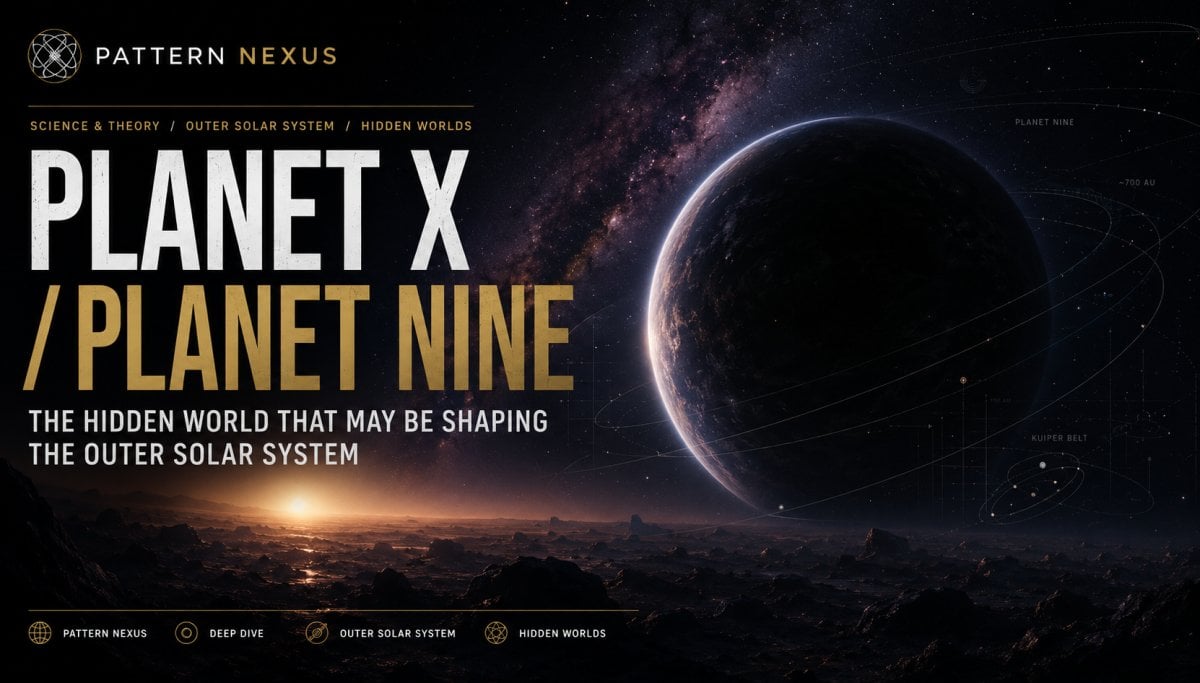

Science & Theory / Outer Solar System / Kuiper Belt / Hidden Worlds
Planet X / Planet Nine: The Hidden World That May Be Shaping the Outer Solar System
Planet X has been searched for, declared found, demoted, resurrected, mocked, modeled, ruled out in one form, revived in another, and now waits inside the coldest argument in planetary science: is there really another world beyond Neptune, or are we watching human pattern recognition fight incomplete data at the edge of the known solar system?
Quick Read
Planet X / Planet Nine has not been discovered. That needs to be said first because this topic has been polluted for over a century by bad headlines, bad assumptions, bad measurements, doomsday mythology, and the human tendency to turn a missing object into whatever story we emotionally want it to be. The modern scientific version is not Nibiru, not a collision threat, not a secret incoming apocalypse, and not a photographed planet hiding behind the Sun. It is a serious but unresolved hypothesis that a distant, massive, cold planet may be shaping some of the strange orbital architecture beyond Neptune.
The modern Planet Nine hypothesis became prominent in 2016 when Caltech astronomers Konstantin Batygin and Mike Brown argued that the clustered orbits of extreme trans-Neptunian objects could be explained by a planet several times Earth’s mass on a long, eccentric orbit far beyond Pluto. NASA describes this hypothetical world as possibly 5 to 10 Earth masses, orbiting 20 to 30 times farther from the Sun than Neptune on average, with an orbital period of roughly 10,000 to 20,000 years. But NASA is also clear that it remains theoretical. It has not been directly observed.
Since then, the case has become both stronger and messier. New simulations in 2024 argued that Planet Nine could explain low-inclination Neptune-crossing trans-Neptunian objects at high statistical confidence. A 2025 Siraj, Chyba, and Tremaine paper proposed different best-fit parameters for a possible unseen planet, closer and lower mass than some earlier models. Another 2025 paper proposed a separate smaller “Planet Y” to explain a warp in the distant Kuiper Belt’s mean plane. But the discovery of Ammonite, a new Sedna-like object whose orbit does not align with the older sednoids, complicates the clean clustering story. That is the real state of the evidence: not solved, not dead, not confirmed, not fake. It is a live structural puzzle.
Inside This Article
- The First Correction: This Is Not Nibiru Why This Story Keeps Returning
- Planet X vs. Planet Nine
- The Full Timeline: From Uranus to Neptune to Pluto to Planet Nine
- Neptune Created the Template
- Percival Lowell, Bad Data, and the First Planet X
- Pluto: The Accidental Answer That Was Too Small
- Voyager 2 and the Collapse of the Old Planet X
- The Kuiper Belt Changed the Entire Problem
- Sedna Opened the Door Again
- The Modern 2016 Planet Nine Hypothesis
- What Kind of Planet Are We Talking About?
- The Main Evidence Lines
- The Dynamical Machine Behind the Claim
- The New Evidence: 2024 and 2025
- Ammonite: The Fossil That Complicates the Pattern
- Planet Y: A Separate Hidden-Planet Theory
- 2017 OF201 and the Problem of New Outliers
- The Skeptical Case: Bias,
- Small Numbers, and Survey Geometry
- OSSOS and the Bias Problem
- What WISE Ruled Out, and What It Did Not
- Why Hasn’t It Been Seen Yet?
- Where Would Planet Nine Be?
- Alternative Theories
- Why Vera Rubin Observatory Matters
- What If Planet Nine Is Real?
- What If Planet Nine Is Not Real?
- Why the Public Turns This Into Myth
- Pattern Nexus Lens
- My Read
- Related Pattern Nexus Reading
- Sources
Status
- Planet Nine has not been directly observed. It remains a hypothesis based on gravitational patterns and orbital structure.
Modern Model
- A distant planet, likely several Earth masses, may be sculpting some extreme trans-Neptunian object orbits.
Strongest Pushback
- Observational bias and small sample size can make apparent clustering look more meaningful than it is.
Next Gate
- Vera Rubin Observatory may expand the distant-object census enough to confirm, redirect, or kill the clean Planet Nine model.
The First Correction: This Is Not Nibiru
We have to clear the trash off the table first because Planet X is one of those topics where real astronomy and internet mythology get dumped into the same bucket by people who either do not understand the distinction or do not want there to be one.
The modern Planet Nine hypothesis is not Nibiru. It is not a secret doomsday object. It is not hiding behind the Sun. It is not about to fly through the inner solar system. It is not going to cause three days of darkness, flip Earth, trigger instant catastrophe, or validate every recycled apocalypse video that gets passed around whenever people hear the phrase “Planet X.”
If a modern Planet Nine exists, it would be extremely far away, likely hundreds of astronomical units from the Sun, moving slowly on an orbit measured in thousands or tens of thousands of years. The scientific hypothesis is not based on fear. It is based on orbital dynamics. Small icy bodies beyond Neptune appear to follow patterns that may require a gravitational explanation. That is the real question.
That does not mean the scientific case is settled. It is not. But it does mean the correct debate is not “is a rogue planet about to kill us?” The correct debate is whether the distant outer solar system contains an unseen massive planet, whether the patterns are real, whether they are caused by bias, whether another mechanism explains them, or whether our sample of extreme objects is still too incomplete to say.
This distinction matters because once bad mythology attaches itself to a real scientific mystery, the whole subject becomes harder to talk about. Skeptics dismiss the entire topic because they associate it with conspiracy content, while believers overstate weak evidence because they feel the establishment is hiding something. Both reactions destroy the middle ground where the real science lives.
The serious version is colder and more interesting. It says the outer solar system still has structure that does not feel fully explained. It says the objects beyond Neptune may preserve gravitational scars from the early solar system. It says something may be out there, or something may have passed through, or something about our surveys may be lying to us. That is not less fascinating than the mythology. It is more fascinating because it is real.
Why This Story Keeps Returning
Planet X keeps returning because it sits at the exact boundary where science, myth, history, and incomplete maps overlap. Human beings do not handle map edges well. When the edge is empty, we fill it. When the data are incomplete, we imagine the missing shape. When the pattern is weak but suggestive, we either worship it or dismiss it.
That is why this topic has survived so many deaths. The old Lowell Planet X died. Pluto did not solve the original problem. Voyager 2 helped remove the need for the old orbital anomaly. WISE ruled out some large nearby hidden bodies. OSSOS and later analyses challenged the orbital clustering argument. Ammonite complicated the sednoid alignment. Yet the idea keeps returning because the outer solar system keeps producing objects that do not feel ordinary.
There is a reason this is psychologically sticky. The known planets feel finished. Mercury, Venus, Earth, Mars, Jupiter, Saturn, Uranus, Neptune. That list feels like a closed sentence. But beyond Neptune is not nothing. It is a field of leftovers, dwarf planets, icy fragments, detached bodies, resonant objects, scattered objects, inner Oort Cloud candidates, and orbital fossils from the early solar system. The more we look, the less simple the edge becomes.
So Planet X keeps returning because the boundary is still alive. It is not alive in the biological sense. It is alive as an unresolved system. Every new distant object is another data point in a cold forensic investigation. Some data points support an unseen planet. Some weaken the case. Some suggest a different planet. Some suggest ancient encounters. Some point directly at the limits of our surveys.
That is why the honest answer cannot be short. Planet Nine is not confirmed, but the outer solar system is not fully explained either. That is the middle ground most people skip because it does not give them the dopamine hit of certainty.
Planet X vs. Planet Nine
Planet X and Planet Nine are related terms, but they are not exactly the same thing.
Planet X is the older historical phrase. It originally referred to an unknown planet thought to exist beyond Neptune, especially in the era of Percival Lowell, who believed something was perturbing the orbit of Uranus. The “X” meant unknown, not the Roman numeral ten. That matters because people often assume Planet X automatically means “tenth planet,” when historically it meant an unidentified body.
Planet Nine is the modern scientific nickname for the hypothesis published in 2016 by Konstantin Batygin and Mike Brown. That model is not just “maybe there is something out there.” It is a specific dynamical argument: certain distant trans-Neptunian objects appear to have orbital structures that could be maintained or produced by a massive unseen planet on a distant eccentric orbit.
NASA uses both names because the public searches both names, but NASA also states clearly that the planet has not been discovered and that debate remains within the scientific community. That is the right framing. Planet X is the historical lineage. Planet Nine is the modern model. Neither one is confirmed.
That is why this article uses both terms. The story is not only about one proposed planet. It is about a century-long pattern where outer solar system anomalies keep pulling human attention past the last confirmed planet, forcing science to ask whether the map is incomplete or whether the pattern is an artifact of how we are looking.
The naming itself reveals the deeper problem. Planet X sounds mysterious because it belongs to the unknown. Planet Nine sounds institutional because it belongs to the post-Pluto official solar system. One carries the mythic weight of the missing object. The other carries the scientific weight of a testable hypothesis. The public blends them together, but they are not the same layer.
The Full Timeline: From Uranus to Neptune to Pluto to Planet Nine
The hidden-planet story begins before Planet Nine and even before Pluto. It starts with a powerful idea: if gravity leaves fingerprints, then an unseen body can be discovered before it is seen.
Uranus was discovered in 1781 by William Herschel, but once astronomers had enough observations, its path did not perfectly match the predictions. That mismatch became one of the great triumphs of celestial mechanics. Urbain Le Verrier and John Couch Adams calculated that an unseen planet could explain the disturbance, and Neptune was observed in 1846 close to the predicted position.
Neptune’s discovery created the template. The sky could be solved backwards. You could see the invisible by watching what it did to something visible. That idea is powerful, and once science proves a method works, people keep trying to reuse it.
The later Planet X search was an attempt to repeat that trick. If Uranus revealed Neptune, then maybe Neptune and Uranus could reveal another world beyond them. Percival Lowell believed this, and his observatory searched for the unknown planet. That search eventually led Clyde Tombaugh to Pluto in 1930, but Pluto was too small to be Lowell’s gravitational culprit.
Then the story shifted again. Pluto became a planet in the public mind, then later became a dwarf planet. The Kuiper Belt emerged as a vast population of icy objects beyond Neptune. Sedna appeared on a strange detached orbit. More extreme objects followed. Batygin and Brown proposed Planet Nine in 2016. WISE constrained some older Planet X ideas. OSSOS and Napier challenged clustering claims. New 2024 work strengthened a different line of evidence. Ammonite complicated the sednoid pattern. Planet Y opened a separate hidden-planet branch.
This is not one story. It is a chain of corrections. Every era thought it understood the outer edge better than the era before it. Every era was partly wrong.
Neptune Created the Template
Neptune matters in this story because it proved that hidden worlds could be inferred mathematically. Before Neptune was visually confirmed, it existed as a disturbance in Uranus’ orbit. That is the pattern every Planet X argument has lived under ever since.
That success is both the strength and the curse of the hidden-planet search. The strength is obvious: gravity is real, and if a massive object is shaping smaller bodies, the pattern may show up before the object itself. The curse is that once people know this method worked once, they become tempted to see every orbital oddity as another hidden planet.
Neptune was not discovered by mythology. It was discovered by mathematics and observation working together. That is the standard Planet Nine has to meet. A model is not enough. Orbital patterns are not enough. A predicted search region is not enough. Eventually, if it is a planet, it has to be found in the sky.
This is why the Planet Nine debate is so interesting. It is trying to repeat one of astronomy’s greatest successes, but with objects that are vastly harder to observe, farther from the Sun, fainter, slower, colder, and embedded inside a survey-bias problem Neptune’s discoverers did not face in the same way.
Percival Lowell, Bad Data, and the First Planet X
Percival Lowell’s Planet X was built on a different foundation than modern Planet Nine. Lowell believed that irregularities in Uranus’ orbit suggested another planet beyond Neptune. The problem was that those irregularities were later understood to be measurement errors and incorrect planetary masses, not real gravitational evidence for a major missing planet.
This is one of the first lessons of the Planet X story: the math can be beautiful and still be aimed at a bad input.
That does not make Lowell irrelevant. His search created the institutional and observational pathway that eventually led to Pluto. But it also warns us about the danger of trusting a pattern before the measurement foundation is strong enough. The outer solar system is hard to observe, and historically that has created room for both genuine discovery and false confidence.
Lowell’s Planet X shows the first version of the trap. The orbit looked wrong. The explanation became a planet. The search became a mission. The discovered object became a symbol. Then later measurements showed the original problem was not what people thought it was.
That same warning still hangs over Planet Nine today. The modern evidence is much better, but the question remains similar: are we seeing a real gravitational pattern, or are we seeing the shape of our incomplete observations?
This is why I do not like lazy certainty on either side. The history is not “scientists are always wrong” and it is not “the current model must be right because it is mathematical.” The history says something more uncomfortable: models can point toward real discoveries, and models can also organize error into a convincing shape.
Pluto: The Accidental Answer That Was Too Small
Pluto was discovered in 1930 by Clyde Tombaugh at Lowell Observatory, and for decades it became the ninth planet in the public imagination. But Pluto was never the massive Planet X Lowell had been searching for. Early estimates overvalued Pluto’s mass because astronomers did not yet know what it really was.
As observations improved, Pluto shrank in scientific meaning. It was not Earth-sized. It was not massive enough to explain the supposed orbital anomalies. The discovery of Pluto’s moon Charon helped refine its mass, and later discoveries in the Kuiper Belt showed Pluto was part of a population, not a lone frontier planet.
Then came the 2006 International Astronomical Union reclassification. Pluto became a dwarf planet, and the solar system officially returned to eight planets. That decision still triggers people emotionally because Pluto was not only a body in space. It was part of childhood memory, classroom posters, identity, and the human desire for stable categories.
But scientifically, Pluto’s demotion created the naming logic for Planet Nine. If Pluto was no longer the ninth major planet, then a newly discovered major planet beyond Neptune would become the true ninth planet.
This is where the irony becomes almost too perfect. Mike Brown, one of the people most associated with Pluto’s demotion because of his work discovering Eris and other outer solar system bodies, later became one of the central figures arguing for a real ninth planet. The man who helped kill the old ninth planet may also be one of the people who points science toward the new one.
That is not just a historical footnote. That is the pattern. Pluto was first treated as the answer to the wrong problem, then reclassified after the larger population around it became visible. Planet Nine may be the answer to a new problem, or it may be another stage in the same process where the map expands and the category changes under us again.
Voyager 2 and the Collapse of the Old Planet X
Voyager 2 matters because it helped close the old Lowell-style Planet X case. When Voyager 2 flew past Uranus and Neptune, it gave scientists better measurements of the outer planets. With improved values, the supposed orbital irregularities that had kept the old Planet X search alive largely disappeared.
That is one of the cleanest examples of how better measurement can erase a mystery. The old story did not need a hidden planet once the known planets were measured more accurately.
This matters because it should humble everyone. Sometimes the missing object is real. Neptune was real. Sometimes the missing object is a bad measurement. Lowell’s Planet X, in its original form, was not real. Sometimes the search produces a real object that is not the answer to the original question. Pluto was real, but Pluto was not the massive perturbing planet Lowell expected.
That three-part lesson is still the best framework for Planet Nine today. The hidden object could be real. The pattern could be biased. Or the search could find something real but different from what the model expected.

The Kuiper Belt Changed the Entire Problem
The Kuiper Belt is the real stage for this whole debate. It is a vast doughnut-shaped region beyond Neptune filled with icy objects, dwarf planets, comets, fragments, fossils of early solar system formation, and objects whose orbits preserve ancient gravitational events.
Before the Kuiper Belt was understood as a major population, Pluto looked more unique. After the Kuiper Belt emerged, Pluto became part of a larger pattern. That shift changed the entire outer solar system story. The question stopped being “why is there one strange small planet beyond Neptune?” and became “what does the distribution of all these distant icy bodies tell us about the solar system’s formation and hidden architecture?”
Some Kuiper Belt objects orbit close enough to Neptune that their paths can be explained through known gravitational interactions. Others sit on far stranger paths, with high perihelia, large semi-major axes, unusual inclinations, or orbital orientations that seem too structured to be random. Those are the objects that feed the Planet Nine debate.
But this is also where the bias problem enters. We do not see the Kuiper Belt evenly. We detect objects based on telescope depth, survey timing, sky position, object brightness, orbital phase, distance from the Sun, albedo, and where astronomers choose to look. A real population can look artificially clustered if the survey window itself is clustered.
That is why Planet Nine lives inside a measurement problem as much as a planetary problem. The outer solar system is not simply distant. It is selectively visible.
The Kuiper Belt is also not a quiet belt of leftovers. It is a gravitational archive. Neptune migration, resonances, scattering, passing stars, the Galactic tide, possible rogue planets, and the Sun’s birth environment all may have written into it. If Planet Nine exists, it is one author in that archive. If it does not, the archive still exists. Something wrote the structure.
Sedna Opened the Door Again
Sedna is one of the key reasons the outer solar system started feeling strange again. Discovered in 2003, Sedna has a highly elongated orbit and a perihelion far beyond Neptune’s strong gravitational reach. It does not behave like a simple scattered object that Neptune can easily toss around every orbit.
That matters because Sedna looked like it belonged to another layer of the solar system: not the ordinary Kuiper Belt, not the main scattered disk, and not the classical Oort Cloud in the distant cometary sense. It looked like an inner Oort Cloud or detached-object candidate, a body whose orbit preserved a story from the early solar system.
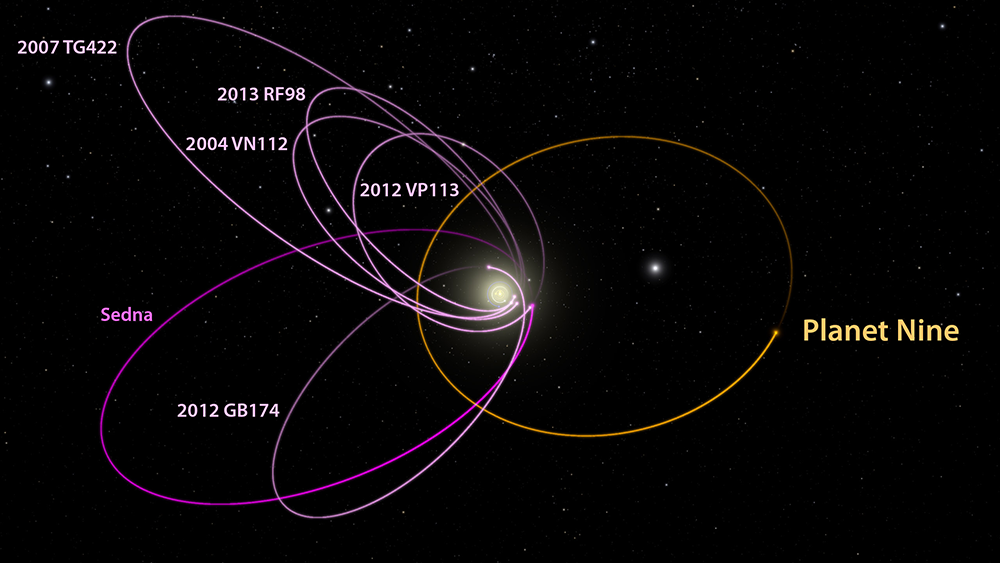
Then more objects followed, including 2012 VP113 and Leleakuhonua, each adding to the sense that the distant outer solar system had a structured population that was not fully explained by Neptune alone.
These objects are important because their closest approaches to the Sun remain so distant that Neptune cannot easily dominate their present motion. When a small body’s perihelion is too far from Neptune, you have to ask what lifted it there. Was it a passing star? A birth-cluster encounter? A rogue planet? A massive primordial disk? Planet Nine? Some combination?
Sedna reopened the door not because it proved Planet Nine, but because it proved the outer solar system had deeper structure than the old Pluto-era picture suggested.
The Modern 2016 Planet Nine Hypothesis
The modern Planet Nine hypothesis was not born from a photograph. It was born from a pattern.
In 2016, Batygin and Brown argued that several distant Kuiper Belt objects had orbital alignments that would be unlikely if they were randomly distributed. Their model proposed that a distant massive planet, roughly several to ten Earth masses depending on the version of the model, could maintain or produce these orbital structures.
The proposed object would be far beyond Neptune, on an elongated orbit, and probably much colder and dimmer than the planets we know. It would not shine by its own visible light in any meaningful way. It would reflect a tiny amount of sunlight and emit faint infrared heat. That makes it extremely difficult to find, especially if it is near the far end of its orbit.
The core idea is not that Planet Nine pulls objects directly like a simple magnet. The dynamics are more subtle. Over millions and billions of years, a distant massive planet could sculpt populations of small bodies through secular gravitational effects, resonances, orbital precession, perihelion lifting, inclination changes, and phase protection. In plain language, a large unseen object could act like a gravitational architecture layer, shaping where smaller objects can remain stable.
That is why the hypothesis is attractive. It does not explain only one weird object. It potentially explains several categories of weirdness. But that is also why it is dangerous. A model that explains many things can feel powerful even if the input sample is incomplete. The question is whether the architecture is real or whether the apparent architecture is created by limited observation.
That is the actual debate. Not “is there a secret planet?” Not “NASA is hiding it.” Not “scientists already know.” The debate is whether the observed distant-object architecture requires a massive unseen perturber, or whether the architecture changes once the sample becomes bigger and the bias corrections get better.
What Kind of Planet Are We Talking About?
If Planet Nine exists, it is not likely to be another Pluto. It would be much more massive. NASA’s public summary describes the hypothetical object as possibly 5 to 10 Earth masses. Some models have pushed higher or lower, and newer work has explored smaller or closer options, but the classic Planet Nine is usually imagined as a super-Earth or mini-Neptune type body.
That matters because our solar system is missing that category in the inner map. Exoplanet surveys show that planets between Earth and Neptune in size are common around other stars. Our solar system has rocky terrestrial planets, gas giants, and ice giants, but no obvious super-Earth. If Planet Nine exists, it might mean our system does contain that common class after all, just stranded in the deep cold beyond Neptune.
There are several formation possibilities. It could have formed closer to the Sun, near the giant planet region, and been scattered outward during the early chaotic era of planet formation. It could be the remnant of a five-giant-planet instability, where one ice-giant-like body was ejected outward but not completely expelled from the Sun’s gravity. It could have been captured from another star in the Sun’s birth cluster, though capture scenarios have their own problems. It could have formed farther out in a massive early disk, although forming a several-Earth-mass planet at hundreds of AU is difficult in standard models.
Each origin story has consequences. A scattered planet says the early solar system was more violent than the clean textbook sequence. A captured planet says the Sun’s birth environment left a permanent fossil inside our planetary system. An in-place planet says planet formation can happen farther out than expected. A no-planet outcome says the structure came from some other combination of early encounters, disk dynamics, and observational bias.
So the question is not only “where is it?” The question is “what history would its existence require?”
The Main Evidence Lines
The pro-Planet Nine case has never been one single object. It is a bundle of patterns.
The first major line is orbital clustering among extreme trans-Neptunian objects. These are distant bodies whose closest approaches to the Sun are still far beyond Neptune’s direct control and whose average orbital distances can be enormous. If their long axes and orbital orientations are not randomly distributed, something may be organizing them.
The second line is detached high-perihelion objects like Sedna and 2012 VP113. These bodies do not come close enough to Neptune for Neptune alone to easily explain their current orbits. Something had to raise their perihelia or detach them from ordinary scattering pathways.
The third line is high-inclination and even retrograde populations. Some distant objects are tilted at extreme angles relative to the plane of the planets. Planet Nine models can naturally produce some of these strange orbital pathways by pumping inclinations over long timescales.
The fourth line is the solar system tilt argument. Some versions of the model have been used to explore whether a distant planet could contribute to the small misalignment between the Sun’s equator and the orbital plane of the planets. This is not the cleanest or simplest evidence, but it is part of the broader argument that a distant planet could shape the solar system on large scales.
The fifth line is newer: low-inclination, Neptune-crossing trans-Neptunian objects. A 2024 paper by Batygin, Morbidelli, Brown, and Nesvorný argued that this population aligns with predictions from a Planet Nine-inclusive model and that a no-Planet-Nine scenario is statistically rejected at about the five-sigma level in their framework. That paper matters because it tries to move beyond the older clustering argument into a different population of objects.
Taken together, the evidence is not “we saw a planet.” It is “several pieces of orbital architecture look easier to explain if a distant massive planet exists.” That is a real scientific argument, but it is still indirect.
The Dynamical Machine Behind the Claim
The Planet Nine argument is not just a visual clustering argument, even though the public usually sees it that way. The deeper claim is dynamical. The question is whether a distant massive planet can create and preserve orbital populations that the known planets cannot easily produce by themselves.
In orbital mechanics, small bodies do not simply move randomly. They precess. Their perihelia shift. Their nodes rotate. They can be trapped in resonances. They can be scattered by Neptune. They can be affected by the Galactic tide. They can be perturbed by passing stars. Over billions of years, these effects can either erase a pattern or preserve it under certain conditions.
Planet Nine models try to show that a massive distant planet can generate a long-lived architecture. It could anti-align extreme objects, lift perihelia, produce high-inclination orbits, and create routes for objects to become detached from Neptune. That is why the hypothesis is appealing. It offers one gravitational engine that can connect multiple categories of weirdness.
But the same complexity also makes the model hard to falsify quickly. If you change Planet Nine’s mass, orbit, eccentricity, inclination, or current sky position, you change which objects it affects and how. If new objects do not match the old version, the model can be adjusted, but at some point adjustment becomes a warning sign. A strong theory should make predictions that survive new data, not endlessly absorb every contradiction.
That is the balance. Planet Nine is attractive because it explains patterns. It is vulnerable because the patterns are still based on small, biased samples and the model has enough flexibility to move as the data change.
The New Evidence: 2024 and 2025
The recent evidence is where the story gets more complicated and more interesting.
In 2024, Batygin and collaborators published work on low-inclination Neptune-crossing trans-Neptunian objects, arguing that this population provides a new line of evidence for Planet Nine. The important part is that this was not just another restatement of the original 2016 clustering argument. It used a different class of objects and simulations that included giant planet perturbations, the Galactic tide, passing stars, early solar system evolution, and observational bias.
That matters because the Planet Nine debate has always needed independent lines of evidence. If every argument depends on the same handful of extreme objects, the hypothesis stays fragile. If different populations begin pointing toward the same hidden architecture, the case strengthens.
Then in 2025, Siraj, Chyba, and Tremaine published a paper titled Orbit of a Possible Planet X, using an expanded sample of stable distant trans-Neptunian objects. They reported statistically significant clustering in longitude of perihelion for objects with semi-major axes greater than 170 AU and ran simulations to infer best-fit unseen planet parameters. Their preferred object was around 4.4 Earth masses, with a semi-major axis near 290 AU, eccentricity around 0.29, and inclination around 6.8 degrees.
That is important because it does not map cleanly onto every classic Planet Nine version. It points to a different preferred region of parameter space: closer, lower mass, and potentially more accessible to Rubin Observatory’s early sky coverage.
Then another 2025 paper by Siraj, Chyba, and Tremaine measured the mean plane of the distant Kuiper Belt and reported a possible warp relative to the invariable plane between roughly 80 and 200 AU. If that warp is real and not a statistical or survey artifact, one possible explanation is a smaller hidden planet, between Mercury and Earth mass, around 100 to 200 AU, inclined by at least about 10 degrees. That proposed object has been nicknamed Planet Y, and it is distinct from classic Planet Nine.
So the new evidence does not simplify the story. It branches it. There may be a distant several-Earth-mass Planet Nine. There may be a closer smaller Planet Y. There may be no planet at all. There may have been a planet or stellar encounter early in solar system history that left fossilized orbital structure but no surviving planet today. The outer solar system is not giving us one clean answer yet. It is giving us multiple overlapping clues.
Ammonite: The Fossil That Complicates the Pattern
Ammonite may be one of the most important recent discoveries in the Planet Nine debate because it does not fit the cleanest version of the story.
Officially designated 2023 KQ14, Ammonite is a Sedna-like trans-Neptunian object discovered by the FOSSIL survey using Subaru Telescope observations, with follow-up from the Canada-France-Hawaii Telescope and archival detections extending its observation arc. It has a perihelion of about 66 AU, a semi-major axis around 252 AU, and an inclination around 11 degrees. Nature Astronomy reported that simulations show it has been dynamically stable over 4.5 billion years.
That alone makes it valuable. Objects like this are rare because they are faint, distant, and hard to detect. Sedna-like bodies carry information about the early solar system because their orbits are detached from Neptune and can remain stable for billions of years.
But Ammonite’s orbit does not align with the other known Sedna-like objects. That is the part that matters. The older Planet Nine argument leaned heavily on the idea that these distant objects seemed clustered in orbital orientation. Ammonite points in a different direction, filling part of a previously unexplained perihelion gap and complicating the alignment picture.
This does not automatically kill Planet Nine. It does force the model to become more subtle. If Planet Nine exists, Ammonite may require a more distant configuration, maybe closer to a 500 AU semi-major axis in some interpretations. Or it may mean the sednoids were once primordially clustered and have since dispersed due to ordinary orbital precession. Or it may point toward an ancient external encounter with a rogue planet or passing star in the Sun’s birth environment.
Ammonite is important because it is not just another dot. It is a fossilized constraint. It tells us that the outer solar system’s memory may be older and messier than the clean Planet Nine story.
This is the part of the story most headlines fail to handle. They either say Ammonite strengthens Planet Nine because it is another distant object beyond Neptune, or they say it weakens Planet Nine because its orbit is opposite the earlier pattern. Both are too simple. Ammonite strengthens the case that the distant outer solar system has unresolved structure. It weakens the cleanest clustering version of Planet Nine. It opens the door to older, deeper formation events. That is the real meaning.
Planet Y: A Separate Hidden-Planet Theory
Planet Y is not Planet Nine with a new name. It is a separate hypothesis.
In 2025, Siraj, Chyba, and Tremaine reported a possible warp in the distant Kuiper Belt’s mean plane. In the absence of unseen planetary-mass bodies, the mean plane of distant Kuiper Belt objects should generally match the invariable plane, the plane perpendicular to the solar system’s total angular momentum. Their analysis found a possible warp in the 80 to 400 AU range, especially around 80 to 200 AU, though with confidence levels that still require more data.
If the warp is real, one possible explanation is a smaller hidden planet, maybe between Mercury and Earth mass, around 100 to 200 AU, inclined by more than about 10 degrees. That proposed object has been nicknamed Planet Y because it is not the classic Planet Nine architecture.
This matters because it changes the hidden-planet conversation from one missing body into a broader structural question. Maybe the outer solar system contains a large distant planet. Maybe it contains a smaller closer planet. Maybe both are wrong. Maybe the warp is not real. Maybe multiple ancient processes shaped the Kuiper Belt and we are trying to compress them into one missing-object explanation.
Planet Y is useful because it reminds us not to worship one model. The outer solar system may be telling us there is a missing planet, but it may not be the missing planet we expected.
It also creates a problem for the public narrative because people want one hidden world. They want Planet X. They want the missing planet to have one identity. But the science is becoming more fragmented. One set of objects may point to an eccentric distant massive perturber. Another measurement may point to a smaller inclined object closer in. Another object like Ammonite may point to ancient fossilized sculpting rather than a present-day planet. The outer solar system may not be hiding one secret. It may be preserving several different histories at once.
2017 OF201 and the Problem of New Outliers
The outer solar system keeps adding new outliers, and every one of them changes the shape of the argument.
One example is 2017 OF201, a distant trans-Neptunian object reported in 2025 with a highly elongated orbit. Its path brings it as close as the outer planetary region and carries it far into the distant solar system, with an orbital period measured in tens of thousands of years. Objects like this matter because they add to the evidence that the outer solar system is not a clean, quiet disk.
But they also complicate Planet Nine. If new distant objects appear outside the expected clustering, the old alignment argument weakens. If they appear in ways that still require unusual sculpting, the broader mystery strengthens. That is the constant tension. New objects can both hurt and help the hidden-planet idea depending on which layer of the argument you are looking at.
This is why the next decade is going to be critical. A small sample can be made to look like a pattern. A large sample is much harder to fool. The more objects we find, the less room there is for narrative to fill the gaps.
The Skeptical Case: Bias, Small Numbers, and Survey Geometry
The skeptical case against Planet Nine is serious and should not be dismissed as scientists being boring or afraid of a big discovery.
The core objection is selection bias. We do not discover distant trans-Neptunian objects randomly across the entire sky with equal sensitivity. Surveys observe certain patches of sky, at certain times, to certain depths, with certain filters, under certain conditions. Objects are brighter near perihelion and often invisible when they are far away. That means the detected sample can be shaped heavily by where and how we looked.
The Outer Solar System Origins Survey, or OSSOS, emphasized this problem. Because OSSOS was a calibrated survey with a well-defined observing history, it could test whether apparent clustering might be consistent with survey bias. OSSOS researchers argued that the distribution of some distant objects did not require Planet Nine when survey bias was properly modeled.
In 2021, Napier and collaborators analyzed 14 extreme trans-Neptunian objects from several well-characterized surveys and concluded that the detected ETNOs were consistent with a uniform distribution, finding no evidence for angular clustering in that sample. That does not prove Planet Nine is false, but it weakens the simplest clustering-based argument.
This is the right tension. The pro-Planet Nine side says multiple orbital patterns are difficult to explain without a distant planet. The skeptical side says the patterns may be partly manufactured by biased discovery conditions and small-number statistics. Both sides are pointing at something real: the data are incomplete.
That is why the next generation of surveys matters more than another argument over the same old sample. You cannot resolve a map problem with philosophy. You need a better map.
The other skeptical point is that the hypothesis has moved. Early public descriptions focused heavily on clustered extreme objects. Later arguments added detached objects, high-inclination objects, retrograde objects, low-inclination Neptune-crossers, and mean-plane structure. That does not automatically make the theory wrong, but it does mean the public needs to understand that the evidence base is not one clean, settled thing. It is a collection of orbital anomalies being interpreted through competing dynamical frameworks.
OSSOS and the Bias Problem
OSSOS matters because it shows what a serious skeptical response looks like. It was not just saying “we do not like Planet Nine.” It was saying the survey history itself has to be modeled before you can decide whether clustering is real.
Imagine shining a flashlight into a dark field and seeing several animals standing in the beam. If you only look at the illuminated area, you might think the animals are clustered there because something drew them there. But maybe that is just where the light was pointed. Outer solar system surveys have a version of that problem. Telescopes do not look everywhere equally. They look where conditions, schedules, depths, and survey designs allow.
That matters especially for distant objects because they are faint, slow, and easiest to detect near perihelion. If your survey footprint covers certain longitudes better than others, you can accidentally create an apparent orbital pattern. This is why calibrated surveys are so important. They do not just discover objects. They record enough about how they searched that scientists can simulate what kinds of objects they would or would not have found.
The Planet Nine debate cannot be resolved by saying “look at the clustering” unless you also ask “what clustering would this survey have produced even if the real population were uniform?”
That is the uncomfortable part. Sometimes the telescope is not just recording the universe. It is also imprinting its own selection function onto the dataset. The map contains the territory and the instrument.
What WISE Ruled Out, and What It Did Not
NASA’s WISE mission is often brought into the Planet X discussion because it searched the sky in infrared light and found no evidence for a large hidden body commonly called Planet X.
This is important, but it is also often misunderstood.
WISE ruled out certain kinds of large objects. NASA reported that WISE found no Saturn-sized body out to 10,000 AU and no Jupiter-sized body out to 26,000 AU. That is a major constraint. It kills many older ideas of a giant planet, brown dwarf, or small star hiding relatively nearby in the outer solar system.
But WISE did not rule out every possible Planet Nine. A cold, distant, several-Earth-mass planet at hundreds of AU could be far dimmer than the kinds of giant objects WISE would easily detect. So when people say “WISE proved there is no Planet X,” that is too broad. WISE ruled out a large class of massive hidden objects, not every possible distant super-Earth or mini-Neptune.
This matters because the Planet X label carries older baggage. If someone is claiming a giant brown dwarf or Jupiter-sized doomsday object is hiding nearby, WISE is devastating to that claim. If someone is discussing a 5-to-10-Earth-mass Planet Nine at several hundred AU, WISE is a constraint but not a final disproof.
This is where precision matters. “No giant hidden planet nearby” is not the same sentence as “no several-Earth-mass cold planet in a difficult search region.” The first claim is mostly killed. The second remains open.
Why Hasn’t It Been Seen Yet?
This is the obvious question, and it is fair. If Planet Nine is real, why have we not photographed it?
The answer is that distance turns even large objects into ghosts. A planet hundreds of AU away receives very little sunlight compared with Neptune. It reflects very little light back to us. If it is cold, its infrared emission may also be faint. If it is near aphelion, it may be farther and dimmer than expected. If its orbit carries it through the Milky Way background from our perspective, it may be harder to separate from dense star fields. If its albedo is low, it may be darker than simple assumptions suggest.
There is also a motion problem. Planet Nine, if distant enough, would move very slowly against background stars. Many survey methods find solar system objects by comparing images over time and looking for motion. But if the object is both faint and slow, it can fall into the difficult middle ground where it does not jump out the way nearer asteroids do.
Search region matters too. The sky is huge. Planet Nine models do not predict one exact point. They predict a broad range of possible positions, with probabilities shaped by the observed TNO population and the model assumptions. Looking for it is not like looking for a missing ball in a room. It is like looking for a faint moving pixel across a massive sky, with uncertain brightness, uncertain orbit, uncertain distance, and an object that may not exist.
That said, not seeing it yet is evidence too. The longer searches fail, the more the model space shrinks. A real Planet Nine has to live in the remaining allowed regions. Every failed search is not meaningless. It tightens the cage.
Where Would Planet Nine Be?
The search zone has changed over time because the model has changed over time. Early Planet Nine estimates often described a more massive object on a very distant, eccentric orbit. Later refinements and different datasets have shifted possible mass, semi-major axis, eccentricity, inclination, and sky position.
In the classic public model, Planet Nine might orbit hundreds of AU away, possibly with a semi-major axis of several hundred AU and an orbital period of many thousands of years. NASA’s public summary describes it as orbiting 20 to 30 times farther from the Sun than Neptune on average. Since Neptune is about 30 AU from the Sun, that puts the average distance in the hundreds of AU.
Newer work has explored somewhat different parameters. The Siraj, Chyba, and Tremaine 2025 Planet X paper suggested a possible object around 4.4 Earth masses with a semi-major axis near 290 AU. Planet Y, by contrast, would be much closer and smaller, perhaps around 100 to 200 AU if that hypothesis is right. Ammonite, meanwhile, may push some Planet Nine interpretations farther out rather than closer in.
The point is that “where is it?” depends on which anomaly you prioritize. If you prioritize apsidal clustering of extreme objects, you may get one orbital region. If you prioritize low-inclination Neptune-crossers, you may get another. If you prioritize the Kuiper Belt mean-plane warp, you may get a smaller closer object. If you prioritize Ammonite, you may need a different early history or a more remote planet.
That is why the search is not only observational. It is interpretive. The sky region follows the theory, and the theory follows the objects included in the dataset.
Alternative Theories
The outer solar system does not have to be explained by a present-day Planet Nine. Several alternative mechanisms have been proposed, and the existence of alternatives is exactly why this topic remains unresolved.
One alternative is survey bias, which may make distant objects look more clustered than they really are. This is not a weak objection because the sample size is small and the detection process is uneven.
Another alternative is a primordial stellar encounter. The Sun likely formed in a cluster, and close stellar flybys early in solar system history could have lifted the perihelia of distant objects or carved strange orbital populations. This could leave fossilized orbital structure without requiring a current unseen planet.
Another possibility is an encounter with a rogue planet or planet-sized body early in the solar system’s formation. Such a body could have passed through or near the outer solar system, sculpted distant orbits, and then left. In that case, the fingerprint remains but the culprit is gone.
Another theory involves the collective gravity of a massive disk of small bodies. If the primordial Kuiper Belt or scattered disk was much more massive than it is now, its self-gravity could have influenced orbital structure. The challenge is whether enough mass existed in the right distribution and whether the model reproduces all observed features.
Another possibility is that multiple processes are being compressed into one explanation. Some objects may preserve early stellar-cluster dynamics. Some may be shaped by Neptune migration. Some may be affected by Galactic tides. Some may reflect observational bias. Some may genuinely require an unseen planet. The real answer may not be one mechanism.
That is usually where nature becomes annoying. Human beings want one missing planet to explain the weirdness. The outer solar system may instead be a layered fossil record of many gravitational events.
There is also a deeper formation problem. The early solar system was not the clean diagram most of us were taught. The giant planets migrated. Resonances shifted. Small bodies were scattered outward. Some material was ejected. Some was trapped. Some may have been lifted into detached orbits. If the Sun formed in a stellar nursery, nearby stars may have passed close enough to disturb the outskirts. That means the outer solar system may not be a simple present-day gravitational machine. It may be a fossil field from a violent early environment.
Why Vera Rubin Observatory Matters
Vera C. Rubin Observatory may be the instrument that finally changes this debate from model war to map correction.
Rubin’s Legacy Survey of Space and Time is expected to scan the southern sky repeatedly over ten years, creating an enormous time-domain map of moving and changing objects. For the outer solar system, this means a huge expansion in the known population of distant objects. More objects means better statistics. Better survey characterization means better bias modeling. Better depth and repeated imaging mean more chances to catch faint, slow-moving bodies.
Rubin Observatory’s own science materials have projected that it will detect tens of thousands of objects beyond Neptune, measuring their orbits and obtaining repeated photometric data. Other reporting around Rubin’s first images emphasized that the observatory should dramatically expand the known solar system object population and may resolve whether the Planet Nine signal is real, either by finding the object directly or by showing the pattern does not hold under a larger dataset.
If Planet Nine exists in the regions Rubin can see, Rubin may find it directly or narrow the search zone dramatically. If Planet Nine does not exist, Rubin may show that the apparent orbital patterns were artifacts of small samples. If Planet Y exists, Rubin may detect the warp more clearly or find the body producing it. If Ammonite-like objects multiply, the entire clustering model may need to be rewritten.
That is why Rubin matters so much. It does not need to confirm one preferred story. It needs to increase the map quality enough that weak patterns either harden into structure or dissolve into noise.
This is the next gate. Planet Nine has survived because the data are incomplete. Rubin is designed to make that incompleteness harder to hide behind.
That also means the next few years could be brutal for everyone’s favorite model. If Rubin finds the planet, the skeptics will have to adapt. If Rubin finds hundreds or thousands of distant objects and the clustering disappears, Planet Nine supporters will have to adapt. If Rubin finds a smaller object or a weird population that points to a different history, both sides may have to throw away the clean version.
What If Planet Nine Is Real?
If Planet Nine is real, it would immediately change the structure of the solar system.
It would mean the solar system contains a major planet that escaped detection until the twenty-first century, not because it was magical or hidden by conspiracy, but because it is cold, distant, dim, slow, and moving through an enormous search area against the background sky.
It would also make our solar system more normal in one sense. Exoplanet surveys have shown that planets between Earth and Neptune in size are common around other stars. Our solar system seems strangely missing that category. A real Planet Nine would mean we do have a super-Earth or mini-Neptune-like object, just not where we expected one.
It would force new questions about formation. Did Planet Nine form near the giant planets and get scattered outward? Was it captured from another star? Did it form in place in the outer disk, which would challenge assumptions about planet formation efficiency? Did the early solar system have five giant cores instead of four, with one stranded in the darkness?
A confirmed Planet Nine would not just add a planet. It would expose a missing chapter in solar system formation.
It would also change how we understand the boundary between the planetary system and the inner Oort Cloud. A massive object in that region would act like a gravitational shepherd, a long-period architecture layer sitting beyond the familiar planets. It would be close enough to belong to the solar system, but distant enough to feel like a bridge into the comet reservoir and the solar system’s outer fossil zone.
And emotionally, whether scientists admit this or not, it would be enormous. A new major planet in our own solar system would rupture the public sense that the local map is complete. It would be the first new major planet since Neptune. It would make the solar system feel unfinished again.
What If Planet Nine Is Not Real?
If Planet Nine is not real, the story is still not meaningless.
A failed Planet Nine hypothesis would still have forced astronomy to map the outer solar system more deeply, characterize survey bias more honestly, discover new distant objects, and refine models of early solar system evolution. That is not failure. That is science doing what science does when it works correctly.
If Planet Nine does not exist, then the weird orbits still need explanation. Maybe the clustering was bias. Maybe ancient stellar encounters did more work than we realized. Maybe the Sun’s birth cluster left a long gravitational scar. Maybe rogue planets passed through. Maybe there are smaller hidden bodies rather than one large planet. Maybe the outer solar system is more dynamically layered than one clean model can handle.
This is why “Planet Nine found” and “Planet Nine dead” are both too simple. The real outcome will probably be more complex. The outer solar system is a forensic field. Whether or not a planet is found, the evidence still points to a history we do not fully understand.
That is the part most people miss. A model can be wrong and still be productive. Lowell’s original Planet X was wrong in its reasoning, but the search discovered Pluto. The old Pluto-as-Planet-X story was wrong, but Pluto led us toward the Kuiper Belt. Planet Nine could be wrong and still lead us to a better understanding of Sedna-like objects, detached populations, ancient stellar encounters, and the true structure of the solar system’s edge.
In that sense, Planet Nine is already useful. It forced the map deeper.
Why the Public Turns This Into Myth
Planet X becomes mythology because it touches one of the oldest human instincts: the fear and fascination of the unseen thing beyond the boundary.
Every civilization has edge-of-map stories. Sea monsters. Underworld gates. Lost lands. Hidden gods. Dark stars. Secret planets. Unknown continents. The specific symbols change, but the structure is the same. The boundary of knowledge becomes a projection surface.
Planet X sits perfectly inside that pattern because it is both scientifically plausible in one form and mythologically explosive in another. A distant massive planet beyond Neptune is not crazy. A rogue apocalypse planet about to destroy Earth is nonsense. But both use the same emotional root: there is something out there we have not seen yet.
The internet collapses the distinction. It takes a real unresolved scientific debate and grafts it onto prophecy, catastrophe, distrust, and hidden-knowledge narratives. That is how a legitimate orbital hypothesis gets dragged into doomsday content.
But the scientific version is more interesting because it does not require panic. It requires patience. It requires mapping. It requires statistics. It requires understanding how incomplete data can look like destiny before the full pattern appears.
That is why the Planet X story is really about epistemology. How do we know what is out there when the evidence is indirect? How do we distinguish gravitational signal from survey bias? How do we keep a hypothesis alive without turning it into belief? How do we remain open without becoming gullible?
Pattern Nexus Lens
Planet X / Planet Nine is not only a planet story. It is a pattern-recognition story.
At the first layer, there is history: Neptune proved unseen planets can be found through gravitational disturbance, Lowell chased a false version of that logic, Pluto became an accidental symbol, and the Kuiper Belt later changed the whole meaning of the outer solar system.
At the second layer, there is data: distant objects, faint magnitudes, long orbits, perihelia, semi-major axes, inclinations, longitudes of perihelion, survey footprints, observation windows, and bias corrections.
At the third layer, there is modeling: simulations that include the known giant planets, the Galactic tide, stellar encounters, early solar system migration, hypothetical planets, and billions of years of orbital evolution.
At the fourth layer, there is interpretation: one group sees a hidden planet as the cleanest explanation, another sees selection bias and small-number statistics, another sees primordial fossil structure, and another sees a smaller closer Planet Y-type body.
At the fifth layer, there is institutional caution: NASA does not claim discovery, Caltech argues evidence, OSSOS argues bias, WISE rules out some large objects, and Rubin becomes the next major adjudicator.
At the sixth layer, there is media compression: “Planet X found,” “Planet Nine confirmed,” “Nibiru incoming,” “Planet Nine dead,” “new evidence proves it,” “new object disproves it.” Each headline compresses a complicated evidence chain into a dopamine trigger.
At the seventh layer, there is the human layer: people want the map to be incomplete because mystery makes reality feel alive, but people also want certainty because ambiguity is uncomfortable.
That is why this topic keeps returning. Planet X is not just an object. It is the edge of the map. It is the place where measurement, myth, history, math, and human imagination keep colliding.
The deeper Pattern Nexus point is that hidden architecture always reveals itself indirectly first. You do not see the control layer immediately. You see the behavior it shapes. In markets, you see liquidity effects before you see the plumbing. In geopolitics, you see chokepoint behavior before you see the full corridor strategy. In the outer solar system, you see orbital structure before you see the planet, if the planet is there at all.
That is what makes this story so aligned with the Pattern Nexus framework. It is about reading the invisible through the visible without letting the pattern become a religion before the evidence becomes strong enough.
My Read
My read is that Planet Nine is not confirmed, but the outer solar system is clearly not finished telling us what it is.
I do not think the clean public version is useful. The clean version says either “there is definitely a hidden ninth planet” or “this is all nonsense.” Both are lazy. The serious version is harder. There are real orbital puzzles. There are real bias problems. There are real new objects like Ammonite that complicate the older model. There are real alternative theories. There are real new hints like Planet Y. And there is a real observational gate coming through Rubin.
That is the uncomfortable middle ground, and it is probably where the truth is sitting right now.
If Planet Nine is real, it will be one of the most important solar system discoveries in modern history because it means a major world has been sitting beyond the edge of the known planetary map this whole time. It would change formation models, outer solar system dynamics, and the way we think about our system compared with exoplanet systems.
If Planet Nine is not real, the search still matters because it means the outer solar system’s strange architecture was produced by something else: survey bias, ancient stellar encounters, a lost rogue planet, a primordial cluster, a smaller Planet Y, a massive early disk, or some layered combination we have not resolved yet.
That is why I think the important thing is not to ask, “Is Planet Nine real?” like this is a yes-or-no Facebook poll. The better question is: what is the outer solar system trying to tell us through these distant objects?
The answer may be a planet. It may be a fossil. It may be bias. It may be a lost encounter from the Sun’s birth cluster. It may be more than one thing at the same time.
But the map is not finished.
That is the deeper point. Planet X keeps coming back because the boundary of the solar system is still not fully known. Every time we think the edge is settled, another object appears, another orbit refuses to behave, another survey changes the sample, another model explains too much or not enough, and the darkness beyond Neptune becomes a little less empty but a lot more complicated.
Planet Nine may be out there. Or it may be the shadow of a deeper history. Either way, something about the outer solar system is still unresolved.
And that is the part that matters to me. Not the doomsday nonsense. Not the clickbait. Not the need to force certainty. The real story is that our own solar system still has hidden structure. We live in a world where people think the local map is finished, but the edge of that map is still arguing with us.
Maybe there is a planet. Maybe there was one and it is gone. Maybe the outer solar system is carrying a fossil record from the Sun’s birth cluster. Maybe our surveys have been drawing patterns with their own blind spots. Maybe Rubin will settle it. Maybe Rubin will make it more complicated before it becomes clear.
But this is why the story keeps pulling at people. It is not just about a planet. It is about the fact that even here, in our own solar system, the darkness beyond the last known world still has leverage over the map.
Sources
- NASA Science: Hypothetical Planet X
- NASA Science: Planet Nine
- Caltech: Researchers Find Evidence of a Real Ninth Planet
- arXiv: Generation of Low-Inclination, Neptune-Crossing TNOs by Planet Nine
- arXiv: Orbit of a Possible Planet X
- Monthly Notices of the Royal Astronomical Society Letters: Measuring the Mean Plane of the Distant Kuiper Belt
- Nature Astronomy: Discovery and Dynamics of a Sedna-like Object with a Perihelion of 66 au
- Subaru Telescope: Ammonite, a Fossil of the Early Solar System
- Academia Sinica: Astronomers Discover New Distant Object Ammonite
- NASA/JPL: WISE Survey Finds Thousands of New Stars, But No Planet X
- Outer Solar System Origins Survey: Striking Biases FAQ
- The Planetary Science Journal: No Evidence for Orbital Clustering in the Extreme Trans-Neptunian Objects
- NASA Science: The Kuiper Belt
- Rubin Observatory / LSST: The Outer Solar System
- The Planetary Society: Orbits of the Hypothetical Planet 9 and Kuiper Belt Objects
- Science News: A Distant Planet May Lurk Far Beyond Neptune
- The Planetary Society: The Discovery of a Planet, Part 5
Pattern Nexus is not just tracking whether a hidden planet exists. It is tracking the deeper system: how evidence becomes a model, how models become public belief, how incomplete maps create mythology, and how the edge of the solar system still refuses to be simple.
Frequently Asked Questions
Kakva je vaša reakcija?
 Sviđa mi se
0
Sviđa mi se
0
 Dislike
0
Dislike
0
 Ljubav
0
Ljubav
0
 Smešno
0
Smešno
0
 Vau
0
Vau
0
 Žalostan
0
Žalostan
0
 Besan
0
Besan
0

Founder of Pattern Nexus. I research markets, macro, geopolitics, AI, history, ancient systems, and the patterns most people overlook. I’m also building Market Radar, a trading scanner designed to read pressure, risk, confirmation, and setup quality before chasing a move. Pattern Nexus is where I connect the dots between data, history, technology, and the bigger system playing out around us.

Komentari (0)