
Taiwan–China Drill Spiral (Dec 2025): “Justice Mission 2025,” Taiwan’s Rapid-Response Posture, and the Blockade Geometry
China’s largest-to-date live-fire exercise around Taiwan (“Justice Mission 2025”) rehearsed blockade and strike sequencing. Taiwan answered with rapid-response readiness and whole-of-society posture. This Pattern Nexus framework breaks down the operational geometry, map logic, escalation ladders, and what to watch next.
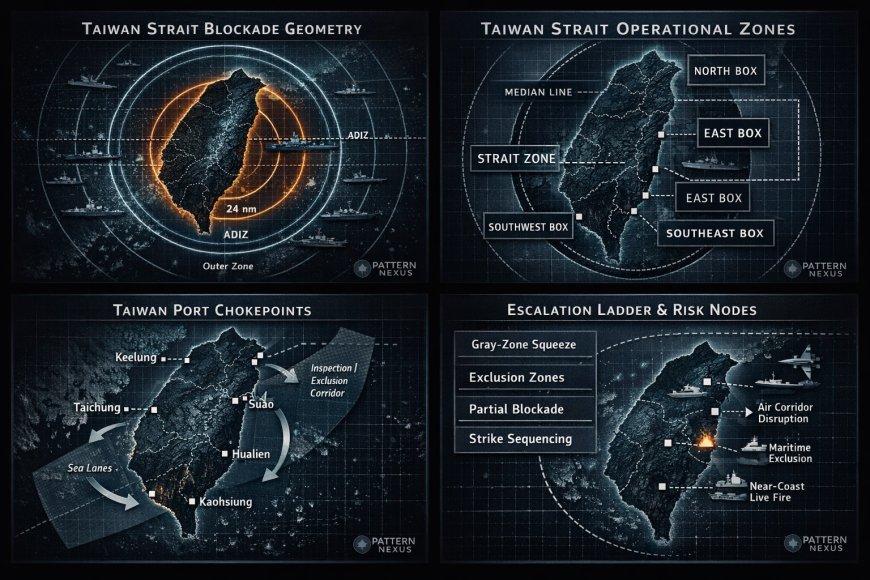
“Exercises” in the Taiwan Strait are no longer episodic signaling. They are iterative capability-builds: China is rehearsing the mechanics of isolation (blockade geometry, port denial, air–sea strike sequencing), while Taiwan is hardening rapid-response readiness and whole-of-society defense. The danger is not a single drill. It is the cumulative drift toward a conflict-ready baseline.
The Core Read
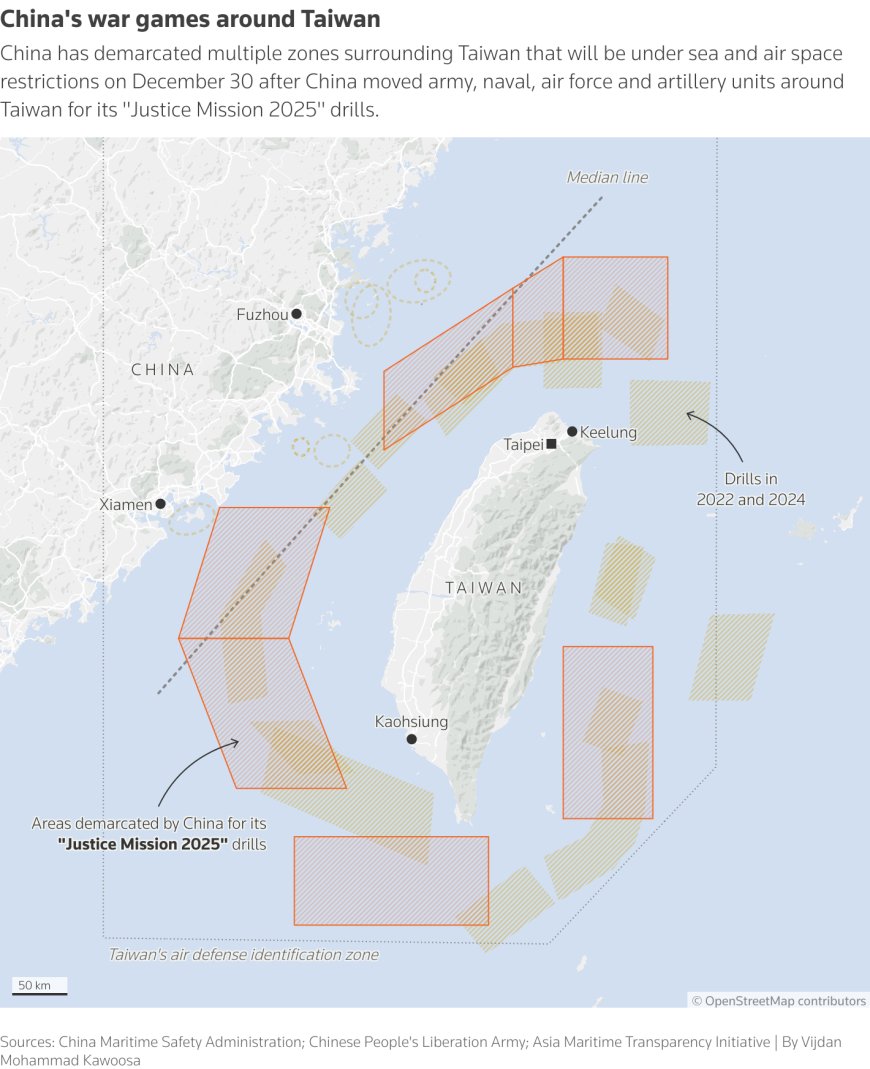
China’s December 29–30 live-fire operation around Taiwan (“Justice Mission 2025”) is best understood as a blockade rehearsal under the cover of political signaling. The operational emphasis is not “invasion tomorrow.” It is control of access: suppress Taiwan’s air and maritime freedom of maneuver, disrupt reinforcement timelines, and normalize a battlespace where Beijing can flip from peacetime pressure to wartime isolation quickly.
Pattern Nexus Frame
War is the tail risk. Isolation is the base case. The strategic center of gravity is the ability to throttle Taiwan’s connectivity (ports, air routes, undersea cables, logistics corridors) without declaring full-scale war on day one.
What Happened: “Justice Mission 2025”
Over two days, the PLA ran its most extensive-to-date drill footprint around Taiwan, combining live-fire activity with joint force sequencing (air, navy, rocket forces, and supporting elements). Public reporting converges on a structure that looks like a rehearsal for:
- Encirclement pressure: Multi-sector presence around Taiwan’s north, east, southwest, and strait-facing approaches.
- Blockade simulation: Practice runs consistent with port and route denial logic, including disruption effects on civil aviation and maritime activity.
- Strike rehearsal: Live-fire components and strike messaging that implicitly targets high-value nodes (air defenses, coastal systems, and U.S.-supplied capabilities).
- Median-line erosion: Crossing patterns consistent with ongoing normalization of PLA freedom of maneuver closer to Taiwan.
Operational Tell
When drills repeatedly emphasize blockade, joint strike, and anti-submarine patterns, you are not watching “political theater.” You are watching the assembly of a repeatable operational script.
Beijing framed the drills as a warning against “separatism” and “external forces,” a messaging structure that has become inseparable from the military template: capability demonstration + political intimidation + deterrence narrative.
Map Logic: The Encirclement Template
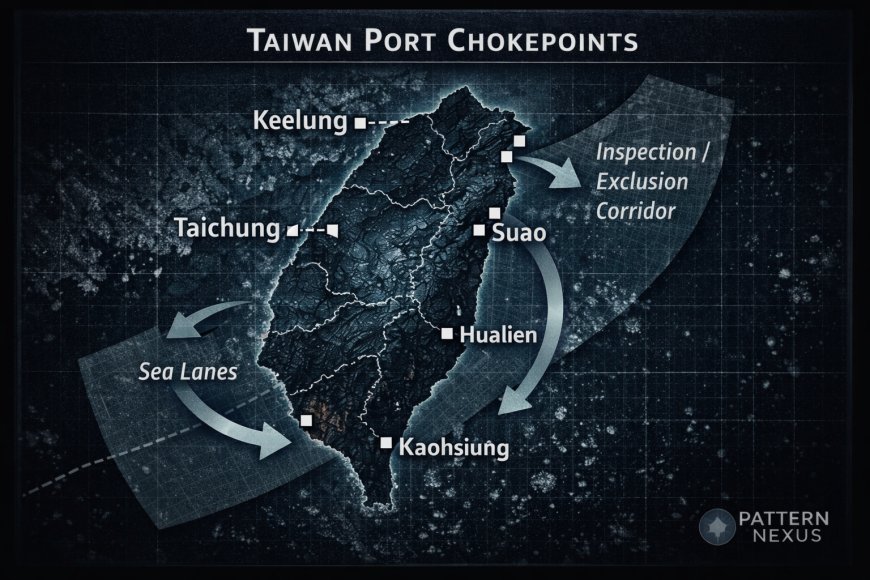
The Taiwan battlespace is not abstract. It is geometry. If you want to understand why “drills” matter, you map what they condition: corridors, ports, straits, and denial rings.
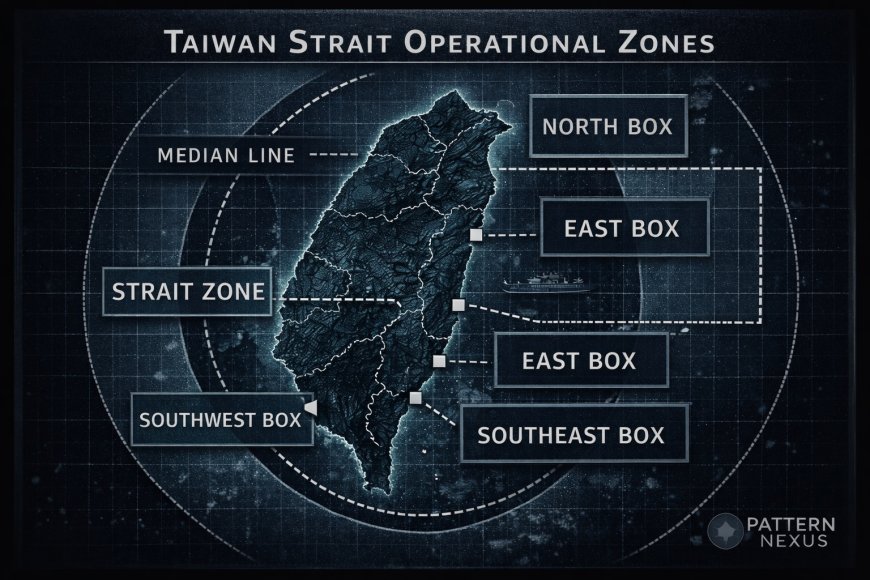
Three Structural Features That Drive the Playbook
- The Strait is a corridor, not a moat. It is narrow enough that air and missile timelines compress rapidly. “Warning time” collapses fast when forces are already forward.
- The east coast is the strategic back door. Taiwan’s eastern approaches are critical for reinforcement and survivability logic; persistent PLA activity there signals focus on sealing the perimeter.
- Ports are choke points. If you can credibly threaten port access and outbound lanes, you can impose economic and psychological pressure without immediate ground occupation.
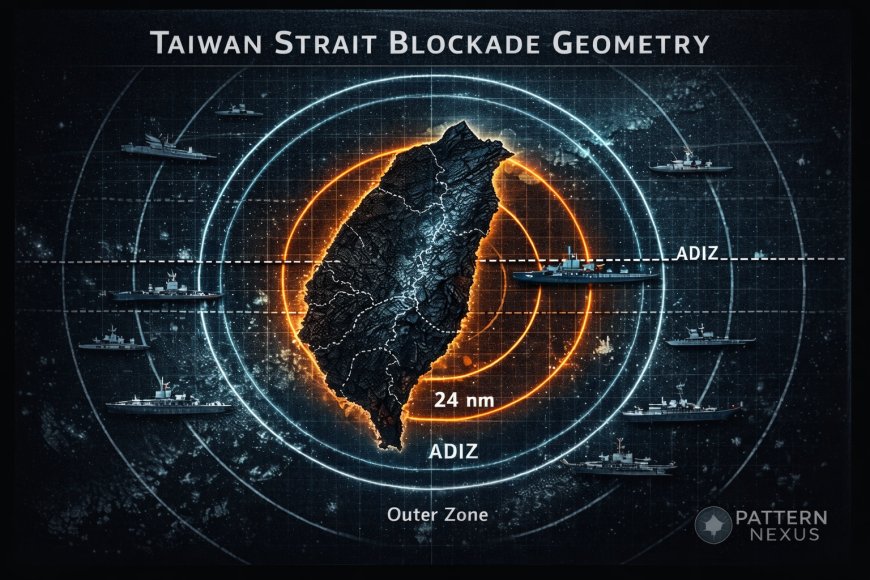
Why This Is Escalatory Even Without Invasion
A blockade rehearsal conditions decision-makers and markets to accept “temporary closures,” “danger zones,” and “exclusion areas” as normal. That normalization is itself a strategic weapon.
Taiwan’s Response: Rapid-Response + Whole-of-Society
Taiwan’s near-term answer to PLA cycles is not symmetrical escalation. It is readiness posture: rapid-response drills, dispersion logic, and the political signaling of calm continuity.
Two Layers of Taiwan’s Drill Posture
- Immediate rapid-response: During PLA activity, Taiwan elevates alert levels, runs quick-turn readiness actions, and demonstrates that it can move from normal operations to defensive posture without panic.
- Annual readiness hardening: Taiwan’s major training cycles emphasize longer duration, live-fire components, civil defense integration, and “gray-zone” stress testing designed for the reality of persistent pressure.
Pattern Nexus Read
Taiwan is optimizing for survivability and continuity: deny China a clean first move, keep society functioning, and preserve options long enough for outside political decisions to matter.
Escalation Geometry: Where Accidents Become Policy
The highest risk in this phase is not “planned war tomorrow.” It is unplanned collision inside a normalized pressure environment:
- Proximity risk: More assets, closer approaches, higher tempo, and compressed reaction time.
- Signal ambiguity: Live-fire zones and “training” announcements can be used to mask real movement.
- Domestic politics multiplier: Nationalist framing pressures leaders to avoid appearing weak after an incident.
- Third-party entanglement: U.S./Japan statements, posture shifts, and arms transfers are baked into Beijing’s narrative and Taiwan’s deterrence calculus.
Scenarios: From Pressure to Partial Blockade
Scenario A: Persistent Gray-Zone Squeeze (Base Case)
China sustains cycles of drills, air and maritime presence, and median-line erosion to degrade Taiwan’s readiness through fatigue, while testing international response thresholds.
Scenario B: “Temporary” Exclusion Zones (Market-Shock Variant)
Beijing expands “danger areas” around Taiwan in a way that materially disrupts flights and shipping for defined windows. The objective is to prove that it can impose economic cost quickly without declaring war.
Scenario C: Partial Blockade Demonstration (Crisis Mode)
A concentrated, multi-day operational package targets specific corridors or ports, framed as a response to “provocations.” Taiwan counters with continuity measures and defensive deployments. The U.S. and partners face a decision: contest the blockade physically, or absorb the precedent.
The Strategic Threshold
The line that matters is not “invasion.” It is credible, repeatable control of access that reshapes the status quo without firing the first widely recognized wartime shot.
Watchlist: Indicators That Matter
- Footprint expansion: Larger drill areas, longer durations, and more explicit blockade language.
- Live-fire normalization: Frequency and proximity of live-fire events relative to Taiwan’s territorial/contiguous zones.
- Multi-domain synchronization: Rocket force timing aligned with air and naval pressure cycles.
- Port/route disruption metrics: Flight cancellations, reroutes, maritime advisories, insurance pricing, and shipping behavior changes.
- International posture shifts: Carrier movements, allied statements, and new arms packages that change Beijing’s perceived timeline.
- Information operations cadence: Messaging that primes domestic audiences for “necessary measures” and frames escalation as defensive.
Pattern Nexus Bottom Line
This is a competition over control of the operating environment. The drills are not just signals. They are repetition. Repetition becomes capability. Capability becomes policy options.
Sources
- Reuters (Dec 30, 2025): China launches live-firing drills around Taiwan in biggest war games to date
- Reuters (Dec 31, 2025): Taiwan stays on high alert as Chinese ships pull back after massive drills
- Reuters (Dec 29, 2025): China’s war games around Taiwan over the years
- AP (Dec 30, 2025): China flexes blockade capabilities near Taiwan on second day of military drills
- AP (Dec 30, 2025): China’s top diplomat blasts U.S. arms sale to Taiwan as drills unfold
- France 24 (Dec 30, 2025): Why China is bringing out the big guns for drills around Taiwan
- CBS/AFP (Dec 29, 2025): China launches live-fire drills; Taiwan conducts rapid-response exercise
- Hudson Institute (Jul 11, 2025): Han Kuang exercise and Taiwan’s road readiness context
Kakva je vaša reakcija?
 Sviđa mi se
0
Sviđa mi se
0
 Dislike
0
Dislike
0
 Ljubav
0
Ljubav
0
 Smešno
0
Smešno
0
 Vau
0
Vau
0
 Žalostan
0
Žalostan
0
 Besan
0
Besan
0

Founder of Pattern Nexus. I research markets, macro, geopolitics, AI, history, ancient systems, and the patterns most people overlook. I’m also building Market Radar, a trading scanner designed to read pressure, risk, confirmation, and setup quality before chasing a move. Pattern Nexus is where I connect the dots between data, history, technology, and the bigger system playing out around us.





Komentari (0)