
The Debt-Free Illusion: How Personal Finance Cults Preserve the Consumer Class and Block Mobility
“Debt-free” is sold as freedom, but in a financialized economy it often functions as compliance: a behavioral cage that blocks asset ownership, leverage literacy, and class mobility.

![[HERO_IMAGE_ALT: flow-era finance plumbing / credit lattice / rails and collateral]](https://patternnexus.com/uploads/images/202601/image_870x_69747c712e32d.jpg)

The modern financial world is a flow network. If you are not on the rails, you are the throughput: wages in, taxes out, consumption out, fees out. Mobility is learning where the pipes run and how to position without breaking your risk boundary.
Risk is not optional. Refusing all financial risk shifts you into a different category of risk: lifetime dependence on wages, policy, and asset inflation you do not control. “Safe” can be structurally unsafe over long durations.
Bankruptcy is not a moral anomaly. It is a circuit breaker designed into the system because sometimes the correct move is impairment, restructure, redeploy. A system that runs on credit must also run on resolution.
The Debt-Free Illusion: What “Freedom” Is Selling
“Debt-free” sells cleanly because it compresses a complex system into a simple moral narrative. There is a villain (debt), a virtue (discipline), and a redemption arc (pay it off and you are free). In the short run, this framing can help households stabilize. In the long run, it becomes dangerous when it is exported as a universal theory of mobility.
The problem is definitional. Freedom is not “no payments.” Freedom is time control and optionality. It is the ability to say no: to an employer, to a landlord, to rising costs, to an unstable industry, to a recession, to a policy regime that changes the rules mid-game. That form of freedom emerges primarily from productive assets and systems—cash-flowing businesses, rental income, equity claims, durable skills with pricing power, intellectual property—not merely from the avoidance of borrowing.
If a person becomes debt-free but remains wage-dependent, the system relationship has not reversed. They are still converting time into money, then money into survival, inside a network they do not control. They may have reduced short-term volatility. They have not created escape velocity.
Many debt-free doctrines trade one category of risk (payment obligations) for another (lifetime wage dependence). The second risk is less visible, but often more structural in a flow-driven economy.
The Leverage Engine: How Civilization Actually Finances Itself
| Layer | What it does | Primary claim | Who benefits most |
|---|---|---|---|
| Sovereign | Defines perimeter + baseline collateral | Treasuries | Primary dealers, institutions, the state |
| Banking | Creates credit claims; routes liquidity | Loans/deposits/repo | Banks, balance-sheet owners |
| Corporate | Scales output via capital structure | Debt + equity claims | Shareholders, credit holders, management |
| Household | Pulls future income forward | Mortgage/consumer debt | Asset owners (via price lift), lenders (via interest) |
| Assets | Compounds via price + cash-flow | Equity/real asset claims | Owners and allocators |
| Rails | Routes flow; captures spreads/fees; controls access | Settlement + collateral rails | Gatekeepers, platforms, issuers, infrastructure |
The modern world is not merely “using debt.” It is built out of debt. Large-scale coordination requires pooled capital; pooled capital is intermediated through credit systems; credit systems create money-like claims through lending; those claims become the financing substrate for everything downstream—housing, infrastructure, energy, corporate expansion, logistics, and now data-center-scale compute buildouts.
A practical way to see the engine is as a ladder of claims:
- Sovereign layer: governments issue debt and define the policy perimeter. This is base collateral of the system.
- Banking layer: banks and shadow banks expand credit claims against collateral. This is money creation in practice.
- Corporate layer: firms scale through capital structure (equity + debt), optimized for cost of capital, duration, and taxes.
- Household layer: mortgages and consumer credit convert future income into present purchasing power.
- Asset layer: aggregate credit expansion tends to lift asset prices over time, especially under supply constraints.
None of this makes debt “virtuous.” It makes debt the system’s language for time, risk, and allocation. Debt pulls the future into the present. If you categorically refuse to learn or use the system’s language, you may reduce personal complexity, but you also restrict access to the primary mobility mechanisms of a leveraged civilization.
The relevant question is not “debt or no debt.” The question is whether an obligation converts into productive capacity or an asset that compounds faster than its carrying cost, inside a survivable risk boundary.
From Productivity to Flow: Plumbing, Rails, Tokenization
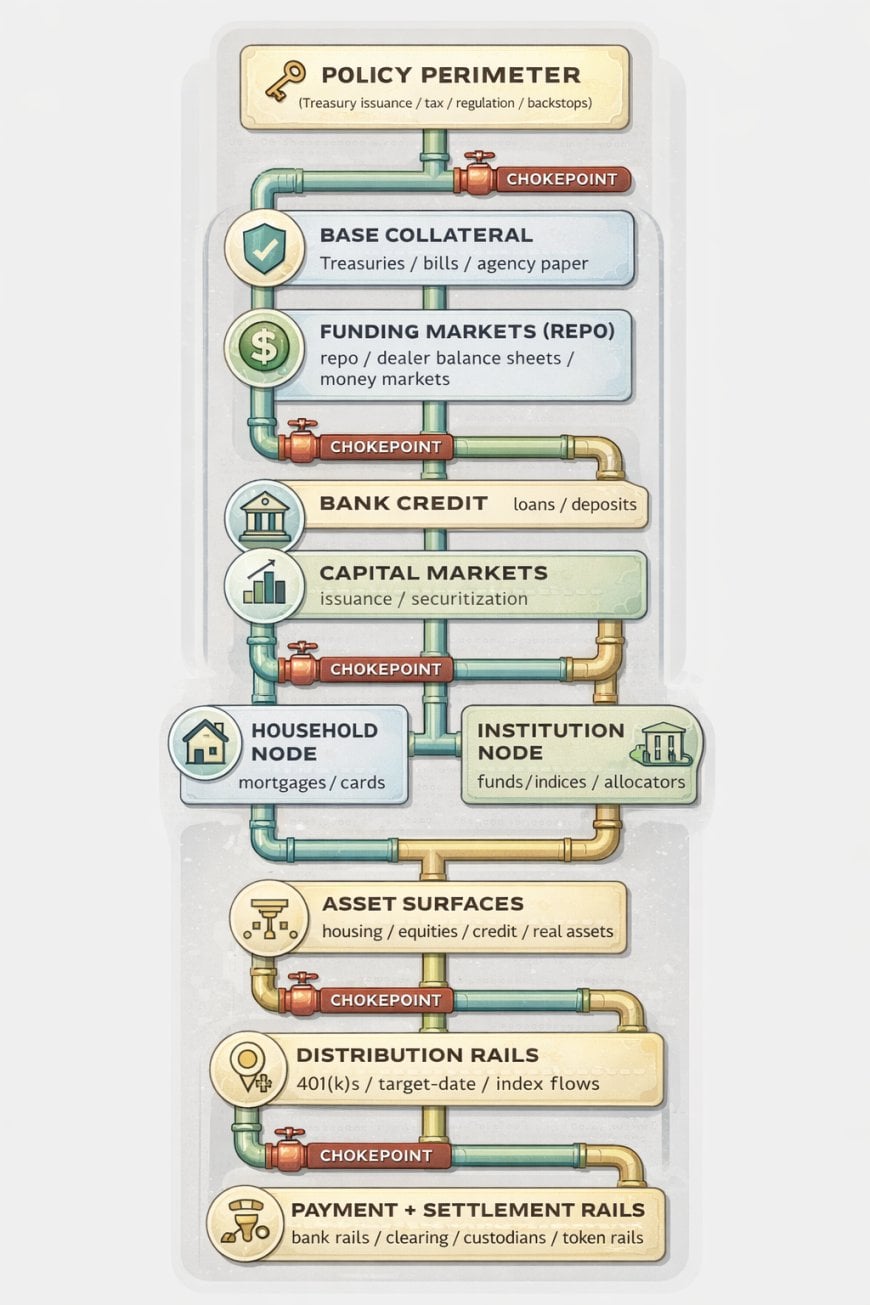
- Collateral eligibility: what counts as “good collateral” determines who can fund cheaply and who cannot.
- Balance-sheet capacity: dealer/bank capacity determines how much “water” can be moved at any moment.
- Funding cost: the price of money (rates/spreads) governs which positions are viable and which get forced out.
- Distribution channels: standardized products (index/retirement flows) force persistent demand into certain surfaces.
- Settlement rails: faster/cheaper settlement increases routing speed and amplifies flow dominance over fundamentals.
| Node / rail | What it controls | How it “moves water” | Who captures value |
|---|---|---|---|
| Policy perimeter | Rules + backstops | Sets constraints, injects/removes liquidity | State + system incumbents |
| Collateral layer | Funding eligibility | Enables cheap leverage where collateral is accepted | Large balance sheets + allocators |
| Funding markets (repo) | Short-term liquidity | Expands or constricts flow rapidly | Dealers, funds, platforms |
| Bank credit | Credit creation | Turns collateral + underwriting into new claims | Banks + borrowers with access |
| Distribution rails | Persistent demand | Auto-buying into surfaces (indices, funds) | Fund complex + surface owners |
| Token rails (emerging) | Settlement speed + composability | Reduces friction, accelerates routing, increases flow dominance | Issuers, platforms, rail operators |
The legacy worldview that dominates mainstream personal finance is linear and productivity-based. It assumes the economy is primarily an output machine: you work, you produce, you earn, you save, you pay down debt, and you retire. That model was always incomplete, but it was closer to operational truth in a world where asset prices, wages, and monetary plumbing moved more slowly and where finance was a thinner layer over real production.
The modern system is not a simple output machine. It is a flow system. Asset prices are frequently set by liquidity, not by productivity. Entire sectors can trade on collateral dynamics, index inclusion, policy expectations, and balance-sheet capacity. When the plumbing opens, prices lift. When the plumbing constricts, prices compress. This is why “hard work” narratives often fail to map to lived outcomes in a financialized world.
Flow is routed by rails:
- Settlement rails: how money and claims move and settle (bank rails, clearing, custodians, payment networks).
- Collateral rails: what can be pledged, rehypothecated, and financed (Treasuries, agency paper, high-grade collateral, increasingly tokenized representations).
- Liquidity rails: where liquidity enters and exits (bank lending, capital markets issuance, repo, central bank facilities, and now digital-dollar-adjacent rails).
- Distribution rails: how flows are forced through products (index funds, target-date funds, standardized retirement channels).
Tokenization intensifies this reality. When claims become more programmable, more composable, and faster to settle, the “flow-ness” of finance increases. Stablecoins, tokenized Treasuries, and real-time settlement compress friction. Less friction means faster routing. Faster routing means the advantage shifts toward those who understand the rails and can position along them.
This is the missing update in the legacy advice culture. “Avoid debt” is a response to personal fragility. It is not a map of a flow-based world. In a flow system, the strategic question becomes: where are the pipes, where are the chokepoints, and what is your survivable way to step into them?
The old model says “work harder.” The modern model says “understand the rails.” Productivity still matters, but flow often determines pricing, timing, and who captures the delta.
Mass Personal Finance as Governance: Why the Advice Is Defensive
Mass-market personal finance is not optimized for maximum upside. It is optimized to minimize failure modes across a broad audience with heterogeneous skills, inconsistent discipline, and limited buffers. That naturally produces a defensive doctrine: reduce volatility, reduce complexity, reduce exposure.
Defensive advice is not automatically wrong. If you are speaking to millions of households who are one surprise expense away from delinquency, “stop borrowing, build a buffer, simplify your life” is broadly stabilizing. The governance issue emerges when stabilization is sold as liberation, and when the doctrine becomes an identity that blocks people from learning the rails.
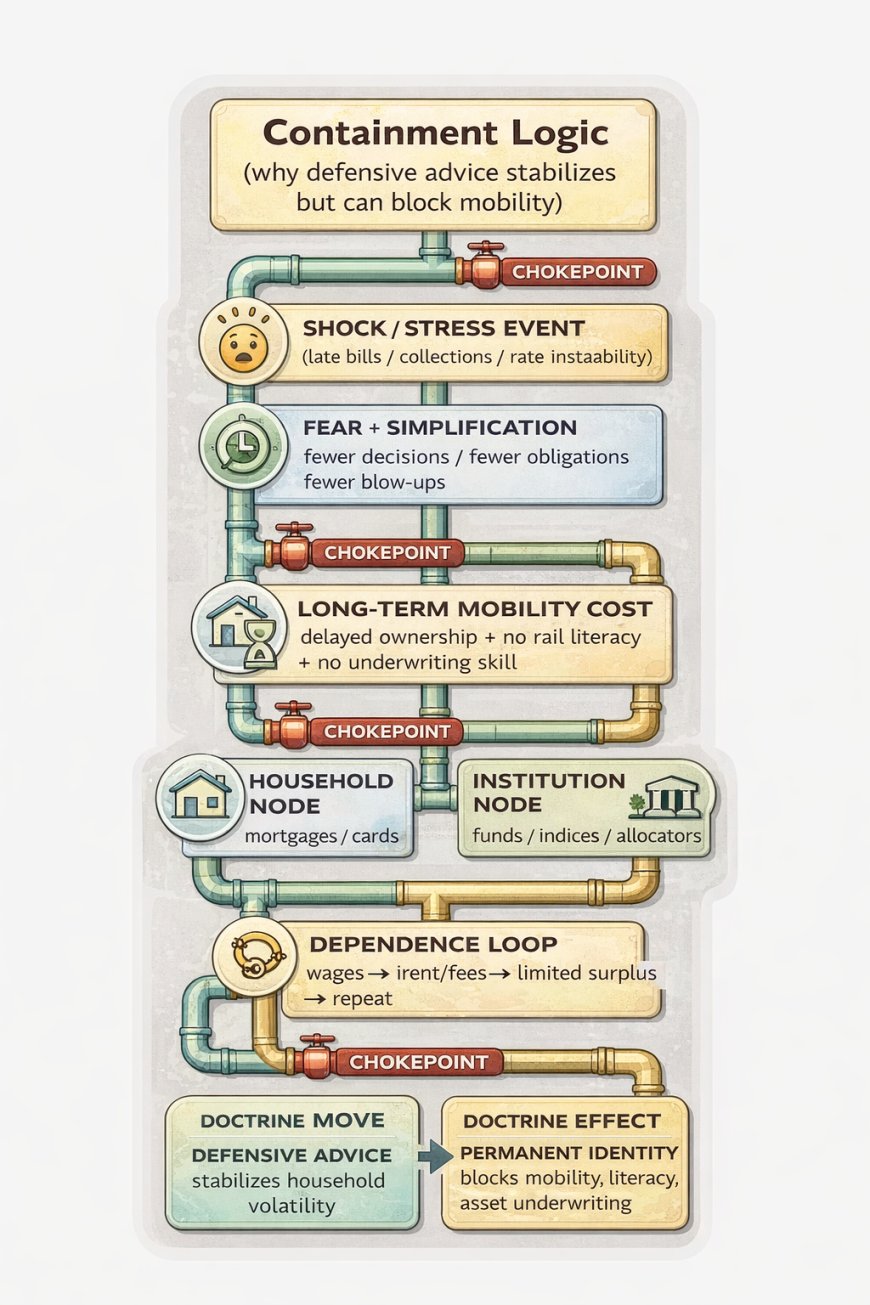
| Doctrine move | What it improves (Phase 1) | What it can suppress (Phase 2+) | Net effect if permanent |
|---|---|---|---|
| “Never borrow” | Prevents high-interest spirals; reduces blow-up risk | Asset acquisition speed; leverage literacy; rail access | Stability without mobility |
| “Debt is immoral” framing | Creates behavioral compliance; reduces impulsive credit use | Distinguishing productive vs consumptive leverage; strategic underwriting | Tool refusal becomes identity |
| Cash-only / envelopes | Spending control; fast behavioral stabilization | Building financial instruments literacy; scaling systems | Low-volatility life, low-upside trajectory |
| “Just retire via funds” end-state | Standardized path; predictable accumulation | Early optionality; ownership of operating cash-flow | Postponed freedom; long wage dependence |
| Avoid learning “rails” | Less complexity; less perceived risk | Positioning, timing, access to cheap funding/collateral channels | Permanent downstream status |
In practice, the most popular personal finance media teaches:
- moral framing (debt as vice, abstinence as virtue)
- simplification as identity (rules over thinking)
- retirement channels as destiny (standard products, standard timeline)
What it rarely teaches is the operating layer: underwriting, risk boundaries, asset acquisition, tax structure, balance-sheet thinking, and rail access. Those are the mechanisms that let a household stop being throughput and start capturing flow.
A rule-set that prevents collapse is not the same as a rule-set that changes class position. Those are different optimization functions.
Operators vs Consumers: Leverage Literacy as a Class Divider
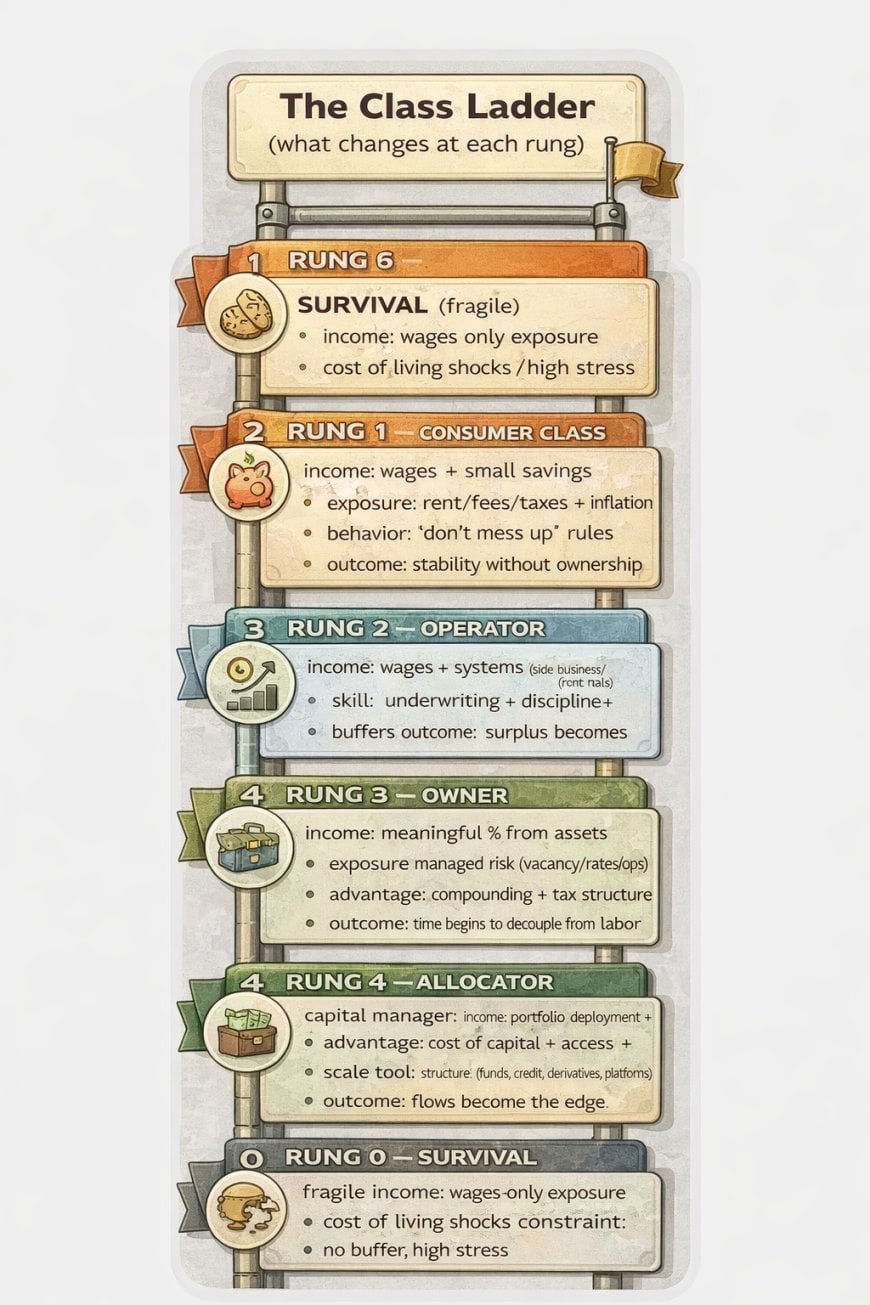
- Buffer gate: cash reserves that prevent one shock from resetting you to zero.
- Income expansion gate: skills, pricing power, or system income that creates surplus.
- Underwriting gate: ability to evaluate risk, terms, and cash-flow—not vibes.
- Rail access gate: access to financing channels and acceptable collateral, not just “saving harder.”
- Structure gate: legal/tax structure that preserves compounding (entity choice, depreciation, etc.).
- Repeatability gate: turning one win into a system rather than a one-time event.
In a flow-based economy, class mobility is increasingly mediated by who can understand and safely use leverage, collateral, and rail access. This does not mean everyone should borrow. It means leverage literacy is a gate. The gate separates those who can convert obligations into compounding assets from those who can only convert wages into payments.
A practical operating taxonomy:
- Consumers (wage-bound): primary income is wages; primary exposure is cost of living; credit is consumption smoothing; savings is fragile.
- Operators (cash-flow builders): income is increasingly produced by systems (businesses, rentals, contracts); risk is managed with buffers and underwriting.
- Owners (asset holders): meaningful income from assets; time is partially decoupled from labor; leverage is managed as a tool.
- Allocators: deploy capital across portfolios; advantage comes from cost of capital, access, and flow positioning.
- Plumbing layer: those who shape the rails and constraints—policy, regulatory perimeter, settlement plumbing, major balance sheets.
Many popular personal finance doctrines teach people to remain consumers and feel morally “clean” while doing it. The outcome is stability without mobility. The consumer stays safe, and the consumer stays downstream.
The Ramsey Doctrine: Stabilization Mis-sold as Liberation
The most influential debt-free doctrine in the U.S. is best understood as a stabilization protocol. It works for households that are financially dysregulated: consumer debt spirals, no buffer, chronic over-spend, high stress, low control. The rules are intentionally simple because simplicity improves compliance.
The conflict starts when a stabilization protocol becomes an ideology: “I don’t use debt” becomes “I don’t participate in the rails.” The first can be transitional medicine. The second is a ceiling.
The doctrine usually treats debt as uniformly dangerous, but in practice debt behaves differently depending on what it finances and whether it expands capability or fragility:
- Consumption debt: finances goods that do not produce income or durable capability; typically increases fragility.
- Capability debt: finances skill acquisition or tooling with a high probability of increasing earning power; can be rational if bounded.
- Asset debt: finances productive assets with defendable cash-flow; can be rational if underwritten and buffered.
- Operating debt: working capital used to bridge timing mismatches in businesses; can be rational with discipline.
Blanket prohibitions collapse these distinctions and block the first serious transition into operator behavior: using bounded leverage to acquire assets and step onto the compounding loop.
A doctrine that permanently prohibits leverage is a doctrine that permanently prohibits scalable ownership in a leveraged, flow-driven civilization.
Asset Inflation Regimes: Why Cash-Only Becomes a Trap
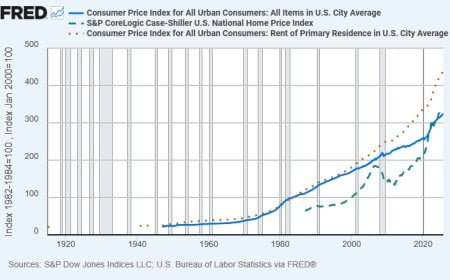
In many modern regimes, assets inflate faster than wages for long durations. Housing, insurance, healthcare, and education behave like structural escalators. In a flow-driven system, price is often a function of credit capacity and liquidity conditions, not just “productivity.” If you attempt to compete using cash-only accumulation from wages, you may be racing a moving target that is being lifted by the plumbing itself.
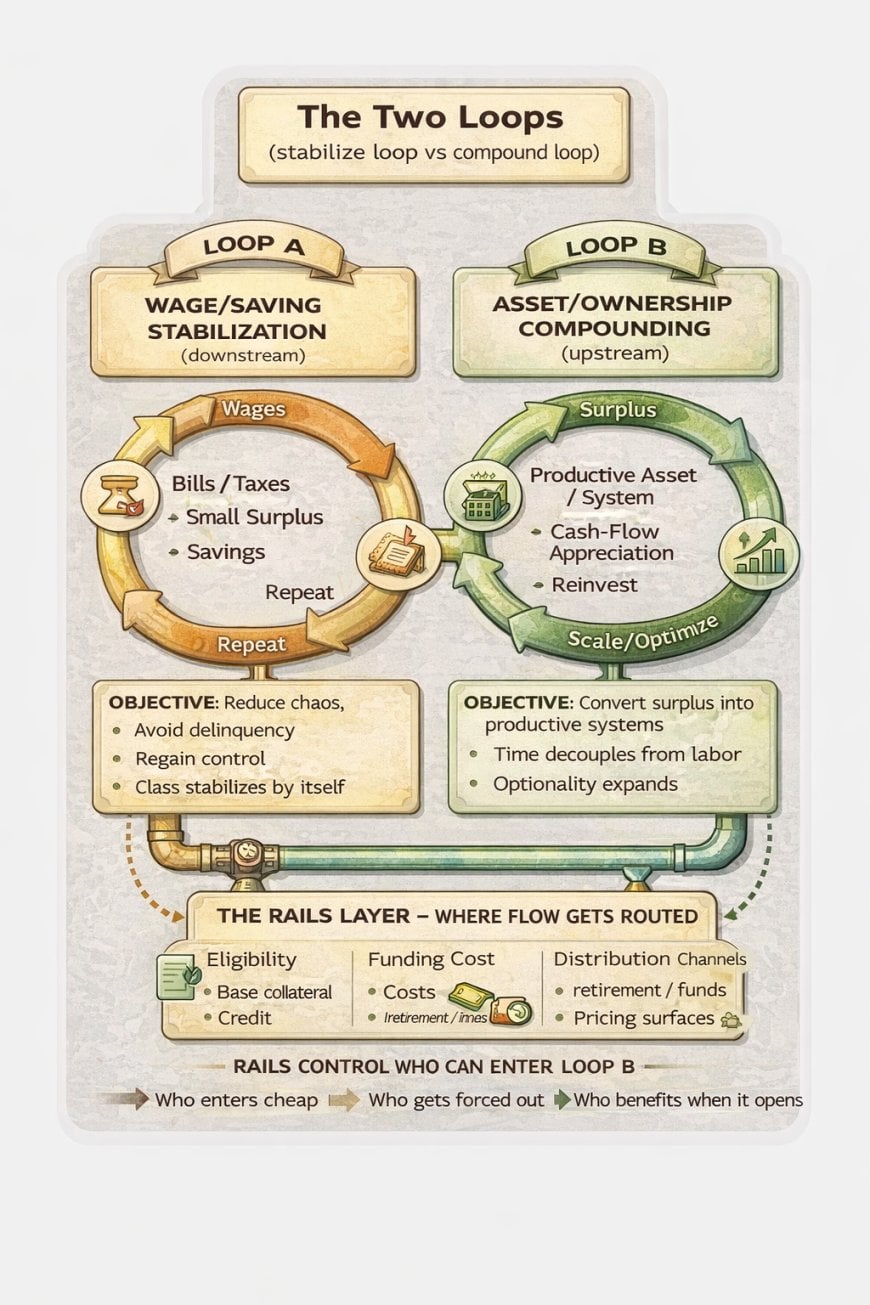
| Feature | Loop A: Stabilize | Loop B: Compound | Rails impact |
|---|---|---|---|
| Primary goal | Stop bleeding; reduce volatility | Build asset income; expand optionality | Controls who can scale and at what cost |
| Main input | Wages | Surplus + structure | Credit eligibility, collateral, settlement speed |
| Failure mode | Shocks drain savings; reset to zero | Overleverage / no buffer / bad underwriting | Liquidity tightening forces deleveraging |
| Upside ceiling | Often capped by wage growth | Can compound beyond wages | Rails determine how fast compounding can scale |
| What “debt-free ideology” does | Improves Loop A compliance | Often delays entry or discourages Loop B | Keeps people downstream of the flow network |
This does not imply “borrow aggressively.” It implies a narrower claim: in an asset inflation regime, refusing all leverage can lock a household into permanent catch-up. Time becomes the cost. The longer you delay ownership, the more you pay in nominal dollars, and the fewer compounding years remain.
Debt-free ideology often frames sacrifice as the path. But in a flow-driven economy, duration is a risk. The world changes while you save. The pipes move. Policy shifts. Liquidity regimes flip. If your plan requires the world to remain stable for a decade, you are making an unacknowledged macro bet.
Bankruptcy as Reset Valve: When the System Admits the Math
Bankruptcy exists because a credit system must include resolution. This is not a moral claim. It is design. Credit markets price risk because not every loan will be repaid. Sometimes the optimal resolution is impairment: losses are recognized, balances are restructured or discharged under law, and economic activity resumes without permanent debtor imprisonment.
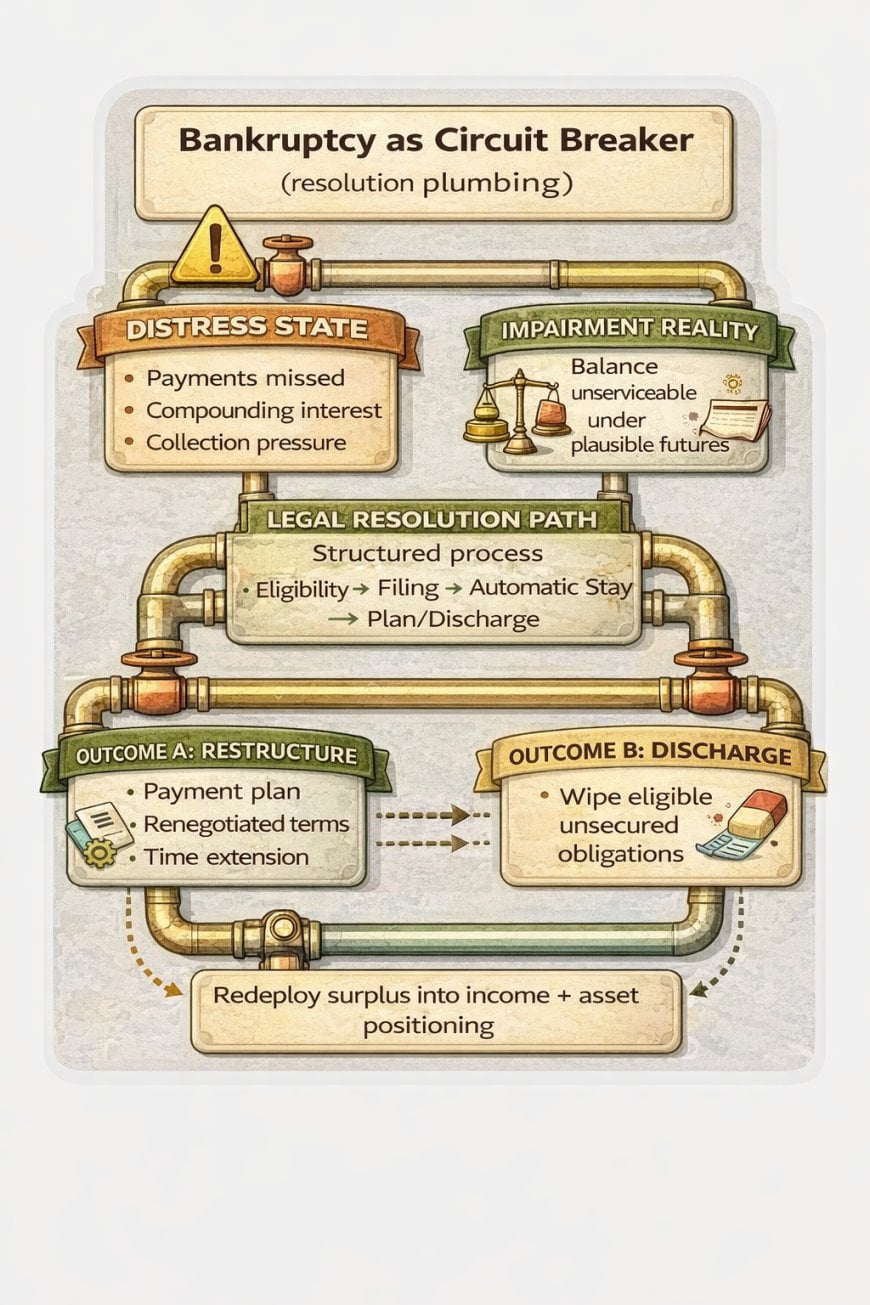
- Credit systems require default: lending prices risk; some obligations fail; resolution prevents endless deadweight.
- Resolution preserves throughput: the goal is to restore productive participation, not permanent debtor imprisonment.
- Corporations use it routinely: restructuring is treated as strategy at the corporate level; stigma is primarily a consumer control layer.
| Signal | What it indicates | Structural implication | Next action (conceptual) |
|---|---|---|---|
| Compounding interest dominates | Debt grows faster than repayment capacity | Payoff may be mathematically irrational | Evaluate resolution options |
| No buffer + repeated delinquency | System is in collapse loop | Stabilization cannot be sustained | Stabilize through restructure/discharge |
| Obligation not serviceable under plausible futures | Insolvency is structural, not behavioral | “Just work harder” is not a plan | Seek professional evaluation |
| High debt load blocks asset positioning | No path to Loop B compounding | Mobility ceiling persists indefinitely | Consider reset to redeploy |
| Stigma drives decision-making | Moral frame overrides math | Compliance replaces strategy | Reframe: resolution is system function |
Two truths are often obscured by shame narratives:
- Stigma is asymmetrical. Corporations restructure as strategy. Consumers are told it is moral failure. Stigma is a compliance mechanism that keeps households servicing obligations long after the math breaks.
- Bankruptcy is bounded. It is not a free pass. It is a rule-governed process with constraints, costs, and consequences. It exists because the system requires a reset path.
The practical point is narrow: if a household is structurally insolvent, “just pay it off” can be economically irrational. Insolvency means realistic income cannot service realistic obligations inside a survivable horizon. In that case, legal restructure is a designed part of the machine.
Bankruptcy is a legal decision with individualized facts. The structural argument is that “never bankruptcy” is not a universal virtue in a credit system designed with a resolution valve.
Retirement Containment: The Mutual Fund Industrial Baseline
Many mainstream systems culminate in a single approved destiny: pay off consumer debt, buy a home, fund retirement accounts, retire on withdrawals. It can work. But it is not a mobility engine. It is a stability channel designed for mass participation.
The retirement baseline is institutionally compatible. It routes household savings into standardized products. It centralizes complexity inside financial institutions. It creates predictable flows. In a flow-driven economy, predictable flows are a form of power.
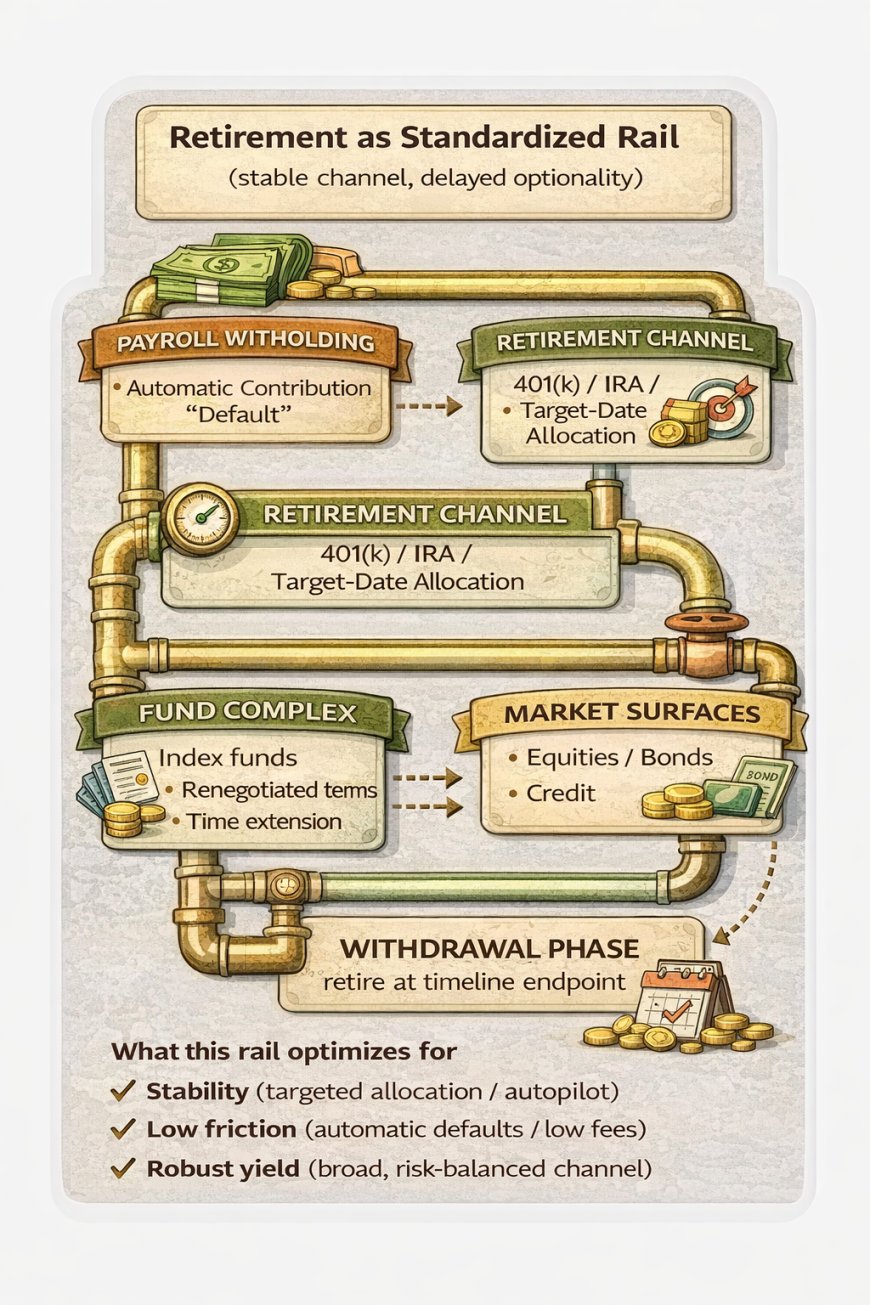
- Compliance: automatic contributions reduce decision load and behavioral failure.
- Standardization: a “one-size” path works for large populations.
- Flow reliability: predictable inflows support market demand over time.
- Institutional compatibility: complexity is centralized inside products and custodians.
- Early optionality: freedom is pushed to the far end of the timeline.
- Operator skill building: underwriting, rails literacy, and system-building are not taught.
- Ownership of operating cash-flow: you own market claims, not necessarily controllable cash-flow systems.
- Resilience to regime shifts: reliance on one long-duration path is itself exposure.
| Dimension | Standardized retirement rail | Ownership/compounding rail | Core tradeoff |
|---|---|---|---|
| Primary goal | Stability + long-term accumulation | Earlier optionality via cash-flow systems | Delay freedom vs build systems |
| Behavioral burden | Low (automated) | Higher (requires underwriting/execution) | Ease vs agency |
| Control | Indirect (market claims) | Direct (operating cash-flow) | Passive exposure vs system ownership |
| Best use-case | Baseline stability for broad populations | Mobility for operators who can manage constraints | Different optimization functions |
The critique is not “investing is bad.” The critique is timing and control. If the plan postpones freedom to late life and discourages early system-building (assets, businesses, rentals, ownership), it can preserve wage dependence for decades. In a fast-changing world, postponement is itself exposure.
Volatility Theater: The Retail Reaction Loop
Debt-free ideology is one containment channel. Financial media is another. A significant share of market media is optimized for attention, not competence. It incentivizes retail behavior that is reactive: headlines, personalities, short time horizons, emotional trades.
This produces the retail reaction loop: narrative stimulus → emotional response → impulsive action → drawdown → capitulation → repeat. The loop is structurally compatible with flow-based markets where large allocators benefit from predictable retail behavior—late entries, early exits, overtrading, and confusion between volatility and information.
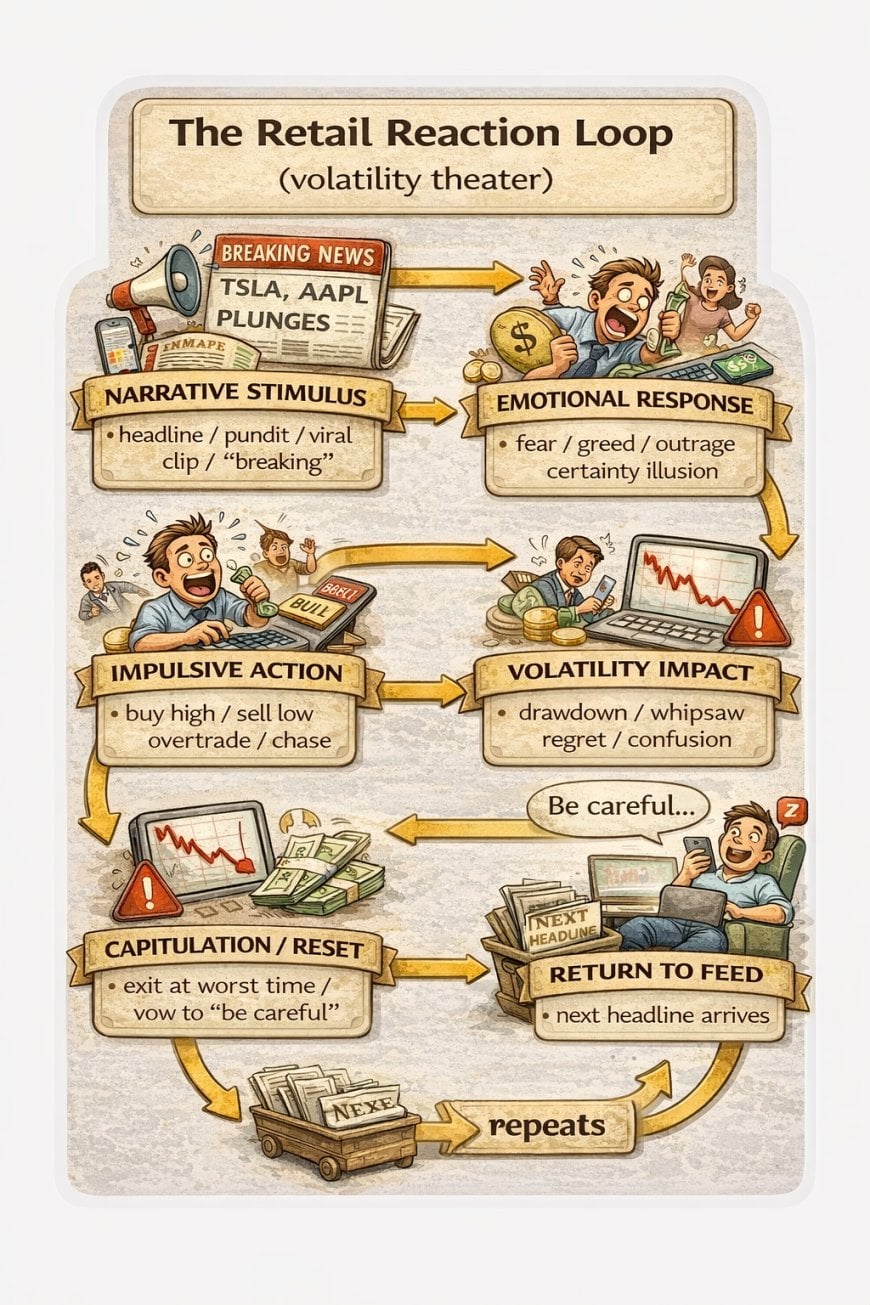
| Input type | What it looks like | What it does to behavior | Who benefits |
|---|---|---|---|
| Stimulus | “Breaking news” + personalities + hot takes | Shortens horizon; increases reaction and turnover | Media + market makers + those selling liquidity |
| Signal | Flows, liquidity regime, collateral/funding stress | Lengthens horizon; improves positioning and survivability | Operators + allocators + disciplined owners |
| Entertainment | Stock-picking theater, “who’s up/down,” drama | Creates certainty illusion; encourages impulsive bets | Platforms + churn-driven ecosystems |
| Plumbing analysis | Rates, repo, issuance, dealer capacity, token rails | Turns “price action” into a map of constraints and flow | Those who see the rails early |
The common denominator with debt-free ideology is simplification that feels like control. One sells moral cleanliness. The other sells participation. Neither reliably teaches rail literacy: how flows move, where collateral sits, and how to position without fragility.
A Real Framework: Stabilize → Position → Compound → Escape
A more accurate model for the modern world is four phases, each with a distinct objective:
- Stabilize: stop bleeding, eliminate high-interest consumer debt, build a buffer, reduce chaos.
- Position: step onto the rails in a survivable way—income expansion, skill leverage, asset acquisition, access to better financing terms.
- Compound: convert surplus into productive assets and systems; reinvest; build redundancy; reduce single-point failure.
- Escape: decouple income from labor, expand optionality, gain time control.
Many popular doctrines teach Phase 1 as a permanent identity. In a flow economy, Phase 2 is where the game changes: access to rails, access to assets, access to leverage terms, access to compounding. That is where “plumbing literacy” becomes the separator.
This is not an argument for recklessness. It is an argument for learning constraints. Positioning without constraints is fragility. Positioning inside constraints is mobility.
If your plan can only stabilize you but cannot position you on the rails and compound you, it is not a mobility plan. It is a maintenance plan.
Mapping Debt: Constraints, Buffers, and Survivability
The debt debate collapses into binaries because most people never define their survivability boundary. The correct lens is constraint mapping: what obligations can you service under multiple plausible futures, and what obligations turn you into a hostage of one timeline?
Constraint mapping is practical:
- Buffer reality: cash reserves are not optional in a leveraged plan; they are the shock absorber.
- Stress scenarios: job loss, vacancies, rate changes, medical expenses, macro recession, policy shifts.
- Exit options: can you refinance, sell, re-tenant, cut costs, increase income, or are you trapped?
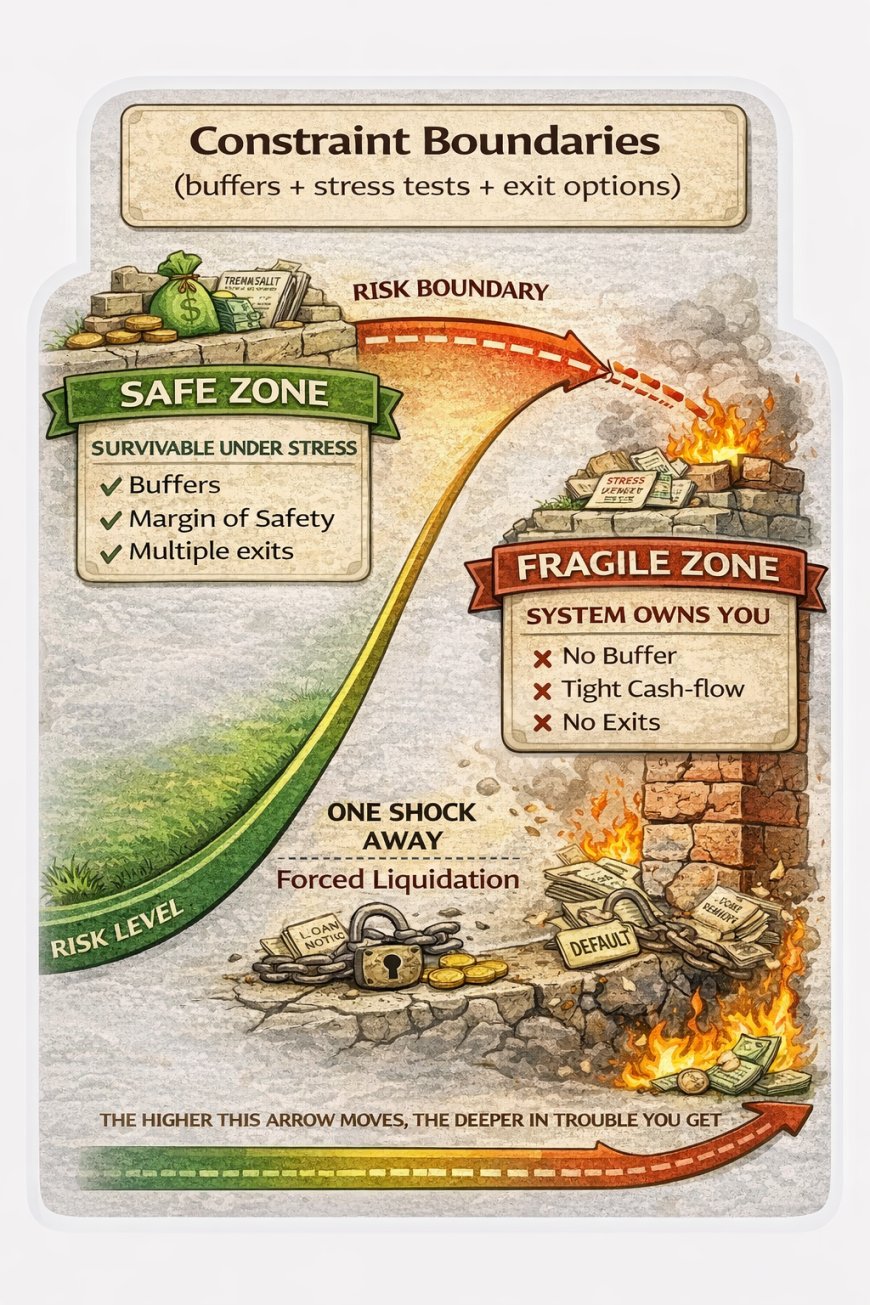
| Constraint element | What “real” looks like | Failure mode if missing | Why it matters in a flow economy |
|---|---|---|---|
| Buffers | Cash reserves that cover shocks without liquidation | One event forces default or sale | Liquidity regimes flip fast; buffers buy time |
| Margin of safety | Room between cash-flow and obligations | Tiny variance breaks the plan | Flow volatility exposes tight structures |
| Stress testing | You can survive multiple plausible futures | Plan depends on “everything going right” | Rails tighten; funding costs rise; shocks cluster |
| Exit options | Refi/sell/retask/cut costs/increase income | Trapped in one timeline | Optionality is the antidote to flow shocks |
| Operational control | Ability to influence outcomes (pricing, tenants, costs, terms) | You are purely price-taker | Control lets you redirect “water” when pipes shift |
| Stress scenario | Question to ask | Pass condition | Fail outcome |
|---|---|---|---|
| Income drop | Can you service obligations for months? | Buffer covers gap without liquidation | Forced sale/default |
| Rate increase / refi lockout | Do higher costs break cash-flow? | Still positive carry or survivable carry | Negative carry spiral |
| Vacancy / revenue shock | Can you hold through downtime? | Reserves + demand thesis | Forced liquidation at worst time |
| Policy / cost shock | Do taxes/insurance/fees spike break you? | Margin absorbs; options exist | Plan collapses from external change |
This is where modern positioning becomes coherent. The goal is not “debt-free.” The goal is “not fragile.” Debt-free is one way to reduce fragility. It is not the only way. In a flow economy, you can also reduce fragility by increasing income power, building redundancy, acquiring productive assets, and choosing obligations that are serviceable under stress.
Freedom Defined Properly: Optionality, Not Abstinence
In a world built on leverage and rails, “never use leverage” is not a neutral lifestyle choice. It is a strategic refusal to learn the operating language of capital. That refusal can be rational in Phase 1 (stabilization). It is not a universal doctrine for mobility.
Freedom is not the absence of obligations. Freedom is the presence of maneuver. It is owning upstream capacity, acquiring assets that throw off cash-flow, and building a portfolio of options. It is being able to absorb shocks and choose constraints rather than being trapped by them.
The debt-free illusion is that the world is a moral test and the reward is peace. The modern world is closer to a control system. The reward is optionality. Optionality comes from compounding and positioning—assets, leverage literacy, and rail access inside a survivable boundary.
Debt-free can reduce chaos, but it does not automatically create freedom. Freedom is optionality. Optionality is built by assets, compounding, and the ability to step onto the rails without becoming fragile.
Pattern Nexus Lens
Personal finance media is a governance layer. It is an interface between households and the financial system. At scale, the messages that dominate are the messages that produce system-stable outputs: predictable repayment, lower default rates, standardized retirement flows, and reduced volatility at the household node. This does not require conspiracy. It is emergent alignment. Systems reward narratives that stabilize the system.
In control-systems terms, debt-free ideology is damping. It reduces oscillation at the household node. Damping has value. But damping without a mobility model preserves stratification. If the system is a river and the rails are the canals, then “avoid the water” is not freedom. Freedom is learning how the water moves, where the gates are, and how to divert some flow for your benefit without flooding your own foundation.
Tokenization accelerates this logic. When claims become programmable and settlement friction drops, flow intensifies. Advantage shifts toward those who understand rails, collateral, and routing. The updated literacy is not merely “budget better.” The updated literacy is plumbing: who controls rails, how flows route, what collateral anchors the system, and what legal structures determine who captures the delta.
Legacy advice trains citizens for stability in a linear model. The modern system runs on flow. Mobility comes from positioning on the rails—assets, underwriting, leverage constraints, and legal structure—inside survivable boundaries.
FAQ
Is this article saying people should take on debt?
No. It is saying that “never use debt” is not a universal liberation principle in a leveraged, flow-driven civilization. The correct frame is constraint-based: can the obligation be serviced under stress, and does it produce durable capability or assets?
Is debt-free ever a good strategy?
Yes, especially for stabilization. If debt is driving chronic stress and repeated delinquency risk, simplifying obligations and building a buffer can restore control. The critique is treating stabilization as a permanent identity that blocks positioning and compounding.
What changed in the world that makes legacy advice outdated?
Financialization and flow dominance. Asset prices often reflect liquidity, collateral capacity, and rail dynamics more than productivity. Tokenization and faster settlement further intensify flow behavior by reducing friction and increasing routing speed.
What does “rails” mean in practical terms?
The pathways money and claims move through: settlement networks, banking channels, collateral financing, repo and funding markets, standardized retirement products, and increasingly tokenized payment and settlement rails. Being “on the rails” means having access to ownership, financing terms, and compounding channels, not merely wage throughput.
Is bankruptcy always the right move if someone is drowning?
No. Bankruptcy is a legal instrument with individualized facts, costs, and consequences. It can be rational when insolvency is structural, but it should be evaluated with qualified counsel and realistic alternatives.
What about “bad debt” like credit cards?
High-interest consumer debt is often the most destructive because it compounds against you without producing income. Eliminating that category is frequently step one. The next step is learning positioning and compounding rather than staying permanently in abstinence mode.
Why do mass-market gurus avoid leverage and entrepreneurship?
Because audience variance is high and failure modes are severe. Teaching sophisticated leverage to a mass audience is risky. The result is defensive rules that are broadly stabilizing but often limiting for those capable of underwriting and operating.
If freedom is optionality, what builds optionality fastest?
Buffers, income expansion, and ownership of productive assets—inside survivable constraints. The path differs by person, but the mechanism is consistent: convert surplus into systems that generate cash-flow and reduce time dependence.
Sources
These sources support core claims about household debt dynamics, credit market plumbing, and bankruptcy as a designed legal resolution mechanism.
- U.S. Courts: Bankruptcy Basics
- New York Fed: Household Debt and Credit Report
- Federal Reserve: Financial Accounts of the United States (Z.1)
- BIS Quarterly Review (macro-financial and market plumbing context)
- CFPB: Data & Research (consumer credit markets)
- IRS Publication 946: Depreciation (MACRS)
Kakva je vaša reakcija?
 Sviđa mi se
0
Sviđa mi se
0
 Dislike
0
Dislike
0
 Ljubav
0
Ljubav
0
 Smešno
0
Smešno
0
 Vau
0
Vau
0
 Žalostan
0
Žalostan
0
 Besan
0
Besan
0

Founder of Pattern Nexus. I research markets, macro, geopolitics, AI, history, ancient systems, and the patterns most people overlook. I’m also building Market Radar, a trading scanner designed to read pressure, risk, confirmation, and setup quality before chasing a move. Pattern Nexus is where I connect the dots between data, history, technology, and the bigger system playing out around us.
















Komentari (0)