

credit
Automatically indexed from the existing article tag.
Theses, forecasts, models, and paths
No published research objects yet
This topic is ready for editors to connect a thesis, forecast, model, or research path.
Latest articles
 Article · related
The Recession Path: How Income, Investment and Credit Can Turn a Technology Boom Into an Economic Reset
A forward model links income, spending, investment and credit, then tests its forecasts against modern U.S. data and 150 years of macrohistory. Growth remains the baseline. The research quantifies the route into recession and the severe, persistent conditions required for a deeper economic reset.
Published Oct 17, 2026 Article · related
CoreWeave Turns AI Data-Center Debt Into a Credit-Market Stress Test
CoreWeave shares and bonds came under pressure this week as investors repriced the leveraged neocloud model behind the AI data-center buildout. Axios reported CoreWeave bond yields above 15%, while Bloomberg reported credit-default pricing implying more than 60% odds of default within five years. The company’s own June 30, 2026 filing shows $35.6 billion of total indebtedness and $103.7 billion of remaining performance obligations, making CoreWeave a live test of whether AI demand can convert into enough cash flow to finance depreciation-heavy infrastructure.
Published Oct 16, 2026 Article · related
QE 2026, Phase Two: When the Long End Forces Duration Control
The Fed already ended QT and expanded Treasury holdings through bill-focused reserve-management purchases, but that repaired the reserve layer without suppressing the long end. With the 10-year Treasury at 4.95%, the 30-year at 5.37%, real long yields near the Pattern Nexus red zone, Treasury doubling long-end buybacks, and August CPI limiting conventional easing, this report calculates the probability that QE 2026 moves into a second phase. It maps the likely program, the names it may use, the dates when it could expand, and the exact yield, reserve, auction, repo, leverage, and credit conditions that could force direct duration absorption.
Published Sep 11, 2026 Video · related
The Leverage Machine — Audio-Video Edition
Episode 5 of the weekly Pattern Nexus audio-video series turns Part 5 of Cycles of Power into a shorter story about how the Volcker shock, Reagan–Thatcher deregulation, market-based credit, junk bonds, leveraged buyouts, securitization, derivatives, and electronic finance made leverage the central growth engine between 1979 and 1994.
Published Sep 7, 2026 Article · related
Aave Turns Tokenized Junk Credit Into a Stablecoin Collateral Test
Securitize and Neuberger launched the Neuberger Securitize High Income Tokenized Fund, or HINC, on August 18, 2026, with exposure to high-yield bonds, CLOs, leveraged loans and related fixed-income assets across Avalanche, Ethereum, Solana and Sui. Separate reports say Securitize filed an Aave Horizon ARFC the same day to make HINC supply-only collateral, allowing approved holders to borrow USDC, GHO or RLUSD if governance, risk and implementation steps clear. The test is whether institutional tokenization can move beyond Treasury-like cash products without creating a new liquidation bottleneck.
Published Aug 21, 2026 Article · related
The Capital Ladder: Where $100 to $1 Trillion Places You in the Global and American Wealth System
A deep Pattern Nexus regression and data analysis mapping where net worth levels from $100 to $1 trillion place an individual within the global and American wealth distributions. The research separates actual net worth from liquidity, accessible credit, gross capital control, leverage, and daily capital-producing capacity. Where do you actually sit within the global wealth system—and how does that position change when we measure not only what you own, but how much capital you can access? This research maps wealth levels from $100, $500, and $1,000 through $1 million, $1 billion, $100 billion, and the theoretical $1 trillion threshold. Global and American wealth distributions are analyzed separately using regression models, percentile estimates, Federal Reserve household data, international wealth-distribution research, and 17 original charts and visualizations. The analysis distinguishes net worth from liquid wealth, available credit, collateral-backed borrowing capacity, and gross capital controlled. It then models how productive leverage can accelerate wealth growth, how destructive leverage can erase equity, and how much daily capital output different levels of wealth may generate. Net worth measures ownership. Liquidity measures deployability. Credit measures reach. Leverage amplifies the result. Capital efficiency determines whether that amplification creates wealth or debt.
Published Jul 10, 2026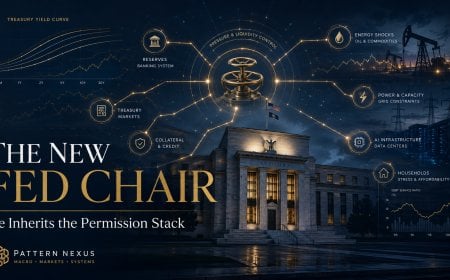 Article · related
The New Fed Chair Does Not Inherit an Economy. He Inherits the Permission Stack.
Kevin Warsh is not simply inheriting the Federal Reserve. He is inheriting the control layer where inflation, debt service, Treasury funding, energy shocks, AI infrastructure demand, repo plumbing, collateral stress, political pressure, and liquidity permission all collide. The public will debate whether the new Fed chair cuts, hikes, pauses, or changes the balance sheet. That is the surface story. The deeper Pattern Nexus story is that the Fed chair is now the public face of the permission stack. He helps decide where credit flows, where pain lands, which markets get oxygen, which sectors get squeezed, and what kind of crisis or cover event makes the next liquidity intervention politically acceptable. This is not a normal Fed transition. It is the next chapter in the liquidity-cover framework.
Published May 18, 2026 Article · relatedFederal Reserve Board announces termination of enforcement actions with UBS Group AG, Credit Suisse AG, Credit Suisse Holdings (USA), Inc., and Credit Suisse AG, New York Branch
Federal Reserve Board announces termination of enforcement actions with UBS Group AG, Credit Suisse AG, Credit Suisse Holdings (USA), Inc., and Credit Suisse AG, New York Branch
Published May 17, 2026 Article · relatedFederal Reserve Board invites public comment on proposal that would allow U.S. banks and credit unions to use intermediaries to transfer funds through the FedNow Service
Federal Reserve Board invites public comment on proposal that would allow U.S. banks and credit unions to use intermediaries to transfer funds through the FedNow Service
Published May 6, 2026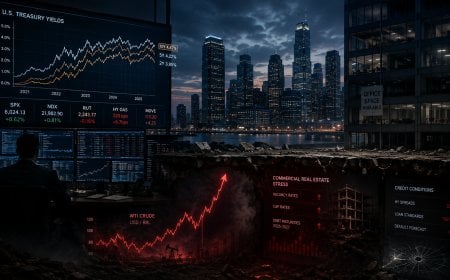 Article · related
Interest Rates, Recession, and the Current Environment
A Pattern Nexus deep research analysis on interest rates, recession risk, energy-led inflation, commercial real estate stress, private credit, AI labor pressure, and why the current environment feels like 2006 without being a direct replay of 2008.
Published May 5, 2026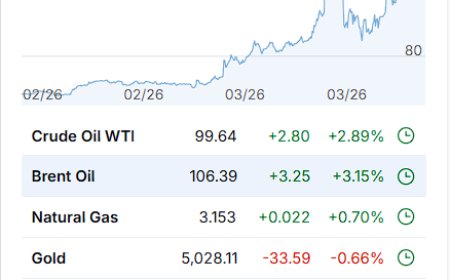 Article · related
Week Ahead (Mar 16–20, 2026): Central Bank Cluster, War-Risk Premium, and a Market Trading Constraints
Week Ahead (Mar 16–20, 2026): This is a constraint week. Oil risk premium is back, DXY is parked near 100, yields are still restrictive, and central banks have to react without pretending energy isn’t inflationary. Here’s the Pattern X map: what matters, what breaks what, and the if/then triggers for the next 5 sessions.
Published Mar 16, 2026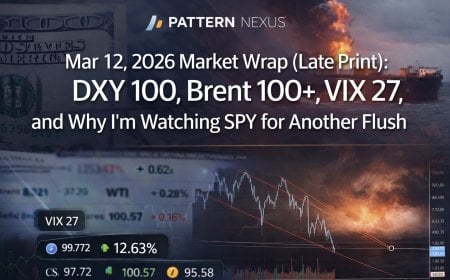 Article · related
Mar 12, 2026 Market Wrap (Late Print): DXY 100, Brent 100+, VIX 27, and Why I’m Watching SPY for Another Flush
The “index optics” crowd can keep coping. Today the plumbing talked: VIX +12%, Brent back over $100, DXY camped at 100, and yields still elevated. Add a war-risk premium plus private credit stress and you get a tape that’s not done. Here’s the full systems read using my screenshots + the Mar 12 news flow.
Published Mar 12, 2026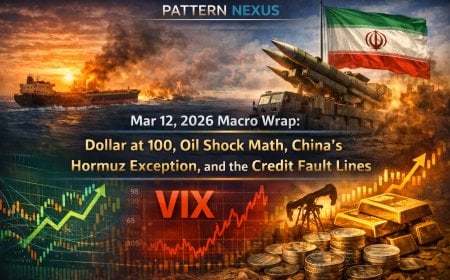 Article · related
Mar 12, 2026 Macro Wrap: Dollar at 100, Oil Shock Math, China’s Hormuz Exception, and the Credit Fault Lines
2026 is moving in whiplash mode. The dollar is pressing 100, yields are back in “you’re not supposed to be here” territory, oil is flirting with $100 again, and the Hormuz layer is no longer theoretical. China is negotiating for safe passage while credit quietly tightens. Here’s the systems-level breakdown.
Published Mar 12, 2026 Article · related
BCRED Redemptions Spike: The Private Credit “Liquidity Mismatch” Goes Live
Blackstone’s BCRED saw redemption requests jump to 7.9% versus a typical 5% quarterly cap, forcing a higher repurchase capacity and a $400M sponsor backstop. This isn’t just a fund story—it’s the private-credit liquidity mismatch showing its teeth.
Published Mar 3, 2026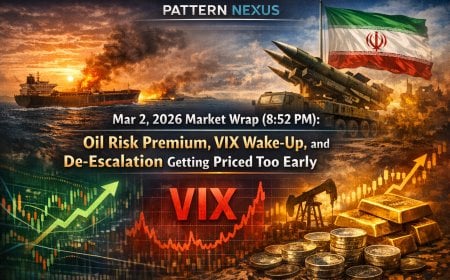 Article · related
Mar 2, 2026 Market Wrap (8:52 PM): Oil Risk Premium, VIX Wake-Up, and De-Escalation Getting Priced Too Early
Equities held together, but VIX jumped, oil stayed bid, and metals kept acting like uncertainty hedges. My read: the market is pricing fast de-escalation in Iran too early. Here’s the systems-level breakdown using the 8:52 PM snapshot.
Published Mar 2, 2026 Article · related
Israel Strikes Iran: Escalation Ladder
Israel says it launched a “pre-emptive” strike on Iran as explosions hit Tehran. Here’s the escalation ladder, the oil chokepoint risk, and the market plumbing
Published Feb 28, 2026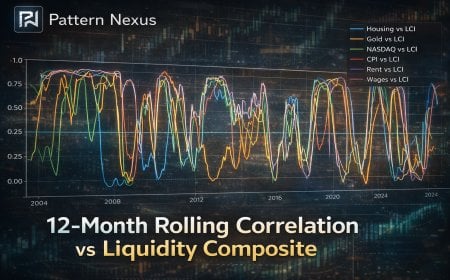 Article · related
The Plumbing Update (2003–2025) Q4 2025 + Jan 26
A full rebuild of the Pattern Nexus liquidity framework using end-of-month data, z-scores, and a PCA composite (WALCL, TGA, RRP, M2). If you want to understand housing, gold, and tech, stop arguing CPI and start watching the pipes.
Published Feb 27, 2026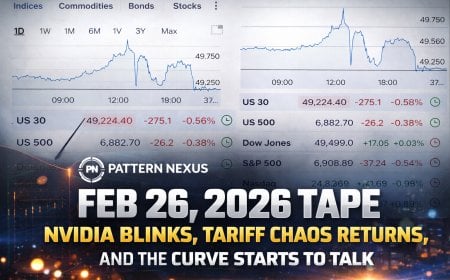 Article · related
Feb 26, 2026 Tape: Nvidia Blinks, Tariff Chaos Returns, and the Curve Quietly Flattens
Tech sold off even after Nvidia “beat,” VIX woke up, tariffs re-entered the equation, and the yield curve steepened. Here’s the systems-level read-through, plus the underbelly: private credit, multifamily stress, and BNPL drift.
Published Feb 26, 2026 Article · related
Agencies issue 2025 Shared National Credit Program report
Agencies issue 2025 Shared National Credit Program report
Published Feb 21, 2026 Article · related
Auto Repos Are the New Foreclosures: The Household Stress Signal the Market Keeps Ignoring
Repossessions are rising, subprime delinquencies are hitting cycle highs, and loan terms keep stretching. This is the stealth foreclosure wave on wheels—and it maps cleanly to the next phase of the household credit cycle.
Published Feb 17, 2026 Article · related
Synthetic Credit Didn’t Die, It Got Rewired
A Pattern Nexus field guide to CDOs, CBOs, CDS, and modern “synthetic” exposure—what still exists, how big it is now, and why post-2008 reforms changed the failure mode rather than eliminating the risk.
Published Feb 7, 2026 Article · related
WWII Was a Resource War Built on Credit: Oil, Steel, Sanctions, and the Narrative Layer
WWII wasn’t a cartoon morality play. It was a systems collision built on oil, steel, credit loops, and diplomatic valves that closed. This piece follows the official record from interwar financing to Japan’s war talks, sanctions, the Hull Note, and the Pearl Harbor timing strike.
Published Jan 15, 2026 Article · related
The Liquidity-Gated Economy: Why Central Banks Control Flow, Not Prosperity
A structural framework explaining modern economies as liquidity-gated systems where central banks regulate monetary flow between upstream credit creation and downstream prices, assets, and inflation.
Published Dec 30, 2025 Article · related
Pending Home Sales Confirm the Hard-Asset Rotation — Not a Housing “Surprise”
November pending home sales rose 3.3% month over month and 2.6% year over year, confirming a liquidity-driven rotation within hard assets. This analysis explains why housing strength can coincide with gold and silver weakness, and why “housing is overvalued” misunderstands credit, currency, and easing dynamics.
Published Dec 29, 2025 Article · related
The Leverage Stack: Collateral, Credit, and Control (2008–2030)
A Pattern Nexus system map of leverage from households to the Fed. How collateral, funding, maturity, and liquidity couple together across consumers, business, corporations, housing, markets, government, and the shadow system—why leverage is power, and why liquidity is the constraint (2008–2030).
Published Dec 14, 2025 Article · related
Half-Century Mortgages and Fantasy Car Loans: How Ultra-Long Debt Turns Households Into Cashflow Collateral
The Trump administration’s 50-year mortgage proposal, paired with viral rumors of 15-year car loans, is being sold as “affordability.” In reality, ultra-long debt structures double the interest burden, trap low-income households in lifetime payments, and weaponize credit against an already fragile workforce.
Published Dec 5, 2025 Article · related
Subprime Autos, Buy-Now-Pay-Later, and Bank Stress: Cracks at the Edge of the Consumer Balance Sheet
As of December 4, 2025, subprime auto borrowers and Buy-Now-Pay-Later users are showing rising strain. This Pattern Nexus deep dive maps where the real risk sits, how much of it flows back into banks, and whether these “buy more, pay more later” rails are the real source of bank stress.
Published Dec 4, 2025 Article · related
The Leverage Machine: How Volcker, Deregulation, and Wall Street Turned Money Into Momentum (1979–1994)
After the 1970s inflation and the end of Bretton Woods, the global system didn’t normalize — it hardened and then financialized. Between 1979 and 1994, Volcker’s shock therapy, Reagan–Thatcher deregulation, junk bonds, LBOs, and market-based credit built a new regime where leverage, not wages, became the main growth engine.
Published Dec 3, 2025 Article · related
The Dollar Fortress: How Bretton Woods, the Marshall Plan, and the 1951 Accord Forged the First Dollar Liquidity Regime (1947–1953)
After World War II, the Bretton Woods system, the Marshall Plan, and the 1951 Treasury–Fed Accord fused into a single architecture: the dollar anchored to gold, capital controls, and state-directed credit. Between 1947 and 1953, this “Dollar Fortress” quietly set the rules of global liquidity that still shape markets today.
Published Dec 2, 2025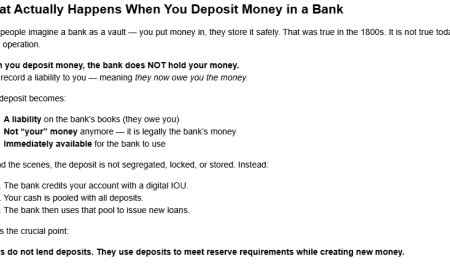 Article · related
Money Is Not What You Think: Debt, Time, Energy & the Hidden Mechanics of Power
Most people have no idea how money actually works. This long-form Pattern Nexus deep dive breaks down the real mechanics behind deposits, credit creation, debt expansion, leverage, and the hidden energy system that powers the global economy. Once you see how money is created, controlled, and weaponized, you can never unsee it.
Published Nov 24, 2025