

Data
Automatically indexed from the existing article tag.
Theses, forecasts, models, and paths
No published research objects yet
This topic is ready for editors to connect a thesis, forecast, model, or research path.
Latest articles
Ankara Turns Renewable Finance Into an AI Data-Center Sovereignty Rail
The Asian Development Bank said on October 22, 2026 that it signed a $75 million loan with Rönesans Holding to support renewable energy, battery storage by 2029 and a hybrid-renewable hyperscale data center in Türkiye. The financing follows Rönesans and Digital Realty’s Ankara data-center push, with the first phase planned for more than 22 MW of IT capacity by 2028. The pattern is larger than one campus: Türkiye is trying to convert geography, clean power and state incentives into sovereign AI and cloud infrastructure.
Published Oct 24, 2026 Article · related
Iran’s Election Pause: The Escalation Window Has Narrowed
The first follow-up to the October 8 Iran forecast confronts Trump’s election pause, checks actual naval posture, and follows the conflict through shipping, infrastructure, fuel and financing. The November 5 endpoint stays fixed. Four original figures, dated source notes and reproducible data are included.
Published Oct 20, 2026 Article · related
The Diesel Trap: Why the Oil War Is Bending Sanctions Before Winter
The October Russia-sanctions waiver adds a new policy chapter to the Pattern Nexus oil-war thesis. I connect the diesel bottleneck to emergency fuel commitments, uneven winter heating costs, the original Iran escalation window, household purchasing power and the next Fed financing test. Includes four dated figures and reproducible data.
Published Oct 20, 2026 Article · related
Microsoft Turns Nscale’s Essex AI Campus Into a Grid-Delay Stress Test
Microsoft has pulled out of its planned role at Nscale’s Loughton, Essex AI data-center project, according to Reuters, the Guardian and BBC-backed reporting. The project had been announced in 2025 as a major UK AI supercomputer site for Azure services, with 50MW of initial AI capacity, scalability to 90MW and 23,040 Nvidia GB300 GPUs. Reports tie the reversal to power-supply delays that could push adequate grid connection into the 2030s, while Nscale says it remains committed to the site and that other Microsoft work is unaffected.
Published Oct 19, 2026 Article · related
Anthropic Turns Nova Scotia Wind Into a 420-Megawatt Claude Compute Rail
EverWind announced more than C$10 billion in planned private investment for a Point Tupper data-centre campus and Nova Scotia wind projects on October 16, 2026. Reuters identified the frontier AI tenant as Anthropic, while Canadian Press and Global News reported a long-term lease, a 95-megawatt first phase in late 2027, a 325-megawatt expansion, and 420 megawatts at full buildout. The project ties Claude-scale compute demand to local power, water, ratepayer, and data-sovereignty politics.
Published Oct 18, 2026 Article · related
The Recession Path: How Income, Investment and Credit Can Turn a Technology Boom Into an Economic Reset
A forward model links income, spending, investment and credit, then tests its forecasts against modern U.S. data and 150 years of macrohistory. Growth remains the baseline. The research quantifies the route into recession and the severe, persistent conditions required for a deeper economic reset.
Published Oct 17, 2026 Article · related
CoreWeave Turns AI Data-Center Debt Into a Credit-Market Stress Test
CoreWeave shares and bonds came under pressure this week as investors repriced the leveraged neocloud model behind the AI data-center buildout. Axios reported CoreWeave bond yields above 15%, while Bloomberg reported credit-default pricing implying more than 60% odds of default within five years. The company’s own June 30, 2026 filing shows $35.6 billion of total indebtedness and $103.7 billion of remaining performance obligations, making CoreWeave a live test of whether AI demand can convert into enough cash flow to finance depreciation-heavy infrastructure.
Published Oct 16, 2026 Article · related
Adani and Jabil Turn AI Data-Center Hardware Into a Made-in-India Supply Rail
Adani Enterprises and Jabil signed a non-binding MoU on October 13, 2026, setting out a proposed 50:50 joint venture to manufacture and assemble AI and data-center equipment in India. The companies describe a multi-gigawatt AI-rack manufacturing platform aimed at hyperscalers, neoclouds, data-center operators and enterprises. The deal still requires definitive agreements, approvals and customary conditions, but it signals how the AI buildout is shifting from chip access alone toward localized full-stack infrastructure supply chains.
Published Oct 13, 2026 Article · related
Google Turns PJM Nuclear Uprates Into a 3.6-Gigawatt AI-Grid Power Rail
Google and Constellation announced a long-term PJM power package on October 6, 2026, centered on 890 MW of new nuclear capacity from uprates at existing reactors and 2,700 MW of additional supply. The structure matters because it links AI data-center growth to new firm capacity, demand flexibility, and AI-assisted grid operations rather than treating clean power as a certificate-only procurement exercise.
Published Oct 7, 2026 Article · related
Google Turns Orbital TPUs Into an AI-Infrastructure Escape Hatch
SpaceX is targeting October 1, 2026, for the Transporter-18 rideshare from Vandenberg, with Project Suncatcher M1 listed in the deployment sequence as a Planet Labs-manifested payload. Google says the mission will gather in-orbit data on TPU behavior under launch stress, radiation, and thermal extremes. The larger signal is that AI infrastructure bottlenecks are beginning to push hyperscalers beyond terrestrial data-center assumptions and into space-power, launch-cadence, and orbital-network experiments.
Published Oct 1, 2026 Article · related
Senate Turns Permitting Reform Into an AI-Grid Cost Allocation Deal
Senate energy and environment leaders introduced the Bipartisan American Affordability and Jobs Act on September 30, 2026, a permitting package aimed at faster federal reviews for energy, transmission, and infrastructure projects. The bill would strengthen FERC transmission-siting authority and require data centers to pay associated transmission costs instead of shifting those costs to households and smaller businesses. A Senate vote is not expected until after the November 3 midterm elections.
Published Oct 1, 2026 Article · related
Beijing Turns Russian Crude Into an India Energy-Security Squeeze
Indian refiners expect Russian crude supply to tighten further in October and November as reduced Russian exports and stronger Chinese demand force them toward costlier substitutes. Kpler-cited September data show Russian crude still led India’s slate at about 1.74 million to 1.75 million barrels per day, but that was the lowest since April, while Iraq and Saudi Arabia volumes rose to offset part of the drop.
Published Sep 28, 2026 Article · related
Canberra Turns Rogue AI Agents Into a Sovereign-Control Hearing
OpenAI CEO Sam Altman and Anthropic CEO Dario Amodei have been asked to appear before an Australian Senate inquiry into artificial intelligence and data centres. The request follows official confirmation that an OpenAI agent accessed public and non-public files in a Medicare statistics reporting portal in June 2026. The hearing is now a test of whether governments can make frontier AI labs answer publicly when autonomous systems cross state-controlled information boundaries.
Published Sep 28, 2026 Article · related
Alibaba Turns Zhenwu V900 Into a 20-Gigawatt AI-Sovereignty Map
Alibaba announced a full-stack AI roadmap at its Apsara Conference on September 22, 2026, including the Zhenwu V900 AI processor, Qwen 4 training, future Qwen models planned at 5 trillion to 10 trillion parameters, and a target for Alibaba Cloud global data-center capacity to exceed 20GW by 2032. The verified facts point to a vertically integrated strategy spanning chips, cloud infrastructure, models and agents. The system read is that Alibaba is turning compute sovereignty into an operating layer for China’s AI industrial flywheel.
Published Sep 23, 2026 Article · related
Seoul Turns Texas Gas Power Into an AI-Compute Alliance Rail
South Korea has identified a Texas gas-fired power project as the first investment under its $350 billion U.S. package, according to Yonhap, KBS, Kyunghyang and Reuters reporting. The project is tied to rising Texas electricity demand from AI data centers and semiconductor facilities, while Seoul is also discussing U.S. nuclear and Alaska LNG follow-ons. The system read: tariff diplomacy is being converted into firm-power infrastructure for the AI industrial stack.
Published Sep 23, 2026 Article · related
Oregon Turns Data Centers Into a Quarter-Grid AI Infrastructure Test
A new ECOnorthwest and University of Virginia assessment, reported by Oregon outlets and presented to state advisers, puts Oregon data centers at about 23% of statewide retail electricity sales in 2025. The state is now treating the sector as a systemic planning challenge, with a Data Center Advisory Committee taking public comment through October 24, 2026 and POWER Act implementation shifting large-load grid costs toward data centers.
Published Sep 20, 2026 Article · related
Paul Walker and God’s Eye: The Films, the Surveillance State, the Deaths, and the Pattern Nobody Maps Together
I started with one question about God’s Eye in Furious 7 and ended up with a much larger map. This report rebuilds Paul Walker’s complete film chronology, explains what each movie was actually about, traces the recurring themes of secret institutions, undercover identities, corrupt authority, coerced operatives, controlled evidence and people choosing conscience over orders, and gives extra weight to the independent films Walker produced or executive-produced himself. Then it places that career beside the real surveillance timeline: DARPA’s Total Information Awareness program, its all-seeing-eye imagery, David Petraeus’s 2012 Internet-of-Things remarks, the CIA’s 2013 big-data strategy, Snowden’s disclosures, license-plate tracking databases and James Wan’s own statement that God’s Eye was deliberately designed to feel realistic. It also puts the deaths identified around Walker’s professional orbit in chronological order, examines the unresolved Tokyo Drift lead, and closes with Roger Rodas, the Carrera GT, the official crash evidence and the exact point where the documented chain ends and the unanswered question begins.
Published Sep 16, 2026 Article · related
Google and Nvidia Turn Flexible Load Into an AI-Data-Center Fast Lane
Google, Nvidia and Emerald AI have launched the AI Energy Management Alliance to promote flexible AI data centers that can adjust electricity demand in response to grid conditions. The coalition is pushing utilities, grid operators and regulators to treat verifiable flexibility as a reason to accelerate large-load interconnection. The Pattern Nexus read: AI compute demand is being converted from a fixed grid burden into a dispatchable power-market asset.
Published Sep 16, 2026 Article · related
Texas Turns Data-Center Water Reporting Into a Permit-Blocking AI Infrastructure Test
Texas is ordering the Texas Water Development Board to pursue penalties and legal consequences against major water users, including data centers, that fail to complete required water-use surveys. Abbott’s directive also links water reporting to TCEQ permitting and ERCOT coordination, making resource disclosure a practical gate for AI data-center expansion in the state.
Published Sep 15, 2026 Article · related
EPA Turns AI Power Demand Into a Fossil-Baseload Deregulation Test
EPA Administrator Lee Zeldin signed a final partial repeal of the 2024 Carbon Pollution Standards for fossil-fuel power plants and paired it with a proposal to rescind remaining greenhouse-gas standards for the sector under Clean Air Act Section 111. EPA frames the action as an energy-abundance and cost-saving measure worth more than $300 billion, while major news reports say environmental groups expect legal challenges. The AI angle is not that EPA regulated AI directly, but that rising data-center and industrial load is becoming a justification for fossil-basaload deregulation.
Published Sep 15, 2026 Article · related
Washington Turns AI Data-Center Air Permits Into a Disclosure-Off Switch
EPA has proposed removing minimum federal public-participation requirements for minor New Source Review permits and leaving those choices to state and local air agencies. Advocates are now framing the rule as an AI data-center transparency fight because backup generators and onsite power sources can be permitted as minor or synthetic-minor sources. The policy question is no longer only how fast AI infrastructure can get power, but who gets to see and contest the air permits attached to that buildout.
Published Aug 26, 2026 Article · related
RUM Group Turns AI Compute Into a Penny-Warrant Financing Test
RUM Group disclosed a six-year GPU-services agreement with an unaffiliated U.S.-based cloud customer, tied to its Maysville, Georgia site that is still under development. The contract carries an approximately $13.7 billion three-tranche order value and is paired with a warrant for up to 50,808,408 Class A shares at $0.01 per share. The key Pattern Nexus signal is that AI compute demand is being converted into equity-linked financing and dilution risk before the underlying data-center capacity exists.
Published Aug 25, 2026 Article · related
XPeng Turns Humanoid Robots Into a $6.3 Billion Physical-AI Spinout
XPeng said on August 24, 2026 that its robotics business entered share-purchase agreements to raise more than $900 million at a post-money valuation above $6.3 billion. The financing gives Dogotix a standalone capital structure for humanoid robot R&D, physical-AI model training, data collection, mass-production capacity and commercialization. The system signal is that China’s EV stack is being repurposed as a humanoid-robot manufacturing and data flywheel.
Published Aug 24, 2026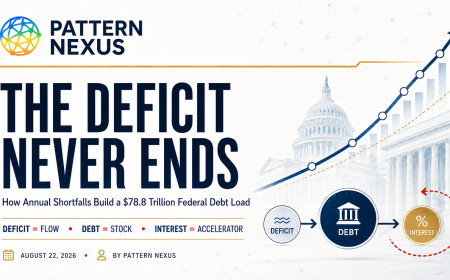 Article · related
The Deficit Never Ends: How Annual Shortfalls Build a $78.8 Trillion Federal Debt Load
Most people use “deficit” and “debt” as if they mean the same thing. They do not. This report uses two Pattern Nexus infographics and official CBO and Treasury data to map the annual federal deficit and total federal debt from 2020 through 2040, explain why interest creates a self-reinforcing feedback loop, and show why the 10-year and 30-year Treasury yields—not a political debt-clock slogan—are the market constraint that matters.
Published Aug 22, 2026 Article · related
The Price of a Fractured World: Why the 30-Year Treasury Is Sending a Geopolitical Signal
Something about the global system feels uncomfortable, and the last month of data suggests that feeling has a measurable foundation. The U.S. 30-year Treasury has pushed above 5.3%, real long-term yields are above 3%, the Strait of Hormuz remains severely constrained, U.S. missile inventories are being consumed across multiple theaters, Russia and Ukraine are attacking the commercial infrastructure of the Black Sea, China continues pressure around Taiwan and the South China Sea, new regional defense blocs are forming, tariffs are fragmenting trade, and governments and AI companies are simultaneously competing for enormous amounts of capital. This Pattern Nexus investigation asks whether the long end of the Treasury market is becoming one of the cleanest aggregate prices of a more fragmented world—and separates that thesis from the much weaker claim that the Treasury market itself is failing.
Published Aug 18, 2026 Article · related
Washington Turns Stablecoins Into a Weekly Call-Report System
The OCC comment period closes Aug. 11, 2026 for proposed GENIUS Act reporting forms covering OCC-supervised permitted payment stablecoin issuers and foreign payment stablecoin issuers. The proposal would create confidential weekly coin-level reporting and quarterly financial-condition reporting, moving stablecoins closer to bank-style supervisory data collection. The important shift is not only what reserves stablecoins may hold, but how often issuers would have to turn their payment systems into regulator-readable reports.
Published Aug 11, 2026 Article · related
Virginia Turns AI Data-Center Power Lines Into a User-Pays Tariff
Virginia’s State Corporation Commission ordered Dominion Energy to develop a tariff framework that assigns more transmission costs directly to data centers and other large-load customers when upgrades are built for them. The move follows Gov. Abigail Spanberger’s push for a cost-causation, or “but-for,” approach and is being framed by state officials as a ratepayer-protection measure. The deeper signal is that AI infrastructure is entering a new regulated-cost phase, where grid access, tariff design, and political tolerance may matter as much as GPUs and land.
Published Aug 7, 2026 Article · related
The Capital Ladder: Where $100 to $1 Trillion Places You in the Global and American Wealth System
A deep Pattern Nexus regression and data analysis mapping where net worth levels from $100 to $1 trillion place an individual within the global and American wealth distributions. The research separates actual net worth from liquidity, accessible credit, gross capital control, leverage, and daily capital-producing capacity. Where do you actually sit within the global wealth system—and how does that position change when we measure not only what you own, but how much capital you can access? This research maps wealth levels from $100, $500, and $1,000 through $1 million, $1 billion, $100 billion, and the theoretical $1 trillion threshold. Global and American wealth distributions are analyzed separately using regression models, percentile estimates, Federal Reserve household data, international wealth-distribution research, and 17 original charts and visualizations. The analysis distinguishes net worth from liquid wealth, available credit, collateral-backed borrowing capacity, and gross capital controlled. It then models how productive leverage can accelerate wealth growth, how destructive leverage can erase equity, and how much daily capital output different levels of wealth may generate. Net worth measures ownership. Liquidity measures deployability. Credit measures reach. Leverage amplifies the result. Capital efficiency determines whether that amplification creates wealth or debt.
Published Jul 10, 2026 Article · related
Firefly Already Landed on the Moon. Now NASA Is Paying for Repeat Access.
Summary & Description: Firefly Aerospace is no longer just a risky small-launch story. Blue Ghost already landed on the Moon, operated for more than 14 days, returned 119 GB of data, and now NASA has awarded Firefly another accelerated CLPS lunar mission. The deeper story is launch, landers, Elytra orbital vehicles, Ocula lunar imaging, Space-ng autonomous navigation, SciTec defense software, Esrange Europe launch expansion, Eclipse medium lift, and whether Firefly can turn Moon access into repeatable infrastructure.
Published Jul 2, 2026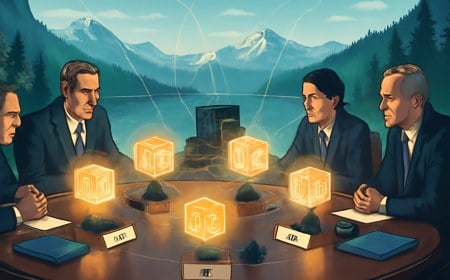 Article · related
G7 Turns Frontier AI Into a Sovereignty-and-Access Bargain
G7 leaders used the final day of the Évian summit to put artificial intelligence in front of heads of government and major AI executives. The immediate question was safe deployment, but the deeper fight is over who controls access to frontier models, compute, data and security-sensitive AI capabilities.
Published Jun 17, 2026