

Ownership
Automatically indexed from the existing article tag.
Theses, forecasts, models, and paths
No published research objects yet
This topic is ready for editors to connect a thesis, forecast, model, or research path.
Latest articles
 Article · related
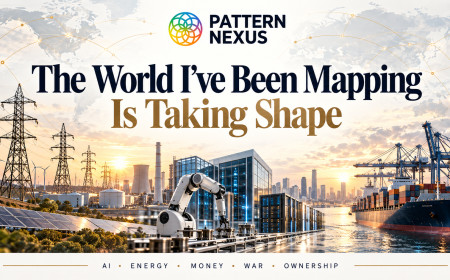
The World I’ve Been Mapping Is Taking Shape
I connect the developments now taking shape across AI infrastructure, private power, critical minerals, the Iran energy shock, digital dollars, machine commerce, robotics and productive ownership. The article explains the mechanisms for readers joining the discussion now, carries the research into September and October, and connects the later housing, Greenland, space, neural-computing and polar-vortex work. Includes links to 46 earlier Pattern Nexus articles, 53 numbered external sources, a practical watch list and six reader questions.
Published Oct 5, 2026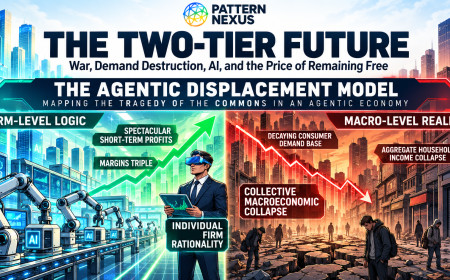 Article · related
The Two-Tier Future: War, Demand Destruction, AI, and the Price of Remaining Free
For years, I followed pieces of a possible two-tier economic future, then moved away from believing they would come together. In September 2026, the Iran oil shock, Ukraine refinery attacks, demand destruction, long-rate pressure, AI, robotics and the ownership of physical infrastructure have forced me to put the entire argument into one place: who retains access to the real world if an increasingly automated economy makes ordinary people dependent on the systems they do not own?
Published Sep 25, 2026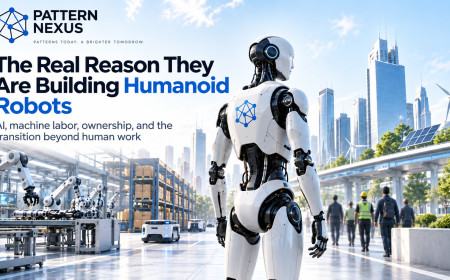 Article · related
The Real Reason They Are Building Humanoid Robots: The End of Human Labor as the Foundation of the Economy
Humanoid robotics is not simply about building machines that walk, talk, and perform household chores. It is about creating a scalable physical labor force that can operate alongside artificial intelligence, transforming production, ownership, wages, consumer demand, and the monetary system. This analysis connects the robotics revolution to the wider Pattern Nexus framework: structural deflation, expanding liquidity, concentrated ownership, universal intelligence, programmable money, and the transition toward a post-labor economy.
Published Sep 21, 2026 Article · related
The Capital Ladder: Where $100 to $1 Trillion Places You in the Global and American Wealth System
A deep Pattern Nexus regression and data analysis mapping where net worth levels from $100 to $1 trillion place an individual within the global and American wealth distributions. The research separates actual net worth from liquidity, accessible credit, gross capital control, leverage, and daily capital-producing capacity. Where do you actually sit within the global wealth system—and how does that position change when we measure not only what you own, but how much capital you can access? This research maps wealth levels from $100, $500, and $1,000 through $1 million, $1 billion, $100 billion, and the theoretical $1 trillion threshold. Global and American wealth distributions are analyzed separately using regression models, percentile estimates, Federal Reserve household data, international wealth-distribution research, and 17 original charts and visualizations. The analysis distinguishes net worth from liquid wealth, available credit, collateral-backed borrowing capacity, and gross capital controlled. It then models how productive leverage can accelerate wealth growth, how destructive leverage can erase equity, and how much daily capital output different levels of wealth may generate. Net worth measures ownership. Liquidity measures deployability. Credit measures reach. Leverage amplifies the result. Capital efficiency determines whether that amplification creates wealth or debt.
Published Jul 10, 2026 Article · related
2026 Landlord Outlook: Cautious Optimism, Multifamily Strength, and the New Housing Map
A Pattern Nexus breakdown of Innago’s 2026 landlord survey showing cautious optimism, portfolio expansion plans, multifamily dominance, Midwest and South rotation, and rising AI adoption in rental ownership.
Published Mar 11, 2026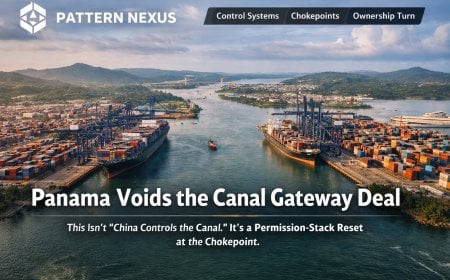 Article · related
Panama Voids the Canal Gateway Deal — This Isn’t About Ships, It’s About Permission
Panama’s Supreme Court ruled the CK Hutchison-linked port concession at Balboa and Cristóbal unconstitutional, resetting the legal wrapper over a strategic chokepoint. This is a permission-stack event: ports as throttle points, cap-table geopolitics, and the U.S. ownership turn colliding in one ruling.
Published Jan 29, 2026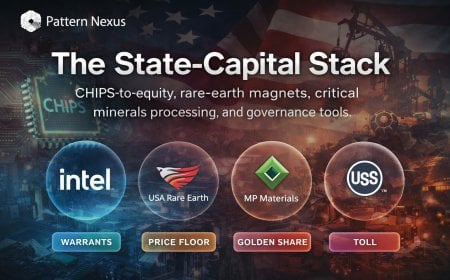 Article · related
The State-Capital Stack: CHIPS-to-Equity, Rare Earths, and the U.S. Ownership Turn
The Trump administration is turning industrial policy into cap-table leverage: converting CHIPS grants into equity, underwriting price floors and offtakes, and using governance instruments like golden shares and tolls. This is the state building rails and buying seats at chokepoints.
Published Jan 25, 2026 Article · related
The Debt-Free Illusion: How Personal Finance Cults Preserve the Consumer Class and Block Mobility
“Debt-free” is sold as freedom, but in a financialized economy it often functions as compliance: a behavioral cage that blocks asset ownership, leverage literacy, and class mobility.
Published Jan 24, 2026 Article · related
Stone Money on Yap: When the Ledger Is the Island
On Yap, massive stone disks called rai functioned as money even when they never moved. Ownership moved through public consensus, proving money is a control system: a ledger, validators, and enforcement.
Published Jan 15, 2026 Article · related
The Wall Street Single-Family Ban: The Action, the Housing Math, and Where the Ownership Actually Sits
Trump says he will ban large institutional investors from buying single-family homes. Here’s the real housing inventory math, what share institutions actually control, where the concentration sits, and what would need to change for affordability to move.
Published Jan 7, 2026 Article · related
Why Hard Work Won’t Save Gen Z in the AI Era
A deep dive into Gary Shilling’s warning that young people will need to work harder in the AI era—and why hustle alone isn’t enough. This long‑form article explores the end of the industrial work ethic, the rise of automation, and the new rules for generational success.
Published Oct 27, 2025 Article · related
The Illusion of Ownership: How Leverage and Liquidity Redefined the Middle Class
For decades, the idea of homeownership was synonymous with security. But after 2008, that dream quietly shifted from ownership to leverage — from building roots to building returns. This analysis explores how central banks, institutional capital, and modern lending turned the middle class from owners into participants in a liquidity machine, and what that means for those still trying to build lasting wealth.
Published Oct 18, 2025