
U.S. Administration Investments in Nuclear Companies (2025)
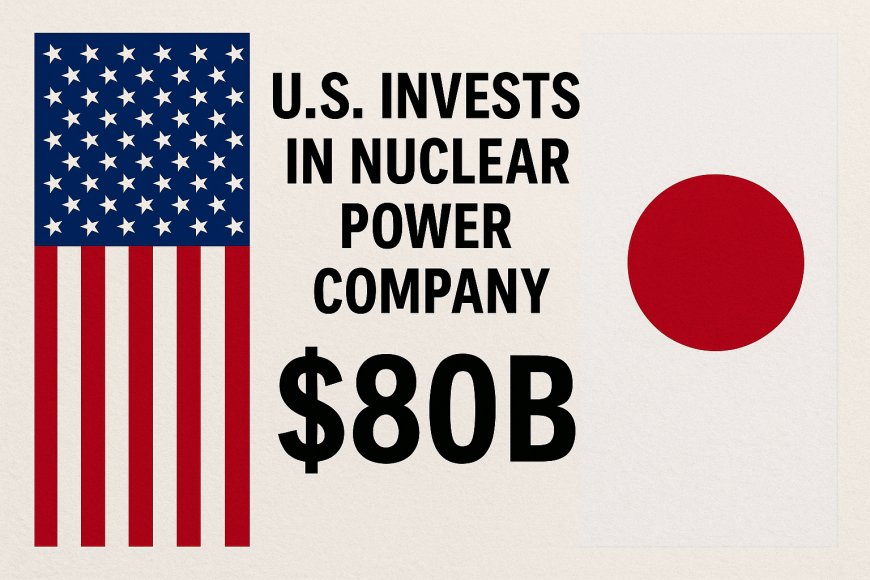
In 2025, the U.S. administration under President Donald Trump announced an $80 billion nuclear partnership with Westinghouse, Cameco, and Brookfield to rebuild America’s nuclear capacity and meet soaring AI-driven power demand. Complementary projects by Amazon, X-energy, Google, Microsoft, and the Department of Defense mark a new era of public-private collaboration in nuclear energy, reshaping U.S. energy strategy and global competitiveness.

U.S. Administration Investments in Nuclear Companies (2025)
Overview
In 2025 the Trump administration continued the U.S. government’s push to revitalise domestic nuclear energy. Rapid growth of artificial-intelligence (AI) data centres and concern about energy security has driven the administration to invest directly in nuclear power infrastructure and partner with major companies. During the summer and autumn of 2025, several government-linked initiatives were announced that collectively represent tens of billions of dollars in investment. The largest deal involves a consortium led by Westinghouse Electric Company, while other partnerships include small modular reactor (SMR) deployments financed by Amazon and microreactor projects supported by the U.S. Department of Defense. This report summarises these investments, their strategic significance and where the U.S. nuclear programme is headed.
Major Government-Linked Investments
$80 billion partnership with Westinghouse Electric
On 28 October 2025 the U.S. government announced a “strategic partnership” with Westinghouse Electric Company, Cameco Corporation and Brookfield Asset Management. According to the joint release, the government will arrange financing and help obtain permits to build at least $80 billion worth of new reactors across the United States using Westinghouse’s AP1000 technology (Reuters; Cameco press release).
In return the government will receive a participation interest in excess cash distributions (20% above $17.5 billion) once the reactors are operational (Reuters). The program is intended to reignite the U.S. nuclear industrial base; each two-unit AP1000 project could sustain 45,000 manufacturing and engineering jobs and a national rollout would create over 100,000 construction jobs (Cameco press release).
The consortium emphasised that nuclear energy would be a pillar of the U.S. program to maintain global leadership in nuclear technology and AI. Government officials said the partnership aims to rebuild American energy sovereignty, create high-paying jobs and support the “nuclear renaissance” envisioned by the Trump administration (Cameco press release). This is one of the largest public investments in atomic energy in decades and reflects the administration’s energy-dominance agenda (Reuters).
Profit sharing and future obligations
The agreement allows the U.S. government to obtain 20% of distributions beyond $17.5 billion (Reuters). A provision also gives the government the option to require Westinghouse to make a public offering if its valuation exceeds $30 billion by January 2029 (Reuters). The deal follows a May 2025 executive order promoting nuclear energy and targets a 5 GW increase in reactor capacity by 2030 (Reuters).
Rationale for the investment
The partnership comes as U.S. electricity demand surges due to AI data centres. Reuters notes that power demand from hyperscale computing infrastructure is driving the first sustained growth in U.S. electricity demand in two decades (Reuters; Reuters). Westinghouse’s new reactors are expected to supply clean, reliable power for AI and other industrial needs (Cameco press release).
Westinghouse’s plans to build ten reactors
Prior to the October deal, Westinghouse had announced an internal $6 billion programme to build ten large AP1000 reactors in the U.S. The company told President Trump in July 2025 that constructing ten of these reactors could generate $75 billion of economic value across the country and $6 billion in Pennsylvania (Westinghouse info site). While the $6 billion investment comes from Westinghouse rather than the government, it demonstrates industry alignment with the administration’s push to expand U.S. nuclear capacity.
SMR and AI-focused partnerships
X-energy, Amazon, KHNP and Doosan
On 25 August 2025, X-energy Reactor Company, Amazon, Korea Hydro & Nuclear Power (KHNP) and Doosan Enerbility announced a strategic collaboration to accelerate deployment of X-energy’s Xe-100 SMR design. The partnership aims to mobilise up to $50 billion in public and private investment for Xe-100 projects and to expand the U.S. supply chain (X-energy release). The consortium combines nuclear engineering expertise (X-energy and KHNP), manufacturing (Doosan) and cloud infrastructure (Amazon) to deliver cost-effective SMRs for data centres and advanced manufacturing (X-energy release). The partners plan to deploy more than 5 GW of new nuclear capacity in the U.S. by 2039 (X-energy release).
The agreement aligns with the administration’s goal to commercialise advanced reactors. CEO J. Clay Sell of X-energy said the collaboration leverages South Korea’s supply chain to accelerate deployment and preserve U.S. leadership in the AI race (X-energy release). KHNP’s Joo-ho Whang emphasised that cooperation would strengthen SMR competitiveness and meet climate-crisis demands (X-energy release).
Amazon’s Cascade Advanced Energy Facility
Separately, Amazon plans to fund a 960 MW Cascade Advanced Energy Facility in Washington state, built by Energy Northwest using X-energy’s technology. Utility Dive reports that the facility will deploy 12 small modular reactors (three sections of 320 MW) on a compact footprint. Each module uses the Xe-100 design, which can be scaled from four reactors (320 MW) to twelve (960 MW) (Utility Dive). Construction is expected to begin near the end of the decade with operations in the 2030s (Utility Dive). Amazon says the project addresses the urgent need for carbon-free energy for AI data centres (Utility Dive). The company previously invested $500 million in X-energy and will utilise the Cascade facility to power its digital infrastructure (Utility Dive).
This facility complements the August partnership: the same release notes that the parties (Amazon, KHNP and Doosan) aim to deploy more than five gigawatts of new nuclear capacity and mobilise up to $50 billion in investment (Utility Dive).
Google, Microsoft and other tech partnerships
The growth of AI has also spurred private deals to secure nuclear power. In October 2025 NextEra Energy and Google signed an agreement to restart an idle nuclear plant in Iowa. Constellation Energy and Microsoft have partnered to restart a unit of the Three Mile Island plant in Pennsylvania to power Microsoft data centres. Although these deals are not government investments, they illustrate how the AI boom is aligning tech companies with nuclear energy, complementing federal initiatives.
Microreactor pilot for military bases
The Department of the Air Force (DAF) aims to pilot microreactors on military bases to enhance energy resilience. In June 2025 the DAF’s energy logistics agency issued a notice of intent to award Oklo a power purchase agreement for a 5 MW microreactor at Eielson Air Force Base in Alaska (Reuters). Under the notice, Oklo would design, construct, own and operate the reactor, delivering electricity and heat under a long-term contract (Reuters). The project builds on an earlier 2023 agreement that was cancelled; the current notice signals renewed federal interest in small reactors for military use (Reuters). While the deal’s value was undisclosed, it demonstrates the Defence Department’s commitment to nuclear innovation to enhance base-level energy security.
Significance and Implications
Rebuilding the U.S. Nuclear Supply Chain and Workforce
The government–Westinghouse partnership could revitalise domestic manufacturing. Each AP1000 two-unit project supports tens of thousands of jobs, and national deployment is expected to create more than 100,000 construction positions (Cameco press release). The program also aims to reverse decades of decline in U.S. reactor construction, positioning American firms as global exporters of advanced nuclear technology (Cameco press release).
Meeting Surging AI Power Demand
Power demands from AI data centres are driving these investments. The Reuters report states that growth in hyperscale computing is boosting U.S. electricity demand for the first time in two decades. Small Modular Reactors (SMRs) and advanced reactors offer carbon-free baseload generation that can be sited near data centres, reducing transmission losses and providing stable power for AI workloads. Amazon’s Cascade facility and the X-energy partnership explicitly tie reactor deployment to AI and digital infrastructure (Utility Dive; X-energy release).
Energy Security and Geopolitics
By investing directly in nuclear technology and partnering with allies such as South Korea, the United States seeks to reduce reliance on foreign suppliers. The X-energy partnership emphasises cooperation with KHNP and Doosan to strengthen supply chains (X-energy release). At the same time, Westinghouse’s expansion demonstrates the U.S. desire to compete with China and Russia in nuclear exports. The partnership aims to maintain American leadership in nuclear technology and AI, aligning with the administration’s broader trade and investment strategies (Cameco press release).
Environmental and Safety Considerations
Although nuclear power produces near-zero carbon emissions, critics highlight unresolved issues. The Reuters report notes there is no permanent U.S. repository for radioactive waste, which is currently stored on site at plants. Additionally, building new reactors can be costly and prone to delays; the last U.S. reactors at the Vogtle site took seven extra years and cost over $35 billion (Reuters). Microreactors like Oklo’s design also raise non-proliferation concerns because the design extracts energy from plutonium (Reuters).
Future Outlook
Implementation Timeline
The Westinghouse partnership is contingent upon final investment decisions and permitting (Reuters). Construction of new large reactors could begin later this decade, but given past delays, completion may extend into the 2030s. X-energy-Amazon SMR projects also anticipate construction starting near the end of the decade with operations in the 2030s (Utility Dive). The Department of the Air Force will need Nuclear Regulatory Commission approval for Oklo’s microreactor; Oklo plans to reapply for a license in late 2025 and hopes to obtain it by 2027 (Reuters).
Potential Expansion and Global Impact
If successful, the U.S. could deploy multiple large AP1000 reactors and numerous SMRs, creating a diversified nuclear fleet. Westinghouse’s contract includes provisions for profit sharing and possible public offering, suggesting the government could recoup its investment over time (Reuters). The X-energy partnership may serve as a model for trans-Pacific collaboration, with Korean partners providing manufacturing capabilities and potential expansion to other countries (X-energy release). The partnership also complements the $350 billion U.S.–Republic of Korea trade deal announced in July 2025, integrating energy and technology cooperation.
Challenges Ahead
Despite ambitious announcements, the nuclear revival faces hurdles. Financing large reactors remains difficult due to high capital costs; Westinghouse’s AP1000 projects will need sustained government backing. The absence of a permanent waste repository could trigger public opposition. Regulatory timelines must accelerate; however, the administration has directed the NRC to issue licenses within 18 months (Reuters), which may raise safety concerns. For SMRs and microreactors, demonstrating cost competitiveness and reliability will be critical to attract private investment and public acceptance. The interplay between AI growth, energy needs and environmental constraints will influence how far the U.S. nuclear renaissance goes.
Conclusion
The U.S. administration’s 2025 nuclear investments mark a significant shift toward public-private partnerships to meet burgeoning electricity demand from AI and to reassert U.S. leadership in nuclear technology. The $80 billion Westinghouse partnership is the most tangible government investment in atomic energy in decades (Reuters), while the X-energy–Amazon collaboration aims to mobilise $50 billion in combined public and private funds (X-energy release). Coupled with microreactor pilots for military bases (Reuters) and corporate deals with Google and Microsoft (Reuters), these initiatives point to a future where nuclear power underpins both energy security and AI-driven economic growth. Implementation will require overcoming regulatory and financial obstacles, but if successful, the U.S. could reemerge as a global nuclear powerhouse while supporting domestic manufacturing, jobs and technological leadership.
In summary, the 2025 U.S. administration has launched its most ambitious nuclear push in decades, partnering with Westinghouse, Cameco and Brookfield to finance and permit an $80 billion program that will deploy AP1000 reactors across the country—delivering at least 5 GW of new capacity, tens of thousands of jobs and a share of future profits (Reuters; Cameco press release). This unprecedented government involvement is complemented by a $6 billion Westinghouse plan to build ten additional reactors, signalling industry alignment with federal policy and underscoring nuclear energy as a cornerstone of the administration’s “energy dominance” agenda (Westinghouse Info).
Explore Related Analyses
Kakva je vaša reakcija?
 Sviđa mi se
0
Sviđa mi se
0
 Dislike
0
Dislike
0
 Ljubav
0
Ljubav
0
 Smešno
0
Smešno
0
 Vau
0
Vau
0
 Žalostan
0
Žalostan
0
 Besan
0
Besan
0












Komentari (0)