
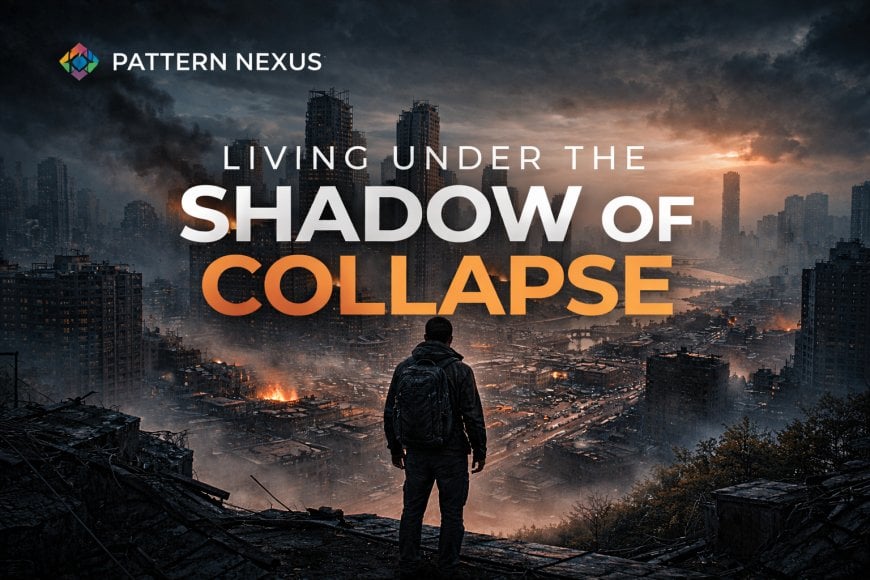
Living Under the Shadow of Collapse
Why collapse narratives spread faster than serious analysis, how fear reshapes behavior long before systems break, and how liquidity, incentives, and control systems quietly decide who freezes and who moves.

Instability is normal. The mistake is treating instability as a countdown timer.
Fear doesn’t need collapse to win. It wins by changing your behavior today.
When fear freezes liquidity, optionality becomes leverage and waiting becomes a tax.
Systems persist not because they are moral, but because incentives demand continuity.
Proportionate preparedness is resilience. Over-preparation is a slow-motion life trade.
Why Simple Narratives Travel Faster Than Reality
A satirical post about silver charts recently reached nearly 200,000 people. It wasn’t rigorous. It wasn’t meant to be definitive. It worked because it compressed complexity into certainty, and certainty is a dopamine machine.
Serious analysis does the opposite. It introduces time horizons, tradeoffs, competing incentives, and uncertainty. It refuses to hand the reader a single outcome. From an attention standpoint, that is a disadvantage. From a reality standpoint, it’s the only honest way to talk about complex systems.
The modern information environment is built to reward emotional activation. Not truth. Not accuracy. Not even usefulness. The algorithm doesn’t ask “is this right?” It asks “did this trigger a reaction?” Fear content triggers reactions more reliably than nuance ever will.
Platforms don’t rank “truth.” They rank interaction. The fastest-moving content is usually the content that triggers a feeling strong enough to force an action. The action is the signal. The signal is what gets multiplied.
- Emotion trigger: fear, anger, outrage, dopamine, certainty
- Engagement: like, comment, share, save, click, watch time
- Distribution: algorithm expands reach based on engagement density and velocity
- Monetization: higher reach + higher engagement = higher payout and follower capture
| Action | Why it matters | Impact (relative) |
|---|---|---|
| Like / Reaction | Low friction signal that content landed | 1× |
| Comment | Creates thread time and repeat opens | ~5–10× |
| Share | Re-distributes into new graphs of people | ~20–100× |
| Long watch / click-through | Proves sustained attention and intent | High when consistent |
- Fear is immediate: it compresses time and forces action now
- Nuance is slow: it demands attention without guaranteeing certainty
- Fear loops: it creates repeat-check behavior (updates, alerts, “are we there yet?”)
- Nuance resolves: resolution reduces compulsive engagement
This is why the loudest narratives dominate. They remove ambiguity. They give people identity and a script. They turn uncertainty into a tribe: “we know what’s coming,” “we are prepared,” “everyone else is asleep.”
The problem is that certainty is often a substitute for understanding. It feels like insight, but it’s frequently just a compressed story designed to travel. If you want to measure the quality of an idea, watch what it does to behavior over time. Does it make people more capable, more resilient, and more adaptive? Or does it make them scared, frozen, and endlessly waiting?
Virality reflects emotional activation, not accuracy. Platforms reward reaction, not resolution, which means the most shareable version of a story is rarely the most correct.
Collapse as a Behavioral Modifier
Collapse rarely begins with an event. It begins with belief. The collapse narrative changes how people value time, how they allocate resources, and how they interpret risk. It changes what feels rational.
When someone internalizes “the system is about to break,” they start treating the present as provisional. They delay long-term commitments. They avoid building. They avoid investing in durable life structures. They treat life like a temporary camp instead of something you grow.
Collapse narratives don’t need to be accurate to be powerful. They operate like a control input: once a belief is installed, it changes decisions immediately. Those decisions compound into real outcomes, which then “prove” the belief and reinforce it. That’s how a story becomes a self-fulfilling loop.
- Belief installed: “collapse is imminent,” “hyperinflation tomorrow,” “the system will break soon”
- Time preference shifts: future feels unreliable → present becomes defensive
- Behavior changes: defer long-term commitments, hoard liquidity, reduce risk-taking
- Outcomes manifest: missed opportunities, lower mobility, weaker networks, stalled life compounding
- Reinforcement: outcomes are interpreted as “proof” → belief hardens → loop repeats
| Domain | High time preference (fear-state) | Low time preference (builder-state) |
|---|---|---|
| Housing | Delay ownership, avoid “commitment” | Buy when feasible, optimize resilience |
| Work / Skills | Stop investing in long projects | Stack capabilities and optionality |
| Relationships | Isolation, mistrust, “why bother” | Build networks and mutual support |
| Money | Hoard, react, chase “crisis assets” | Diversify, cash-flow, plan, position |
| Health | Stress loops, doom-scrolling, poor routines | Fitness, sleep, durable energy, calm focus |
- Opportunity collapse: you stop compounding life because you’re waiting for the event
- Optionality collapse: you become less mobile/adaptive because you anchored to the narrative
- Define a baseline prep: short-term buffer + essentials + redundancy
- Then build: skills, health, cash-flow resilience, community
- Keep living: commit to long-horizon goals anyway, because the future is always uncertain
This matters because belief is not passive. Belief is a control input. It feeds directly into decision-making. If you believe instability is permanent and catastrophic, you will prioritize defensive positioning over constructive positioning. You will optimize for protection at the expense of growth.
In real systems, outcomes rarely arrive in a single dramatic snap. They arrive through long sequences of policy tradeoffs, credibility management, and constraint migration. The human brain wants a clean ending. The world is usually messier than that.
And here’s the part that people hate hearing: none of this requires collapse to happen. People can lose decades of their life waiting for a crisis that never arrives, or arrives in a form that doesn’t match the narrative they trained themselves on.
- Belief changes time preference and risk weighting
- Time preference changes savings, investment, and relationship behavior
- Behavior shapes outcomes long before any macro event resolves
The most destructive part of collapse ideology is not the prediction. It’s the lifestyle it quietly creates: delay, paralysis, and a permanent “not yet.”
Preparedness, Mobility, and the Cost of Waiting
Preparedness is rational. Being able to absorb shocks is a real form of power. The issue is proportionality. There’s a difference between building resilience and building a life around a story.
If modern civilization experienced genuine systemic failure, it would likely arrive through an external shock that disrupts power, logistics, and coordination. In that scenario, dense population centers become liabilities. Supply chains collapse into scarcity. Rule systems degrade into localized force.
Preparedness is not binary. It’s a spectrum, and the same actions that create resilience at one level can create fragility at another. The goal is not maximum preparation. The goal is maximum optionality: the ability to absorb shocks without becoming trapped by your own plan.
| Stage | What you add | What you gain | Hidden risk |
|---|---|---|---|
| Resilience | Buffer supplies, redundancy, cash buffer, basic plans | Shock absorption, calm decision-making | Overconfidence if you stop upgrading skills |
| Rigidity | Large fixed stockpiles, heavy gear, single-location dependency | Comfort illusion, “I’m ready” identity | Reduced mobility, reduced adaptability |
| Paralysis | Life organized around collapse timing, constant alertness, no long-horizon building | A feeling of control through anticipation | Opportunity loss, isolation, chronic stress, stalled life compounding |
If your plan assumes you can defend and hold a fixed position indefinitely, run the mobility test: What if you have to leave within 60 minutes? What goes with you? What do you abandon? The more your strategy collapses under that question, the more you’re drifting from resilience into rigidity.
- Resilience: you can move with essentials + competence
- Rigidity: you can’t move without losing “the plan”
- Paralysis: you don’t move because you stopped living long ago
- Health: fitness, sleep, stress control, injury resilience
- Skills: repair, navigation, first aid, communications, basic construction
- Cash-flow resilience: income diversity, low fixed costs, buffers
- Community: trusted relationships, mutual support, local knowledge
- Supplies: short-term essentials, not a lifestyle replacement
- Time buffer: 2–4 weeks of essentials (food/water/heat/meds) based on your household
- Redundancy: power/heat/communications backups scaled to realistic outages
- Liquidity buffer: cash reserves to handle job loss or short shocks
- Then stop: shift the rest into building life structures and optionality
Now run the scenario honestly. If you have to leave, what can you carry? Realistically, not much. Mobility becomes survival. Weight becomes risk. The most valuable assets become things you can’t stockpile: fitness, skills, planning, community, and decision speed.
This is why over-preparation can be a trap. It ties you to objects, locations, and fantasies of control. It can make you feel safer while quietly reducing your adaptability.
Prep is not a bunker. Prep is optionality: enough supplies to absorb short-term disruptions, plus the skills and mobility to adapt when plans fail.
The goal is not to pretend risk doesn’t exist. The goal is to avoid letting risk steal your life before it ever materializes. Build resilience, then keep living.
The Rabbit-Out-of-the-Hat Machine
The world has always gone through periods of instability. Empires rise and fall. Monetary regimes rotate. Wars reorder trade routes. Crises surface constraints that were always there. That’s history.
What feels different now is the density of stressors layered together: geopolitical fragmentation, higher energy and security constraints, demographic pressure, and sovereign debt loads that have grown into a permanent policy variable. Many countries are walking around with debt dynamics that limit flexibility, especially when rates rise and refinancing becomes a budget problem instead of an accounting detail.
Instability isn’t one thing. It’s layered. Most “collapse” narratives fail because they treat the system like a single switch: stable → broken. In reality, instability arrives as stacked constraints that reduce policy flexibility and increase volatility. The system can remain “alive” while becoming more fragile, more contested, and more uneven.
| Layer | What it is | How it creates instability | Typical symptom |
|---|---|---|---|
| Geopolitics | Trade fracture, sanctions, security blocs, supply-chain re-routing | Raises baseline costs, reduces efficiency, increases tail-risk events | Energy spikes, chokepoint risk, supply shocks |
| Sovereign debt | High debt loads + refinancing cycles + rising carry costs | Limits policy options, forces monetization or repression choices | Austerity talk, emergency facilities, “temporary” measures |
| Policy constraints | What central banks/governments can realistically do without breaking legitimacy | Creates narrower corridors: every move has higher political cost | Stop-go policy, “data dependent,” sudden pivots |
| Credibility | Trust in institutions, currency, and forward guidance | When trust weakens, stabilizing actions become less effective and more inflationary | Volatility, polarization, flight-to-safety pulses |
Any one of these layers is manageable. The stress comes from stacking. When layers stack, the system doesn’t necessarily collapse — it becomes more brittle, more reactive, and more unequal in outcomes. That’s the modern pattern: repeated volatility spikes, followed by interventions that restore order but at the cost of higher long-run distortion.
- They don’t remove the problem: they move it (time, sector, balance sheet, currency)
- They re-price the burden: inflation, repression, taxation, regulation, or defaults
- They change the rules: facilities, backstops, accounting, collateral definitions
- They buy time: because time is political stability
- Geopolitics: sanction expansions, shipping chokepoint risk, energy security policy
- Debt: refinancing stress, rising interest expense share, rollover headlines
- Policy: emergency tools, “temporary” programs that become permanent, soft defaults
- Credibility: currency pressure, inflation expectations, political legitimacy fractures
This is where people drift into “it has to break soon.” And maybe someday, something does break. But the more important point is this: systems can often extend themselves longer than people expect because the incentive to extend is enormous.
They can restructure liabilities. They can change rules. They can invent new liquidity facilities. They can provide regulatory forbearance. They can re-route flows. They can socialize losses. They can run financial repression in slow motion. They can kick the can, not because it’s elegant, but because the alternative is politically unacceptable.
That doesn’t mean there are no consequences. It means the consequences often arrive as distortions instead of endings: lower growth, higher volatility, regional stress, periodic liquidity seizures, credibility games, and wealth transfers hidden in policy mechanics.
So yes, we may be entering an era of more instability. Geopolitically. Financially. Socially. But the actionable point is not to sit in a corner waiting for collapse. The actionable point is to prepare proportionately while continuing to build a life.
Nobody knows what happens tomorrow. Systems can fail, or they can mutate and persist. Treat uncertainty as a constant feature of life, not a reason to stop living it.
Pattern Nexus Lens
From a Pattern Nexus perspective, collapse narratives function as behavioral liquidity traps.
When fear rises, liquidity often does not disappear, it freezes. People delay spending, delay investment, delay projects, and delay life commitments. Velocity drops. The economy doesn’t “end,” it slows, fragments, and becomes more unequal in opportunity. In that environment, those with access to liquidity and optionality gain leverage over those who are waiting.
Most people imagine “collapse” as an explosion. In markets and real life, it usually shows up first as a liquidity freeze: transactions slow, credit tightens, risk appetite disappears, and the system turns from “price discovery” to “who has cash and who needs cash.” That’s where the leverage transfers happen.
- Fear spike: negative narrative intensity rises (geopolitics, debt, rates, contagion, “something is breaking”)
- Velocity drop: households and businesses delay spending/investment; lenders tighten standards
- Credit contraction: financing costs rise, access narrows, collateral haircuts increase
- Forced selling: the most levered actors sell first (margin calls, refinancing walls, liquidity needs)
- Price dislocation: assets gap down not because “value changed,” but because liquidity disappeared
- Leverage shifts: cash-rich buyers and policy-backed actors acquire at discounts
- Stabilization phase: facilities/backstops appear; narrative shifts from panic to “contained”
| Position | Behavior under stress | Outcome |
|---|---|---|
| Highly levered | Sells to meet calls/roll debt | Forced seller at worst timing |
| Illiquid holders | Can’t exit quickly; relies on financing | Trapped or diluted |
| Cash-rich / optional | Waits, then buys dislocations | Acquires at discounts |
| Policy-adjacent | Has facilities/backstops/privileged funding | Becomes buyer of last resort |
A liquidity freeze can feel like collapse because daily life tightens: credit disappears, layoffs rise, discretionary spending drops, and sentiment turns. But the system often survives by re-routing liquidity through new channels (facilities, guarantees, rule changes). That’s why “it should have collapsed already” is a common refrain — the response is not obvious unless you track the plumbing.
- Credit spreads: widening signals stress before headlines
- Funding markets: repo strain, collateral haircuts, rollover difficulty
- Bank standards: tightening lending standards and higher rejection rates
- Forced seller zones: refinancing walls, margin debt, illiquid asset pockets
- Policy response: new facilities, guarantees, “temporary” backstops
- Build buffers: enough liquidity to avoid becoming a forced seller
- Avoid fragility: excessive leverage turns volatility into liquidation
- Keep optionality: mobility, skills, and cash-flow resilience matter more than perfect prediction
- Don’t freeze your life: fear-based waiting is the most common “silent loss” during a freeze
This is why it’s so dangerous to confuse instability with imminence. If you believe “it’s ending tomorrow,” you become conservative in the wrong way. You protect yourself from imagined endings while exposing yourself to real opportunity costs.
Institutions are structurally incentivized to prevent uncontrolled collapse. They intervene through liquidity tools, policy framing, and time extension. They don’t do this because they are benevolent. They do it because the alternative is unacceptable to power. This is the core mismatch between online collapse narratives and real-world regime behavior.
The control stack operates through expectations. Not just force. Not just laws. Expectations drive behavior. Behavior drives flows. Flows drive outcomes. If you can control the narrative, you can control the distribution of fear, the freezing of liquidity, and the timing of decision-making across a population.
Instability is the background. Incentives decide the response. Fear freezes; literacy mobilizes. The people who understand liquidity cycles and control mechanics don’t panic, they position.
FAQ
Is this saying collapse can’t happen?
No. It’s saying collapse is not a daily operating system. Instability is common, but total systemic failure is rarer and usually slower, messier, and more political than the internet version.
Are you downplaying sovereign debt and geopolitical risk?
No. Debt dynamics and geopolitical fragmentation are real constraints. The point is that regimes can often extend, restructure, and mutate in response, which makes “imminent collapse” a poor life strategy.
So what’s the “right” level of preparedness?
Prepared enough to absorb short disruptions without panic, but not so committed to a collapse identity that you stop building a life. The best prep is optionality: cash-flow resilience, skills, health, planning, and community.
Why do fear narratives dominate online?
Because platforms reward engagement and fear is the most reliable engagement engine. Fear content doesn’t need to resolve. It loops, and the loop is profitable.
What does “keep living” actually mean in practice?
It means continuing to build durable structures even under uncertainty: relationships, skill acquisition, health, income resilience, and assets that improve your freedom. You can prepare and still live. That’s the balance.
Sources
These sources support the behavioral and macro framing: risk perception, crisis policy response, liquidity dynamics, and sovereign debt constraints.
- BIS: Global debt and credit statistics
- IMF Fiscal Monitor: Sovereign debt dynamics and constraints
- Behavioral economics: risk perception and time preference under uncertainty
- Crisis policy response: liquidity facilities, forbearance, and stabilization tools
- Narrative and information incentives: engagement mechanics and fear propagation
Vad är din reaktion?
 Gilla
0
Gilla
0
 Ogilla
0
Ogilla
0
 Kärlek
0
Kärlek
0
 Rolig
0
Rolig
0
 Wow
0
Wow
0
 Ledsen
0
Ledsen
0
 Arg
0
Arg
0

Founder of Pattern Nexus. I research markets, macro, geopolitics, AI, history, ancient systems, and the patterns most people overlook. I’m also building Market Radar, a trading scanner designed to read pressure, risk, confirmation, and setup quality before chasing a move. Pattern Nexus is where I connect the dots between data, history, technology, and the bigger system playing out around us.



















Kommentarer (0)