
The Moon Is Not Just a Rock: The Lunar Anomaly Stack, Apollo UAP Files, and the Far-Side Base Question
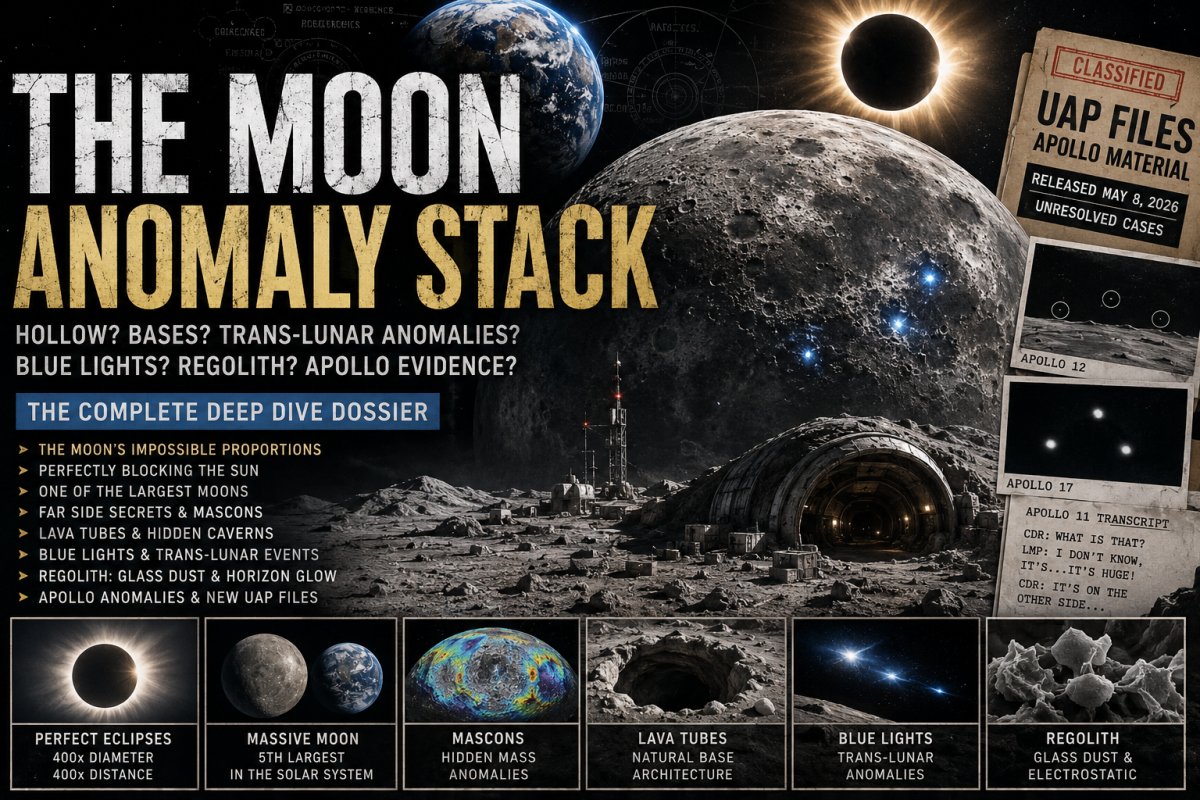
The Moon has been normalized because it is always there, but the actual anomaly stack is hard to ignore: its strange proportion to Earth, its eclipse-perfect relationship with the Sun, its tidal lock, its hidden far side, its seismic ringing, its lava tubes, its charged glass-like regolith, its buried mass anomalies, its reported blue lights and flashes, and now Apollo-related UAP files released through the government’s 2026 disclosure archive. This is not a claim that the Moon is definitely hollow or that an alien base has been proven. It is a deeper Pattern Nexus breakdown of why the Moon should be treated as the closest unresolved object in human history.
The Moon Is Not Just a Rock
The Moon’s proportion, eclipse calibration, far-side concealment, seismic behavior, lava tubes, charged regolith, blue lights, trans-lunar Apollo anomalies, and newly released UAP files do not prove a base. They prove the mainstream frame is too small.
Quick Read
This is not a normal Moon article. I am not writing this like a clean institutional explainer where every anomaly gets buried under a polite sentence and called “interesting.” That kind of writing is part of the problem. The Moon has been normalized because it is always there, but familiar is not the same thing as explained.
The argument here is not that the Moon is definitely hollow, definitely artificial, or definitely an alien base. That is not what the public record proves. The argument is that the Moon is a stacked anomaly platform sitting beside Earth: proportionally huge, eclipse-calibrated from our viewpoint, tidally locked, geologically asymmetric, gravitationally uneven, metal-complicated, seismically strange, full of subsurface void potential, covered in charged glass-like regolith, associated with historical lights and flashes, and now tied to Apollo-era UAP records released through an official unresolved archive.[1][2][3][4]
The Moon appears almost the same size as the Sun during a total eclipse because the Sun is about 400 times larger than the Moon and about 400 times farther away.[8] Mainstream astronomy calls that coincidence. This article treats it as one layer in a larger anomaly stack.
The Moon is the fifth-largest moon in the solar system, yet it orbits a rocky planet instead of a gas giant. NASA also describes it as stabilizing Earth’s wobble, which helps make long-term climate less variable.[7]
The Moon is tidally locked. One hemisphere always faces Earth. The far side is not always dark, but it is naturally hidden from direct Earth observation.[6]
Lunar pits and radar evidence show accessible cave-conduit potential. That does not prove a base, but it proves the Moon has natural underground architecture useful for one.[12]
The Moon does not have to be artificial to be suspicious. The real argument is that the Moon has too many layered anomalies to keep treating it as a dead rock with a children’s textbook explanation. The correct frame is not blind belief. The correct frame is anomaly discipline.
Table of Contents
- Why this article exists now
- Source media and embedded videos
- How to read the Moon anomaly stack
- The geometry problem: proportion, distance, eclipse calibration
- The size problem: one of the biggest moons in the solar system
- The Earth-system problem: tides, axial stability, time, life
- The lock problem: one face, one blind side
- The two-faced Moon: near side versus far side
- The hollow Moon claim and where it came from
- The ringing Moon: seismic anomaly without cartoon conclusions
- The cave Moon: lava tubes, pits, and natural base architecture
- Mascons: gravity anomalies hidden under the surface
- South Pole-Aitken: the far-side buried mass
- The metallic Moon problem
- Regolith: charged glass dust as an active surface layer
- Horizon glow, levitating dust, and blue-light reports
- Lunar swirls and magnetic scars
- Photo anomalies, towers, shards, domes, and pareidolia
- Apollo 11: trans-lunar observations and bright lights
- Apollo 12: lunar horizon image anomalies
- Apollo 17: triangular dots, fragments, flashes, and the last crewed Moon mission
- The 2026 UAP release changed the category
- The far-side base hypothesis, cleaned up
- Cover-up logic: what could be hidden and what probably could not
- What would actually prove engineered presence?
- Pattern Nexus Lens
- Sources and reference trail
1. Why This Article Exists Now
The Moon has always had a fringe file. Hollow Moon. Spaceship Moon. Far-side bases. Lunar towers. Shards. Domes. Blue lights. Apollo cover-ups. Astronauts seeing objects. NASA airbrushing images. Most people either swallow the whole thing or dismiss the whole thing. Both reactions are lazy.
The serious version is harder. It does not begin with “aliens.” It begins with the stack. The Moon’s geometry is unusual. Its relationship to Earth is unusually powerful. Its orbital lock creates a permanent blind side. Its far side is geologically different from the side we see. Its gravity field has hidden mass concentrations. Its largest basin hides a massive density anomaly. Its subsurface may be more metallic than expected. Its regolith is not dirt; it is charged, abrasive, glass-rich impact powder. Its surface and near-surface environment can produce strange light phenomena. Apollo crews reported lights, flashes, particles, fragments, and objects in the Earth-Moon corridor. And now Apollo-related material has been placed into an official UAP release framework.[1][2][3][4][5]
That does not prove the strongest conspiracy claim. But it changes the seriousness of the conversation. When Apollo-era images and transcripts are included in a government archive of unresolved anomalous phenomena, the subject can no longer be treated as nothing but message-board noise. The responsible position is not to declare a Moon base. The responsible position is to build an anomaly map and ask what category each signal belongs to.
This is the Pattern Nexus version of that map. Not mainstream comfort. Not blind fringe. A systems-level read of why the Moon keeps attracting the same question: what exactly is sitting beside Earth?
This article does not claim the Moon is definitely an artificial body. It does not claim the May 2026 UAP release proves non-human intelligence. It argues that the Moon’s anomaly stack is too large to keep writing off as childish, especially now that Apollo-era material is part of an official unresolved release.
2. Source Media and Embedded Videos
The two videos below are included because they were part of the working context for this article and because the public-facing narrative around the Apollo UAP release is now part of the signal environment. They should be treated as reader-view media, not standalone proof. The factual spine of this piece is built on public records, NASA science pages, mission archives, published studies, and the May 2026 UAP release coverage.
Public interpretation matters, but interpretation is not evidence by itself. When a claim matters, it is tied back to a numbered source in the article and source list.
3. How to Read the Moon Anomaly Stack
The Moon discussion breaks down because people flatten all evidence into one bucket. That is the wrong method. A seismic anomaly is not the same thing as a photo anomaly. A lava tube is not the same thing as a base. A UAP release is not the same thing as alien confirmation. A fringe author’s claim is not the same thing as NASA radar data. But none of those categories should be ignored either.
There are five evidence layers here.
Distance, radius, orbital lock, eclipse geometry, lunar formation evidence, near/far-side asymmetry, and Apollo sample data.[6][7][8][9]
Moonquakes, low attenuation, mascons, buried density anomalies, radar signatures, metal-oxide distribution, magnetic swirls, and regolith charging.[10][11][13][14][15][16][19]
Lava tubes, pits, shadowed craters, regolith preservation, radio-quiet far-side zones, and future base logic.[12][17]
The mistake is treating layer five as if it invalidates layers one through four. It does not. A bad conclusion does not erase a real anomaly. The opposite mistake is treating a real anomaly as permission to believe every extreme conclusion. That is also wrong.
The disciplined position is this: the Moon is not proven artificial, but it is absolutely not fully explained at the level most people think it is. The public has been given a simple object. The data shows a layered system.
4. The Geometry Problem: Proportion, Distance, and Eclipse Calibration
The first anomaly is visible without a telescope.
The Moon’s average distance from Earth is about 238,855 miles, or 384,400 kilometers. NASA describes the Moon as having a radius of about 1,080 miles, or 1,740 kilometers, and notes that it is slowly moving away from Earth at roughly an inch per year.[6] That distance is not small in human terms, but in planetary terms the Moon is close enough to dominate Earth’s visual sky and gravitational rhythm.
Then comes the eclipse geometry. NASA’s eclipse page states the simple version: the Sun is about 400 times bigger than the Moon, but also about 400 times farther away, which makes the Sun and Moon appear almost exactly the same size in our sky.[8] During a total solar eclipse, the Moon does not merely pass in front of the Sun. It barely covers the solar disk, revealing the corona around it.[8]
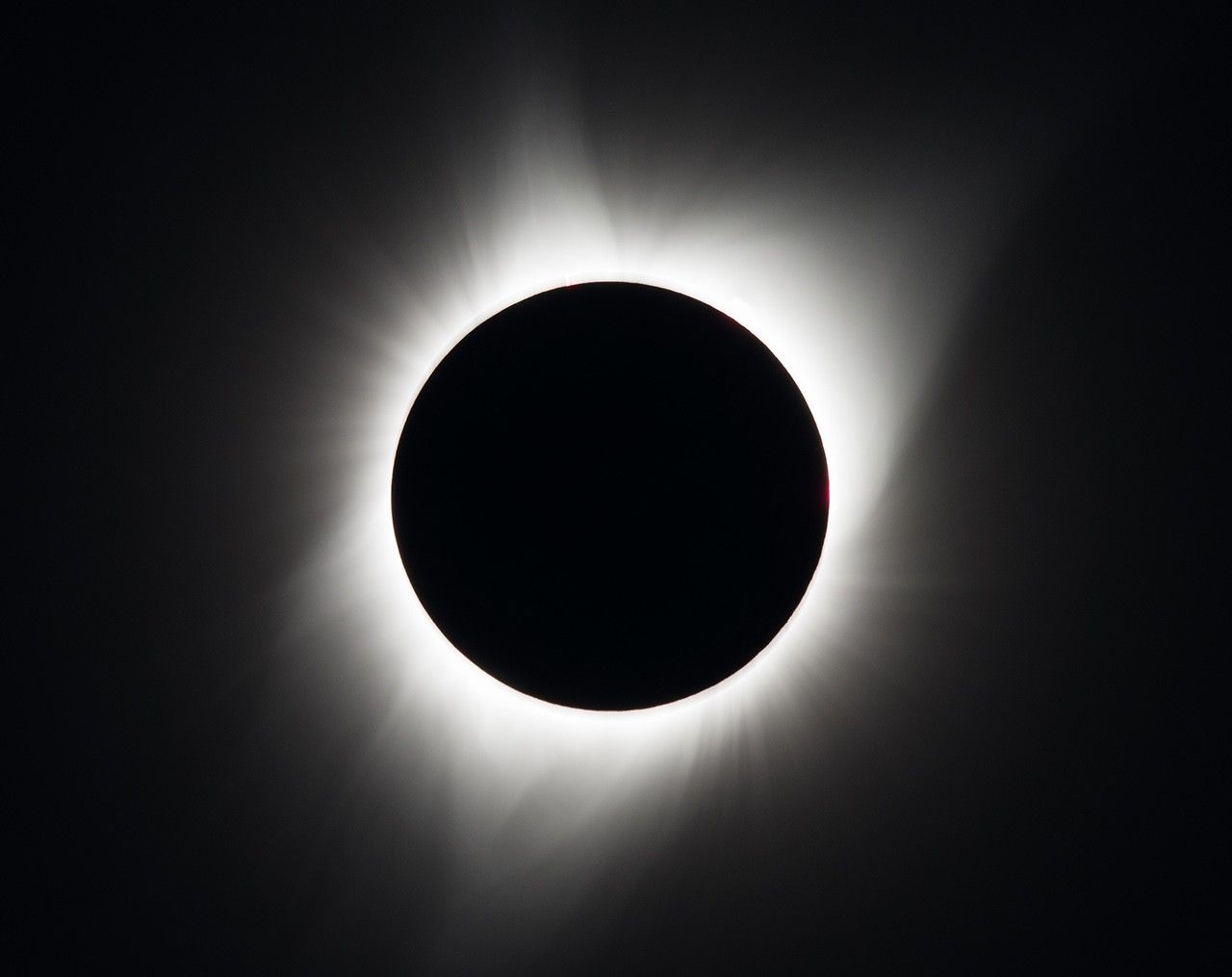
Mainstream astronomy calls this a coincidence. It may be. But calling it coincidence does not make it uninteresting. It makes it more interesting. There is no requirement that a moon fit the parent star’s apparent disk so precisely. Most worlds do not get that view. From Earth, the Moon is not just a satellite. It is an astronomical instrument. It hides the blinding body and reveals the outer atmosphere.
The fringe version jumps from this to design. I am not doing that. The better question is more disciplined: if we found an exoplanet with a large stabilizing moon that appeared from the surface to nearly match the host star’s angular size, would we call that meaningless? No. We would write papers on its habitability implications, climate implications, observer effects, tidal effects, eclipse frequency, and scientific discovery value.
That is the first Pattern Nexus point. The Moon has been domesticated by familiarity. If it were somewhere else, we would immediately call it remarkable.
5. The Size Problem: One of the Biggest Moons in the Solar System
The Moon is not tiny. It is not a background pebble. NASA’s Earth facts page describes the Moon as the fifth-largest moon in the solar system, after Ganymede, Titan, Callisto, and Io.[7] That ranking matters because those four larger moons orbit gas giants. Earth is not a gas giant. Earth is a rocky terrestrial planet with a moon large enough to reshape the entire Earth system.
The Moon’s diameter is roughly 27 percent of Earth’s. That makes the Earth-Moon relationship feel less like a standard planet-with-small-satellite arrangement and more like a paired planetary system, even though Earth is still dominant by mass. In public language, people say “our moon.” In dynamical language, it is a large companion body with a major gravitational and cultural footprint.
NASA says Earth’s Moon likely formed after a large impact billions of years ago, when a large chunk of rock struck the young Earth and debris clumped together to form the Moon.[7] NASA’s Moon formation page adds that Apollo samples strongly support a high-energy impact history: the Moon was molten, had a magma ocean, and shares striking chemical and isotopic similarities with Earth rocks.[9]
That is the mainstream model. It explains a lot. But it also leaves strange edges. NASA itself notes that any viable Moon formation model has to explain where the Moon is now, its orbit and inclination, its low iron content compared with Earth, the chemical similarity between Earth and Moon rocks, and the strange discrepancies between the near side and far side.[9]
That is important. The giant impact model is not a dead-simple solved answer. It is the current best framework for an object that still forces model constraints. When mainstream science says “the Moon formed from a giant impact,” a lot of people hear “there is no mystery.” That is not what the actual science says. The actual science says the giant-impact framework has to explain a complicated set of surviving signatures.
The Moon is not weird because it is the biggest moon. It is weird because it is one of the biggest moons orbiting a rocky planet, and because its size, distance, and visual geometry all matter at once.
6. The Earth-System Problem: Tides, Axial Stability, Time, Life
The Moon is not decoration. It is part of Earth’s operating system.
NASA says the Moon stabilizes Earth’s wobble, which has made Earth’s climate less variable over thousands of years.[7] The Lunar and Planetary Institute summarizes the same broader relationship: the Moon’s gravitational pull is responsible for Earth’s current length of day, stable seasons, and tides.[26]
That means the Moon is not just visually strange. It is functionally important. It affects the ocean. It affects the planet’s rotational evolution. It affects biological timing. It became one of humanity’s first clocks. Calendars, tides, planting cycles, ritual systems, navigation, mythology, and early observational astronomy all formed under the Moon’s recurring control layer.
This matters because the “Moon as object” framing is too small. The Moon is a timing device, gravitational stabilizer, tidal engine, night-sky regulator, eclipse disk, and historical coordinate system. That does not prove design. But if you are analyzing systems, you do not ignore a body that helps regulate the conditions under which complex observers emerged.
The Pattern Nexus read is not mystical. It is structural. The Moon is embedded into the Earth system so deeply that calling it “just a rock” is an analytical failure. A rock does not normally coordinate tides, seasons, calendars, eclipses, myths, navigation, axial stability, and the public imagination across all human history.
7. The Lock Problem: One Face, One Blind Side
The public says “dark side of the Moon.” The technical term is far side. NASA is clear on this: the Moon rotates at the same rate that it revolves around Earth, so the same hemisphere faces Earth all the time. The far side is not always dark. It receives sunlight. The term “dark side” is misleading if it means no sunlight.[6]
But the phrase survives because it points to something real. There is a permanent blind side from Earth’s perspective. Before spacecraft, humans did not directly see it. Even now, the far side retains a different psychological and operational status. It is not hidden from orbiters. It is not magical. But it is naturally shielded from direct Earth line-of-sight.
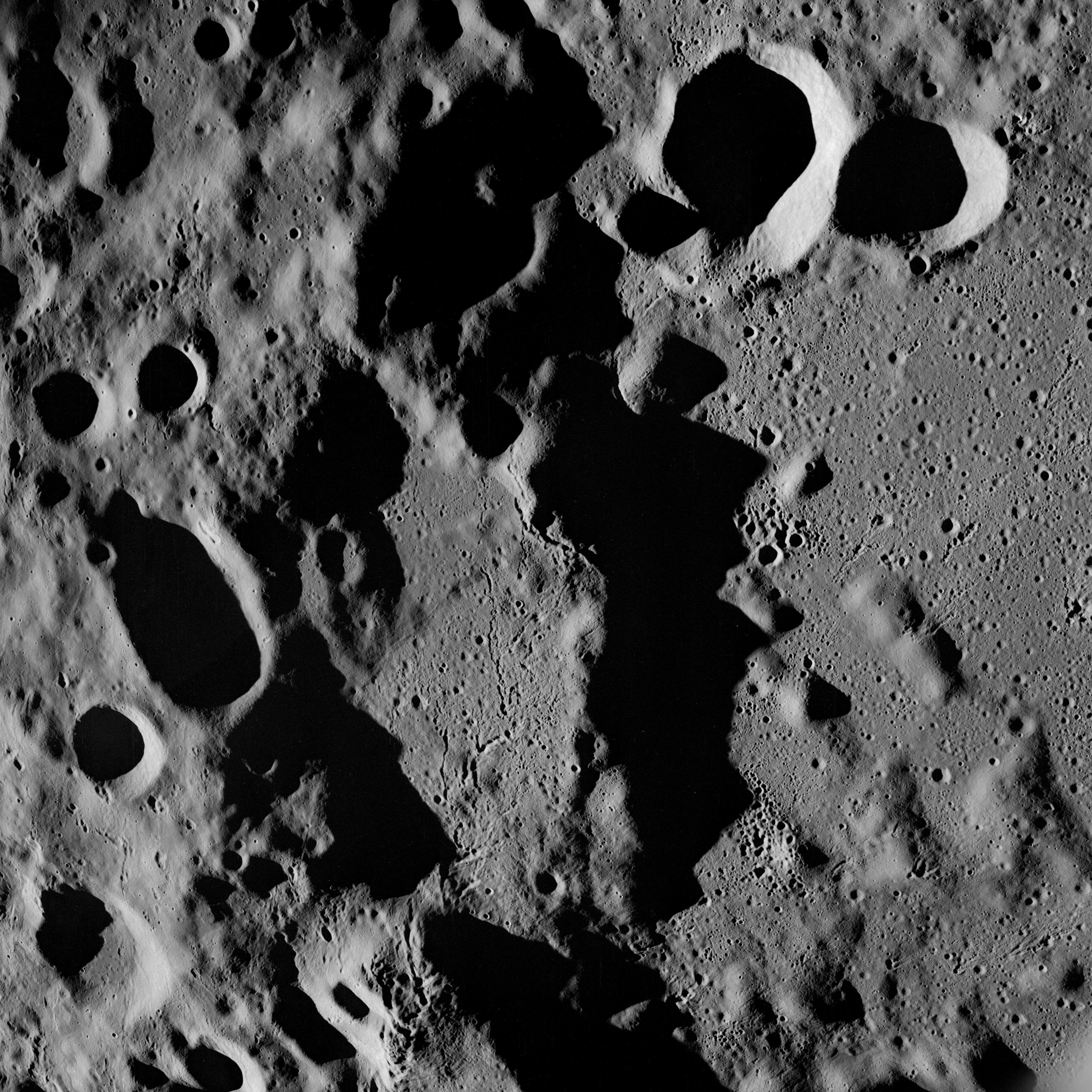
This is where the base hypothesis gets its strength. Not because a base has been proven. Because the concealment logic is obvious.
If something wanted to operate near Earth while reducing direct observation from Earth, the lunar far side is the obvious natural shield. If something wanted radio quiet, the far side is desirable. If something wanted subsurface protection, lava tubes and pits matter. If something wanted thermal stability, underground spaces matter. If something wanted to avoid weathering, the Moon’s airless surface preserves traces for enormous timescales. If something wanted to hide from casual observation, crater walls, shadowed regions, and subsurface voids are better than open plains.
That does not mean there is a base. It means the Moon offers base logic. That is not fringe. Humans already discuss using lunar caves and lava tubes for future habitation because they offer shelter from the surface environment.[12] The only controversial part is whether something else got there first or whether anything has been hidden.
8. The Two-Faced Moon: Near Side Versus Far Side
The Moon is not symmetrical in the simple way people imagine. NASA’s Moon formation page states that strange discrepancies exist between the near and far sides. These differences include crustal thickness, geological makeup, radioactive element concentration, and volcanic history.[9] NASA gives one striking contrast: about 43 miles of crust on the near side versus about 93 miles on the far side.[9]
The near side is dominated by the familiar dark maria, the basaltic plains people see as the “face” of the Moon. The far side is more heavily cratered, has fewer maria, and carries a thicker crustal signature. This two-faced structure is not a fringe claim. It is central to lunar science.
For the anomaly stack, the near/far-side difference matters for two reasons.
First, it means the hidden side is not just visually hidden. It is physically different. If the far side were merely the same terrain turned away from Earth, the concealment argument would be weaker. But the far side has a different crustal and impact history. That makes it scientifically distinct.
Second, the far side hosts the South Pole-Aitken basin, one of the biggest and most important impact structures in the solar system. That basin is tied to a massive buried density anomaly and cannot be seen from Earth because it sits on the far side.[14]
So the far side is not just a blind side. It is a different side. Any serious lunar anomaly article has to make that distinction.
9. The Hollow Moon Claim and Where It Came From
The hollow-Moon idea did not come from nowhere. It grew out of a combination of real seismic language, density comparisons, eclipse geometry, lunar formation puzzles, and speculative writing. The problem is that the real observations were often pushed farther than the evidence allowed.
The basic fringe claim says the Moon is hollow, artificial, or a disguised spacecraft. A closely related version is the “Spaceship Moon” hypothesis. One of the most famous origin points was a 1970 Soviet popular-press article by Mikhail Vasin and Alexander Shcherbakov asking whether the Moon was the creation of alien intelligence.[24] Later authors expanded the idea into claims of machinery, inhabited interiors, artificial shells, and NASA cover-ups.[24]
There are also later lunar-structure claims associated with figures like Richard Hoagland, who argued for artificial glass structures or ruins on the Moon. Smithsonian’s discussion of Moon-landing conspiracy culture notes Hoagland’s long-running claim that Apollo discovered artificial glass structures that were allegedly hidden from the public.[25]
Those claims are not proven. They are part of the fringe file. But a serious article should not pretend that the fringe file appeared out of thin air. It attached itself to real unresolved or unusual features: the Moon’s low density compared with Earth, its small core, seismic ringing language, eclipse geometry, near/far-side asymmetry, and decades of photo anomalies.
The disciplined question is not “which fringe author was right?” The disciplined question is: what real anomalies were strong enough that the public kept building extreme theories around them?
The literal claim that the Moon is a hollow artificial shell is not supported by current lunar interior models. But the fact that this claim is overstated does not erase the real record of lunar voids, caves, seismic oddity, mass anomalies, and metal-distribution questions.
10. The Ringing Moon: Seismic Anomaly Without Cartoon Conclusions
The phrase “the Moon rang like a bell” is usually where people either get excited or shut down. Both reactions are too simple.
NASA’s current Moonquake page says Apollo astronauts placed seismometers on the lunar surface and revealed that the Moon experiences moonquakes. Some shallow moonquakes originate around 20 to 30 kilometers deep, can register up to about 5.5, and can last more than ten minutes.[10] NASA also explains that deep moonquakes can be tidal events produced by Earth’s gravitational tug on the Moon’s internal structures.[10]
The stronger “ringing” language appears in NASA technical literature. A NASA-hosted Apollo-era lunar science summary says the Apollo 12 seismometer showed that the Moon’s upper crust “rings like a bell” when hit, with unusual low attenuation and intense wave scattering. The paper’s explanation is not a hollow artificial shell. It points toward a dry, pervasively fractured crust with blocks in firm contact.[11]
That is the crucial distinction. The Moon’s seismic behavior is real. The hollow-Moon interpretation is not required. A dry, cold, fractured, low-damping body can reverberate differently from Earth because Earth is wet, active, tectonic, sedimented, and internally dynamic in a different way.
But the mainstream explanation does not make the phenomenon boring. It makes it structurally important. A body with low attenuation, intense scattering, fractures, crustal blocks, moonquakes, tidal stressing, thermal quakes, impact quakes, and cave/void architecture is not a simple inert object. It is a resonant body with a complicated interior and crustal system.
The problem is that mainstream debunking often behaves as if explaining a mechanism destroys the anomaly. It does not. It only relocates the anomaly into lunar structure. The Moon does not have to be hollow to be seismically strange.
11. The Cave Moon: Lava Tubes, Pits, and Natural Base Architecture
This is where the base conversation becomes physically serious.
In 2024, a Nature Astronomy paper analyzed radar images of the Mare Tranquillitatis pit using Mini-RF data from NASA’s Lunar Reconnaissance Orbiter. The authors reported that part of the radar reflection could be attributed to a subsurface cave conduit tens of meters long, suggesting the pit leads to an accessible cave beneath the Moon’s surface.[12] The abstract also states the discovery makes the site promising for a lunar base because it offers shelter from the harsh surface environment.[12]
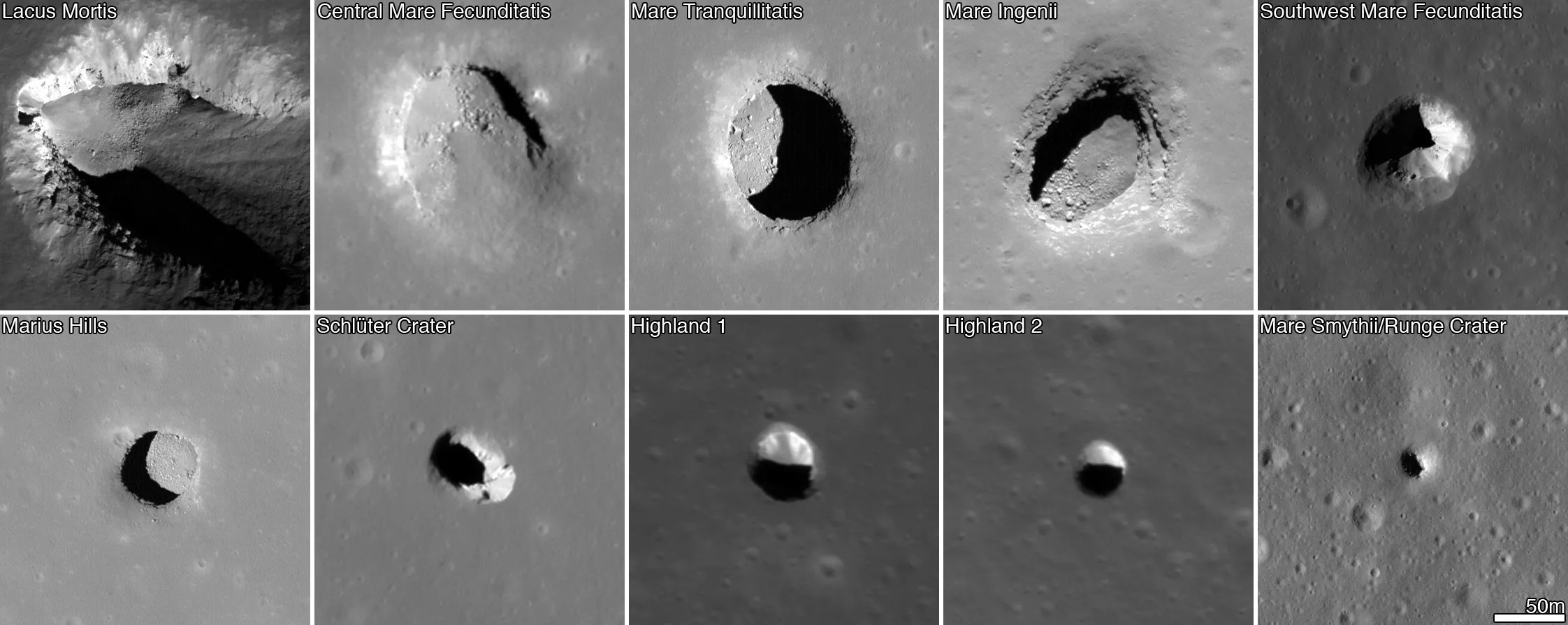
That is not fringe. That is the practical logic of lunar settlement. A surface base has to fight radiation, micrometeorites, thermal extremes, dust, and visibility. A cave or lava tube gives natural shielding. It is a bunker, tunnel, thermal buffer, radiation shield, and concealed infrastructure corridor already carved by ancient volcanic processes.
Now put that beside the far-side question. A concealed installation would not sit on an exposed plain waving at orbiters. It would use natural structure. It would use crater walls, skylights, lava tubes, shadowed slopes, and subsurface spaces. It would minimize thermal signature. It would reduce reflective geometry. It would avoid obvious surface disturbance.
This is why the “base” question should be cleaned up. The sloppy theory imagines a giant alien city sitting visibly on the far side. The serious search model asks whether caves, lava tubes, pits, or shadowed subsurface zones have signatures that deviate from natural geology.
The existence of lunar caves does not prove non-human presence. But it proves the Moon has the kind of architecture a base would use. That alone keeps the hypothesis alive as a search model.
12. Mascons: Gravity Anomalies Hidden Under the Surface
The Moon’s surface is only one layer of the story. Some of the most important anomalies are invisible to ordinary cameras.
NASA’s JPL says the GRAIL mission studied the Moon’s internal structure and composition in unprecedented detail and pinpointed large, dense regions called mascons, or mass concentrations. These regions have strong gravitational pull, lurk beneath the lunar surface, and cannot be seen by normal optical cameras.[13]
That last sentence matters. Optical imagery is not enough. A person scrolling lunar photographs cannot rule out every anomaly, because major lunar structure is gravitational, radar-based, compositional, thermal, and subsurface. Mascons were not “seen” in the ordinary sense. They were detected through gravitational behavior.
NASA/JPL’s explanation is that mascons were generated when large asteroids or comets impacted the ancient Moon while its interior was hotter. The impacts created density patterns through excavation, collapse, melt, and cooling.[13] That is a strong explanation. But it also means the Moon contains buried density architecture produced by catastrophic ancient events.
From an anomaly perspective, this matters because it establishes a method: the Moon has hidden structure that requires indirect reading. If you only look for surface buildings, you are using the wrong instrument. The Moon’s most important mysteries may not be visible structures. They may be hidden density, subsurface voids, thermal patterns, radar echoes, chemical signatures, and magnetic anomalies.
13. South Pole-Aitken: The Far-Side Buried Mass
The South Pole-Aitken basin is one of the most important places on the Moon and one of the strongest examples of why the “dead rock” frame fails.
Baylor University reported in 2019 that a mysterious large mass of material had been detected beneath the Moon’s South Pole-Aitken basin, the largest crater in the solar system. The mass may contain metal from the asteroid that crashed into the Moon and formed the basin.[14] Lead author Peter B. James compared the detected mass to burying a pile of metal five times larger than Hawaii’s Big Island underground.[14]
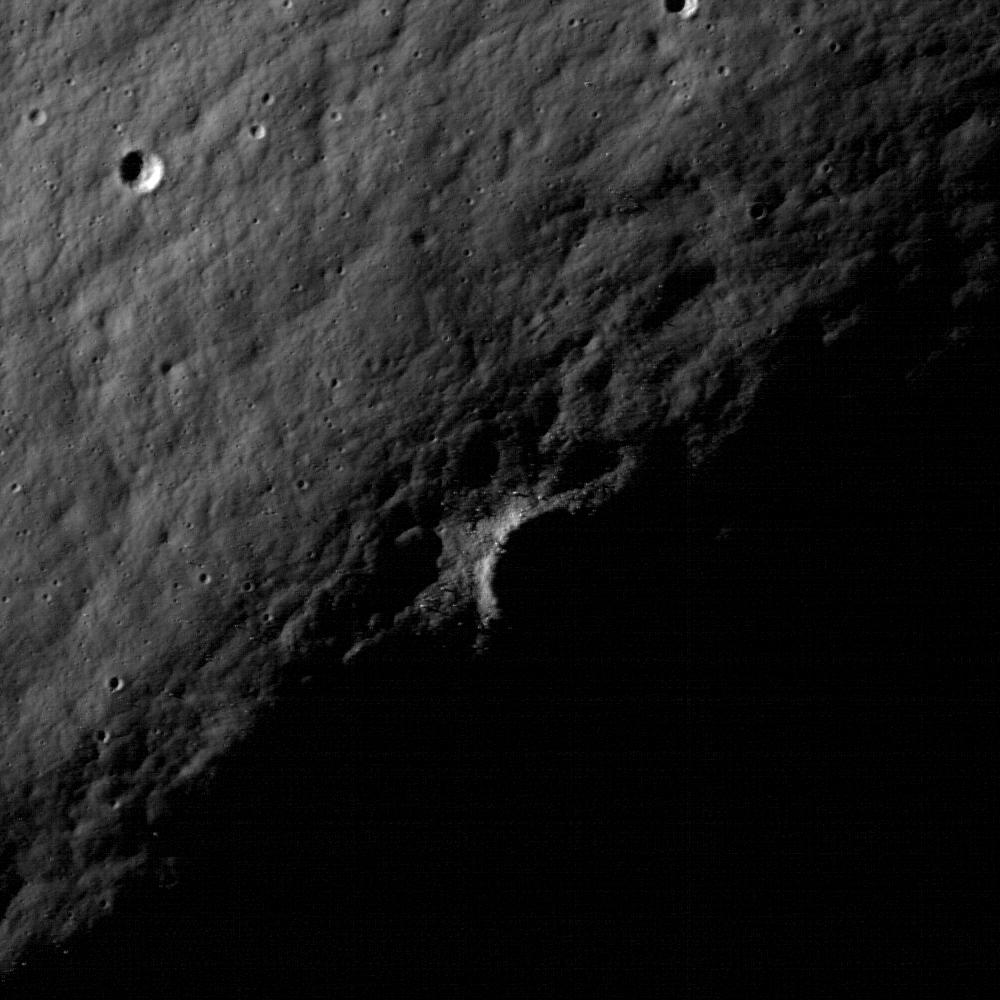
The crater is roughly 2,000 kilometers wide and several miles deep, and Baylor notes that it cannot be seen from Earth because it is on the far side of the Moon.[14] Researchers combined GRAIL gravity data with Lunar Reconnaissance Orbiter topography data to identify the unexpectedly large mass hundreds of miles beneath the basin.[14] Possible explanations include dispersed iron-nickel asteroid core material or dense oxides associated with lunar magma-ocean solidification.[14]
That is mainstream science. It is also genuinely strange. A buried mass under the far side’s largest basin is exactly the kind of fact that, if it were found on another world, would draw intense attention. The explanation may be natural. But natural does not mean trivial. A giant buried mass under a far-side impact scar is a major structural signal.
This is also why the far-side base conversation is not just fantasy geography. The far side contains major, poorly accessible, scientifically unusual terrain. If you are looking for hidden lunar structure, South Pole-Aitken is one of the places where gravity, impact history, deep crust/mantle exposure, and far-side concealment all overlap.
14. The Metallic Moon Problem
Another real anomaly category is metal distribution.
NASA reported in 2020 that Mini-RF radar data from the Lunar Reconnaissance Orbiter suggested the Moon’s subsurface might be richer in metals like iron and titanium than researchers previously thought.[15] The finding came from radar measurements of crater floors. Researchers noticed the dielectric constant of material on crater floors increased with crater size, then reasoned that larger impacts excavated deeper material richer in iron and titanium oxides.[15]
NASA’s article says that for larger craters, increased dielectric material was also richer in metals, suggesting that more iron and titanium oxides were excavated from roughly 0.5 to 2 kilometers deep than from shallower layers.[15] NASA also explicitly says the result raises questions about previous Moon formation hypotheses.[15]
This is where the fringe and mainstream tracks nearly touch without becoming the same thing. The fringe says “metal shell.” NASA says “unexpected metal-rich subsurface distribution.” Those are not equivalent claims. But they are not unrelated either. Both point toward the same broad issue: the Moon’s subsurface is not compositionally simple.
The correct interpretation is not “therefore artificial hull.” The correct interpretation is: the Moon contains metal-distribution questions that still matter for formation models, impact history, resource mapping, and subsurface interpretation. If someone wants to investigate the hollow/artificial claims seriously, they should stop staring at blurry towers and start asking where radar, dielectric, gravity, and composition datasets overlap.
15. Regolith: Charged Glass Dust as an Active Surface Layer
Lunar regolith is one of the most important and underappreciated parts of the whole anomaly file. Calling it “moon dirt” is misleading.
NASA says researchers study lunar regolith because abrasive dust grains interact with astronauts, spacesuits, and equipment. NASA also states that the Moon is highly charged by solar wind and ultraviolet light from the Sun, causing regolith grains to be attracted to explorers and equipment in a static-like way.[16] NASA’s ERIE experiment was designed to study tribocharging, or friction-induced charges, in microgravity.[16]
ESA’s lunar dust summary is even more direct. Apollo astronauts returned with dust on their spacesuits that made their throats sore and eyes water. Harrison Schmitt described it as “lunar hay fever.” ESA describes lunar dust as sharp, abrasive, glass-like, electrostatically charged, and potentially harmful.[17] ESA also notes that without wind and water, lunar dust does not become rounded like Earth dust; it stays sharp and spiky.[17]
NASA technical work on lunar agglutinates adds another layer. Agglutinates are regolith grains fused together in a glassy matrix of shock melt produced by micrometeorite impacts, and their formation can generate tiny metallic iron particles called nanophase Fe.[27] That means the lunar surface is a violent processing layer: solar wind, micrometeorites, radiation, impact melt, electrostatic charge, glass formation, and optical alteration all happening over deep time.
This matters for several reasons.
First, the regolith preserves. With no rain, no wind, no vegetation, and no normal erosion, tracks and disturbances can survive for a very long time. That is why Apollo tracks and artifacts are still visible to orbiters.[21][22]
Second, the regolith distorts. Hard shadows, reflective grains, glassy particles, static movement, and low-angle sunlight can create visual artifacts that look strange in photos.
Third, the regolith participates. It does not just sit there. It charges, clings, levitates, scatters light, damages equipment, and changes optical properties over time.
That means any lunar anomaly claim has to pass through the regolith filter. Is the object really an object? Is it dust? Is it shadow? Is it glassy reflectance? Is it electrostatic lofting? Is it a track? Is it a plume mark? Is it a natural regolith flow? Is it an image artifact? Is it a surface process?
The Moon’s dust is not a minor detail. It is the active skin of the Moon.
16. Horizon Glow, Levitating Dust, and Blue-Light Reports
The Moon has a light problem.
Some lunar lights are almost certainly ordinary: meteoroid impacts, optical effects, cosmic rays, reflections, spacecraft debris, sunlight geometry, or camera artifacts. But the category itself is real enough to deserve discipline.
NASA’s technical report archive includes Surveyor observations of lunar horizon glow. One NTRS summary states that electrically charged grains could be levitated into a dust cloud by intense electrostatic fields across sunlight-shadow boundaries, and that electrostatic transport was probably the dominant local transport mechanism of lunar surface fines.[18] Another Surveyor-related NTRS entry says Surveyor 7 photographed a bright glow along the western lunar horizon one hour after local sunset, interpreted as forward scattering of sunlight by dust grains above the local horizon.[18]
This is crucial. A glow on the lunar horizon is not automatically a craft. It can be dust. But the dust itself is anomalous behavior by Earth standards. No wind. No air. Yet charged particles can move, lift, scatter light, and create luminous effects near the terminator.
That helps explain why historical transient lunar phenomena are so hard to categorize. Reports of bluish, reddish, white, or brief luminous events may include natural effects: impact flashes, electrostatic dust, outgassing-like events, telescope artifacts, seeing conditions, and observational errors. But the existence of natural mechanisms does not mean every report is false. It means the Moon has a real luminous environment that needs sorting.
The “blue lights” thread belongs here. Blue-white flashes, glow reports, and bright light observations should not be swallowed whole as proof of a base. They should be sorted into mechanisms: impact, dust, optical, charged particle, spacecraft, artificial, unknown. The mistake is skipping the sorting step.
17. Lunar Swirls and Magnetic Scars
Lunar swirls look artificial to the human brain. They form bright, curling, looping patterns on the surface. Reiner Gamma is the famous example.

NASA says Reiner Gamma is a bright patch in Oceanus Procellarum and that lunar swirls have long defied easy explanation. Recent modeling and spacecraft data point toward crustal magnetism: localized magnetic anomalies act like a magnetic sunscreen, shielding parts of the surface from solar wind weathering and creating brighter patterns.[19] NASA Goddard’s visualization page similarly says ARTEMIS data suggests lunar swirls could result from solar-wind interactions with isolated magnetic pockets in the lunar crust.[20]
The mainstream explanation is strong enough to avoid fantasy. But it still leaves the Moon with localized magnetic scars, optical patterns, and crustal anomalies in a body that does not have a global magnetic field like Earth.
This is why the Moon anomaly stack is not one thing. It is geometry, gravity, dust, magnetism, seismic response, impact history, and official UAP records layered on top of each other. A single swirl does not mean artificial design. But a Moon with swirls, mascons, buried masses, lava tubes, metallic gradients, far-side asymmetry, and Apollo UAP material is not analytically boring.
18. Photo Anomalies, Towers, Shards, Domes, and Pareidolia
This is where most Moon conspiracy content lives, and it is also where the weakest material tends to pile up.
The classic claims include lunar towers, domes, bridges, the “Shard,” the “Tower,” the Blair Cuspids, glass ruins, rectangular structures, airbrushed craters, grid-like terrain, and artificial-looking objects along crater rims. Some of these claims come from old Lunar Orbiter imagery. Some come from Apollo photographs. Some come from modern image browsing and zoomed screenshots. Some come from older fringe authors who believed Apollo imagery revealed artificial glass structures or ancient lunar ruins.[25]
The problem is that lunar photography is brutal. Low sun angles stretch shadows into architecture. Crater rims create geometric silhouettes. Old film, scanning, compression, sharpening, transmission noise, and contrast manipulation can create false structures. The human brain is also built to find pattern. It sees faces in clouds, animals in rocks, and buildings in shadow fields. That does not mean every anomaly is false, but it does mean every image anomaly starts weak until it survives multiple tests.
The correct question is not “does this look artificial?” That question is too easy. The correct questions are harder: does the feature appear in multiple images? Does it appear under different sun angles? Does it cast a consistent shadow? Does topography support it? Does radar see anything? Does thermal data show anything? Does another spacecraft see it? Does the object persist after returning to raw mission data instead of a compressed reposted image?
Most famous Moon photo anomalies fail that standard. That has to be said. But the conclusion should not be “therefore nothing matters.” The conclusion should be that optical anomalies are the weakest layer unless they connect with radar, gravity, spectral, thermal, or mission-record data.
A lunar photograph can start an investigation. It cannot finish one. The Moon has too many optical traps to treat a single strange-looking frame as proof.
19. Apollo 11: Trans-Lunar Observations and Bright Lights
Apollo 11 is usually discussed as a landing story. But in the anomaly file, the important material is also the transit: the Earth-Moon corridor, the objects seen en route, the lights, the flashes, and the difficulty of separating spacecraft debris, optics, particles, and unknowns.
AP reported in the May 2026 UAP release coverage that Buzz Aldrin recalled a “fairly bright light source” aboard Apollo 11 and that the 1969 debriefing included unusual observations, such as a sizeable object close to the Moon and a bright light the crew thought could be a laser.[3] CBS also reported that Aldrin described seeing something with sizeable dimension, used a monocular on it, and later described small flashes inside the cabin while trying to sleep.[4]
The point is not that Apollo 11 proves alien craft. It does not. Apollo spacecraft produced debris, reflections, particles, optical artifacts, and mission hardware separation events. The crew themselves often tried to identify what they were seeing. The serious point is that the Apollo record includes trans-lunar visual anomalies in official debriefing material.
That matters because the Earth-Moon corridor is not empty in the way the public imagines. It is a harsh environment of sunlight, darkness, particles, optics, spacecraft surfaces, ejected materials, cosmic rays, and high-contrast observation conditions. Some things will be explainable. Some may remain ambiguous. The release does not end the debate; it forces better classification.
20. Apollo 12: Lunar Horizon Image Anomalies
Apollo 12 matters for two different reasons.
First, Apollo 12 is tied to the seismic story. Apollo-era geophysical work helped establish the “rings like a bell” language associated with the Moon’s upper crust and its unusual seismic behavior.[11]
Second, the May 2026 UAP release brought Apollo 12 imagery back into public attention. Reuters reported that the files include grainy photos of “unidentified phenomena” taken from the Moon’s surface by the 1969 Apollo 12 lunar mission.[2] CBS described Apollo-related materials in the release and identified Apollo 12 image material as part of the broader file.[4]
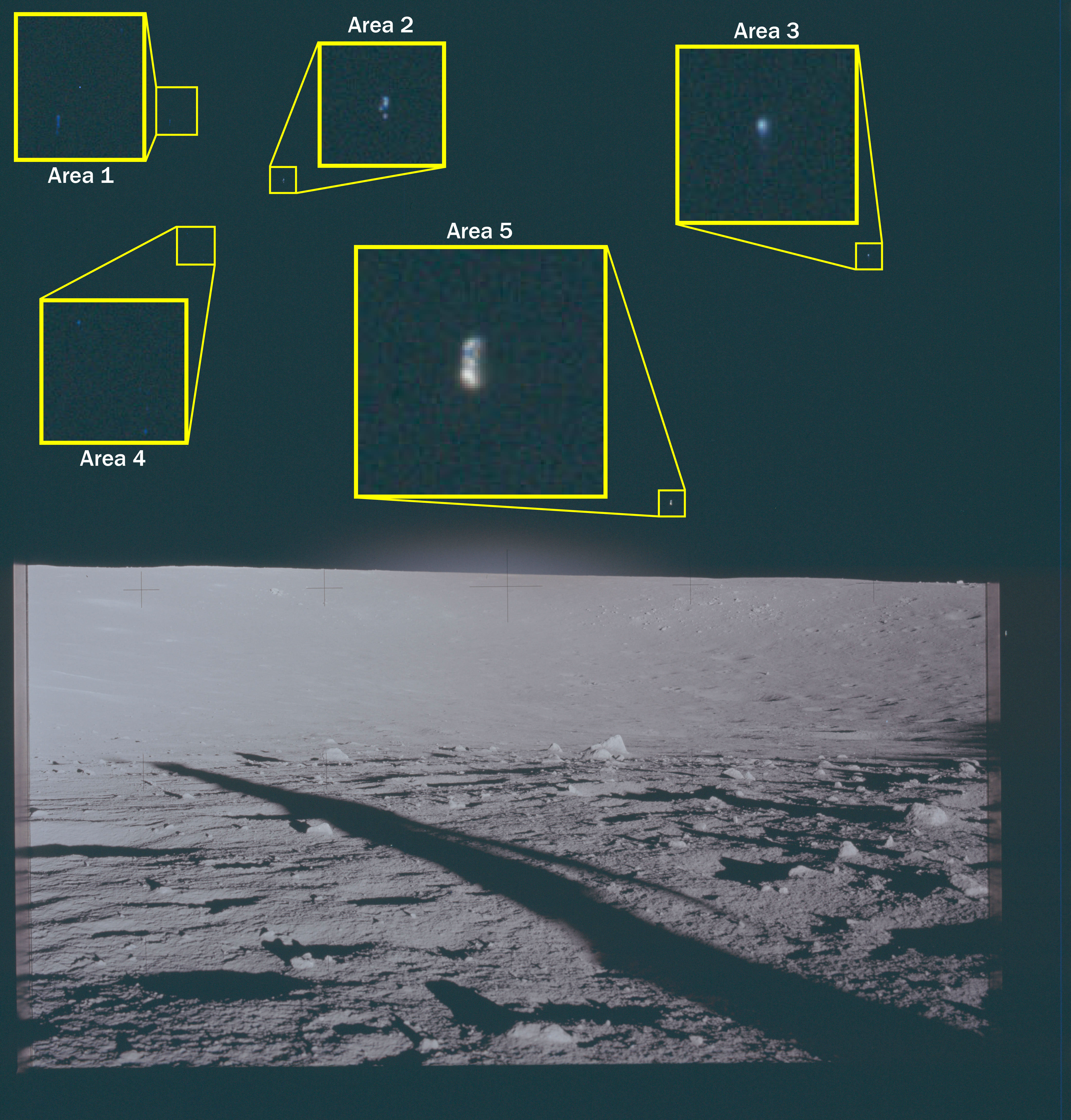
That is the correct way to frame Apollo 12. Not proof. Category change. A lunar horizon image with dots or lights can have many explanations: film artifacts, reflections, dust, particles, development flaws, cosmic ray hits, distant hardware, or actual objects. The only reason it matters more now is that it is not just floating around as rumor. It is attached to the official UAP release.
The serious analysis should ask: are the highlighted points consistent across frames? Do they align with film artifacts? Are they near the horizon? Do they cast any signature? Are there mission-timeline events that could explain them? Are similar anomalies present in adjacent images? What do original frame scans show? What does magnification do? Were these visible to crew or only in film?
That is how the article stays serious while still going deep.
21. Apollo 17: Triangular Dots, Fragments, Flashes, and the Last Crewed Moon Mission
Apollo 17 is the strongest Apollo section because it connects multiple signals at once: the final crewed Moon mission, trained geologist Harrison Schmitt, lunar surface observations, bright particles, cabin/window phenomena, and the newly released triangular-dot image.
CBS reported that the May 2026 UAP files include a NASA photograph from Apollo 17 showing three dots in a triangular formation in the lower-right quadrant of the lunar sky, visible upon magnification. The Pentagon caption reportedly says there is no consensus about the anomaly, while a preliminary analysis indicated it could be a physical object.[4] AP reported the same basic point: an Apollo 17 NASA photograph shows three dots in triangular formation, and the Pentagon caption says there is no consensus about the nature of the anomaly.[3]
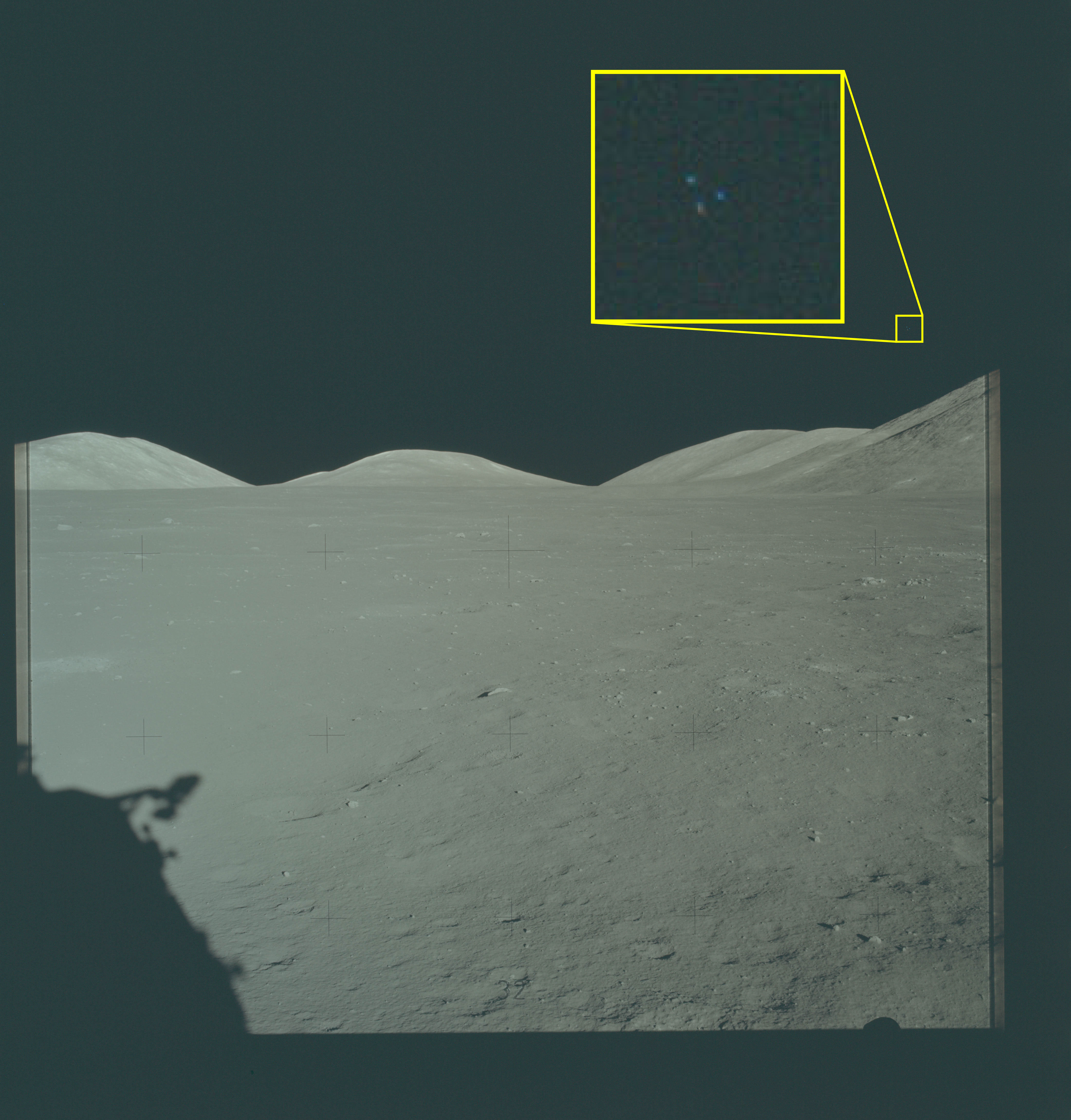
CBS also reported that Apollo 17 crew members described bright tumbling sparks and jagged fragments. Ronald Evans described bright particles or fragments drifting by as the spacecraft maneuvered; Harrison Schmitt described bright objects near a window and compared the view to the Fourth of July; and Eugene Cernan reportedly described flashing, rotating phenomena that he assessed as corresponding to physical objects rather than purely optical effects.[4]
Again, this does not prove non-human technology. Spacecraft produce particles. Maneuvers can shed debris. Ice crystals, insulation fragments, window contamination, reflected sunlight, and optical effects can all generate strange visuals. But the crew observations are still part of the anomaly file. The correct question is: which observations were ordinary spacecraft debris, which were lighting effects, which were physiological flashes, which were impact events, and which remain unresolved after review?
What changed in 2026 is not the existence of Apollo oddities. Researchers and enthusiasts have discussed them for decades. What changed is category. These records are now being presented as part of a new public UAP archive. That forces the conversation out of the old binary: either “aliens” or “nothing.” The better category is unresolved lunar/trans-lunar observation requiring structured analysis.
22. The 2026 UAP Release Changed the Category
The Department of War’s UAP archive states that the materials are unresolved cases, meaning the government is unable to make a definitive determination on the nature of the observed phenomena. The archive says this can occur for many reasons, including insufficient data, and welcomes private-sector analysis.[1] Release 01 was cleared for release on May 8, 2026.[1]
Reuters reported that the release included roughly 160 files, including Apollo mission photos and transcripts, and that more releases are expected.[2] Reuters also reported that the batch contained no conclusive evidence of alien technology or extraterrestrial life.[2] AP likewise emphasized caution, noting that the files are unresolved but that a 2024 Pentagon report found no evidence the U.S. government had confirmed alien technology.[3] Wired reported that the release included Apollo program material, Apollo crew accounts, a light flash on the lunar surface during Apollo 17, and unidentified lights in an Apollo 17 picture.[5]
That is the correct balance. The release does not say “aliens.” It does not say “Moon base.” It does not say “NASA lied about everything.” But it does say, effectively, that certain records remain unresolved and are now public enough for outside analysis.
For decades, lunar anomaly claims lived in a contaminated zone: part archival record, part blurry internet mythology, part conspiracy circuit. The May 2026 release does not validate every claim. It validates the need to examine the category seriously.
This is where mainstream writing often fails. It rushes to say “no proof of aliens,” which is true but incomplete. The more important analytical point is that the public is being handed unresolved Apollo-linked material during a broader UAP disclosure push. That matters whether or not the final explanation is exotic.
23. The Far-Side Base Hypothesis, Cleaned Up
The sloppy version says there is an alien city on the dark side of the Moon. The serious version says something different.
If an advanced actor wanted to place a monitoring station, archive, relay, observatory, shelter, or concealed installation near Earth, the Moon is the obvious platform. It is stable relative to Earth. It has a far side shielded from direct Earth view. It has caves and lava tubes. It has polar cold traps and permanently shadowed regions. It has regolith that preserves disturbance but also complicates interpretation. It has gravity anomalies, buried mass concentrations, and metallic distribution questions. It has no weather to erase long-term traces. It has natural terrain shielding. It has scientific and strategic value.
That does not mean a base exists. It means the base hypothesis should be evaluated as a search model, not a meme.
A real concealed installation would likely not be visually obvious. It would probably use natural cover: lava tube entrances, crater-wall shadows, skylights, boulder fields, collapsed pits, or buried modules. It would avoid obvious heat. It would minimize reflective geometry. It would not need to be huge. It could be old, inactive, automated, partially buried, or designed to look like terrain. The strongest possible version of the theory is not a visible city. It is a low-signature system integrated into lunar geology.
The weak version relies on a single photo. The strong version asks for cross-domain signatures: optical repeatability, thermal anomaly, radar regularity, unusual spectral materials, radio emissions, surface disturbance, gravitational inconsistency, or independent confirmation from multiple agencies.
That is where the debate should live.
24. Cover-Up Logic: What Could Be Hidden and What Probably Could Not
The cover-up question has to be scaled.
Could a small object be missed on the Moon? Yes. The Moon is huge. Even high-resolution imaging does not mean every small object, cave interior, shadowed region, and buried space is perfectly characterized.
Could an underground object or installation avoid normal optical detection? Yes. Optical cameras cannot see deep inside lava tubes unless there is a visible entrance and favorable geometry. Radar, thermal mapping, gravity, and in-situ missions would matter more.
Could a classified payload be under-described or miscategorized? Possibly. Human governments classify things. Space programs involve military contractors, dual-use technology, sensors, radar, communications, and national security interests.
Could a giant active city on the far side be hidden from every orbiter, every independent space agency, every radar dataset, every thermal dataset, every mission contractor, every analyst, and every international mission? That is much harder to believe. A large active base should leave signatures. It should have thermal behavior, surface changes, communications, landing/launch disturbances, dust movement, reflective infrastructure, or repeated anomalies in independent datasets.
So the scale matters. Small, buried, old, inactive, or deliberately camouflaged is a different claim than giant visible alien civilization. The first category cannot be dismissed casually. The second category requires extraordinary evidence and does not have it publicly.
Small payloads, experimental hardware, buried objects, cave interiors, old/inactive structures, or undisclosed mission details.
Large active bases, open surface cities, constant operations, heavy infrastructure, regular landings, obvious power systems, and repeatable emissions.
Subsurface radar anomalies, cave-like voids, metallic concentration zones, thermal irregularities, or old terrain disturbances that have not been physically inspected.
25. What Would Actually Prove Engineered Presence?
A blurry image is not enough. A strange dot is not enough. A glowing point is not enough. A transcript phrase is not enough. A crater that looks like a dome is not enough. A shadow that looks like a tower is not enough. This subject needs a higher standard, not a lower one.
The proof stack would look like this:
The same object visible in multiple frames, from multiple missions, under different sun angles, with consistent shadow behavior.
Heat behavior inconsistent with rock, regolith, sunlight, shadow, or normal cooling patterns.
Subsurface shapes too regular, angular, segmented, or material-distinct to fit cave collapse, lava tubes, or impact structure.
Processed metals, alloys, ceramics, polymers, engineered glass, or material combinations not explained by known lunar geology.
Fixed emissions from a lunar location, especially from the far side or subsurface, not attributable to known spacecraft or natural plasma behavior.
Tracks, plume marks, excavation lines, landing pads, repeated dust disturbance, or changes between dated images.
Mass anomalies too regular or localized to fit impact basins, mantle uplift, or known density structures.
A rover, lander, astronaut, sample return, or independent mission physically inspecting the anomaly.
That is the evidentiary line. Anything below that is signal, suspicion, or lore. Anything above that becomes a real disclosure event.
The Moon should be studied with that standard. Not laughed away. Not worshipped as a spaceship. Studied.
26. Pattern Nexus Lens
The Moon is the closest unexplained object in human history.
That sounds extreme only because we have been trained to confuse familiarity with understanding. We see the Moon every month, so we think we know it. But the data does not support the simple version.
The Moon is proportionally huge beside Earth. It is close enough to shape tides and planetary stability. It nearly matches the Sun’s apparent size during total eclipses. It is tidally locked, giving Earth a permanent facing hemisphere and a permanent far side. Its far side is geologically different. Its crust is lopsided. Its gravity field is uneven. Mascons sit beneath major basins. South Pole-Aitken hides a massive buried density anomaly. Radar suggests the subsurface may be richer in iron and titanium oxides than expected. Lunar caves and lava tubes offer natural base architecture. Its regolith is charged, abrasive, glass-like, and active. Horizon glow and dust levitation show the surface can produce strange light behavior. Lunar swirls show magnetic scars in a body without a global Earth-like field. Apollo crews reported lights, fragments, flashes, and objects in the Earth-Moon corridor. And now Apollo-related images and transcripts are inside a May 2026 UAP release archive.
That does not prove the Moon is artificial.
It does not prove a base.
It does not prove non-human intelligence.
But it absolutely proves the mainstream “dead rock” frame is too small.
If we discovered this same object around another planet, we would not treat it like scenery. We would treat it like a system: geometry, orbit, tides, surface, subsurface, light behavior, gravity, magnetism, cave structure, dust, artifacts, and anomalous observations all tied together.
That is the correct frame. The Moon is not a claim. It is a file. And the file is not closed.
Sources and Reference Trail
[1] Department of War UAP Archive, Presidential Unsealing and Reporting System for UAP Encounters: https://www.war.gov/ufo/
[2] Reuters, “Trump releases government UFO files, more expected,” May 8, 2026: https://www.reuters.com/world/trump-releases-previously-classified-ufo-files-2026-05-08/
[3] Associated Press, “Bright lights and hot orbs: UFO files shed light on sightings but leave interpretation to the public,” May 8, 2026: https://apnews.com/article/trump-ufos-uap-aliens-pentagon-records-investigation-3e658d2cf3742465127c0049c872240a
[4] CBS News, “UFO files reveal Apollo 17 crew saw mysterious objects, lights during 1972 mission,” May 8, 2026: https://www.cbsnews.com/news/ufo-files-apollo-17-crew-mysterious-objects-1972-mission/
[5] Wired, “‘Orbs,’ ‘Saucers,’ and ‘Flashes’ on the Moon: Pentagon Drops New UFO Files,” May 8, 2026: https://www.wired.com/story/pentagon-drops-new-ufo-files/
[6] NASA Science, Moon Facts: https://science.nasa.gov/moon/facts/
[7] NASA Science, Earth Facts: https://science.nasa.gov/earth/facts/
[8] NASA Science, Why Do Eclipses Happen?: https://science.nasa.gov/eclipses/geometry/
[9] NASA Science, Moon Formation: https://science.nasa.gov/moon/formation/
[10] NASA Science, Moonquakes: https://science.nasa.gov/moon/moonquakes/
[11] NASA Technical Reports Server, Apollo-era lunar science summary discussing the Moon’s upper crust ringing like a bell: https://ntrs.nasa.gov/api/citations/19750006623/downloads/19750006623.pdf
[12] Carrer et al., Nature Astronomy, “Radar evidence of an accessible cave conduit on the Moon below the Mare Tranquillitatis pit,” 2024: https://www.nature.com/articles/s41550-024-02302-y
[13] NASA/JPL, “NASA’s GRAIL Mission Solves Mystery of Moon’s Surface Gravity”: https://www.jpl.nasa.gov/news/nasas-grail-mission-solves-mystery-of-moons-surface-gravity/
[14] Baylor University, “Mass Anomaly Detected Under the Moon’s Largest Crater”: https://news.web.baylor.edu/news/story/2019/mass-anomaly-detected-under-moons-largest-crater
[15] NASA, “Radar Points to Moon Being More Metallic Than Researchers Thought”: https://www.nasa.gov/missions/radar-points-to-moon-being-more-metallic-than-researchers-thought/
[16] NASA, “NASA Experiment Sheds Light on Highly Charged Moon Dust”: https://www.nasa.gov/centers-and-facilities/kennedy/nasa-experiment-sheds-light-on-highly-charged-moon-dust/
[17] European Space Agency, “The toxic side of the Moon”: https://www.esa.int/Science_Exploration/Human_and_Robotic_Exploration/The_toxic_side_of_the_Moon
[18] NASA Technical Reports Server, Surveyor observations of lunar horizon glow: https://ntrs.nasa.gov/citations/19730051136
[19] NASA Science, Lunar Swirl Reiner Gamma: https://science.nasa.gov/resource/lunar-swirl-reiner-gamma/
[20] NASA Goddard Scientific Visualization Studio, “Magnetic Bubbles on the Moon Reveal Evidence of Sunburn”: https://svs.gsfc.nasa.gov/13150
[21] Lunar Reconnaissance Orbiter Camera Apollo landing site imagery: https://lroc.im-ldi.com/image_tags/Apollo
[22] NASA, Catalogue of Manmade Material on the Moon: https://www.nasa.gov/wp-content/uploads/2024/02/final-catalogue-of-manmade-material-on-the-moon.pdf
[23] NASA History, Apollo Lunar Surface Journal and Apollo Flight Journal: https://www.nasa.gov/history/alsj-and-afj/
[24] Armagh Planetarium, “Is the Moon Hollow?”: https://armaghplanet.com/is-the-moon-hollow.html
[25] Smithsonian Magazine, “Yes, the United States Certainly DID Land Humans on the Moon”: https://www.smithsonianmag.com/smithsonian-institution/yes-united-states-certainly-did-land-humans-moon-180972161/
[26] Lunar and Planetary Institute, “The Moon’s Influence on Us”: https://www.lpi.usra.edu/education/explore/marvelMoon/background/moon-influence/
[27] NASA Technical Reports Server, “Evolution of Shock Melt Compositions in Lunar Regoliths”: https://ntrs.nasa.gov/citations/20160002382
Pattern Nexus closing note: This is not about forcing a conclusion. It is about refusing to let the closest unexplained object in human history be flattened into a children’s textbook answer. The Moon is familiar. That does not mean the file is closed.
Frequently Asked Questions
Vad är din reaktion?
 Gilla
0
Gilla
0
 Ogilla
0
Ogilla
0
 Kärlek
0
Kärlek
0
 Rolig
0
Rolig
0
 Wow
0
Wow
0
 Ledsen
0
Ledsen
0
 Arg
0
Arg
0

Founder of Pattern Nexus. I research markets, macro, geopolitics, AI, history, ancient systems, and the patterns most people overlook. I’m also building Market Radar, a trading scanner designed to read pressure, risk, confirmation, and setup quality before chasing a move. Pattern Nexus is where I connect the dots between data, history, technology, and the bigger system playing out around us.
Kommentarer (0)