
NASA’s Moon Base, MoonFall, Nuclear Missions, and the Drone Layer of Mars
A Pattern Nexus analysis of NASA’s 2026 surface-first lunar architecture, MoonFall hopper drones, lunar nuclear power, nuclear-electric Mars plans, and the next rotorcraft layer after Ingenuity.
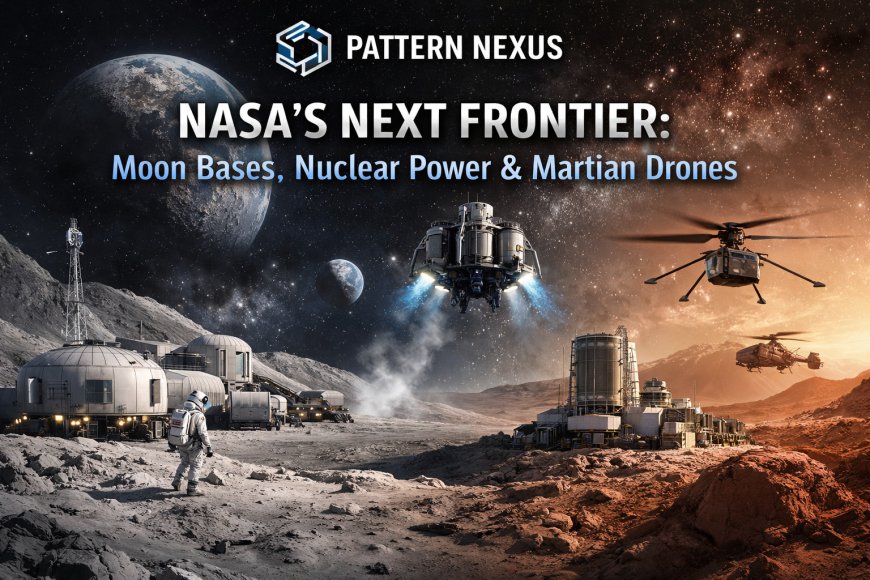
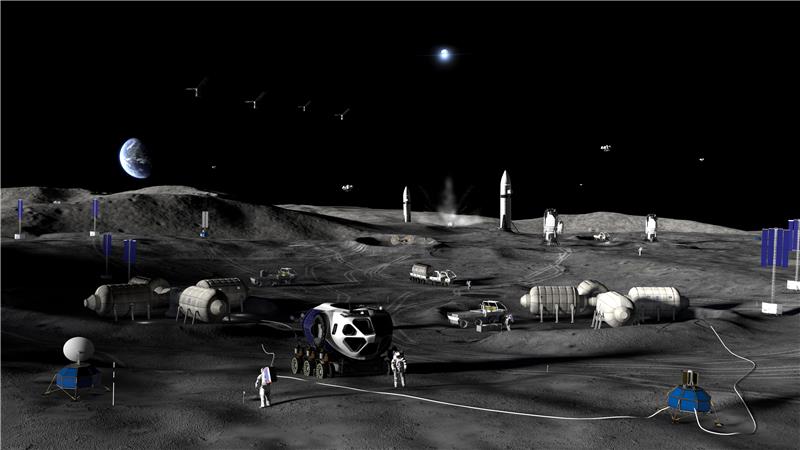

Most of the first-wave coverage missed the point. The story is not simply that NASA talked about a Moon base, a reactor, some lunar hoppers, and more helicopters for Mars. The story is that NASA’s public language got much more operational over the last few weeks. Instead of talking mostly in destination language, the agency started talking more openly in infrastructure language. That means cadence, logistics, rover classes, procurement windows, communications, navigation, payload lanes, survive-the-night capability, and eventually fission-backed continuity. For Pattern Nexus readers, that is the real signal. A base is never just a building. It is the system underneath the building.
The key shift is not “NASA wants a Moon base.” The key shift is that NASA is finally talking more openly in the language of cadence, logistics, mobility, payload lanes, and power continuity.
Most people will overfocus on the concept renderings and underfocus the procurement language. That is backwards. The real signal is in the RFIs, draft RFPs, task orders, rover requirements, and lunar-night survival incentives.
Nuclear matters here for one reason above all: continuity. A lunar foothold that dies in darkness is not a real foothold. A Mars architecture trapped inside pure solar and pure chemical limits is not scaled yet.
Why this matters and what changed
People are reading this wrong. They are reading it like NASA put out several disconnected announcements: Moon base, lunar drones, nuclear power, a Mars mission, maybe some helicopter talk. That is not the best way to read it. The better way to read it is as an architecture reveal. Not a full one, not a finished one, and not one without risk, but still a reveal.
NASA’s late-February and late-March materials moved the conversation away from one-shot hero missions and closer to a repeated-operating-model discussion. That is a real shift. The agency is now talking about more frequent landings, multiple rover classes, Moon Base capability demonstrations in the next two to four years, CLPS follow-on procurement, hopper drones, communications relay, navigation, lunar-night survival, nuclear power, and Mars payload hosting that extends beyond a single rover-and-camera paradigm.
For regular readers, this matters because it is the same pattern seen everywhere else: the public notices the object, while the real story is the system. The object gets the headlines. The system determines whether the project survives contact with reality.
From flags and footprints to infrastructure
The easiest way to understand what changed is to back up and frame the problem correctly. Apollo proved that human beings could reach the Moon, land there, work there briefly, and come home. What Apollo did not build was durable lunar infrastructure. It was flags and footprints, not a surface operating system. Artemis was supposed to be the next bridge, but for a long time the public conversation still leaned too hard on mission names, not enough on the stacked requirements that make sustained presence possible.
A Moon base is not one habitat. It is not one lander. It is not one reactor. It is not one rover. It is a layered capability stack. Something has to deliver mass. Something has to move people and equipment. Something has to scout where you should and should not go. Something has to keep talking to Earth when terrain, horizon geometry, and distance start working against you. Something has to survive darkness. Something has to provide enough power for operations, science, and eventually manufacturing. Something has to keep doing all of that repeatedly instead of once.
That is why the lunar south pole matters so much. It is attractive because of volatile deposits and operational potential, but it is also brutal because lighting is uneven, communications geometry is not simple, and the places where the resources matter most are often the places where sunlight is worst. That turns power and mobility from side issues into the central problem. Once you understand that, NASA’s recent announcements make much more sense.
What NASA actually announced in late February and March
The first major shift came with NASA’s late-February Artemis architecture update. NASA said it is increasing Artemis cadence, adding another mission in 2027, and undertaking at least one lunar surface landing every year thereafter. It also recast Artemis III as a 2027 low-Earth-orbit systems test mission designed to rendezvous and dock with one or both commercial landers and validate integrated systems before an Artemis IV lunar landing in 2028. Then NASA’s March Ignition material pushed the cadence language even further, saying post-Artemis V operations would initially target crewed lunar landings every six months as capabilities mature.
That alone is a big change in framing. The goal is no longer being presented as “get back once.” NASA is talking more like an operator trying to move from unique, infrequent missions toward a repeatable and modular campaign.
The second major shift is even more important for long-term readers: NASA says it intends to pause Gateway in its current form and shift focus toward surface infrastructure that enables sustained operations. That is not a small tweak. That is a center-of-gravity change. It means the architecture is being pushed downward from orbital staging toward surface utility, surface persistence, and surface logistics.
Then the procurement side showed up, and that is where the article really had to be fixed. NASA’s Ignition page is not just political branding. It includes actual requests for information, draft requests for proposal, rover-service changes, CLPS 2.0 details, and specific Moon Base delivery pathways. NASA is now publicly discussing:
- CLPS 2.0 as a competitive follow-on with a 10-year ordering period, a 15-year execution window, and a $6 billion target cap
- Moon Base capability RFIs aimed at technologies and hardware that can be rapidly developed or repurposed for lunar demonstration in the next two to four years
- Supply-chain and test-facility bottlenecks including tank domes, high-thrust hypergolic engines, radiation-hardened electronics, and altitude-capable hypergolic test stands
- A revised Lunar Terrain Vehicle Services approach focused on multiple crewed and uncrewed rovers by 2028
- CX-2 delivery work tied to getting one or more LTVs to the Moon’s south pole
- CS-8 payload-delivery work with a lunar-night survival incentive tied to deploying a radioisotope device and still transmitting after enduring a full lunar night
That is not fluff. That is NASA showing more of the plumbing. For Pattern Nexus readers, that is the real story. Programs become real when the constraints start getting named in public.
Moon Base is now a build sequence, not just concept art
NASA’s March 24 Moon Base fact sheet is more important than most of the public reaction gave it credit for. It lays out a three-phase buildout that makes the architecture legible even if the final hardware stack is still evolving.
Phase 1: Now through 2029 — Experiment, Learn
This is the scouting and proving layer. NASA describes up to 25 missions, including 21 landings. That is a serious tempo change by itself. This phase includes crewed and autonomous rovers for basic mobility and surface improvement, hopper drones called MoonFall, relay and observation satellites, early power and navigation demonstrations, communications work, and nuclear RHU demonstrations meant to prove systems can survive the lunar night. NASA also says this phase would deliver the first real surface footprint of the Moon Base effort, with roughly four tons of payload sent to test what works on the surface.
That is exactly how a serious buildout starts. You do not begin with the final city. You begin by testing the conditions that determine whether a city is even possible.
Phase 2: 2029 through 2032 — Early Habitation
This is where NASA says the Moon Base would begin shifting from scouting into assembly of semi-permanent infrastructure. The agency talks about improved solar power, initial nuclear-based power stations that may include both fission reactors and RTGs, upgraded rovers, advanced MoonFall drones, improved surface-to-orbit communications, and as much as 60 tons of cargo delivered over up to 24 landings. This is the part where the surface starts looking less like a mission site and more like a working environment.
For readers who want the deeper frame, this is where the system begins changing categories. Phase 1 is mostly about validation. Phase 2 is about operational continuity.
Phase 3: 2032 and beyond — Sustained Human Presence
This is the scale-up layer. NASA describes semi-permanent habitation modules, pressurized rovers for longer-range travel, advanced logistics networks, and an operational fission surface power station capable of providing steady power through the long lunar nights. NASA also says this phase could eventually support delivery of up to 38 tons of cargo per year. That is not “Apollo but nicer.” That is the start of real off-world infrastructure thinking.
The key point is simple: NASA is now describing the Moon Base as a sequence of dependencies. Mobility first. Communications first. Navigation first. Survive-the-night capability first. Logistics first. Only then do repeated crew operations make sense at scale.
MoonFall, VIPER, LuSEE-Night, LuGRE, and the surface intelligence layer
One reason the earlier draft felt wrong is that it did not explain what all these pieces mean together. MoonFall, VIPER, LuSEE-Night, LuGRE, lunar lidars, rover services, and relay work are not random side stories. They are the surface intelligence layer.
MoonFall is one of the clearest examples. NASA now explicitly names MoonFall hopper drones in both the Moon Base and science materials. That matters because it tells you NASA sees hopping and aerial-style repositioning as part of the south-pole problem set. A terrain where lighting is difficult, communications can be tricky, and valuable resources live in hostile zones is a terrain that rewards flexible scouting. MoonFall fits that logic.
VIPER fits the same logic from the resource side. NASA already awarded Blue Origin a CLPS task order with an option to deliver VIPER to the Moon’s south pole region. That rover is not there for symbolism. It is there to search for volatile resources such as ice and collect science data that directly informs how a sustained lunar presence could actually function.
LuSEE-Night fits the harsh-environment side of the same story. NASA says the instrument, developed with the U.S. Department of Energy, is slated to launch later this year on Firefly’s next CLPS delivery and is designed to survive the far-side lunar night. Public coverage will mostly focus on the radio science, but the larger systems point is just as important: if your hardware cannot survive the night, your architecture is still fragile.
Then there is the navigation and communications layer, which most people will ignore even though it may be more important than the better-known names. NASA says LuGRE became the first technology demonstration to acquire and track Earth-based navigation signals on the Moon’s surface. NASA’s SCaN program is also developing KaSTLE so a Lunar Terrain Vehicle can stream high-definition video while in motion on the Moon. At the same time, NASA is studying how lunar terrain affects communications links near the south pole and is building out lunar and deep-space communications capacity more broadly.
That is what real infrastructure looks like. The Moon has to become more legible, more navigable, and more connected before it becomes routine. The public tends to picture the base. NASA’s documents are telling you the real work begins well before the base looks like a base.
Why nuclear is not optional
This is where the entire conversation stops being decorative and starts becoming serious. Nuclear is not in this stack because it sounds futuristic. It is in the stack because solar alone cannot carry every part of the lunar and Mars problem. NASA and the Department of Energy said in January they are working toward a lunar surface reactor by 2030. NASA also said the goal is a fission surface power system that can operate for years without refueling, providing continuous and abundant power regardless of sunlight or temperature.
That is the continuity layer. On the Moon, even the best locations still face darkness, and the places people care about most for volatile access can be worse. On Mars, dust and distance keep changing the energy equation. Once you start thinking in terms of continuity instead of demonstration, the logic becomes obvious. A system that depends on perfect sunlight is not a robust frontier system.
NASA’s own Moon Base phasing matches that logic. Phase 1 includes early nuclear RHU demonstrations. Phase 2 includes initial nuclear-based power stations. Phase 3 includes an operational fission surface power station as part of sustained human presence. In other words, nuclear is not an optional add-on at the end of the story. It is the thing that gradually transforms the architecture from fragile to durable.
A lunar base that only works when the light cooperates is still basically a field camp. A lunar base with reliable power through darkness starts becoming infrastructure.
The Mars air layer after Ingenuity
NASA’s Mars-side updates fit the same pattern. People will tend to isolate them into a different category, but they are part of the same broader buildout logic: transport, telecom, surface intelligence, and autonomous scouting.
The new centerpiece is SR-1 Freedom. NASA says SR-1 Freedom is planned to launch in December 2028 as the first nuclear-powered interplanetary spacecraft using a fission reactor for propulsion beyond Earth orbit. NASA says it would use nuclear electric propulsion to reach Mars and carry the Skyfall payload of three Ingenuity-class helicopters equipped with cameras, ground-penetrating radar, and radios to survey potential human landing sites, search for subsurface water, and relay navigation data for future landers.
That is not a small announcement. It links propulsion, surface science, future human-site preparation, and the industrial base for nuclear space systems into one mission path. Even if every detail does not survive unchanged, the architecture signal is obvious: NASA is trying to connect transport and surface intelligence more tightly than before.
It also fits the trajectory that started with Ingenuity. Ingenuity already proved that powered flight on Mars is real. NASA says it completed 72 flights before the mission ended in January 2024. That already moved rotorcraft from science-fiction category to operational category.
Then there is Mars Chopper, which should be handled carefully because it is still concept-stage. NASA describes it as a more capable proposed follow-on to Ingenuity, about the size of an SUV, with six rotors, six blades on each rotor, payload capacity of roughly 11 pounds, and range of roughly 1.9 miles per Martian day. That is not flight hardware yet, but it shows where the category is trying to go. Ingenuity proved the threshold. Skyfall points toward operational deployment. Mars Chopper shows the scaling path after that.
There is also an adjacent data point that matters more than most people will think: NASA’s Dragonfly mission entered rotorcraft integration and testing this month. Dragonfly is a Titan mission, not a Mars mission, but the broader takeaway is still useful. Rotorcraft is becoming a standing exploration layer inside NASA’s playbook across multiple environments, not a one-off experiment that ends with Ingenuity.
Rovers make terrain traversable. Rotorcraft make terrain legible. Once those two layers start working together, the exploration model changes.
Reality check: what is real now vs what is still concept-stage
This section matters because space coverage gets sloppy fast. A NASA fact sheet is not the same thing as flight-proven hardware. A concept image is not the same thing as a funded and schedule-stable stack. A public policy push is not the same thing as a solved engineering problem. That does not mean the announcements are fake. It means they need to be read with the right level of discipline.
What looks real in the sense of present direction and program movement is the cadence shift, the reframe of Artemis III, the Moon Base three-phase sequence, the Gateway pause in its current form, the new RFIs and draft RFPs, CLPS 2.0, the rover-services push, the CX-2 and CS-8 payload pathways, the explicit naming of MoonFall, the VIPER delivery path, LuSEE-Night, LuGRE, the reactor-by-2030 push, and the SR-1 Freedom nuclear pathfinder concept.
What remains much less settled is whether the transport and lander stack can deliver on the schedule pressure NASA is now implying. NASA’s Office of Inspector General put that problem in plain language this month. The OIG said both SpaceX and Blue Origin face delays and technical or integration challenges that can further impact schedule and cost. More specifically, the OIG said SpaceX’s lander will not be ready for a lunar surface mission by June 2027, and NASA is assessing proposals from both providers aimed at accelerating development toward a 2028 landing date. The same report flagged vehicle-to-vehicle cryogenic propellant transfer as one of the most significant technical challenges in SpaceX’s architecture.
That is the correct framing for readers. Do not write this like NASA already has a working Moon base. That is false. Do not write it like nothing meaningful happened either. That is also wrong. What happened is that NASA exposed much more of the intended operating system, while the hardest hardware and schedule problems remain very real.
Pattern Nexus Lens
This is what real systems buildout looks like when the public finally starts seeing the plumbing. People default to object thinking. They see a base. A rover. A hopper. A reactor. A helicopter. A spacecraft. That framing is too shallow. The object is never the real system. The system is cadence, delivery mass, industrial readiness, communications, navigation, mobility, autonomy, night survival, logistics, power continuity, and the procurement architecture underneath all of it.
That is why the last couple of weeks matter. NASA showed more of the dependency chain. It showed that the Moon Base is not a one-image destination. It is a layered operating model. It showed that the science payload story is not separate from the infrastructure story. It showed that nuclear is not just a prestige technology. It is a continuity technology. It showed that Mars rotorcraft is not just a cool follow-up to Ingenuity. It is part of a broader surface-intelligence layer tied to future lander support and human-site preparation.
Once you read the announcements that way, the whole thing becomes much more coherent. The story is not “NASA unveiled several interesting projects.” The story is that NASA is trying to make an off-world infrastructure stack visible before it is fully built. For Pattern Nexus readers, that is the real article.
The real story is not that NASA announced four cool ideas. The real story is that NASA is showing more of the operating system it thinks sustained lunar and Mars presence will require.
FAQ
Is NASA actually building a Moon base right now?
NASA is clearly talking that way in official architecture and procurement language, but that does not mean the final stack is already mature or locked. What changed is that the agency is now describing the base as a phased buildout with real program lanes attached to it.
Is MoonFall already a deployed lunar drone?
No. Right now MoonFall is best understood as an explicitly named hopper-drone layer inside NASA’s lunar architecture and science materials. That matters because it shows NASA views hopping and aerial-style scouting as part of the actual south-pole operating problem.
Why is the Gateway pause a big deal?
Because it signals a shift in emphasis from orbit-first staging toward surface-first utility. That changes where the architecture’s center of gravity sits and tells you NASA wants the surface infrastructure layer to move faster.
Why does nuclear keep showing up in both the Moon and Mars story?
Because NASA is now linking continuity on the surface with propulsion in deep space. Lunar fission power addresses durable surface operations. SR-1 Freedom addresses nuclear-electric transport and flight heritage beyond Earth orbit. Together they help build a broader nuclear-space industrial base.
Are helicopters on Mars still just a concept?
Not as a category. Ingenuity already proved the category. What remains in development is the next operational scale. Skyfall is the newly named next step in NASA’s current materials, while Mars Chopper represents a larger follow-on concept that remains early-stage.
Sources
These sources support the program changes, architecture language, procurement shifts, Moon Base phases, nuclear plans, rotorcraft updates, and the distinction between current direction and unresolved hardware risk.
- NASA Adds Mission to Artemis Lunar Program, Updates Architecture — NASA
- NASA Unveils Initiatives to Achieve America’s National Space Policy — NASA
- Ignition — NASA
- Igniting Golden Age of Exploration, Innovation — NASA PDF
- NASA Unveils Plan to Establish America’s First Moon Base — NASA PDF
- Golden Age of Science and Discovery — NASA PDF
- NASA, Department of Energy to Develop Lunar Surface Reactor by 2030 — NASA
- SCaN & Moon to Mars — NASA
- NASA Selects Blue Origin to Deliver VIPER Rover to Moon’s South Pole — NASA
- America Underway in Space on Nuclear Power — NASA PDF
- Ingenuity Mars Helicopter — NASA Science
- NASA’s Mars Chopper Concept (Rendering) — NASA Science
- NASA’s Dragonfly Mission Begins Rotorcraft Integration, Testing Stage — NASA Science
- NASA’s Management of the Human Landing System Contracts — NASA OIG PDF
- Moon Base concept image — NASA
Vad är din reaktion?
 Gilla
0
Gilla
0
 Ogilla
0
Ogilla
0
 Kärlek
0
Kärlek
0
 Rolig
0
Rolig
0
 Wow
0
Wow
0
 Ledsen
0
Ledsen
0
 Arg
0
Arg
0

Founder of Pattern Nexus. I research markets, macro, geopolitics, AI, history, ancient systems, and the patterns most people overlook. I’m also building Market Radar, a trading scanner designed to read pressure, risk, confirmation, and setup quality before chasing a move. Pattern Nexus is where I connect the dots between data, history, technology, and the bigger system playing out around us.
















Kommentarer (0)