
The Regime Change Question: Has Washington Crossed the Line in Venezuela?
Despite a string of U.S. naval strikes and CIA authorizations inside Venezuela, no public confirmation has been made that the U.S. formally decided to remove Nicolás Maduro from power. The pattern suggests escalating covert pressure—but official denials leave the line between regime change and counter-narcotics blurred.
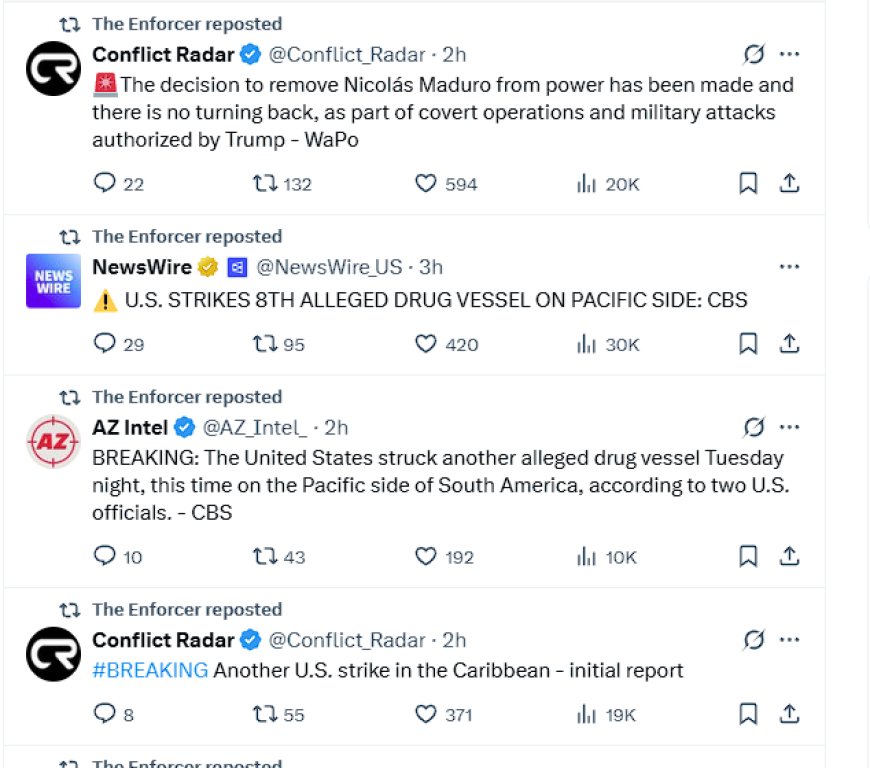
The United States has expanded its strike campaign from the Caribbean into the Pacific, targeting alleged narcotics-linked vessels amid covert-action authorizations against Venezuela. While online claims say Washington has decided on Maduro’s removal, official records show no such confirmation—only a growing pattern of pressure, intelligence activity, and escalation. The result is a gray zone between counter-narcotics enforcement and political warfare, raising the question of whether regime change is policy or consequence.

From the Caribbean to the Pacific: The U.S. Narco-Strike Campaign Just Crossed a Line
We just witnessed the eighth U.S. strike on an alleged drug-smuggling vessel—only this one wasn’t in the Caribbean. It was on the Pacific side of South America. That shift matters. You don’t move the battlespace from the southern Caribbean to the Eastern Pacific unless the operation is evolving in scope, logistics, and intent.
Since early September, the pattern has been consistent: precision strikes on small vessels the administration labels as cartel-linked or tied to designated terrorist organizations. The stated rationale is simple—attack the maritime arteries that move drugs. But the surrounding signals have always pointed to something larger than drug interdiction. Now those signals are flashing.
What’s actually happening
On paper, this is a counter-narcotics campaign—targeted kinetic strikes against boats said to be moving product from or around Venezuela. The opening salvos hit the Caribbean lanes. Ships, aircraft, and special operations units were surged into the region. Each strike is framed as a clean, surgical cut on a specific smuggling node.
Today’s development changes the geography. A strike in the Pacific means the target set isn’t just “Venezuelan boats in the Caribbean.” It means planners are mapping the broader network—feeder routes off Colombia, Ecuador, and Peru; staging coves; forward supply points; and the dark-fleet logistics that connect the Caribbean and Pacific circuits. That’s a wider canvas with more assets, more refuel points, and more intelligence tasking.
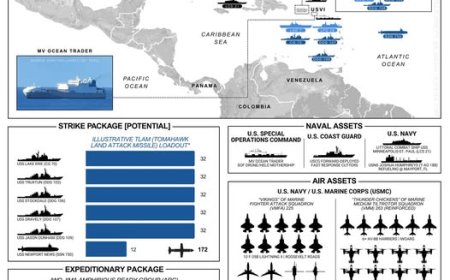
Layer on top of that two more facts. First, reporting in recent days made public that covert-action authorities were signed to greenlight CIA activities in Venezuela. Second, the Pentagon has quietly normalized this new strike pattern with official confirmations, while the force posture in the Caribbean keeps thickening—amphibs, ISR flights, Marines embarked, the whole stack. When you put these together, you’re staring at a multi-track campaign: overt military pressure at sea, covert pressure on land, and diplomatic pressure through sanctions and messaging.
Why the Pacific strike is a big tell
If the goal were purely drug interdiction, the Coast Guard and partner-nation law enforcement would typically be your front line: boardings, seizures, prosecutions. That’s the enforcement model the U.S. has used for decades. What we’re seeing now is different—military strikes, intelligence-compartmented targeting, and legal language that leans heavily on “narco-terrorism.” Moving to the Pacific widens the legal and operational aperture: it says this is not a one-off deterrent but a roving, persistent campaign with flexible rules of engagement.
Operationally, shifting theaters forces cartels and aligned actors to re-route, re-price, and re-risk their logistics. That alone can break cash flow if the disruption is sustained. But it also creates friction inside the Venezuelan power structure if those maritime rents have been propping up key commanders or internal loyalists. You cut the money, you test the cohesion. That’s pressure toward a political outcome without ever saying the word.
What’s likely about to happen
1) More strikes, varied waters. Expect tempo. The Caribbean isn’t closed, it’s just contested. The Pacific strike announces that both coasts are now inside the envelope. Planners will look for high-certainty targets that are cheap to hit and expensive for the network to replace—fast boats at sea, motherships loitering offshore, and staging areas that never dock in a friendly port.
2) ISR saturation and maritime harassment. The quiet story here is surveillance. Persistent P-8s, drones, SIGINT platforms, and partner feeds create a “find-fix-finish” loop that can move in hours. With that kind of picture, you don’t need to hit everything; you need to make the network behave like it’s always under the reticle. That alone reduces throughput.
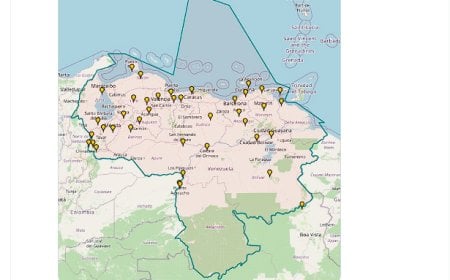
3) Political shaping against Caracas. Covert authorities and public statements about Venezuela are the second track. You’ll likely see defections, leaks, or “anti-corruption raids” inside the regime—tells that financial stress is bleeding into political stress. If the U.S. objective is to force a negotiated transition, the maritime campaign is the lever. If the objective is a faster break, you’ll see attention shift to land-based enablers: airstrips, coastal fuel depots, and militia logistics. That hasn’t happened overtly yet—but the rhetoric says it’s on the table.
4) Regional friction and legal debate. Some neighbors will cheer the hits; others will warn about sovereignty and due process. That debate is already happening, and it will intensify with each cross-basin strike. The administration’s legal frame is “narco-terror.” Critics will argue it’s a stretch and that lethal force at sea without interdiction and trial is a dangerous precedent. Expect court challenges and hearings, but not fast enough to slow the operational tempo in the near term.
How this likely plays out
Short term: flow disruption. The network adapts—bigger gaps between runs, costlier decoys, more overland routes—and prices move accordingly. That’s the first-order effect the White House wants because it hits cash flow where it’s most valuable: keeping elites loyal. If the maritime lanes choke for weeks, not days, that starts to bite.
Medium term: political inflection. If intelligence is right that sea-based revenue props up key Venezuelan insiders, the squeeze forces choices. You’ll see mixed messaging from Caracas: hardline denunciations in public, quiet backchannels in private. If a face-saving transition offer surfaces, it will be floated via third countries. If the regime digs in, you’ll see the U.S. telegraph readiness to hit shore-based enablers “if necessary”—with one or two deniable incidents blamed on “unknown actors” to keep pressure high.
Worst-case escalation: a misidentification or a mass-casualty incident at sea triggers international blowback. That risk grows as the number of strikes rises. The more dispersed the theater, the more chances for a bad read. The administration seems willing to hold that risk, betting the operational picture is tight enough to keep errors rare. It only takes one to change the politics.
Best-case glide path: sustained maritime pressure collapses the profitability of the sea lanes; insiders hedge; negotiations materialize; and a managed transition roadmap appears. Nobody says the word “regime change,” but the outcome rhymes with it. The Pacific strike suggests planners believe the network is brittle enough to reach that outcome if they keep striking nodes faster than the smugglers can rewire them.
What I’m watching
1) Strike cadence and geography. If the next hits bounce between basins—Caribbean one night, Pacific the next—that’s a sign the ISR net is wide and the green lights are pre-cleared. If tempo slows, it likely means political friction is catching up.
2) Any confirmed land targets. A single strike on a coastal fuel dump, radar site, or militia warehouse would signal phase two. That would move this from “sea control” to “coercive shaping” in a heartbeat.
3) Financial indicators. Watch regional shipping chatter, insurance rates for small craft, and black-market pricing in Colombian and Venezuelan coastal towns. When the economics change on the ground, politics follows.
4) The narrative. The official line is drugs. Independent reporting is increasingly blunt that this is also about Venezuela’s power structure. If the administration begins openly tying sea strikes to “political change,” then the mask is off and we’re in a declared coercive campaign.
The bottom line
Moving from the Caribbean to the Pacific is not mission creep; it’s mission disclosure. The campaign aims to strangle maritime cash flow, fracture the loyalties that keep Caracas glued together, and force decisions from people who don’t want to make them. The boats are the symptoms. The target is the system that profits from them.
I don’t see this slowing. The pieces already on the board—covert authorities, naval presence, public appetite for “hard solutions,” and an ISR picture good enough to hit boats at will—tell me we’re headed into weeks of rolling strikes across both coasts. If the cash dries up fast enough, you’ll feel the shift in Venezuela’s tone long before you see it in headlines.
Sources
- CBS News – U.S. strikes 8th alleged drug vessel, this time on the Pacific side
- Reuters – U.S. military strikes suspected drug vessel in the Pacific
- The Guardian – U.S. military kills two people in strike on alleged drug-trafficking boat in Pacific
- USNI News – U.S. Forces Strike Eighth Suspected Narco Boat
- Al Jazeera – U.S. conducts eighth strike on alleged drug-smuggling boat in the Pacific
- Washington Post – Trump beats the drums of war for direct action in Venezuela
- Reuters – Trump authorizes CIA operations in Venezuela
- Vox – Is the U.S. about to attack Venezuela?
- Fox News – U.S. military buildup in the Caribbean
Vad är din reaktion?
 Gilla
0
Gilla
0
 Ogilla
0
Ogilla
0
 Kärlek
0
Kärlek
0
 Rolig
0
Rolig
0
 Wow
0
Wow
0
 Ledsen
0
Ledsen
0
 Arg
0
Arg
0

Founder of Pattern Nexus. I research markets, macro, geopolitics, AI, history, ancient systems, and the patterns most people overlook. I’m also building Market Radar, a trading scanner designed to read pressure, risk, confirmation, and setup quality before chasing a move. Pattern Nexus is where I connect the dots between data, history, technology, and the bigger system playing out around us.













Kommentarer (0)