
Global Power Shifts in 2025: U.S. Foreign Policy, Regional Flashpoints, and a World on the Brink
A deep dive into global geopolitics in late 2025: Trump clashes with Colombia’s Petro, U.S. pressure on Venezuela and Ukraine, China cyberclaims, Middle East unrest, a Pakistan-Afghanistan ceasefire, BRICS expansion, Arctic rivalry, and a humorous take on a mysterious object possibly being an alien spaceship.
Global Flashpoints and Shifting
Alliances in Late 2025
Trump vs. Petro: U.S.-Colombia Relations on the Rocks
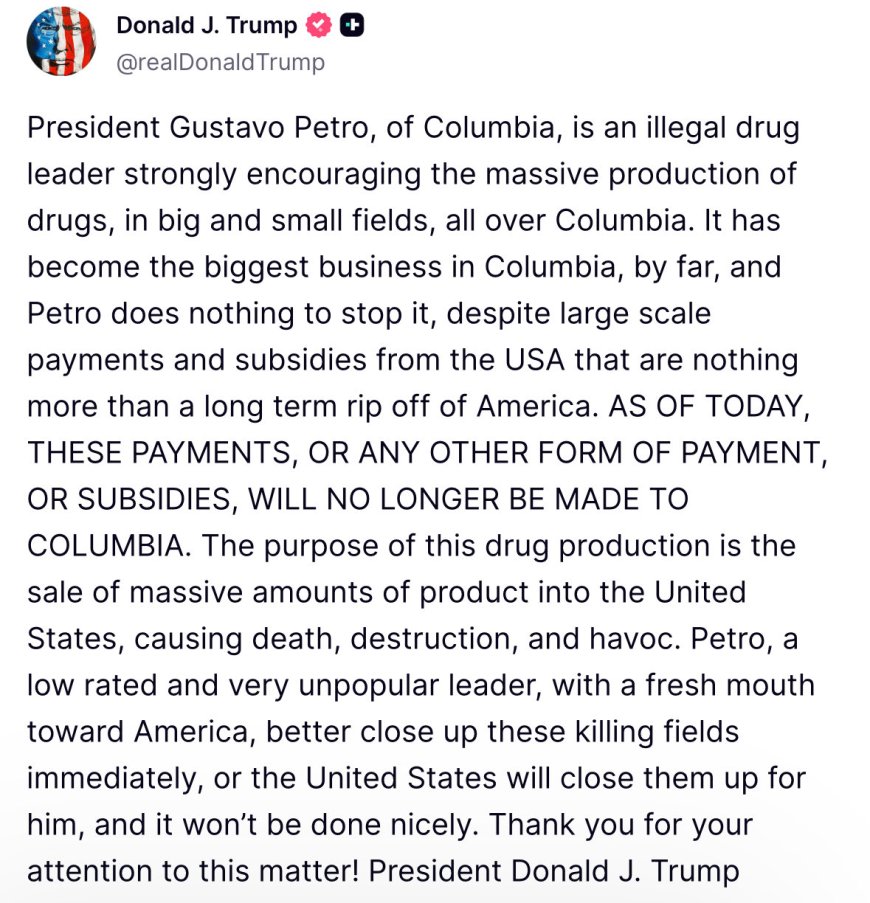
Former U.S. President Donald Trump and Colombian President Gustavo Petro have traded sharp accusations amid fraying bilateral ties. In a recent outburst, Trump lambasted Petro as an “illegal drug leader,” claiming the leftist Colombian leader is “strongly encouraging the massive production of drugs” and warning that U.S. payments to Colombia are a “rip-off” (Al Jazeera). On his Truth Social platform, Trump vowed to halt all U.S. subsidies and aid to Colombia effective immediately unless Petro “closes up” the drug trade, or else the U.S. “will close them up for him, and it won’t be done nicely” (Al Jazeera). These extraordinary threats — essentially accusing Petro’s government of colluding in narcotics trafficking — have sparked outrage in Bogotá. Colombia’s Foreign Ministry blasted Trump’s comments as a “direct threat to national sovereignty” after Trump even mused about using the U.S. military to unilaterally intervene in Colombia (Washington Post, Al Jazeera).
Cuando Petro dijo que a Colombia ya no la conocían por Pablo Escobar sino por el, tenía toda la razón, ahora el mundo lo ve como el nuevo capo del narcotráfico. pic.twitter.com/LC2gcCAZcV
— Santiago Uribe (@santiuribedel10) October 19, 2025
Petro, a former guerrilla and Colombia’s first left-wing president, has bristled at Trump’s provocations. The feud comes on top of existing tensions: since returning to the White House in January, Trump’s administration revoked Petro’s U.S. visa after the Colombian leader attended a pro-Palestine rally in New York and controversially urged American soldiers to disobey “unjust” orders (Reuters). Petro has accused the U.S. of violating Colombian sovereignty with recent counternarcotics operations. For example, a series of U.S. Navy strikes on suspected drug-smuggling vessels in the Caribbean — conducted without Bogotá’s sign-off — prompted Petro to decry “murder on the high seas” and demand answers (Al Jazeera, Al Jazeera). All of this marks a low point in U.S.-Colombian relations. Once one of Washington’s closest Latin American partners in the war on drugs, Colombia now faces an American president openly hostile to Petro’s government. Analysts worry that cooperation on security and development could collapse if Trump follows through on cutting the roughly $800 million in annual aid that Colombia has been receiving (Reuters). In response, Petro has doubled down on Colombia’s “sovereignty and dignity,” insisting his country “will not accept imperialist threats” and exploring closer ties with other powers as a counterbalance.
#AHORA | Senador Lindsey Graham, tras conversar con Trump, dice que EEUU impondrá “fuertes aranceles contra Colombia” por promover el narcotráfico. pic.twitter.com/Xy0QgAahC1
— Orlando Avendaño (@OrlvndoA) October 19, 2025
Targeting Caracas: Venezuela’s Role and Washington’s Hard Line
Washington’s tough talk isn’t limited to Colombia. In Venezuela, President Nicolás Maduro’s socialist government has become another focal point of the Trump administration’s assertive (critics say belligerent) Latin America policy. Tensions have skyrocketed in recent weeks as the U.S. ramps up covert and overt pressure on Caracas. Trump confirmed he has authorized CIA covert operations in Venezuela – a dramatic escalation – and even hinted that ground attacks by U.S. forces might be on the table (Al Jazeera).
The New York Times and other outlets reported that Trump’s goal is explicit: regime change. According to U.S. officials, the White House is pursuing ways to remove Maduro from power and install a more friendly government (Al Jazeera).
Trump's \"war on drugs\" is a blood-soaked lie to justify a deliberate, violent escalation toward war with Venezuela... pic.twitter.com/VM7ak1vrO1
— Manolo De Los Santos (@manolo_realengo) October 18, 2025
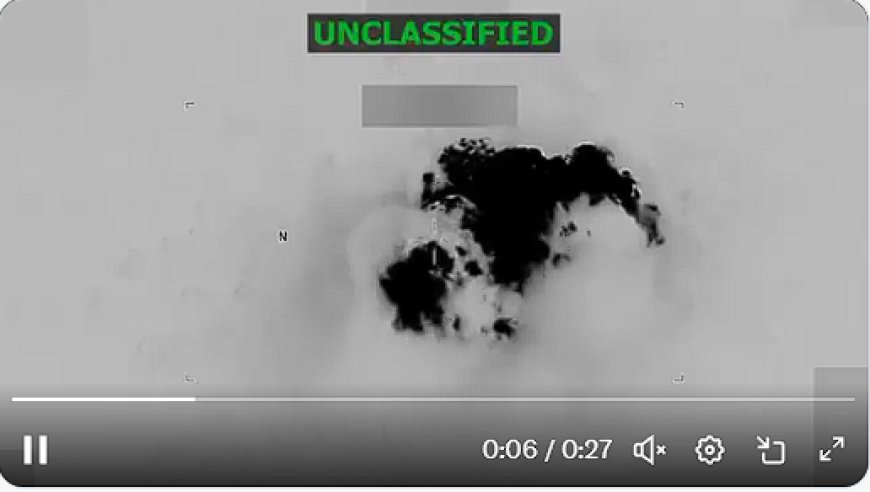
On the military front, the U.S. Southern Command has carried out a series of strikes on vessels in Caribbean waters near Venezuela, claiming they were carrying narcotics. Since September, at least six attacks on suspected drug smuggling boats have been conducted by U.S. forces, resulting in the deaths of 27 peoplealjazeera.comaljazeera.com. Trump officials say these semi-submersible craft were linked to Venezuelan or Colombian cartels and even to the ELN rebel group, although notably no public evidence has been provided to verify the drug cargo claimsaljazeera.com. Venezuelan authorities and many international legal experts have condemned the U.S. strikes as a blatant violation of international law (one human rights group called it “murder on the high seas”aljazeera.com). Maduro’s government says some of those boats were just civilian craft; in one incident, a Venezuelan fisherman was killed when his disabled boat was allegedly mistaken for a narco-subaljazeera.com. Caracas has blasted the U.S. for violating its sovereignty and even threatened to take the case to international courtsaljazeera.com.
Far from backing down, President Trump has coupled military pressure with fiery rhetoric. He accused Maduro of “emptying their prisons into the United States” via mass migration and of flooding America with drugsaljazeera.com. At a press conference, Trump pointedly refused to rule out targeting Maduro personally, calling the question “ridiculous… but [Venezuela] is feeling heat”aljazeera.com. In response, Maduro went on national TV to urge restraint, warning that Venezuela will not tolerate a U.S.-engineered coup: “No to regime change... Latin America does not want them, does not need them, and rejects them,” Maduro declaredaljazeera.com. He has put Venezuela’s military on alert and sought diplomatic backing from allies like Russia, China, and Cuba to deter any U.S. invasion threat.
Regionally, Venezuela’s neighbors are watching with trepidation. Many Latin American governments have no love for Maduro’s autocratic regime, but they also deeply oppose U.S. military intervention in the region given the painful Cold War history. So far, most are responding cautiouslyaljazeera.comaljazeera.com. For instance, Colombian President Petro – despite his own clashes with Maduro – warned that a U.S. attack on Venezuela would spark chaos that spills over borders. “If missiles start falling over there... if a violent operation begins by land… that would run counter to [international law],” Petro said, vowing that Colombia must be prepared for fallout if war erupts next dooraljazeera.comaljazeera.com. Brazil’s government likewise urged dialogue and reportedly offered to mediate. Even traditional U.S. allies in the hemisphere prefer a negotiated approach: there are whispers of reviving talks between Maduro and Venezuela’s opposition, with regional mediators, to find a peaceful way out of the crisis. But for now, Washington’s stance remains maximalist – heavy sanctions (with only sporadic easing for limited oil exports), diplomatic isolation of Maduro, and now CIA ops and saber-rattling. Venezuela thus continues to be a flashpoint in U.S.–Latin American relations, where ideological divides (leftist governments vs. Trump’s right-wing populism) are increasingly colliding.
War and Peace in Ukraine: Battlefield Stalemate and Trump’s Overtures
“Make a deal.” That was Donald Trump’s blunt message to Ukrainian President Volodymyr Zelenskyy this past week, as the Russia-Ukraine war ground through its fourth year. In a surprise White House meeting on October 17, 2025, Trump pressed Zelenskyy to accept Russia’s terms for ending the war, warning that if he didn’t, “Putin [will] destroy Ukraine”reuters.com. Multiple sources confirm that Trump urged Zelenskyy to surrender the entire eastern Donbas region to Moscow – essentially giving Vladimir Putin what he wants – and repeatedly echoed talking points straight from a phone call Trump had with Putin one day priorreuters.comreuters.com. This unprecedented pressure from a U.S. president on a beleaguered ally caused palpable shock among European diplomats. According to the Financial Times report, Zelenskyy pushed back hard. The Ukrainian leader refused to “gift” any sovereign territory, reminding Trump that Ukraine’s constitution forbids ceding land and that Ukrainians will not accept capitulation after so much bloodshedreuters.comreuters.com. Heated discussions ensued, but ultimately Zelenskyy managed to convince Trump to soften his stance slightly: by the end of their meeting, Trump grudgingly agreed to endorse a ceasefire that freezes battle lines where they are, rather than outright handing Donbas to Russiareuters.com. After the meeting, Trump claimed progress, saying both sides should “stop the war at the current battle line”, which Zelenskyy cautiously welcomed as an “important point”reuters.com.
For Zelenskyy, it was a diplomatic tightrope. He arrived in Washington urgently seeking more U.S. weapons and aid – Ukraine is running low on air defenses and ammunition – but instead found an American president eager to broker a quick peace, even at Ukraine’s expensereuters.com. The episode highlights a stark shift in Washington’s approach. Under the previous administration, the U.S. blanketed Ukraine with support, helping it resist Russia’s invasion. But President Trump, skeptical of what he calls “endless wars,” campaigned on forcing Ukraine and Russia to negotiate. Since taking office in January, he has pursued that line: In fact, back in August, Trump met one-on-one with Putin in Anchorage, Alaska – a high-profile summit aimed at forging a peace dealreuters.com. That Alaska meeting ended with no formal deal, as Putin held firm on maximalist demands (he insists that four Ukrainian regions and Crimea are now part of Russia) and Trump conceded there were “significant sticking points”aljazeera.comaljazeera.com. Still, Trump hailed the meeting as “extremely productive” and gave himself a “10 out of 10” for effortaljazeera.comaljazeera.com, then immediately pivoted to pressuring Zelenskyy. “It’s really up to President Zelenskyy to get it done… Make a deal,” Trump told Fox News after Alaskaaljazeera.com.
A Stalemate on the Battlefield
On the ground in Ukraine, meanwhile, the military situation has largely stalemated in recent months. Neither side has landed a knockout blow in 2025. A senior Russian senator, Dmitry Rogozin, frankly admitted that the front lines have become an impasse where offensives grind forward at “colossal price” in lives for minimal gainsreuters.comreuters.com. Minefields, drones, and trench fortifications dominate a static war of attrition from the Donbas down to Zaporizhzhia. “It’s impossible to get up from a chair, let alone go somewhere to attack,” Rogozin quipped, describing how any armored vehicle that comes within 20 km of the front is promptly blown up by artillery or anti-tank minesreuters.comreuters.com. Even the coming winter may not change this dynamic much, beyond worsening the humanitarian toll.
Notably, Trump himself has oscillated in his rhetoric about the war’s trajectory. At times he sounds like a dealmaker urging compromise, but at other moments he’s vented frustration at Putin. In a striking turn, Trump recently chastised Russia’s military as inept, saying Russia has been fighting “aimlessly” and sneering that a “real military power” would have won in a weekreuters.com. He even called Russia a “paper tiger” and mused that Ukraine might be able to retake all occupied territory if it had proper supportreuters.com. This tougher talk appears calculated to push Putin back to the table. Indeed, U.S. officials signaled that Trump threatened Putin with new sanctions and tariffs if he didn’t cooperate on a ceasefirereuters.com. For example, in August the Trump administration slapped a 25% tariff on goods from India – a key Russian oil customer – to punish Delhi’s continued imports of Russian crudereuters.comreuters.com. Such moves show Trump trying to balance carrot and stick: woo Putin with respect and summit pageantry, yet also flex economic pressure through secondary sanctions.
Europe, for its part, is nervously navigating this new U.S. approach. NATO allies continue to back Ukraine – countries like Poland, the Baltic states, and the UK remain hawkish on not rewarding Russian aggression. Polish Prime Minister Donald Tusk said in August that a “freeze in the conflict” might be nearing, but only a freeze – not a final peace – and he stressed any deal must involve Europe and uphold Ukraine’s core interestsreuters.comreuters.com. European leaders have participated in calls with Trump and Zelenskyy, striving to keep Western unity intacttheguardian.com. Still, if Trump’s Washington ultimately forces Kyiv into a unfavorable peace, splits could emerge in the Western camp. Some U.S. lawmakers (in both parties) have voiced alarm about abandoning Ukraine, while others echo Trump’s skepticism about writing a “blank check.” All agree the war’s humanitarian costs are staggering: hundreds of thousands killed or wounded, millions displaced, and cities like Mariupol and Bakhmut in ruins. That painful status quo is why Zelenskyy has been open to a ceasefire that stops the killing – but he insists it cannot permanently legitimize Putin’s land-grab. Any “peace” that leaves large swathes of Ukraine under Russian occupation will remain fragile. As Zelenskyy warned, decisions made “without Ukraine” are “stillborn” and won’t lead to a durable peacereuters.com.
For now, active combat continues in eastern and southern Ukraine even amid talk of peace. Russian forces daily shell Ukrainian positions (and occasionally launch drone strikes on Ukrainian cities), while Ukraine’s army fights to inch forward in Zaporizhzhia toward Melitopol, and to hold back Russian assaults around Donetsk. The international involvement also continues: NATO countries are training Ukrainian brigades and providing intelligence, while Russia in turn is sourcing artillery shells from North Korea and attack drones from Iran in a shadow proxy war. And in a symbolic twist, China’s role hovers in the background – Beijing has pushed a 12-point peace proposal and maintains ties with Putin, even as it publicly claims neutrality. Any eventual diplomatic settlement may require sign-off (or at least tacit buy-in) from the major powers on both sides, from Washington and Brussels to Moscow and Beijing. The next few months – as battlefields freeze and the U.S. heads deeper into election season – could prove decisive in determining whether the Ukraine war finally winds down or explodes anew.
Fragile Peace Between Pakistan and Afghanistan
Amid these great-power dramas, a quieter but significant breakthrough occurred in South Asia: Pakistan and Afghanistan have struck a tentative peace deal to halt cross-border hostilities. After a week of the worst clashes since the Taliban took power in Kabul in 2021, the two neighbors agreed to an “immediate ceasefire” during talks in Doha, Qatarreuters.com. This came after several deadly incidents that alarmed the region. In early October, militants from the Pakistani Taliban (TTP) staging from Afghan soil ramped up attacks in Pakistan’s border provinces. In retaliation, Pakistan’s military launched airstrikes inside Afghanistan, targeting what it claimed were TTP hideouts in Khost, Paktika, and even around Kabulaljazeera.comreuters.com. The result was open combat between the Pakistani Army and the Afghan Taliban along multiple frontier areas – a jarring conflict between two forces that were ostensibly allies. Dozens of fighters were killed and hundreds of civilians on both sides wounded or displaced in the border skirmishesreuters.com.
Under heavy diplomatic pressure from China, Qatar, and other interested mediators, Pakistan’s Defence Minister Khawaja Muhammad Asif and the Taliban’s Defence Minister Mullah Mohammad Yaqoob (Mullah Omar’s son) met in Doha. Qatari and Turkish mediators helped broker a trucereuters.comreuters.com. The agreement, announced on October 19, commits both Islamabad and Kabul to stop all fighting and “refrain from hostile actions” against each otheraljazeera.comaljazeera.com. Crucially, the Taliban side “reaffirmed” that Afghan territory will not be used to shelter or support militants conducting attacks against Pakistanreuters.comaljazeera.com. This addresses Islamabad’s core demand: Pakistan has been adamant that the Taliban must crack down on the TTP and other extremist groups who have found refuge in Afghanistan’s lawless eastern provincesaljazeera.com. Since the Taliban’s return to power, TTP violence in Pakistan has skyrocketed – 2025 was on track to be the deadliest year yet for militant attacks, with dozens of Pakistani soldiers and civilians killed in suicide bombings and ambushes in Khyber Pakhtunkhwa and Baluchistanaljazeera.com. Pakistani officials, including Army chief Field Marshal Asim Munir, publicly accused the Afghan regime of harboring these “proxies” and demanded it “rein in” the militants or face consequencesreuters.com.
The Taliban government in Kabul, however, denies giving safe haven to the TTP. In Doha, Taliban spokesman Zabihullah Mujahid went so far as to claim Pakistan is spreading “misinformation” and even accused Islamabad of itself sheltering militants of the Islamic State Khorasan (an enemy of the Taliban) to destabilize Afghanistanreuters.comreuters.com. This war of narratives underscores the deep mistrust between the two. The ceasefire deal tries to paper over that: both sides agreed to meet again on October 25 in Istanbul for “detailed talks” on verifying and sustaining the peacereuters.comaljazeera.com. A joint mechanism may be established to monitor the border and ensure neither side’s militants cross over. Thus far, the truce is holding, albeit shakily. There was a scare when Afghan officials accused Pakistan of an airstrike even after the initial ceasefire took effect (Pakistan denied this)reuters.com. In protest, Afghanistan withdrew from a scheduled cricket tournament with Pakistanreuters.com. Despite such hiccups, optimists see this as a first step toward stabilizing a very volatile frontier. If Pakistan and the Taliban can reach an understanding, it could dial down a brewing inter-Muslim conflict and refocus efforts on the real threat common to both: the local ISIS affiliate and other extremist factions. For Pakistan’s part, easing tensions with Kabul is critical as it grapples with economic crisis and political turmoil at home – the last thing it needs is a two-front security problem. Afghanistan, under the Taliban, also seeks international legitimacy and desperately needs trade and aid from Pakistan and beyond. These mutual interests might just incentivize both to uphold the truce. Still, history cautions that ceasefires in the region have a way of unraveling. Much will depend on whether the Taliban actually restrains the TTP, and whether Pakistan exercises patience and diplomacy rather than immediately resorting to force if the next terror attack occurs. For now, at least, a fragile peace has replaced gunfire in the Pashtun borderlands, offering a glimmer of hope in a region that has known four decades of war.
U.S.–China Cyber Tensions Boil Over
If Ukraine is a hot war and Gaza a tense truce, the U.S. and China are locked in a quieter, but relentless, cold war in cyberspace. In late October, China went public with explosive allegations that the U.S. has been hacking into critical Chinese infrastructure. In a stern statement, Beijing’s Ministry of State Security accused the U.S. National Security Agency (NSA) of conducting a long-term cyber espionage campaign against China’s National Time Service Centerreuters.com. This might sound like an odd target, but the Time Service Center (which maintains China’s official atomic clock and time standard) is a backbone facility – disrupting it could wreak havoc on communications networks, financial transactions, and power grids that rely on precise timingreuters.comreuters.com. Chinese officials claim they have “irrefutable evidence” of NSA hackers stealing data and credentials from the time center going back to 2022reuters.com. They even detailed a specific intrusion: according to Beijing, the NSA exploited a vulnerability in a popular foreign-brand smartphone messaging app to infect the devices of the center’s staff, giving U.S. spies access to internal networksreuters.comreuters.com. Additionally, China says the Americans attempted to compromise the center’s high-precision timing systems in 2023 and 2024 – essentially an act of cyber sabotagereuters.com.
The U.S. government had no immediate comment on these claimsreuters.com. Western cybersecurity experts note that China’s allegations, if true, are hardly surprising: of course the NSA targets Chinese infrastructure (just as China’s hackers target American infrastructure). What is notable is China choosing to air this dirty laundry so publicly. Beijing’s statement warned that the U.S. hacks “could have disrupted” major systems and “threatened… international standard time”, clearly aiming to paint Washington as a reckless aggressorreuters.com. It’s part of a broader narrative battle. In recent years, both Washington and Beijing routinely accuse each other of cyberattacks, each portraying itself as the victim and the other as the ultimate “hacking empire.” Indeed, the FBI and U.S. intelligence frequently call out China as America’s “most active and persistent” cyber espionage threat, blaming Chinese state-backed groups for everything from the massive Office of Personnel Management data breach to hacks of corporate trade secrets. China, in turn, often responds by highlighting revelations from Edward Snowden that exposed NSA operations like “Operation Socialist” (hacking Huawei) and others. Now, with this Time Center incident, China is on the offensive in the blame game. The timing is conspicuous: it comes amid tense U.S.–China relations on multiple fronts – from trade disputes (China just imposed export controls on critical rare-earth metals, and the U.S. is considering new tech tariffsreuters.com) to military maneuvering in the South China Sea and around Taiwan.
The cyber domain is increasingly a theater of strategic rivalry akin to a digital arms race. Each side is hardening its networks and investing in offensive capabilities. Just in the past year, U.S. agencies alleged Chinese hackers inserted malware in Guam’s power grid (perhaps to disrupt U.S. Pacific military logistics), while China’s security services pointed to NSA malware found in aeronautics and telecom systems in China. The public accusations are getting louder. “The United States must stop its cyberattacks on China. We have the proof, and the world sees your hypocrisy,” blasted an editorial in China’s state media after the latest incident. Washington, for its part, has been rallying allies about the need to counter Chinese cyber-espionage, tightening export bans on Chinese tech firms like Huawei and urging stricter vetting of software supply chains to root out potential Chinese spyware. Unfortunately, there’s no equivalent of an arms control treaty in cyberspace – so for now, this tit-for-tat is likely to continue. The danger is that as both superpowers probe each other’s critical systems (power grids, satellites, financial networks), the risk of miscalculation or unintended damage grows. A malware operation gone wrong could accidentally knock out part of a grid or disrupt an airport, which in a heated geopolitical climate could even be misconstrued as an attack. As of late 2025, cybersecurity has become one more flashpoint in the U.S.-China rivalry, alongside trade, Taiwan, and the South China Sea – a silent conflict raging behind computer screens and firewalls, with potentially global consequences.
Middle East Turmoil: Gaza’s Ceasefire on a Knife’s Edge
Gaza now❗️ pic.twitter.com/LmlGArWEKT
— MAKS 25 🇺🇦👀 (@Maks_NAFO_FELLA) October 19, 2025
Middle East Turmoil: Gaza’s Ceasefire on a Knife’s Edge
Halfway around the world, the Middle East remains as volatile as ever. In Israel and Palestine, a precarious ceasefire in the Gaza Strip is teetering after a serious escalation. Earlier this month, the U.S. helped broker a truce to pause a conflict that had raged on-and-off for two years. But on October 19, that ceasefire suffered its gravest test yet. Hamas fighters in Gaza launched an anti-tank missile at Israeli troops near the border and opened fire, killing two Israeli soldiers (Reuters, Reuters). In response, Israel’s military quickly launched a wave of airstrikes and artillery shelling across Gaza, asserting that Hamas had violated the truce. The Israeli reprisal was intense: explosions rocked the tiny enclave from north to south. At least 18 Palestinians were killed, including women and children, and dozens more injured, according to Gaza health authorities (Reuters). One strike hit a former school housing displaced families, turning a refuge into rubble (Reuters).
Israeli Prime Minister Benjamin Netanyahu said he ordered the army to “respond forcefully” to Hamas’s “blatant violations” of the ceasefire (Reuters). The Israeli government also halted humanitarian aid shipments into Gaza again, sealing the crossings that had briefly opened to allow fuel, food, and medicine to alleviate Gaza’s dire conditions (Reuters). For 2.3 million Gazans who have endured a devastating war and siege, the flare-up triggered real fear that full-scale fighting would resume. Panicked residents rushed to markets to stock up on goods, and some families in the south packed belongings and fled farther from border areas (Reuters, Reuters).
Hamas, for its part, denied it intentionally broke the ceasefire. The group’s armed wing said it “remains committed” to the truce and had “no knowledge” of any clash in Rafah (the area of the incident) (Reuters). Analysts note Gaza has other militant groups who could have acted independently. Still, Israel holds Hamas, as Gaza’s de facto authority, responsible for any aggression. Both sides had already accused each other of multiple small-scale violations in the days before this breach (Reuters, Reuters).
Behind the scenes, U.S. diplomats scrambled to rescue the truce. Washington leaned on Israel to resume the flow of aid into Gaza to prevent humanitarian collapse (Reuters, Reuters). By the next day, Israeli media (via Axios) reported that under U.S. pressure Israel agreed to reopen a Gaza crossing for aid on a limited basis, stepping back from an immediate total collapse of the ceasefire (Reuters, Reuters). The ceasefire, which began on October 10, paused fighting that had killed thousands and devastated large swaths of Gaza City (Reuters, Reuters), and enabled the release of 20 Israeli and international hostages in exchange for many Palestinian prisoners (Reuters, Reuters).
Yet, the path to a durable peace is profoundly uncertain (Reuters, Reuters). Key issues remain unresolved: Who will govern Gaza if calm returns? Will Hamas disarm or at least refrain from rearmament? How will Gaza be rebuilt under blockade? In Israel, political pressures mount: hardliners attack the ceasefire; families of hostages demand more than a temporary lull (Reuters, Reuters). For now, the truce is alive but fragile. Mediation by the U.S., Egypt, Qatar and others may keep a lid on escalation—or not. For civilians, it’s another anxious wait (Al Jazeera, Al Jazeera).
Taiwan Strait: Beijing’s Pressure and Taipei’s Preparations
Another geopolitical tinderbox in 2025 is the Taiwan Strait, where tensions between China and the self-ruled island of Taiwan (backed unofficially by the U.S.) remain very high. On October 10 (Taiwan’s National Day), President William Lai Ching-te rallied the public and underscored readiness amid growing Chinese “threats,” pledging to accelerate a “T-Dome” air-defense shield with multi-layered detection and interception capabilities (Al Jazeera, Al Jazeera). Practically, that means upgrading Patriot and Sky Bow systems and integrating them into a dome-like network. Lai announced defense spending above 3% of GDP now, targeting ~5% by 2030 (Al Jazeera).
Beijing’s stance has only hardened. The PLA runs frequent large-scale drills around Taiwan; ADIZ incursions are near-daily (Al Jazeera). Days after Lai’s speech, China blasted expanded U.S. military aid for Taiwan and even the idea of Taipei participating in RIMPAC as a “provocative escalation,” warning the U.S. would “pay a heavy price” (Defence Blog, Defence Blog).
Despite a lack of formal ties, the U.S. remains Taiwan’s key supporter, supplying advanced weapons and maintaining “strategic ambiguity.” In 2025, Trump’s approach mixes hardline and deal-making; reports suggest possible curbs on high-level visits or scaled-back cooperation as an olive branch to Xi (Al Jazeera). Taipei is doubling down on self-reliance: indigenous weapons programs (including drones and naval vessels) and expanded civil defense training (Al Jazeera).
The Strait remains a powder keg; miscalculation could spark conflict. For now, deterrence holds: China hasn’t invaded, and Taiwan hasn’t declared independence. But weekly frictions persist, and many call for tacit freezes to stabilize the status quo.
Chaos in the Sahel: Coups, Jihadists, and Great-Power Jostling
While Asia sees superpower rivalry, Africa’s Sahel region faces state collapse, insurgency, and geopolitical realignment. Coups in Mali (2020/2021), Burkina Faso (2022), and Niger (2023) toppled civilian governments amid rising jihadist violence. French forces were expelled; Wagner elements entered; the UN mission left Mali in 2023, and Tuareg separatists reignited rebellion in 2024. Niger’s coup triggered an ECOWAS standoff; juntas formed a mutual-defense alignment and pivoted toward Russia (and some Chinese engagement). The humanitarian fallout is severe—displacement, food insecurity, and spillovers toward Gulf of Guinea states. Western influence wanes as others fill gaps; prospects hinge on African-led initiatives and eventual transitions to civilian rule.
New Northern Frontiers: The Arctic Heats Up (Literally and Strategically)
Melting sea ice is opening new sea lanes and resource access, drawing military buildup by Russia, NATO’s Arctic members, and growing Chinese interest. With Finland and Sweden in NATO, seven of eight Arctic states are now in the alliance. NORAD reported a spike in Russian flights near Alaska—on one day in August 2025, U.S. F-22s intercepted Russian surveillance aircraft four times (responsiblestatecraft.org, responsiblestatecraft.org). The Arctic’s fragile environment and thin rule-sets raise risks of incidents; confidence-building measures are widely urged.
Global Order at a Crossroads: Implications for U.S. Policy and Alliances
From Latin America to Europe, Africa to Asia, these flashpoints reveal a shifting, more multipolar order. Transatlantic jitters over Ukraine negotiations, a tightening Russia–China–Iran axis, and the rise of alternative blocs complicate U.S. strategy. In 2024, BRICS expanded—adding Saudi Arabia, Iran, UAE, Egypt, Argentina, Ethiopia—boosting aggregate population/GDP and commodity heft (cfr.org, infobrics.org, weforum.org). Some alliances strain; others adapt (NATO Arctic focus, Quad growth, U.S.–Japan–Korea trilateral). Global governance lags as great-power rivalry undercuts collective action.
Looking ahead, overlapping networks (rather than tidy blocs) define risk. The U.S. must prioritize, reassure allies, and lean into diplomacy (e.g., negotiated outcomes in Ukraine; stabilization in the Sahel). Talk of a modern “Helsinki moment” reflects the need for updated rules of the road.
The “Aliens” Among Us? A Lighthearted Look at 3I/ATLAS
Amid the turmoil, sky-watchers buzzed over 3I/ATLAS—the third known interstellar object to enter our solar system. Rumors of “alien spacecraft”? Scientists say it’s likely a quirky comet (earthsky.org, news.northeastern.edu). NASA emphasized it poses no threat (closest approach ~170 million miles) (science.nasa.gov, ffesp.org). Still, it’s fun to imagine—while we tackle the very terrestrial problems below.
Stay tuned — the international stage is changing fast, and these events are connected. NATO and allies are adapting as groups like BRICS expand to challenge the old order. Buckle up.
คุณมีปฏิกิริยาอย่างไร?
 ชอบ
0
ชอบ
0
 ไม่ชอบ
0
ไม่ชอบ
0
 รัก
0
รัก
0
 ตลก
0
ตลก
0
 ว้าว
0
ว้าว
0
 เศร้า
0
เศร้า
0
 โกรธ
0
โกรธ
0

Founder of Pattern Nexus. I research markets, macro, geopolitics, AI, history, ancient systems, and the patterns most people overlook. I’m also building Market Radar, a trading scanner designed to read pressure, risk, confirmation, and setup quality before chasing a move. Pattern Nexus is where I connect the dots between data, history, technology, and the bigger system playing out around us.















ความคิดเห็น (0)