

Mars May Not Be Geologically Dead: The Hydrogen Chloride Signal Above Alba Mons
A European orbiter has found an unusual HCl signal over cracks in the flank of a giant Martian volcano. The discovery adds a new atmospheric line of evidence to the case for a still-active interior—a…
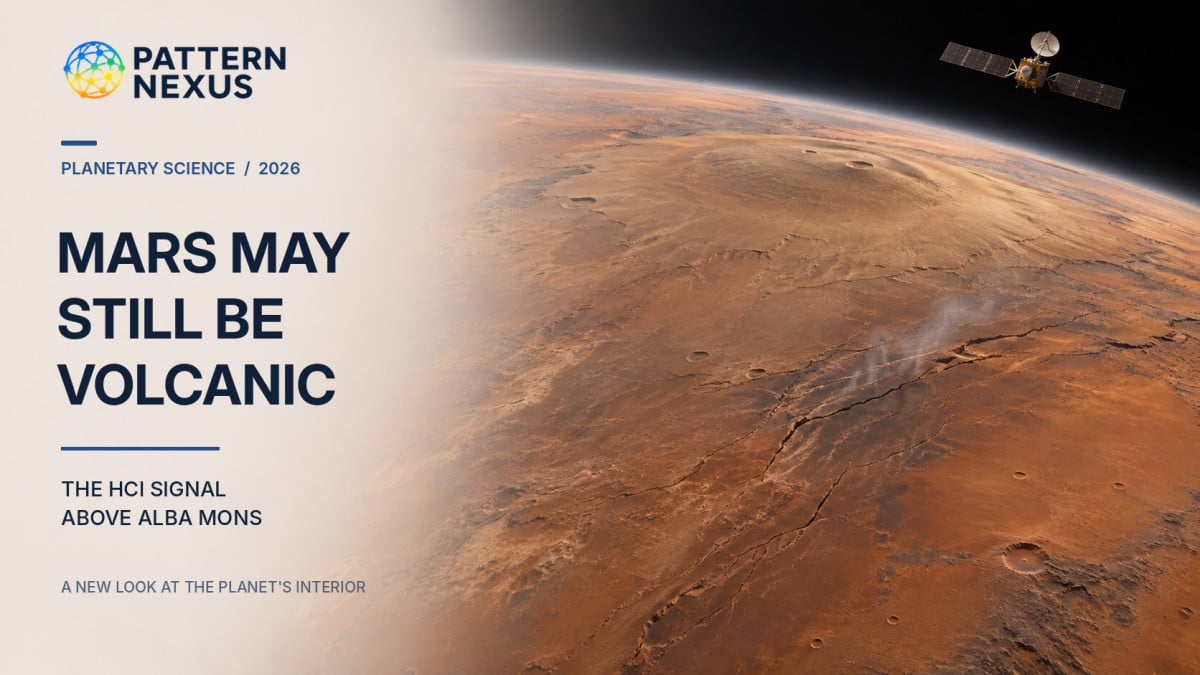
- The measured gas is hydrogen chloride (HCl), not hydrogen sulfide or sulfur dioxide. A November 4, 2026 paper reports localized HCl detections over the northern Alba Mons region, outside the usual seasonal pattern. [1] [2]
- The concentrations are tiny: on the order of two parts per billion by volume. Small abundance is normal for a trace-gas study; the location, season, repetition and atmospheric profile carry the evidentiary value. [3]
- The geography is significant. Scientists matched the unusual atmospheric detections with recently identified, narrow fractures and altered-looking patches along a giant volcanic edifice. The link between the gas and specific fissures is an inference, not a surface measurement. [2] [4]
- Mars already had a nonvolcanic HCl mechanism. Dust, salty minerals, water vapor and sunlight explain much of the gas previously observed across both hemispheres. The 2026 finding is about a restricted anomaly that the earlier model does not readily explain. [5] [7]
- The question is geothermal activity, not an imminent eruption. No erupting lava or active volcanic vent has been directly observed at Alba Mons. A magmatic explanation is favored by the researchers but still needs corroboration. [1] [4]
- Life remains a separate proposition. Heat plus protected water and reactive rock could support hydrothermal niches. No organism, metabolism, liquid-water reservoir or HCl-producing living system has been detected in the fissures. [3] [13]
Measured
~2 ppbv HCl in anomalous observations; an atmospheric trace signal, not a gas cloud.
Place
Northern Alba Mons; narrow fissures and surface discoloration are candidate pathways.
Separate Evidence
InSight and 2026 melt studies concern Elysium Planitia, not the gas-detection site.
Not Demonstrated
No observed eruption, magma sample, liquid-water aquifer or microbial life at Alba Mons.
01 · EXECUTIVE THESIS
The Red Planet May Have Lost Its Surface Climate Without Losing All of Its Internal Activity
Mars is usually described as a world whose major volcanic era ended long ago: enormous shield volcanoes, dried channels, a thinned atmosphere and a cold, irradiated surface. That shorthand is useful, but geological dormancy and geological extinction are not the same condition. The distinction is no longer just a matter of old lava flows and crater counts.
On November 4, 2026, an international team led by Alexander Trokhimovskiy published a paper in Science Advances reporting unusual hydrogen-chloride detections over the northern flank of Alba Mons. The results combine the ExoMars Trace Gas Orbiter’s atmospheric spectroscopy with high-resolution observations of nearby fractures. The authors argue that the combined pattern is most consistent with gas escaping from igneous activity somewhere beneath the crust. [1] [2]
This is a multi-instrument inference, not an image of molten rock. The HCl was measured in the atmosphere; the fissures were seen in imagery; the link between them and a deeper magmatic source is a hypothesis supported by their timing and geography. The new data raise the likelihood of presently active geologic processes at Alba Mons without settling the question.
Research boundary: Observation = atmospheric HCl and mapped surface structures. Interpretation = possible magmatic seepage. Extrapolation = hydrothermal liquid water and habitable niches. Unsupported leap = confirmed eruption or present-day Martian life.
02 · THE MEASUREMENT
What Was Actually Detected: A Few HCl Molecules in a Billion
The gas is hydrogen chloride, HCl . It contains hydrogen and chlorine, not sulfur. In water it forms hydrochloric acid, but an orbital trace-gas detection of HCl is not a cloud of concentrated liquid acid. Nor is the observation an announcement that the whole Martian atmosphere has become poisonous; Mars is already unbreathable to humans for multiple reasons.
In a detailed ESA interview, co-author Daniel Mège described concentrations on the order of two parts per billion by volume, approximately two HCl molecules for every one billion atmospheric molecules. The result is chemically minor in absolute abundance but potentially important as a tracer of the process producing it. A smoke detector responds to a signal, not necessarily to a large mass of smoke. A planetary spectrometer works on an analogous principle: rare molecules can identify a source if the spectral measurement is credible and the background chemistry cannot account for the pattern. [3]
The atmospheric detections were concentrated over the high northern Alba Mons sector during the cold aphelion season, when Mars is farther from the Sun. Earlier work had documented much broader HCl episodes during the warm perihelion part of the Martian year, making the new seasonal behavior unusual. [1] [7]
The critical observations are repeatability, season, location and height profile. None alone identifies the source; together they narrow the explanations. The orbiter did not lower a sensor into a fissure or chemically sample material flowing from it.
03 · DETECTION SYSTEM
How an Orbiter Finds a Gas That Barely Exists
ExoMars TGO was launched in 2016 to investigate trace constituents of the Martian atmosphere, including gases that might signal current geological or biological activity. The new measurements came from its Atmospheric Chemistry Suite , including infrared spectral observations capable of identifying absorption features associated with HCl. [5] [13]
A central observing technique is solar occultation : the spacecraft watches sunlight pass through the atmospheric limb as Mars moves between the instrument and the Sun. Molecular fingerprints appear in the absorbed wavelengths, allowing scientists to reconstruct gas abundance as a function of altitude. The method offers sensitivity to trace quantities, but it is not a camera pointed straight at the ground.
Dust and ice aerosols can block the sightline and set a floor on the lowest observable altitude. That means an HCl enhancement at the lowest retrieved levels is consistent with a near-surface input, but the instrument does not directly determine which specific crack emitted it. Atmospheric transport between the source and the line of sight also has to be modeled.
The geological half of the investigation used high-resolution imaging, including the Trace Gas Orbiter’s CaSSIS camera and broader orbital context, to locate surface disruptions that could plausibly serve as pathways. Spectroscopy identifies the substance; imaging identifies candidate plumbing. Neither instrument alone proves the plumbing connects to melt. [2] [4]
04 · THE RESEARCH TIMELINE
This Started in 2021. The 2026 Result Is a New Interpretation of a More Specific Signal
| Period | What the research established | Interpretation at that stage |
|---|---|---|
| 2018 dust storm / 2021 publication | ExoMars identifies HCl globally, sometimes in both hemispheres. | Seasonal dust, salts and water chemistry are favored over widespread volcanism. [5] |
| 2024 | Detailed atmospheric climatology documents typical 1–3 ppbv seasonal behavior and aerosol correlations. | HCl can be generated without current volcanoes; background conditions must be subtracted. [7] |
| Extended targeted campaign | Repeated out-of-season observations are concentrated near northern Alba Mons. | A geographically restricted, near-surface input becomes plausible. [3] [4] |
| November 4, 2026 | Science Advances publishes atmospheric and geological synthesis. | Ongoing igneous seepage becomes the favored explanation, not a proven surface eruption. [1] |
The causal reversal is important: scientists did not discover “gas on Mars” for the first time in November 2026. They had known HCl existed for years. What changed was a persistent spatial and seasonal exception to the dust-cycle model. The same gas can be almost unremarkable in one context and geologically consequential in another.
05 · THE LOCATION
Alba Mons: An Ancient Giant With a Disturbed Northern Flank
Alba Mons is a low-relief but extraordinarily broad volcanic structure in the Tharsis region of Mars. Olympus Mons is taller; Alba Mons covers a more expansive surface footprint. Its slopes record long-lived volcanism, fracturing and deformation. The new target is not the summit of a currently erupting cone but a high-latitude area along its northern flanks. [2]
ESA identifies a CaSSIS context image taken February 3, 2023 , covering roughly 20 by 20 kilometers near 64.6°N, 274.4°E . Scientists describe narrow fractures, in some cases hundreds of meters long, with colored or pale deposits nearby. The paper’s abstract describes newly recognized fractures under one meter wide. These measurements refer to observed surface features; they are not a measured width of the entire subsurface magma pathway. [1] [3]
On Earth, fumaroles discharge gases through faults, joints and hydrothermally altered ground. A similar mechanism on Mars could produce mineral coatings or color changes. But bright spots or young-looking cracks can have multiple geological causes. Cracks can exist without present magma, deposits can be produced by other chemistry, and high-resolution imagery cannot date a fracture simply because it looks fresh.
Nor should the highlighted ESA image be treated as a photograph of gas visibly pouring into the atmosphere. It is a geological image of a candidate source environment. The HCl evidence comes from separate spectrometric observations.
06 · THE SEASONAL GATE
How Martian Winter Ice Could Hide a Gas Source Until Summer
Mars has a polar frost cycle dominated by seasonal carbon-dioxide ice and variable water ice. At high northern latitudes, colder months can change near-surface permeability, trap or adsorb some gases, and alter the atmosphere’s ability to preserve HCl long enough for an orbiter to see it. ESA notes winter temperatures in this setting can fall toward −120°C. [2] [3]
The proposed sequence is straightforward: gas is supplied from below; near-surface ice or frost limits escape or contributes to chemical uptake; warming and sublimation during early northern summer temporarily reopen pathways or improve atmospheric detectability; a localized HCl pulse becomes visible and later fades. This is a plausible gating mechanism, not a directly observed frost plug opening and closing.
The seasonal timing makes a shallow volatile reservoir possible as well. A gas could have been released from mineral deposits or pore spaces before the observation window, stored, and then re-emitted without requiring freshly rising magma on each occasion. That ambiguity is one reason the inference must be evaluated against the entire geochemical system.
Working causal chain: possible subsurface supply → fractures and permeable rock → seasonal freezing/uptake → early-summer release → low-altitude atmospheric HCl → rapid chemical or atmospheric removal. Every arrow needs independent testing.
07 · COMPETING EXPLANATIONS
Four Plausible Routes to HCl—and Only One Requires Active Magma
| Hypothesis | Can produce HCl? | Problem it must solve | Assessment |
|---|---|---|---|
| Dust–salt–water atmospheric chemistry | Yes; already documented as a major seasonal mechanism. | Explain local, repeated cold-season pulses above Alba Mons. | Verified background chemistry; incomplete explanation for new anomaly. [5] [7] |
| Release from frost, ice or adsorbed/chloride-rich ground | Plausible through storage and re-emission or local reactions. | Account for source inventory, location and repeatability. | Relevant alternative; not excluded by orbital HCl alone. [3] |
| Hydrothermal or rock–fluid reactions | Potentially, depending on water, temperature and mineral chemistry. | Demonstrate sufficient water/heat and actual gas production. | Mechanistic alternative; present-day liquid water not measured at site. [4] |
| Magmatic degassing through fractures | Yes. HCl is a known volcanic halogen gas. | Show source-to-surface transport and rule out nonmagmatic alternatives. | Favored interpretation in 2026 paper; not direct confirmation of melt. [1] [2] |
The 2024 atmospheric climatology matters because it stops an easy mistake: HCl is not an exclusively volcanic fingerprint. Salt-containing dust interacting with water vapor produces chlorine chemistry under Martian conditions. Near-Earth analogies do not override that measured Martian pathway. [6] [7]
At the same time, attributing every HCl observation to dust simply because dust can make HCl would be the opposite mistake. The unusual Alba Mons events were observed when and where the standard seasonal cycle predicted little. Source discrimination must be performed against timing, altitude, weather, transport and surface geology as a combined inverse problem.
08 · EVIDENCE LADDER
Measured, Inferred, Plausible, and Not Demonstrated
| Claim | Status as of November 5, 2026 | Evidence basis |
|---|---|---|
| HCl exists in Mars’ atmosphere | Established | ExoMars spectroscopy and years of published measurements. [5] |
| Unseasonal HCl occurs near Alba Mons | Reported in peer-reviewed research | Localized aphelion-season observations. [1] |
| Fresh-looking narrow fissures exist in the same broad region | Observed surface morphology | CaSSIS and associated imaging. [2] |
| Those exact fissures emit HCl | Not directly established | Spatial association plus transport/source hypothesis. |
| An active magma body lies beneath Alba Mons | Supported inference, unconfirmed | Possible igneous origin of the gas and volcano context. [4] |
| Liquid groundwater makes active hydrothermal habitats | Physically plausible, unmeasured here | Thermal/geochemical reasoning, not a water sample. |
| Life exists beneath Alba Mons | No evidence of detection | No biological measurement or sampled environment. [3] |
The way to read a planetary discovery is not “true or false” but through the evidentiary depth of each claim. The new data legitimately move the volcanic hypothesis upward. They do not automatically promote every downstream habitability or life claim with it.
09 · INDEPENDENT INTERIOR CLUES
The Case for a Living Martian Interior Does Not Depend on Alba Mons Alone
Across Mars, a different region supplies an independent geophysical argument. NASA’s InSight lander recorded marsquakes associated with Cerberus Fossae in Elysium Planitia . Research in Nature Astronomy attributed some deeper low-frequency signals to a potentially warm and magmatically modified source region around 30–50 kilometers deep. InSight’s signal was not a local tremor monitor stationed beside Alba Mons; the geographic distinction is essential. [8] [12]
A 2022 mantle-plume model proposed a roughly 4,000-kilometer-wide hot upwelling beneath Elysium Planitia that could help explain unusual topography, recent lava, faulting and marsquakes. This was an interpretation of geophysical and geological evidence, not a camera image of a liquid mantle plume. [9]
In 2026, separate seismic work published in Nature Communications interpreted low-velocity zones beneath several Elysium sites at roughly 70–100 kilometers depth, with model-derived melt fractions near 2–12% . Those numerical estimates are specific to that study and depend on seismic modeling assumptions. They cannot be transferred directly to Alba Mons, but they weaken the simplistic premise that the entire Martian mantle is necessarily frozen and immobile. [10]
The correct synthesis is geographical independence, not geographical equivalence. Elysium supplies a potential deep-heat mechanism and an example of concentrated modern activity. Alba Mons supplies a new and distinct atmospheric-plus-geological anomaly. Agreement on the broad possibility of remaining internal heat does not prove that both locations share one magma chamber.
10 · GEOLOGIC TIME
“Recent” Volcanism Means Something Different on a Planetary Clock
Orbital crater counts and surface stratigraphy suggest some Martian volcanic deposits are extraordinarily young by planetary standards. A 2021 Icarus paper described a possible explosive volcanic deposit near Cerberus Fossae, with crater-count model ages spanning roughly 53,000 to 210,000 years . The low end of that range is often repeated in news reports as though an eruption occurred precisely 53,000 years ago. The study’s uncertainty and model assumptions are part of the finding. [11]
A volcano that was active 100,000 years ago is young in a 4.5-billion-year planetary record, yet it is not a volcano seen erupting today. A chamber can cool, fracture and continue releasing gases long after its last surface lava. A planet may preserve localized heat without a continuous global plate-tectonic engine.
Therefore, the new HCl result does not establish an eruptive forecast. It suggests a process may still be transporting volatile chemistry from depth toward the surface. That could matter more for long-term habitability than whether lava is visibly spilling down Alba Mons this year.
11 · ASTROBIOLOGY
A Hydrothermal Niche Is a System, Not a Gas Reading
Life as we know it requires a combination of accessible liquid water, usable energy, chemical building blocks and sufficient environmental stability. Geothermal activity could help with some of those requirements. Warm rock can release chemical energy, drive fluid circulation and create protected environments beneath an otherwise harsh surface. Hydrothermal systems are one major hypothesis for life’s emergence on Earth, though the origin of terrestrial life remains unresolved.
If Alba Mons possesses hot rock, permeable fractures and groundwater or melting ice, it could host chemical gradients suitable for microbes. But the conditional stack is long: heat is not proof of water; water is not proof of habitability; habitability is not proof of biology . The HCl detection is most naturally a possible geological tracer, not a biological marker. [3] [4]
There is another counterintuitive detail. In ESA’s interview, Mège emphasized that HCl itself is not the life-sustaining ingredient; chemically harsh HCl is generally associated with magmatic gases, while more benign hydrothermal environments may exist elsewhere along a source-to-surface pathway. The biologically interesting reservoir might be adjacent to , rather than identical with, the vent where HCl eventually escapes. [3]
Even on Earth, many environments with water, heat and chemical energy host no organisms—or lack a record of an indigenous origin. Duration, permeability, freezing behavior, brine chemistry and the depth of any liquid-water interface would determine whether a Martian setting could preserve a stable ecological niche.
12 · WATER AND ENERGY
The Real Unknown Is Whether Any Warm Water Reservoir Exists There Today
Present-day Mars loses surface liquid water quickly because the environment is cold, low-pressure and irradiated. Salts can lower freezing temperatures, ice can shield deeper materials, and buried rock can retain heat. Those conditions make deep liquid or transient briny water physically interesting, but do not prove a currently connected aquifer under Alba Mons.
For the new magmatic model to become an astrobiological target, a follow-up program would need evidence of depth-dependent temperature, subsurface dielectric or radar signatures, hydrated alteration minerals, or geochemical signals requiring liquid-phase circulation. A thermal anomaly alone could come from solar heating, rock properties or other effects. The water question cannot be answered by HCl concentration in the atmosphere.
The engineering challenge is severe. Orbiters are exceptionally good at broad spectroscopy and geological reconnaissance, while direct sampling of deep fractured rock is much harder. Future life detection would need methods that distinguish indigenous Martian chemistry from instrument contamination and terrestrial biology carried by spacecraft.
13 · MISSION ARCHITECTURE
Why the Next Mars Missions Will Not Automatically Settle the Alba Mons Question
ESA’s Rosalind Franklin rover is currently targeted for launch in 2028, with an unusual transfer plan that anticipates a Mars landing around 2030. Its design includes a drill capable of sampling down to approximately two meters, an important step beyond surface-only sampling for organics protected from ultraviolet radiation. [13] [17]
But the rover’s selected scientific terrain is Oxia Planum , an ancient clay-rich environment. That site was selected for preserved evidence of past water and habitability. It is not the suspected vent field on Alba Mons. The 2026 HCl discovery does not mean the rover is suddenly being redirected to sample the northern volcano. [14]
A dedicated Alba Mons campaign would be a different mission class: sustained regional spectral monitoring from orbit; repeat imaging with precise geolocation; detection of surface temperature and changes in frost cover; then—if the evidence sharpens—a landed geophysics, heat-flow or chemical instrument package. Subsurface drilling deep enough to reach a genuine hydrothermal zone could be orders of magnitude more demanding than a two-meter rover drill.
TGO itself has already demonstrated the value of long-baseline observations. The difficult event may be brief, localized and seasonal; a single flyby or one Mars season could miss it. Designing for temporal coverage is as important as peak instrument sensitivity.
14 · FALSIFIABLE TESTS
Six Measurements That Would Sharpen or Break the Magmatic Hypothesis
- Repeat the same local signal in successive northern summers. The HCl peak should recur over a constrained area after accounting for atmospheric transport. A diffuse global pattern would weaken a fixed-vent model. [1]
- Resolve the vertical gradient. A stronger signal at low altitudes, with rapid decline aloft, supports a near-surface source but does not by itself identify the chemistry.
- Track water vapor, dust, aerosols and frost independently. If ordinary salt–dust chemistry fully predicts the anomaly, the need for deep magma diminishes. [7]
- Search for co-varying volcanic chemistry and mineral deposits. Additional halogens, altered ground or surface compositional changes could strengthen the degassing interpretation. The continued lack of detectable sulfur dioxide limits claims about active eruptions. [1]
- Watch for repeatable physical change. New fractures, thermally unusual regions or documented seasonal changes around candidate vents could support a throughgoing plumbing system.
- Seek direct geophysics near Alba Mons. Regional seismology, heat-flow observations, electrical structure or ground measurements would help distinguish hot rock from purely atmospheric or shallow cryogenic chemistry.
None of these tests requires a dramatic eruption. A null result is useful too: if HCl disappears after changing dust conditions, or peaks migrate in ways predicted by circulation, the hypothesis should be revised. Planetary science advances when a proposed mechanism makes measurements that can fail.
15 · INTERPRETATION MATRIX
Three Outcomes, and What Each Would Mean for Mars
| Outcome | What future data would show | Implication |
|---|---|---|
| Localized active igneous degassing | Recurring fixed source; atmospheric profiles and geophysics consistent with deep heat. | Mars retains regional magma-related processes. Habitable niches become worth targeted investigation. |
| Shallow cryogenic or geochemical release | HCl tied to subsurface salts, frost transitions or water–rock reactions without evidence of active melt. | Mars remains chemically dynamic; a geothermal conclusion becomes weaker. |
| Atmospheric circulation/dust explanation | Detailed aerosols and transport models account for local anomalies without a fixed surface vent. | The HCl result still improves atmospheric chemistry but does not establish present igneous activity. |
These are conditional pathways, not numerical probability forecasts. The observations support further discrimination, not invented certainty. The primary paper’s wording—“potential signature”—is appropriately narrower than much of the headline coverage. [1]
16 · OFF-WORLD INFRASTRUCTURE
A Warm Planetary Interior Would Change Exploration Priorities More Than It Would Change Tomorrow’s Mars Weather
The Mars mission stack is normally divided into orbital relays, surface mobility, sample collection, landing systems and eventual human infrastructure. This result adds a targeting problem: a future mission searching for active subsurface life may need different sites and instruments from one searching for fossil biosignatures in ancient sedimentary rock.
A mineral-rich hydrothermal area might offer energy gradients, altered materials and sheltered microenvironments. It could also be physically hazardous, chemically corrosive, difficult to land on and subject to strict planetary-protection protocols. There is no engineering basis to treat an HCl hotspot as a ready-made future settlement location.
The infrastructure conclusion is therefore about reconnaissance and decision quality. Establish persistence of the source first. Identify the mechanism second. Confirm actual water and depth third. Only then does it make sense to discuss drilling, biological assays or permanent support hardware. A speculative aquifer is not a resource reserve.
18 · PATTERN NEXUS LENS
Mars Is Not a Dead World or a Living World. It Is a System With Hidden Gradients.
A planet is a coupled thermal, chemical, atmospheric, hydrological and mechanical system. Its surface can look inert while energy continues moving through buried pathways. HCl is useful because it may make one of those pathways observable. The public headline reduces that to “noxious gas.” The scientific question is which reservoir is releasing it and what that implies about the interior.
The sequence is familiar across planetary science. The first measurements reveal a weak signal. A simple model explains the common cases. A localized exception survives repeated observation. Geology suggests a mechanism. Then new observations are designed to distinguish that mechanism from its alternatives. It is a process of eliminating explanations, not jumping to the most dramatic one.
If the igneous hypothesis survives, it will say something profound but specific: Mars may retain enough regional heat and permeability to cycle gases from depth into the atmosphere today. If it fails, the failure will still reveal a more complex, time-dependent salt and frost chemistry than our current atmospheric picture captures. Both outcomes advance the planetary record.
The strongest conclusion available on November 5, 2026 is that Mars now has a geographically focused atmospheric anomaly with a credible volcanic interpretation—and a new target for falsifiable follow-up research. The leap from that statement to a confirmed underground ecosystem remains entirely unwritten.
FAQ
Questions Readers Are Asking
What gas did scientists find on Mars?
Hydrogen chloride, HCl. It is a chlorine-containing gas detected at trace levels, not hydrogen sulfide or sulfur dioxide.
Did scientists find an active volcano on Mars?
They found a localized gas signal and fissures consistent with possible igneous seepage. There is no direct observation of an eruption or confirmed active magma chamber at Alba Mons.
How much hydrogen chloride was measured?
The ESA research interview gives an approximate concentration on the order of two parts per billion by volume in the anomalous observations.
Where are the fissures?
They are on the northern flanks of Alba Mons. ESA describes a February 2023 close-up near 64.6°N, 274.4°E; the source of the measured gas has not been confirmed at a particular crack.
Could dust and salt produce HCl without volcanoes?
Yes. ESA and previous peer-reviewed work documented an atmospheric dust–salt–water reaction pathway. The 2026 puzzle is the unusually localized cold-season signal.
Has life been found under Alba Mons?
No. The study detected no organisms or metabolism and did not sample a liquid-water reservoir. Hydrothermal habitability remains a possibility.
What did NASA InSight detect?
Marsquakes, particularly near Cerberus Fossae in Elysium Planitia, a different region from Alba Mons. Other research interprets some seismic structures as evidence of lingering heat and possible partial melting.
Will Rosalind Franklin explore the new gas site?
Not under the current mission plan. The ESA rover targets Oxia Planum, an ancient clay-rich setting, and is currently planned for a 2028 launch.
Could Mars erupt again?
Future eruptions cannot be ruled out on geological grounds, but the HCl result does not forecast an eruption, give an eruption probability or locate a definite surface vent.
SOURCES
Primary Research and Source Record
Peer-reviewed papers and mission-agency technical reports lead this research record. Press reporting is used only for context. The Science Advances DOI may require journal access; its abstract and researcher descriptions are publicly available. Source numbers return to the first linked citation in this report.
- [1] Trokhimovskiy, A., Mège, D., et al., Science Advances, Enigmatic HCl detections as a potential signature of igneous activity on Mars . Published online November 4, 2026; DOI 10.1126/sciadv.aeb9422. ↩
- [2] European Space Agency, European orbiter detects hints of volcanic activity on Mars . November 5, 2026; official release and instrument/geology context. ↩
- [3] European Space Agency / Daniel Mège interview, Geological intuition for Mars . November 4, 2026; first-person research explanation, HCl concentration and life limits. ↩
- [4] University of Oxford, Department of Physics, European orbiter detects hints of volcanic activity on Mars . November 4, 2026; reporting from collaborators, seasonal behavior and fissure interpretation. ↩
- [5] European Space Agency, ExoMars discovers new gas and traces water loss on Mars . February 10, 2021; original identification and nonvolcanic chemistry. ↩
- [6] European Space Agency, How hydrogen chloride may be created on Mars . February 10, 2021; salts, dust, water and photochemical cycle. ↩
- [7] Olsen, K. S., et al., Journal of Geophysical Research: Planets, Relationships Between HCl, H₂O, Aerosols, and Temperature in the Martian Atmosphere: 1. Climatological Outlook . August 27, 2024; measured seasonal HCl, aerosol and water relationships. ↩
- [8] Stähler, S. C., et al., Nature Astronomy, Tectonics of Cerberus Fossae unveiled by marsquakes . 2022; InSight seismic evidence from a different Martian region. ↩
- [9] Broquet, A., and Andrews-Hanna, J. C., Nature Astronomy, Geophysical evidence for an active mantle plume underneath Elysium Planitia on Mars . December 5, 2022; modeled mantle plume, geographically separate from Alba Mons. ↩
- [10] 2026 Nature Communications research team, Partially melted low velocity zones reveal an active upper mantle beneath Elysium Planitia, Mars . 2026; seismic interpretation of partial melt at roughly 70–100 km depth. ↩
- [11] Horvath, D. G., et al., Icarus, Evidence for geologically recent explosive volcanism in Elysium Planitia, Mars . 2021; crater-count modeled age of candidate volcanic deposit. ↩
- [12] NASA / JPL, NASA’s InSight Reveals the Deep Interior of Mars . 2021; location and constraints of recorded marsquakes. ↩
- [13] European Space Agency, ExoMars Mission Overview . Mission information, 2028 Rosalind Franklin target and two-meter drilling capability. ↩
- [14] European Space Agency, ExoMars rover targets vast bed of clay in search for life . June 4, 2026; actual Oxia Planum geological target; not Alba Mons. ↩
- [15] American Association for the Advancement of Science, Noxious gas discovered above cracks in the Martian surface suggests volcanic activity . November 4, 2026; press information and peer-reviewed paper reference.
- [16] Reuters, Pungent gas above Martian fissures hints at ongoing volcanism . November 4, 2026; independent contemporaneous reporting.
- [17] European Space Agency / ExoMars, ExoMars Rosalind Franklin mission profile . Late-2028 launch plan, 2030 arrival architecture and drilling objectives. ↩
Pattern Nexus examines the systems beneath individual headlines: evidence thresholds, energy gradients, planetary chemistry, geological memory, infrastructure and the limits of measurement. No single gas detection proves biology.
Article overview
A European orbiter has found an unusual HCl signal over cracks in the flank of a giant Martian volcano. The discovery adds a new atmospheric line of evidence to the case for a still-active interior—and forces a sharper separation between volcanic chemistry, underground habitability, and proof of life.
คุณมีปฏิกิริยาอย่างไร?
 ชอบ
0
 ไม่ชอบ
0
 รัก
0
 ตลก
0
 ว้าว
0
 เศร้า
0
 โกรธ
0

Nexus (Christopher)
Founder of Pattern Nexus. I research markets, macro, geopolitics, AI, history, ancient systems, and the patterns most people overlook. I’m also building Market Radar, a trading scanner designed to read pressure, risk, confirmation, and setup quality before ch…
Related research
Polar Vortex Watch 2026–27: The Sun Quieted, the Vortex Hit a Record — Now the Real Test Begins
The early-season Arctic vortex has now crossed from unusual into a verified date-matched record at 10 hPa. At the same time, NOAA reports v…
3 shared topics, same research avenue.
Polar Vortex Watch 2026–27: Early Arctic Organization Is Now Pressing Historical Extremes
What started as an unusual late-August structural signal is becoming something much harder to dismiss. The 10-hPa Arctic winds have moved a…
3 shared topics, same research avenue.
The Space Infrastructure Race Just Escalated: PALLAS-1, Orbital Warfare, and NASA’s Mars Network
Three developments in the first days of September 2026 pushed the space-infrastructure thesis forward again. China’s Galactic Energy succes…
3 shared topics, same research avenue.Did Life on Earth Begin on Mars? Sample 25, Viking, and the Evidence We Left Behind
Perseverance sealed the strongest potential Martian biosignature yet inside Sample 25. Viking's 1976 results are being re-litigated. NASA's…
3 shared topics, same research avenue.
Sunset on Mars: The Blue Hour That Shows What Happened to a World
A sunset on Mars is not just a beautiful image from another planet. It is a physics lesson, an atmospheric fossil, and a reminder that Mars…
3 shared topics, same research avenue.
Oxygen on Venus: The Discovery That Is Not Life, but Still Changes the Search
Scientists directly detected atomic oxygen in Venus’ atmosphere on both the day side and night side, but this is not breathable oxygen and …
3 shared topics, same research avenue.
K2-18 b: The Planet That Shows How Close We Are to the Edge of Knowing
K2-18 b is not proof of alien life, but it may be one of the most important exoplanets ever studied because it shows how the search for lif…
3 shared topics, same research avenue.
NASA’s Moon Base, MoonFall, Nuclear Missions, and the Drone Layer of Mars
A Pattern Nexus analysis of NASA’s 2026 surface-first lunar architecture, MoonFall hopper drones, lunar nuclear power, nuclear-electric Mar…
3 shared topics, same research avenue.
ความคิดเห็น (0)
Security Check
Please complete the captcha to verify you are human.