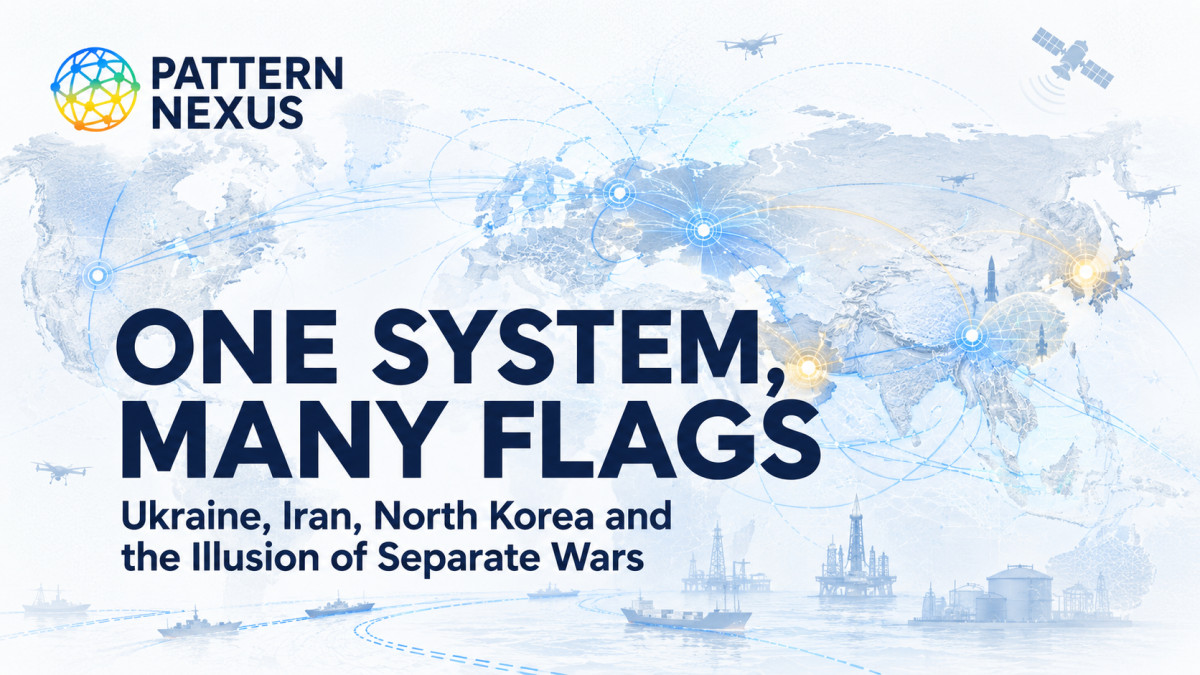
One System, Many Flags: Ukraine, Iran, North Korea and the Illusion of Separate Wars
The United States can arm Ukraine while temporarily easing pressure on Russian oil, convert stockpile transfers into new procurement, court North Korea while Pyongyang supplies Russia, and fight Iran while Russia and China-linked systems help Tehran. The contradictions resolve when the wars are mapped as one connected system of energy, munitions, intelligence, shipping, sanctions and leverage.
 Pattern Nexus Premium Research
One System, Many Flags: Ukraine, Iran, North Korea and the Illusion of Separate Wars
The fighting is real. The deaths are real. What is becoming impossible to defend is the clean map of separate wars, fixed alliances and consistent enemies. Oil, sanctions, munitions, intelligence, shipping lanes, drones and peace talks now form one connected war economy.
The wars are separate on the map and connected in the machinery.
- Washington reduced direct, newly appropriated Ukraine support without ending the weapons flow. Congress has not passed a new Ukraine supplemental since April 2024, but previously authorized funds, U.S. stocks and more than $6 billion of allied purchases through NATO’s PURL mechanism have kept equipment moving.[9][10]
- The Russian-oil waiver was real, consequential and temporary. From March through June 17, the United States authorized delivery and sale of specified Russian cargoes to cushion the energy shock from the Iran war. Ukraine estimated a possible $10 billion benefit to Moscow; analysts disputed the likely magnitude because Russian export flows were already near capacity.[2][5][6]
- As of this article’s cutoff, the broad oil waiver is no longer active. Treasury’s August 20 Russia license concerns negotiations and maintenance connected to the sale of Lukoil’s foreign holding company. It is not a renewal of the Russian seaborne-oil license.[7]
- The weapons-replacement loop is documented; an intentional “burn the old arsenal” strategy is not. U.S. oversight materials say allied PURL money can buy new equipment for Ukraine or replenish U.S. stocks already transferred. GAO says drawdowns generated billions in replacement purchases and new production capacity. That is inventory turnover and industrial stimulus, but it does not prove Washington is prolonging the war to discard obsolete weapons.[9][11]
- The modernization pivot is explicit. The fiscal 2027 defense request directs more than $750 billion toward capability development and procurement, triples drone and counter-drone spending, and prioritizes AI and data infrastructure.[12]
- North Korea’s support for Russia is no longer peripheral. Roughly 14,000 North Korean troops served in Russia’s Kursk region, while Pyongyang supplied millions of artillery rounds, ballistic missiles, long-range artillery and rocket systems. Claims of tens of thousands of additional troops remain disputed.[20][21]
- A wartime North Korean intelligence role for Iran remains unverified. I found no public evidence establishing that Pyongyang supplied Iran targeting intelligence during the 2026 war. The possibility cannot be ruled out, especially given the countries’ historic missile ties, but it cannot be written as fact. South Korean intelligence instead reported that North Korea was publicly distancing itself from Iran and had sent no weapons or war supplies.[33][34]
- The Russia and China intelligence lanes are much better evidenced. U.S. officials said Russia supplied Iran information on American military assets; a Ukrainian assessment alleged Russian satellite and cyber support; and the United States sanctioned three China-based firms for imagery that it said enabled Iranian strikes. Russia and China denied key allegations.[28][29][30]
- Washington is courting North Korea while pressuring South Korea. Trump ordered the annual joint exercise cut from eleven days to five, linked his frustration to Seoul’s refusal to join action against Iran, and sought another meeting with Kim Jong Un. But the United States still stations about 28,500 troops in South Korea and retains sanctions on Pyongyang. This is accommodation and leverage—not U.S. material support for North Korea.[23][24][26]
- The conclusion is not that war is fake. The illusion is the belief that each theater can be understood alone. Follow the oil, interceptors, satellite images, cargo ships, production lines and bargaining chips, and the same system appears beneath every flag.
This article separates confirmed facts, attributed intelligence claims, official denials and Pattern Nexus inference. “Possible” does not mean “proven.” A sanctions license does not automatically mean unrestricted trade. A weapons-replacement mechanism does not prove that a war was engineered to clear inventory. The network is strong enough without stretching the evidence.
Forget the names for a moment. Follow what moves.
I keep looking at this system and reaching the same point: it does not make sense if I read every headline as a separate moral story.
The United States pressures Russia, then temporarily permits specified Russian oil cargoes to move because the Iran war has tightened global energy supply. That oil produces revenue for the same Russian state fighting Ukraine. Washington reduces new direct aid to Kyiv, then helps organize a system in which allies buy American weapons for Ukraine and replenish the inventories being drawn down. The weapons crossing the Atlantic are part of today’s war; the replacement contracts help finance tomorrow’s military.
North Korea sends troops, shells and missiles to Russia. At almost the same time, Washington cuts exercises with South Korea, calls Pyongyang comparatively “unthreatening,” and tries to reopen direct diplomacy with Kim Jong Un. Seoul’s unwillingness to join American action against Iran becomes leverage inside a Korean military exercise. A Middle Eastern war changes an Asian alliance signal.
Russia is accused of helping Iran locate American military assets while the United States tries to negotiate with Russia over Ukraine. China remains North Korea’s economic anchor, buys most of Iran’s exported oil, is accused of enabling Iranian targeting through commercial imagery, and is simultaneously treated as a necessary diplomatic power in both the Gulf and Korea.
Ukraine then strikes shipping in the Caspian that it says is linked to Russian and Iranian military logistics. An Iranian sailor is killed. Kyiv tells Tehran the hit was unintentional and warns Iran to stop supporting Russia. A war that began in Ukraine has now physically entered the Russia–Iran corridor.
Read one headline at a time and this looks incoherent. Read the flows and it becomes recognizable:
Energy moves across theaters. Munitions move across theaters. Intelligence moves across theaters. Sanctions are adjusted across theaters. Alliances are pressured across theaters. The wars are politically distinct but materially coupled.
That is what “one world” means here. It does not mean one secret command center. It means one physical and financial system with too few interceptors, too few production lines, a small number of chokepoints, shared satellite infrastructure, linked commodity markets and governments that trade one theater against another.
The illusion is not the war. The illusion is the box around it.
What survives verification—and what needs a boundary
The pattern gets stronger when the weak claims are removed. This is the evidence ledger I am using.
| Claim | Verdict | Evidence boundary |
|---|---|---|
| The Trump administration reduced U.S. support for Ukraine. | CONFIRMED, WITH CONTINUATION | Direct aid and intelligence were temporarily paused in March 2025; no new Ukraine supplemental has passed since April 2024. Previously funded deliveries and allied purchases of U.S. weapons continued.[9][14][16] |
| The United States waived Russian oil sanctions, helping Russia finance its war. | CONFIRMED, TIME-LIMITED | Specified cargo transactions were authorized from March through June 17, 2026. Sales create Russian revenue, but the realized windfall is uncertain and the license no longer applies.[2][5][6] |
| Washington is currently renewing that oil waiver. | NOT AS OF AUGUST 22 | The August 20 Russia general license is a narrow Lukoil divestment and maintenance authorization, not a new Russian-oil-sales waiver.[7] |
| Ukraine is receiving stockpiled weapons while allied money finances replacements. | CONFIRMED | PURL and drawdown authorities explicitly allow U.S. stock transfers and replenishment. More than $6 billion had been committed to PURL by June.[9][10] |
| The United States is deliberately burning obsolete weapons in Ukraine to build an AI-and-drone force. | UNPROVEN AS INTENT | Inventory turnover and modernization are real. The claim that prolonging war is the purpose is not supported. Many transferred items, especially Patriot interceptors, remain current and scarce.[11][12][42] |
| North Korea materially supports Russia’s war. | CONFIRMED | Troops, artillery rounds, ballistic missiles, artillery and rocket systems are documented. A new missile unit and large future troop deployments are attributed claims, not settled facts.[20][21] |
| North Korea may have given Iran intelligence during the war. | POSSIBLE, PUBLICLY UNVERIFIED | Historic missile cooperation makes contact plausible, and intelligence transfers are harder to observe than weapons shipments. I found no public reporting that establishes a 2026 North Korean intelligence transfer to Iran.[33][34] |
| Russia and China helped Iran’s targeting or war capacity. | STRONGLY REPORTED / PARTLY DISPUTED | U.S. officials alleged Russian targeting support; Ukraine alleged Russian imagery and cyber support. Washington sanctioned China-based imagery firms; China denied the broader accusation.[28][29][30] |
| Ukraine attacked Iran and apologized. | STRIKE CONFIRMED; “APOLOGY” ATTRIBUTED | Ukraine said it struck military-linked shipping; an Iranian commercial vessel was hit. Kyiv said the hit was unintentional and it did not seek escalation. Iran described the contact as an apology.[35][36] |
| Washington is removing support from South Korea and supporting North Korea. | OVERSTATED | Exercises were sharply reduced and U.S. strategy shifts more burden to Seoul. There is no announced general troop withdrawal, and U.S. sanctions remain. Washington is offering diplomatic accommodation, not military or economic support to Pyongyang.[23][26] |
That table is not a retreat from the thesis. It is the thesis with the noise removed.
Pressure is no longer a direction. It is a dial.
Since Trump returned to office, U.S. policy toward the Ukraine war has not moved in one straight line. It has oscillated among coercion, retrenchment, continued supply, threat escalation and negotiation.
In March 2025, Washington temporarily paused military assistance and intelligence sharing to pressure Kyiv after the Oval Office rupture with Volodymyr Zelensky. That was a real withdrawal of support, even though it was later reversed.[14] Congress, meanwhile, has not enacted a new Ukraine supplemental since April 2024. The administration inherited a large pipeline of previously authorized funds and equipment—some of which the Pentagon says will take years to finish spending—then shifted a larger share of the political and financial burden to European and other NATO partners.[9][15][17]
That is how the United States can be “withdrawing” and “still supplying” at the same time. The old model was a U.S.-funded aid program. The newer model is a transactional marketplace: NATO identifies Ukrainian needs, allies finance packages, the United States supplies equipment, and the industrial base receives replacement or new-production orders.
The same bidirectional pressure appears in diplomacy. Trump has threatened Russia with new sanctions and backed weapons deliveries, while continuing to push Kyiv and Moscow toward a negotiated settlement. By August 2026, Ukraine had submitted new proposals to American negotiators, but direct peace work had slowed for months as Washington’s attention and military capacity were absorbed by Iran.[18][19]
This is not ideological consistency. It is leverage management. Support is made conditional. Sanctions are tightened or licensed according to another constraint. Exercises are expanded or reduced as bargaining signals. The alliance is no longer treated as a permanent moral category; it is treated as a contract that can be repriced.
The Iran war opened a temporary Russian revenue valve
This is the clearest example of one theater financing another.
On March 5, 2026, Treasury issued General License 133, authorizing delivery and sale to India of Russian crude and petroleum products already loaded on vessels by that date.[1] On March 12, General License 134 expanded the authorization beyond India for qualifying cargoes loaded by March 12.[2] Later versions advanced the cargo cutoff to April 17 and kept qualifying transactions open through June 17.[3][4]
The reason was not a change of heart about Ukraine. It was the Iran war. Fighting around the Gulf and severe restrictions through the Strait of Hormuz threatened global supply and pushed fuel prices higher. Washington chose to let specified Russian barrels clear rather than allow the energy shock to deepen.
That choice had a direct contradiction built into it. Treasury had sanctioned Rosneft and Lukoil in October 2025 on the ground that Russia’s energy sector funds the Kremlin’s war machine.[8] Months later, the United States temporarily loosened the transaction channel for Russian oil because another American war had made those barrels economically useful.
Zelensky estimated the waiver could deliver roughly $10 billion to Russia. European allies objected. But that number should not be treated as a measured transfer. Analysts told Reuters that Russian exports were already close to available capacity and that the licenses primarily regularized cargoes already at sea. The actual increment to Russian revenue may therefore have been materially smaller.[5]
The direction of the effect is still hard to dispute. A Russian barrel sold is revenue to the Russian oil system; taxes and transfers from that system support the Russian state. The magnitude is uncertain, not the connection.
The waiver expired June 17.[6] That matters because the word currently changes the claim. Treasury did issue a new Russia-related general license on August 20, but General License 131I concerns negotiations for the sale of Lukoil International GmbH and related maintenance. It does not reopen the spring oil-cargo authorization.[7]
The important pattern is not “America lifted all Russia sanctions.” It did not. The important pattern is that a U.S. war against Iran temporarily changed how much pressure Washington was willing to impose on Russia.
That is one system. Hormuz changes Russian cash flow. Russian cash flow changes Ukraine’s battlefield. Ukraine’s battlefield shapes NATO procurement. NATO procurement changes U.S. industrial policy.
Ukraine is a battlefield, a procurement channel and a live military laboratory
The strongest version of the weapons thesis is not that the United States is dumping junk. It is that war converts stored inventory into new production.
U.S. oversight reporting says at least $177.8 billion of the wider Ukraine response had been obligated and $116 billion disbursed by March 31, 2026. The United States had committed $67.8 billion in defense articles and services, while NATO partners had contributed $4.2 billion through PURL either to procure new articles for Ukraine or replenish U.S. stocks drawn down for Ukraine. Another $11.9 billion remained available for obligation, most of it for replenishment.[9]
NATO’s current figure is larger: more than $6 billion committed to U.S.-sourced equipment through PURL by June 2026, with deliveries underway.[10] NATO also says the program has supplied most of the ammunition used by several Ukrainian air-defense systems, including a large share of Patriot interceptors.[42]
GAO describes the mechanical consequence. The Pentagon ordered more than $20 billion in assistance out of its stockpiles and then invested billions in replacements and in production capacity, including 155 mm artillery rounds.[11]
That is a real replacement conveyor:
- Equipment leaves an American or allied inventory.
- Ukraine uses it in an active war.
- Congressional money or allied PURL contributions finance replacement.
- Factories expand production, suppliers add capacity and the replacement item may be newer than the one transferred.
- Battlefield lessons influence what the next system is designed to do.
But the word older needs care. Some transferred vehicles and weapons are legacy systems. Others are among the most modern and scarce capabilities in the Western inventory. A Patriot interceptor destroyed over Ukraine is not surplus simply because a replacement contract follows it. The Iran war has exposed how dangerously thin those magazines already are.
The modernization side is not speculative. The fiscal 2027 defense request is $1.5 trillion, up 42 percent. More than $750 billion is directed to capability development and procurement. The department says it will triple spending on drones and counter-drone systems while funding AI, data infrastructure, space, missile defense and next-generation aircraft.[12] The administration’s drone-dominance policy explicitly seeks large-scale domestic production of low-cost unmanned systems.[13]
Ukraine is also feeding the knowledge loop. NATO’s joint center with Ukraine exists to capture lessons on air defense, critical infrastructure, resilience, drones and adaptation. NATO openly says Ukraine’s war is reshaping modern warfare.[10]
The system does not need that hidden motive. The openly documented incentives are already enormous. Weapons flow out. Contracts flow back. Data flows home. The next force is designed around what survived.
North Korea is Russia’s magazine while Washington courts Kim
North Korea is no longer merely issuing statements in support of Moscow. It has become part of Russia’s military supply system.
Reuters’ August review found that roughly 14,000 to 15,000 North Korean troops had been deployed to Russia, mostly in the Kursk campaign. Pyongyang has supplied millions of artillery and mortar rounds, ballistic missiles, long-range artillery and multiple-launch rocket systems. Ukraine and outside researchers estimate North Korean supplies account for a very large share of Russia’s front-line ammunition, though exact percentages are difficult to verify.[20]
Ukraine also says a roughly ninety-person North Korean missile unit has deployed to Russia’s Voronezh region with launchers and potentially as many as 120 ballistic missiles. That is an attributed Ukrainian intelligence claim; Russia and North Korea did not confirm it.[21] Likewise, Ukrainian claims that another 30,000 to 50,000 North Korean troops may arrive have been denied by Pyongyang. The previous 14,000-person deployment is acknowledged. The future expansion is disputed.
The exchange benefits North Korea. Its troops gain combat experience against a Western-equipped military. Its missiles receive live battlefield testing. Russia can pay in food, fuel, cash, technology, air-defense knowledge, space support or diplomatic cover. The U.S. intelligence community assessed in March that the partnership has already improved North Korean capabilities.[22]
Then look at the other side of the peninsula.
On August 16, Trump ordered the Pentagon to “substantially reduce” the Ulchi Freedom Shield exercise with South Korea. He called the drills costly and an inappropriate, hostile signal to a North Korea he described as unthreatening and respectful during his presidency. He also tied his anger to Seoul’s refusal to participate in action against Iran.[23]
The exercise was cut from eleven days to five, and field training was reduced. South Korean officials said they had not been warned in advance. Trump then renewed his effort to meet Kim Jong Un.[24][25]
This is the weirdness the headlines do not resolve:
- North Korea helps Russia wage war against a U.S.-supported Ukraine.
- The United States reduces a major exercise with South Korea partly because Seoul would not help in the Iran war.
- The reduction is offered as a signal to the North Korean leader whose forces and munitions are strengthening Russia.
- North Korea responds that the gesture is insufficient, while preserving the possibility of leader-level diplomacy.
But Washington is not materially “supporting North Korea.” About 28,500 U.S. troops remain in South Korea. The defense treaty remains. North Korea remains heavily sanctioned, and the State Department continues to enforce restrictions against its cyber, weapons and revenue networks.[26]
The accurate phrase is strategic accommodation. Washington is lowering one form of pressure in hopes of buying dialogue, reducing costs or separating Pyongyang from Moscow and Beijing. Whether that works is another question.
China remains North Korea’s largest economic anchor. Bilateral trade rose 22 percent in the first two months of 2026, while full-year 2025 trade returned close to pre-pandemic levels. Russia has added a second lifeline through war-linked trade and support.[27]
The United States is not funding North Korea. It is trying to reprice the cost of North Korean alignment. The danger is that Pyongyang can accept the signal, keep the Russian benefits and concede nothing.
Russia is reported, China is documented and disputed, North Korea remains an open question
Intelligence support is the part of the network most likely to be real before it is public. It is also the part most vulnerable to overclaiming.
Russia: the strongest wartime case
On March 6, Reuters reported that Russia was providing Iran targeting information that included the locations of American warships and aircraft, citing a Washington Post report based on three officials. Russia later denied sharing information on U.S. military assets.[28]
In April, Reuters reviewed a Ukrainian intelligence assessment alleging that Russian satellites surveyed forty-six military and critical sites in eleven Middle Eastern countries and that Iranian strikes followed some of those surveys. The assessment also described Russian–Iranian cyber coordination. The White House said outside support had not changed U.S. operations; Moscow rejected earlier allegations.[29]
That evidence is not the same as a declassified public intelligence file. It is nevertheless multi-source, specific and consistent with the strategic relationship between Moscow and Tehran.
China: a commercial and dual-use intelligence layer
The China lane is different. The most visible support came through commercial imagery and dual-use systems rather than an acknowledged state intelligence transfer.
On May 8, the U.S. State Department sanctioned MizarVision, The Earth Eye and Chuang Guang. Washington said the three China-based entities published open-source imagery of U.S. activity and supplied satellite imagery of U.S. and allied facilities to Iranian forces, enabling strikes against American forces.[30]
A separate Financial Times investigation, summarized by Reuters, reported that Iran had acquired the Chinese-built TEE-01B satellite and used it to image U.S. bases before or after attacks. China denied the report, and Reuters said it could not independently verify the leaked documents.[31]
The U.S.–China Economic and Security Review Commission has since assembled a much wider timeline of China’s support: Iranian oil purchases, imagery, dual-use components, financial channels, diplomatic protection and reported weapons negotiations. The commission also records China’s denials and its role in ceasefire diplomacy.[32]
North Korea: structurally plausible, publicly unproven
This is where I need to be exact.
North Korea and Iran have decades of missile and military-technology ties. Public and congressional records describe earlier missile transfers, technical cooperation and shared designs. A covert intelligence relationship is therefore not an absurd hypothesis.[34]
But I found no credible public report establishing that North Korea supplied Iran intelligence, satellite imagery, targeting data or cyber support during the 2026 war.
South Korea’s National Intelligence Service said in April that North Korea appeared to be distancing itself from Iran to preserve the possibility of talks with Trump. It found no sign that Pyongyang had sent weapons or other war-related supplies and noted North Korea’s unusually muted public response.[33] That assessment addresses material aid and public posture, not every possible intelligence contact. It therefore does not disprove a covert transfer. It simply leaves the claim unresolved.
This distinction matters because the real network does not require all four countries to behave as one formal alliance. They can cooperate selectively, deny involvement, compete for influence and still generate a combined strategic effect.
Ukraine did not enter the Iran war. The logistics network pulled Iran into Ukraine’s target set.
In late July, the theoretical overlap became physical.
Iran said a Ukrainian drone attack hit an Iranian commercial vessel in the Caspian Sea, killing one sailor and injuring another. Zelensky said Ukraine had struck a Russian warship and other vessels transporting military cargo connected to Iran.[35]
Iran warned that the attack could not go unanswered. On July 28, Ukrainian Foreign Minister Andrii Sybiha called his Iranian counterpart. Sybiha said Ukrainian operations were aimed solely at defending the country from Russian aggression and were never intended to target civilians or civilian vessels. Iran said Sybiha assured it that the strike on the Iranian ship was unintentional and that Kyiv did not seek escalation.[36]
Iranian officials and media later described that assurance as an apology. The public Ukrainian language is narrower: unintentional harm, no desire to escalate, and willingness to address losses.
The incident exposes the corridor beneath the flags. Iran previously supplied Russia with Shahed drones and other military support. Russian and Iranian vessels move through a Caspian logistics environment that Ukraine increasingly treats as part of the Russian war machine. Once the shipping network becomes targetable, an Iranian hull can be hit in a Ukrainian operation even without Kyiv declaring war on Tehran.
This is why proxy-war language is becoming insufficient. The proxies, suppliers, intelligence providers and commercial carriers now occupy the same operating space. A strike against the logistics layer can cross a national boundary faster than diplomacy can explain it.
The Caspian incident was not random spillover. It was the material network revealing itself: a Russian war target, an Iran-linked cargo claim, a commercial casualty and an emergency diplomatic call inside the same chain.
Iran, Israel and Hormuz are pulling on every other theater
Operation Epic Fury began on February 28, 2026. The Department of Defense described the campaign as a U.S. effort to destroy Iran’s nuclear, missile, drone and naval capabilities; by April it reported more than 12,300 targets struck.[37]
Whatever one thinks of the war’s justification, its systems effects are now global.
Energy: Restrictions through Hormuz drove the decision to license Russian cargoes, raised prices and altered Asian refining and export policy. By August 20, Reuters vessel data showed shipping still severely impaired amid the U.S.–Iran stalemate.[39]
Munitions: Patriot, THAAD, Tomahawk and other high-end inventories are shared across theaters. Every interceptor used over the Gulf is one not immediately available for Ukraine, South Korea, Japan or a Pacific contingency. NATO officials have acknowledged the physical limits on available interceptors even while saying PURL deliveries to Ukraine continue.[42] Pattern Nexus previously mapped this as a two-theater magazine-depth problem.[41]
Alliances: Seoul’s refusal to join the Iran campaign became part of Trump’s stated rationale for cutting Korean exercises. Asian allies worry that Middle Eastern demand will draw away air defense and naval resources. Gulf partners seek American protection while also maintaining economic and diplomatic links with China and Russia.
Sanctions: Washington temporarily eased specified Russian oil transactions to contain the energy shock, briefly relaxed and then reversed some Iran oil permissions during negotiations, and is now preparing what Treasury calls its toughest Iran sanctions yet. China buys more than 80 percent of Iran’s exported oil, making Chinese cooperation or defiance central to the next sanctions phase.[38]
Diplomacy: The United States simultaneously bombs Iran, negotiates through intermediaries, threatens new sanctions and seeks navigation terms for Hormuz. It supports Israel militarily while pressing for agreements in Gaza and Lebanon. An August Gaza proposal paired Hamas disarmament with staged Israeli withdrawal, but disputes over sequence and enforcement remain unresolved.[40]
This is not evidence that every event was planned together. It is evidence that no event remains contained.
The Iran war did not merely add a new front. It changed the price of Russian oil, the availability of Ukrainian air defense, the tone of the U.S.–South Korean alliance, China’s leverage over energy flows and the pace of Gaza diplomacy.
China does not need to command the network to benefit from every connection
China is often described as if it must choose a side. That misunderstands the advantage.
Beijing can buy sanctioned Iranian oil, deepen energy ties with Russia, keep North Korea economically viable, sell dual-use components through commercial networks, condemn American military action and still present itself as the diplomatic broker required to end the crisis.
It can deny state involvement in Iranian targeting while Chinese commercial satellites, imagery platforms and navigation systems expand the information environment available to Tehran. It can tell Washington it is not arming Iran while Chinese firms are sanctioned for imagery and procurement support. It can pressure Iran toward negotiations because Tehran needs Chinese oil demand and diplomatic protection.
On the Korean Peninsula, China remains North Korea’s largest traditional trading partner even as Russia becomes Pyongyang’s military patron. Beijing gains from reduced U.S.–South Korean exercises but does not want an uncontrolled North Korean escalation that brings more American forces to the region.
In Ukraine, China benefits from discounted Russian energy and from a Europe focused on security rather than economic competition, while avoiding the direct costs Russia bears. At the same time, prolonged war tightens Western controls on Chinese technology and increases pressure for secondary sanctions.
That is why “alliance” is the wrong word for much of this system. China, Russia, Iran and North Korea do not share a unified command or identical goals. Their interests overlap enough to create strategic depth for one another:
- Russia supplies intelligence, energy and diplomatic cover.
- China supplies demand, dual-use infrastructure, finance and political space.
- Iran supplies drones, missiles, regional pressure and control over a global chokepoint.
- North Korea supplies mass ammunition, missiles, troops and a second nuclear crisis.
Each relationship is transactional. Together they stretch the same American stockpiles, sanctions bureaucracy, alliances and diplomatic attention.
China’s leverage is therefore not that it owns every node. It is that it sits near enough to nearly all of them to monetize the congestion.
Five shared layers make separate wars behave like one war economy
1. The energy layer
Oil does not recognize the moral boundary between wars. Remove Iranian supply or restrict Hormuz and Russian barrels become more valuable. Sanctions written for Ukraine are adjusted because of Iran. Chinese purchasing decisions determine whether pressure on Tehran works. Gulf shipping becomes a variable in Moscow’s budget.
2. The magazine layer
There is no separate Patriot inventory for each geopolitical storyline. The same factories and stockpiles must serve Ukraine, the Gulf, Korea, Europe and the Pacific. Missile defense turns alliances into a queue. Whoever faces the most immediate attack moves forward; everyone else becomes more exposed.
3. The intelligence layer
Commercial satellites, state reconnaissance, cyber groups, shipping databases, signals intelligence and AI-assisted imagery interpretation blur the line between civilian infrastructure and military support. A firm can publish “open-source” imagery that becomes targeting data. A state can deny direct involvement while its commercial ecosystem changes the battlefield.
4. The industrial layer
Weapons transferred from inventory create replacement demand. Replacement demand creates factories, jobs, supply contracts and political constituencies. Battlefield performance determines the next procurement cycle. Drones, counter-drones, AI and electronic warfare rise because Ukraine and Iran reveal the cost exchange of the old model.
5. The diplomatic layer
Every concession becomes tradable. A Russian oil license helps manage Iran-driven inflation. A Korean exercise becomes pressure on Seoul over Iran. A Kim summit becomes a possible wedge against Moscow and Beijing. Ukraine’s air-defense knowledge becomes a bargaining asset in the Gulf. Gaza negotiations affect the legitimacy and duration of the wider Iran campaign.
This is not one war because one leader commands it. It is one war economy because every government is bidding for capacity inside the same constrained system.
That distinction avoids both naïveté and conspiracy. Governments have real conflicts. Their citizens pay real costs. Their leaders make independent decisions. But those decisions enter a shared machine whose bottlenecks transmit pressure everywhere.
Pattern Nexus has repeatedly argued that geopolitics is logistics and collateral wearing a flag. This is the military version of the same framework: the flag tells you who claims the objective; the flow tells you what the system is actually doing.[43]
The illusion is clean sides, not real suffering
I want to be careful with the word illusion, because used lazily it erases reality.
The invasion of Ukraine is not an illusion. The Iranian missiles are not an illusion. Israeli strikes, American bombs, North Korean soldiers, dead sailors, displaced families and destroyed cities are not symbolic pieces in somebody else’s game. They are real events produced by states making choices.
What is illusory is the simplified map we are given afterward:
- One war over here, another war over there.
- Allies on one side, enemies on the other.
- Sanctions as permanent moral walls.
- Aid as charity rather than procurement and leverage.
- Commercial satellites as separate from warfare.
- Peace talks as the opposite of military pressure.
None of those categories survives contact with the network.
The United States can sanction Russian oil and license it. It can reduce direct support for Ukraine and keep American weapons flowing. It can sanction North Korea and court Kim. It can protect South Korea and pressure Seoul by cutting exercises. It can fight Iran and negotiate with Iran. It can arm Israel and push Israel toward a political settlement.
Russia can fight a U.S.-supported Ukraine while reportedly supplying Iran information to strike American forces. China can support Iran’s economic survival while seeking to mediate. North Korea can fight for Russia while muting its support for Iran to preserve a path back to Trump.
Those are not logical errors inside the system. They are the system’s operating method. States do not seek consistency. They seek position.
Once the names are stripped away, the contradiction reduces to a balance sheet. Who has energy? Who has interceptors? Who can replace them? Who can see the target? Who can clear the payment? Who can keep the route open? Who can offer or remove political permission?
That is the world under the story.
What would confirm—or weaken—the one-system thesis
| Signal | Why it matters | What would change the reading |
|---|---|---|
| New Russian oil General License | Would show renewed willingness to trade Ukraine pressure for Gulf energy stability. | A license limited to safety, divestment or blocked accounts should not be called an oil waiver. |
| PURL delivery versus funding | Commitments matter less than actual interceptor and ammunition delivery dates. | Sustained deliveries despite the Iran war would weaken the crowd-out thesis. |
| Patriot, THAAD and Tomahawk production | Magazine recovery determines whether simultaneous theaters remain mutually constraining. | A step-change in output could reduce the zero-sum allocation problem. |
| Verified North Korean force expansion | Would move Pyongyang from support role toward durable co-belligerency. | Independent verification is required; Ukrainian estimates and North Korean denials must remain labeled. |
| Evidence of North Korea–Iran intelligence exchange | Would close the weakest current edge in the network. | Look for declassified assessments, sanctions designations, captured systems, documented cyber coordination or named officials—not inference from historic ties alone. |
| Trump–Kim summit terms | Would reveal whether reduced drills buy restraint, sanctions concessions or distance from Russia. | If Pyongyang keeps expanding Russian support without concessions, accommodation will have failed as a wedge. |
| U.S. Forces Korea posture | Exercise cuts are not troop withdrawal. Force levels, command roles and missile-defense movements are the harder signals. | A formal drawdown below the current roughly 28,500 would materially strengthen the retrenchment thesis. |
| Chinese imagery and sanctions cases | Additional named firms would show a persistent commercial ISR pipeline to Iran. | Public evidence that sanctioned imagery was not used operationally would weaken the claim. |
| Caspian strikes and cargo records | Repeated attacks would confirm the Russia–Iran logistics corridor as an active Ukrainian target set. | Verified civilian cargoes with no military link would increase the legal and escalation risk. |
| FY27 procurement execution | Budget rhetoric becomes strategy only when contracts, deliveries and unit structures change. | Track drone volumes, counter-drone systems, AI/data programs and whether legacy procurement actually falls. |
A connected-world thesis can become unfalsifiable if every event is interpreted as proof. That is why the disconfirming conditions matter. If stockpiles recover, Russian oil licenses do not return, Korean accommodation produces verifiable restraint and no North Korea–Iran intelligence evidence emerges, several of the strongest feedback loops will weaken.
One world does not mean one side
At the beginning, this looked like a pile of contradictions.
America helps Ukraine and constrains Ukraine. It sanctions Russia and licenses Russian transactions. It supplies weapons from stockpiles and finances a new arsenal. It confronts North Korea and courts Kim. It protects South Korea and uses Iran to pressure Seoul. It fights Iran while Russia and China-linked systems help Tehran see and sustain the fight. Ukraine strikes a vessel in the Russian–Iranian logistics space and then calls Tehran to prevent another front.
None of it fits the clean story of two sides.
It fits a world in which states are rivals at one layer, counterparties at another and reluctant partners at a third. Russia can be an enemy in Ukraine, an energy pressure valve during the Iran war and a negotiating party in peace talks. China can be the economic support under North Korea and Iran while also being the diplomatic actor Washington needs. North Korea can support Russia and still leave the door open to Trump. South Korea can host American troops and refuse an American war.
The old map treats those positions as hypocrisy or chaos. The systems map treats them as layered transactions inside shared constraints.
So yes: we live in one world.
Not because the flags are fake. Not because the wars are staged. Not because one invisible hand controls every move.
We live in one world because a missile fired in the Gulf changes what can be fired over Kyiv. A ship stopped at Hormuz changes the value of a Russian barrel. A Russian barrel changes Moscow’s war budget. A North Korean shell changes Russia’s endurance. A Chinese satellite image changes Iran’s targeting. A Korean exercise becomes leverage over a Middle Eastern war. A Ukrainian strike in the Caspian reaches an Iranian deck.
The wars are real. The borders between their operating systems are the illusion.
Forget the names for a moment.
Follow what moves.
FAQ
Is this article saying the wars are fake or staged?
No. The wars, decisions and casualties are real. The “illusion” is the assumption that Ukraine, Iran, Korea, Israel, energy sanctions, weapons inventories and intelligence networks operate in separate boxes.
Is the United States currently waiving sanctions on Russian oil?
Not under the spring 2026 oil-cargo program. The relevant license expired on June 17. Treasury issued another Russia-related license on August 20, but it concerns negotiations and maintenance related to the sale of Lukoil’s foreign holding company, not a renewal of the broad seaborne-oil authorization.
Did the Russian oil waiver fund the war in Ukraine?
Russian oil revenue supports the Russian state and therefore its capacity to wage war. Ukraine estimated a possible $10 billion benefit, but the realized incremental amount is uncertain because the licenses focused on qualifying cargoes and Russian exports were already near capacity.
Is the United States sending obsolete weapons to Ukraine just to replace them?
The stock-transfer and replacement mechanism is documented. Some transferred systems are older; others, including Patriot interceptors, are current and scarce. There is no public evidence that Washington is prolonging the war for the purpose of discarding obsolete weapons.
Did North Korea give Iran intelligence during the 2026 war?
No public evidence reviewed for this article establishes that. Historic North Korea–Iran missile cooperation makes continued contact plausible, and covert intelligence transfers may be hard to observe, but the wartime intelligence claim remains unverified.
What evidence exists for Russian and Chinese intelligence support to Iran?
U.S. officials said Russia provided Iran information on American military assets, and a Ukrainian assessment alleged Russian satellite and cyber support. The United States sanctioned three China-based imagery firms for support it said enabled Iranian strikes. Russia and China denied important parts of those accounts.
Did Ukraine apologize to Iran?
Ukraine told Iran that the strike on an Iranian vessel was unintentional and that Kyiv did not seek escalation. Iranian sources characterized the contact as an apology. The narrower, directly documented formulation is an assurance of no intent plus discussion of restitution.
Is the United States withdrawing from South Korea?
No general troop withdrawal had been announced by the August 22 cutoff. The administration sharply shortened a major joint exercise and has argued for a more limited U.S. role, while roughly 28,500 U.S. troops remain stationed in South Korea.
Is Washington supporting North Korea?
Not materially. U.S. sanctions remain and the defense alliance with South Korea continues. Washington is offering conciliatory signals and seeking leader-level diplomacy. That is strategic accommodation, not military or economic support.
What does “one system” mean?
It means the theaters share energy markets, missile inventories, factories, satellite infrastructure, shipping corridors, payment systems and diplomatic leverage. Pressure applied in one theater changes the options available in another.
Primary documents, current reporting and related Pattern Nexus research
- [1] U.S. Treasury / OFAC, Russia General License 133—specified Russian oil cargoes to India, March 5, 2026.
- [2] U.S. Treasury / OFAC, Russia General License 134—delivery and sale of qualifying Russian crude and petroleum products, March 12, 2026.
- [3] U.S. Treasury / OFAC, Russia General License 134B, April 17, 2026.
- [4] U.S. Treasury / OFAC, Russia General License 134C, May 18, 2026.
- [5] Reuters, U.S. Russian-oil relief riles European allies; benefit estimate and market caveats, March 13, 2026.
- [6] Reuters, United States allows Russian seaborne-oil waiver to expire, June 17, 2026.
- [7] U.S. Treasury / OFAC, Russia General License 131I—Lukoil International divestment negotiations and related maintenance, August 20, 2026.
- [8] U.S. Treasury, Treasury sanctions Rosneft and Lukoil, October 22, 2025.
- [9] Ukraine Oversight, Funding pipeline, defense commitments, PURL contributions and replenishment through March 31, 2026.
- [10] NATO, NATO support for Ukraine—PURL, NSATU and joint innovation programs.
- [11] U.S. Government Accountability Office, Military Readiness—Ukraine drawdowns, replacement investment and production capacity, March 4, 2026.
- [12] U.S. Department of Defense, Fiscal 2027 defense-budget briefing—procurement, drones, AI and data infrastructure, April 21, 2026.
- [13] White House, Unleashing American Drone Dominance, June 6, 2025.
- [14] Reuters, United States pauses intelligence sharing and military assistance to Ukraine, March 5, 2025.
- [15] Council on Foreign Relations, How much U.S. aid is going to Ukraine—appropriations, direct support and domestic spending.
- [16] Reuters, NATO official says aid volume continued after U.S. policy shift, December 19, 2025.
- [17] Reuters, Pentagon says some approved Ukraine funding will extend beyond Trump’s term, July 27, 2026.
- [18] Reuters, Ukraine submits proposals to U.S. negotiators, August 11, 2026.
- [19] Reuters, Ukraine peace talks stalled as U.S. attention moved to Iran, August 14, 2026.
- [20] Reuters, What is known about North Korean forces and weapons supporting Russia, August 6, 2026.
- [21] Reuters, Ukraine alleges North Korean missile-unit deployment to Russia, August 5, 2026.
- [22] Office of the Director of National Intelligence, 2026 Annual Threat Assessment remarks—North Korea’s Russia partnership and capability gains.
- [23] Reuters, Trump orders substantial reduction in U.S.–South Korea exercises, August 16, 2026.
- [24] Reuters, South Korea says exercise cut appears linked to pressure over Iran and investment, August 19, 2026.
- [25] Reuters, Trump seeks another meeting with Kim Jong Un, August 21, 2026.
- [26] U.S. State Department, Democratic People’s Republic of Korea sanctions.
- [27] Reuters, China–North Korea trade rises as ties improve, March 20, 2026.
- [28] Reuters, Russia reportedly provides Iran information to target U.S. forces, March 6, 2026; and Russia’s denial, March 10, 2026.
- [29] Reuters, Ukrainian assessment alleges Russian satellite and cyber support to Iran, April 7, 2026.
- [30] U.S. State Department, Sanctions on entities including China-based imagery providers supporting Iranian military activity, May 8, 2026.
- [31] Reuters, Report that Iran used a Chinese-built satellite to image U.S. bases; China denies, April 15, 2026.
- [32] U.S.–China Economic and Security Review Commission, Enabling Iran—timeline of China’s role during and after Operation Epic Fury, August 6, 2026.
- [33] Reuters, South Korean intelligence says North Korea is distancing itself from Iran and sent no weapons or war supplies, April 6, 2026.
- [34] Congressional Research Service archive, Iran–North Korea–Syria ballistic missile and nuclear cooperation; and JINSA, The Axis Behind Iran, March 25, 2026.
- [35] Reuters, Iranian vessel hit during Ukrainian Caspian operations, July 25, 2026.
- [36] Reuters, Ukraine tells Iran vessel strike was unintentional and warns against escalation, July 28, 2026.
- [37] U.S. Department of Defense, Operation Epic Fury goals, February 28, 2026; and April 1 fact sheet.
- [38] Reuters, U.S. and Iran trade threats as Washington prepares new sanctions, August 22, 2026.
- [39] Reuters, Hormuz shipping remains impaired amid U.S.–Iran stalemate, August 20, 2026.
- [40] Reuters, Gaza plan hinges on Hamas disarmament and Israeli withdrawal, August 10, 2026.
- [41] Pattern Nexus, Iran Turns America’s Missile Stockpile Into a Two-Theater Deterrence Gap.
- [42] NATO, PURL share of Ukrainian air-defense ammunition and interceptor constraints, May 20, 2026.
- [43] Pattern Nexus, Research Hubs—Pattern Nexus systems framework; and The Price of a Fractured World.
This article is a geopolitical systems analysis based on public information available through August 22, 2026. Intelligence claims are attributed to the officials, governments and assessments that made them. Absence of public evidence is not proof of absence, but it is a limit on what can responsibly be published as fact. This is not investment advice.
คุณมีปฏิกิริยาอย่างไร?
 ชอบ
0
ชอบ
0
 ไม่ชอบ
0
ไม่ชอบ
0
 รัก
0
รัก
0
 ตลก
0
ตลก
0
 ว้าว
0
ว้าว
0
 เศร้า
0
เศร้า
0
 โกรธ
0
โกรธ
0

Founder of Pattern Nexus. I research markets, macro, geopolitics, AI, history, ancient systems, and the patterns most people overlook. I’m also building Market Radar, a trading scanner designed to read pressure, risk, confirmation, and setup quality before chasing a move. Pattern Nexus is where I connect the dots between data, history, technology, and the bigger system playing out around us.
ความคิดเห็น (0)