
LifeLog Died. Facebook Launched. The Surveillance Internet Was Born.
DARPA’s LifeLog was publicly killed the same day Facebook launched. That does not automatically prove a covert handoff, but it does expose something larger: the post-9/11 state, Silicon Valley, venture capital, intelligence-linked technology, platform surveillance, PRISM, data brokers, Flock cameras, AI bots, and the dead internet shift all moved along the same structural rail. The story is not just whether DARPA built Facebook. The deeper story is how government surveillance incentives and commercial platform incentives converged into the same machine.
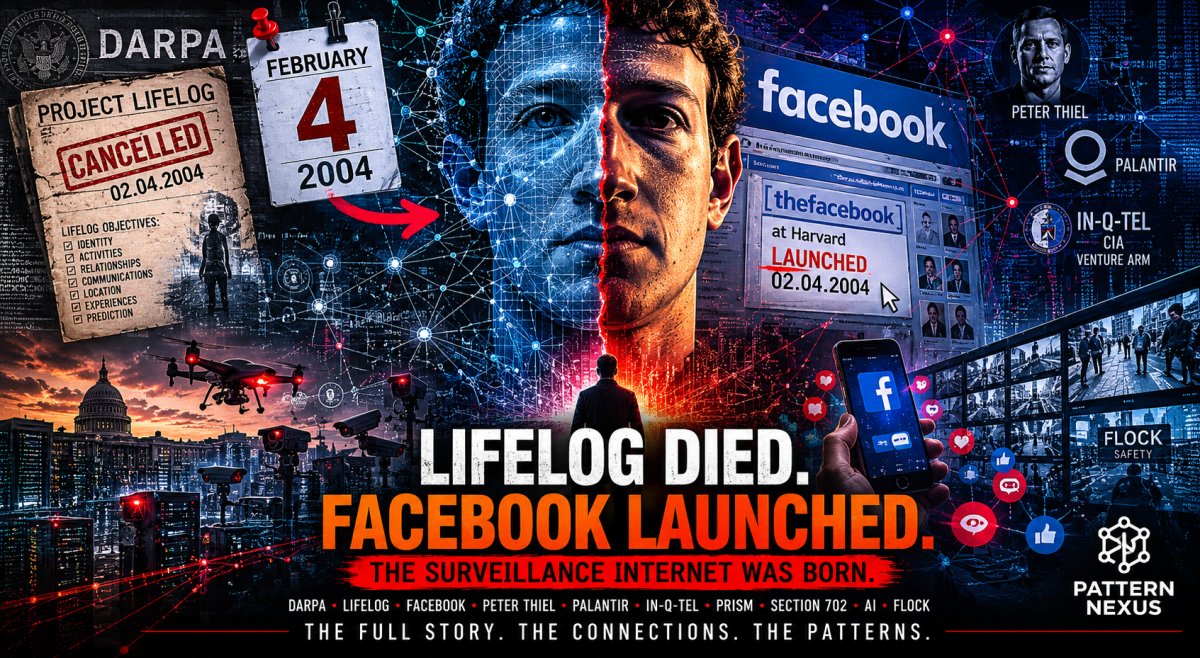

DARPA’s LifeLog program was publicly reported as canceled on February 4, 2004. Facebook launched at Harvard that same day. That timing is real. It is not internet folklore. But the cleaner version of the record also matters: thefacebook.com had already been registered on January 11, 2004, and the earliest Harvard reporting describes Facebook as a fast-built campus social directory influenced by Friendster, not as a publicly documented DARPA transfer. [1] [2] [5]
That does not mean there is “nothing here.” That is the lazy institutional answer, and it misses the actual system. The direct handoff theory is not publicly proven. No public document reviewed here proves that DARPA took LifeLog, changed the logo, and handed it to Facebook. But the convergence is not imaginary. Post-9/11 Washington was openly building information-awareness systems around data fusion, link discovery, social-network analysis, identity, behavior, anomaly detection, prediction, and preemption. At the same time, Silicon Valley was building consumer platforms that collected identity, relationships, preferences, messages, photos, location signals, social graphs, and behavioral data at civilian scale. [3] [4]
The stronger Pattern Nexus reading is this: Facebook does not need to have been literally “LifeLog renamed” for the story to matter. A private social platform emerged inside the same historical current as the post-9/11 surveillance state, then matured into exactly the kind of behavioral infrastructure that governments, advertisers, intelligence agencies, law enforcement, campaigns, data brokers, and AI systems could exploit.
This is not a fact-check article. Fact-checking is too small for this story. The simple fact-check frame asks one narrow question: “Was Facebook directly proven to be LifeLog?” The answer is no, not from the public record reviewed here.
But that is not where the story ends. That is where the real story begins.
The premium value is not repeating the coincidence. Anyone can repeat the coincidence. LifeLog died. Facebook launched. Same day. The value is understanding why that coincidence has survived for more than twenty years, why people keep noticing it, and why the institutional dismissal feels weak even when the direct handoff claim remains unproven.
The government wanted persistent life data. Platforms normalized persistent life data. Venture capital scaled persistent life data. Advertisers monetized persistent life data. Intelligence and law enforcement found ways into persistent life data. Data brokers liquidated persistent life data. AI is now turning persistent life data into prediction. That is the Pattern Nexus frame.
Facebook is not publicly proven to be LifeLog.
But Facebook became one of the most important civilian rails through which the LifeLog logic entered everyday life.
The public record does not prove a direct DARPA-to-Facebook transfer. But the public record does show a broader post-9/11 environment where government data-fusion programs, social-network analysis, intelligence venture capital, private identity platforms, platform surveillance, data brokers, law-enforcement access, and AI inference all moved toward the same destination.
That destination is behavioral visibility.
Once prediction becomes the shared goal, human behavior becomes the raw material.
This Is Not Just a Coincidence Story
There are dates in history that feel too clean. February 4, 2004 is one of them.
On that day, Wired reported that the Pentagon had killed DARPA’s LifeLog program, an effort to build a database that could track a person’s life through communications, media, relationships, location, events, and experiences. [1] That same day, Mark Zuckerberg launched TheFacebook at Harvard. [5]
That is the part people remember, because it sounds insane. A government life-tracking program dies, and a private social network appears almost immediately in its place. The institutional answer is always the same: coincidence. Move along. Nothing to see here.
But “coincidence” is not an answer. It is a placeholder. Coincidence does not prove causation, but it often marks a pressure point where two systems are moving through the same corridor.
The harder, cleaner version is this: the direct LifeLog-to-Facebook handoff is not publicly proven. The domain thefacebook.com was registered on January 11, 2004, weeks before LifeLog’s public cancellation. [2] Harvard’s own contemporaneous reporting described Zuckerberg as building a campus directory because Harvard was slow to create an official online facebook. He explicitly compared the social features to Friendster. [5]
So no, the clean public record does not show DARPA closing a folder called LifeLog and handing it to a Harvard sophomore the next morning. But that is also not the only way power works. Systems do not always transfer by memo. Sometimes they converge because the incentives are identical.
That is the piece that gets missed. The public argument usually gets trapped between two stupid options: either Facebook was literally a government op from day one, or the entire LifeLog comparison is meaningless. That is not how complex systems work. Institutional architecture does not always move through a single command chain. It moves through incentives, funding rails, procurement needs, private markets, legal authorities, contractor ecosystems, cultural adoption, and technological convergence.
The real question is not only whether Facebook was secretly LifeLog. The deeper question is why the government and the market both arrived at the same destination: total behavioral capture.
That is where the date matters. February 4, 2004 does not have to prove a secret handoff to prove a regime change. It marks the symbolic transition from surveillance as something the state wanted to build directly, to surveillance as something the public would build voluntarily through the platforms they used every day.
Evidence Board: What Is Actually Known
Before the systems layer, start with the hard evidence.
LifeLog was publicly killed on February 4, 2004. Facebook launched on February 4, 2004. That timing is not fake. The mistake is treating the date alone as proof of transfer.
No public contract, equity record, personnel transfer, source-code transfer, grant record, or official document reviewed here proves DARPA gave LifeLog to Facebook.
The U.S. security state and consumer platforms were moving toward the same data model: identity, relationships, behavior, prediction, influence, and control.
PRISM, Section 702, Meta government requests, FTC surveillance findings, data brokers, and censorship litigation all show that platform power and state power became structurally intertwined.
The paid value is not pretending the evidence says more than it says. The paid value is connecting what the evidence actually shows.
LifeLog shows the state imagining the mapped individual. TIA shows the state building data-fusion and network-analysis logic. Facebook shows the consumer internet normalizing identity and social graph capture. Thiel and Palantir show the venture-intelligence corridor. PRISM shows platform-state access. FTC findings show commercial surveillance at scale. Data brokers show the market for human exhaust. Flock shows the same logic leaving the screen and entering physical space. AI shows the next step: interpretation and prediction.
That is not one isolated claim.
That is a pattern stack.
What LifeLog Actually Was
LifeLog was not simply “government Facebook.” That phrase is too small. Facebook began as a social directory. LifeLog was closer to a machine-readable life archive.
DARPA’s own LifeLog proposer material described a system designed to trace the “threads” of an individual’s life through events, states, and relationships. It was interested not just in what a person did, but in higher-level inference: preferences, goals, plans, routines, and markers of intentionality. [4]
Wired’s reporting described LifeLog as an effort to collect nearly everything a person says, sees, or does, then use software to map the relationships between those events and experiences. [1]
That is not merely a diary. That is an ontology of a human being. It is the transformation of life into structured data.
Think about what that means. A normal diary records memory from the inside. LifeLog imagined memory from the outside. It wanted the events, the communications, the places, the media, the relationships, the sequence, the context, and the machine-readable links between all of it.
That is not nostalgia.
That is pattern extraction.
The deeper ambition was not “store everything” for the sake of storage. Storage is only the first layer. The point of storing everything is to make the person computable. Once the person becomes computable, the system can search them, summarize them, model them, compare them, score them, predict them, and eventually intervene around them.
This is why the LifeLog/Facebook comparison is powerful even if the direct-handoff claim remains unproven. Early Facebook did not have all of LifeLog’s ambition. But the internet that emerged later absolutely did.
Profiles, photos, messages, likes, groups, relationship status, location tags, login systems, advertising pixels, app integrations, contact uploads, facial recognition, metadata, off-platform tracking, and behavioral prediction eventually created a commercial version of what LifeLog imagined as a defense research concept.
LifeLog was the state imagining the life graph. Facebook became one of the companies that normalized the social graph. Later, the social graph became part of the behavioral graph. And the behavioral graph became an asset class.
The Information Awareness Office Was the Bigger Story
LifeLog matters, but LifeLog was not floating alone. It sat inside a broader post-9/11 research climate where the national-security state was openly trying to solve a specific problem: how do you detect threats before they act?
The answer was data. More data. Better data. Integrated data. Social data. Transactional data. Identity data. Pattern data. Link data. Movement data.
DARPA’s Information Awareness Office was created in January 2002. The May 2003 report to Congress on the Terrorism Information Awareness program described an explicit mission of “total information awareness” for preemption, warning, and decision-making. [3]
This is not conspiracy language. This is the government’s own architecture language. The programs around TIA included Evidence Extraction and Link Discovery, Scalable Social Network Analysis, Human Identification at a Distance, Activity Recognition and Monitoring, and other systems designed to fuse information into operational insight. [3]
Read that again slowly. Scalable Social Network Analysis was an actual program area. The government was not merely interested in phone calls or bank transfers. It was interested in networks of relationships.
That matters because social networks are not just entertainment. They are maps of trust, influence, proximity, ideology, status, affiliation, vulnerability, and behavior. A social graph tells you who someone knows. A behavioral graph tells you what they do. A communications graph tells you how information moves. A location graph tells you where they go. When those graphs are fused, you are no longer looking at isolated data. You are looking at the operating pattern of a human life.
The state wanted preemption. Preemption requires prediction. Prediction requires pattern extraction. Pattern extraction requires massive data capture. Once that incentive exists, every identity platform becomes strategically interesting.
This is where the institutional dismissal breaks down. The issue is not whether every program survived under the same name. Public-facing names are disposable. The operating logic survived.
Wired later reported that DARPA pursued ASSIST, a battlefield-oriented memory assistant concept, after LifeLog’s cancellation. [7] So even if LifeLog as a program was killed, the desire for persistent memory, contextual reconstruction, and machine-assisted life/event tracking did not disappear.
That is the first real Pattern Nexus layer: the brand died, but the logic remained.
And that is usually how these systems move. The public sees a program canceled and thinks the architecture disappeared. But a program name is not the architecture. A program name is an administrative container. Kill the container, and the need still exists. The contracts still exist somewhere else. The research questions still exist. The people still move. The contractors still bid. The agencies still need capability. The private sector still sees a market.
That is why “LifeLog was canceled” is not the end of the story.
It is the start of the real one.
Facebook Did Not Come From Nowhere, But It Landed Perfectly
The Facebook origin story is often told in two false ways.
The mainstream version says it was just a dorm-room startup, nothing more. The conspiracy version says it was simply LifeLog with a new logo. Both flatten the actual system.
The documented founding path is more grounded. Friendster launched in 2002. MySpace launched in 2003. [21] [22] Social networking was already becoming an obvious internet category. Harvard already had physical and institutional “facebooks.” Zuckerberg had already built Facemash. He registered thefacebook.com on January 11, 2004, and launched the site on February 4. [2] [5]
The earliest Harvard Crimson article is important because it shows the launch-era product clearly: student profiles, house directories, class-based search, friend links, and campus identity. [5] That does not look like a black-budget defense platform. It looks like a socially obvious campus tool built at the precise moment social identity was becoming the next internet layer.
But that is exactly why it worked.
The platform did not need to arrive as a government database. It arrived as a social tool. That made it more powerful. If Facebook had launched as “upload your life to a national-security database,” almost nobody would have used it. But if it launched as “find your classmates, see who is in your courses, connect with friends, upload a photo, build a profile,” then the data capture became socially desirable.
That was the genius of the model. The database did not feel like a database. It felt like belonging.
And once people accepted the profile, everything else became easier. The profile became identity. Identity became login. Login became tracking. Tracking became advertising. Advertising became prediction. Prediction became power.
Facebook did not need to look like LifeLog in 2004. It only needed to train society to upload itself.
Once that happened, the rest followed. The campus graph became the college graph. The college graph became the public social graph. The public social graph became the advertising graph. The advertising graph became the political influence graph. The influence graph became the moderation graph. The moderation graph became the governance layer.
That is not a conspiracy theory.
That is the history of platform power.
The Trick Was Voluntary Surveillance
This is the part people still do not fully understand. The most efficient surveillance system is not the one that watches people from the outside. The most efficient surveillance system is the one people willingly feed because they think it is social life.
Old surveillance was expensive. You needed agents, files, phone taps, cameras, records, court orders, informants, physical presence, and bureaucratic effort. New surveillance is ambient. People carry the sensors themselves. They tag their own locations. They upload their own photos. They describe their own beliefs. They reveal their own relationships. They hand over contact lists. They write their fears, attractions, arguments, habits, and political reactions into the machine in real time.
That is a different civilization-scale model.
The state could never have forced the public to build that database without enormous resistance. But the market could gamify it. Social proof did what coercion could not. Attention did what surveillance law could not. The like button did what an intelligence form never could. It made disclosure rewarding.
People reveal themselves because visibility becomes social currency.
The database is framed as friendship, memory, and belonging.
Login, personalization, recommendations, and frictionless access become the extraction layer.
Once the platform becomes necessary, surveillance becomes the cost of participation.
This is why the LifeLog/Facebook discussion should not be trapped in a childish yes-or-no frame. The bigger shift was not a single program becoming a single company. The bigger shift was surveillance becoming culture.
And once surveillance becomes culture, it does not need to be hidden in the same way. It hides in plain sight as convenience, personalization, safety, connection, relevance, discovery, frictionless login, better recommendations, better ads, better moderation, better security, better experience.
That is the language of the modern control system. It rarely says “control.” It says safety. It says optimization. It says user experience. It says integrity. It says community standards. It says trust and safety. It says relevance. It says personalization. It says national security. It says child protection. It says misinformation. It says convenience.
The label changes depending on the audience.
The direction is the same: more capture, more visibility, more ranking, more permissioning, more prediction.
The Real Bridge: Thiel, Palantir, In-Q-Tel, and the Intelligence Venture Rail
If there is a documented bridge between Facebook and the national-security technology world, it is not LifeLog itself. It is Peter Thiel.
Founders Fund’s own biography says Thiel made the first outside investment in Facebook and co-founded Palantir. [10] The Harvard Crimson reported that Thiel backed Facebook in the fall of 2004, when the company was under legal and financial pressure. [8] Facebook’s 2012 S-1 later listed Thiel as a director. [11]
That matters because Palantir is one of the clearest examples of Silicon Valley merging with national-security data infrastructure. Palantir’s own S-1 stated that government partnerships had been and would continue to be significant to its business. [12]
This does not prove Thiel used Facebook as an intelligence project. It proves something narrower and still important: one of Facebook’s decisive early financial and board-level actors was also central to one of the most important intelligence-adjacent data companies of the century.
Then there is In-Q-Tel.
The CIA openly states that it works with In-Q-Tel to identify and assess startups that meet agency technology needs. [13] In-Q-Tel describes itself as a bridge between private-sector innovation and intelligence/defense needs. [14]
In-Q-Tel’s Keyhole investment is the clean precedent. In 2003, In-Q-Tel announced a strategic investment in Keyhole, a company whose technology later became part of Google Earth. The announcement said the investment had been made in February 2003 and that NIMA used the technology to support U.S. troops in Iraq. [15]
This matters because it proves the general model. The intelligence community absolutely did use venture channels to accelerate private companies whose technology could later become civilian infrastructure. That is not theory. That is documented.
The strongest documented connection is not “DARPA built Facebook.” It is: Facebook was funded and governed early by people connected to the same Silicon Valley-defense-intelligence ecosystem that produced Palantir, Keyhole, and the modern national-security data stack.
Here is the evidentiary line: the reviewed public record does not show In-Q-Tel investing in Facebook. It does not show DARPA investing in Facebook. It does not show LifeLog personnel transferring into Facebook’s founding team. It shows a real intelligence venture rail. It shows Thiel as the strongest bridge into the national-security-tech world. It shows later platform-state integration. It does not publicly close the loop on a direct LifeLog handoff.
That distinction matters. If you overstate the direct claim, the entire argument becomes easier to dismiss. But if you stay on the documented corridor, the argument becomes harder to avoid. The intelligence world was interested in data fusion. Silicon Valley was building data-fusion companies. Venture capital was the bridge. Government contracts became the revenue model for some firms. Consumer platforms became the voluntary data layer for others.
Different companies. Same century. Same pressure. Same direction.
The Point Where Suspicion Becomes Documented Architecture
The founding story remains murky at the strongest claim level. The later integration does not.
The PRISM slides published after the Snowden disclosures list Facebook as entering the PRISM provider timeline on June 3, 2009. [16] That is a major line in the story. It means Facebook became part of the disclosed Section 702-era surveillance architecture by the end of the 2000s.
Companies disputed the most extreme interpretation of “direct access” in the original reporting, and operational details remain contested. But the broad point is no longer a vibe. Facebook was in the disclosed provider stack.
Section 702 is the legal backbone of much of this debate. PCLOB’s 2026 report describes Section 702 as an authority for targeting non-U.S. persons reasonably believed to be abroad for foreign-intelligence purposes. [17] Supporters describe it as targeted and essential. Critics focus on incidental collection, U.S.-person queries, and the way foreign-intelligence collection can sweep through American platform infrastructure.
This is where the early question changes. It is not only, “Was Facebook created by the surveillance state?” It becomes, “At what point did Facebook become operationally useful to the surveillance state?”
The answer is documented: by 2009 at the latest, Facebook appears in the disclosed PRISM materials. [16]
Meta’s own transparency reports show the scale of government requests in the modern period: 322,062 government requests for user data in the second half of 2024 and 374,516 in the first half of 2025. [18] [19]
These are legal-process transparency numbers, not the full intelligence picture. But they reveal the platform’s role as a massive standing archive of human behavior routinely accessed by governments.
You do not need to prove Facebook began as a surveillance program to prove it became surveillance infrastructure.
That is the cleanest sentence in this whole story. Origin is one question. Function is another. A thing can begin as a campus social network and still evolve into a core layer of surveillance capitalism and state-accessible behavioral infrastructure.
That is what makes the institutional dismissal so weak. They act like if Facebook was not secretly LifeLog on day one, then the story ends.
It does not.
The mature system matters more than the origin myth.
The Commercial System Became the Surveillance System
The FTC’s 2024 social-media report is one of the most important official documents in this entire conversation because it says the quiet part in institutional language.
The FTC found that major social-media and video-streaming companies engaged in “vast surveillance” of users. [20] Chair Lina Khan’s statement said these firms harvested enormous amounts of Americans’ personal data and monetized it to the tune of billions of dollars. [24]
That is surveillance capitalism with a government letterhead.
This is the part people miss when they only argue over whether DARPA created Facebook. The commercial system developed its own reason to build LifeLog-like capabilities. It did not need a secret order. Advertising provided the revenue model. Engagement provided the behavioral laboratory. Network effects provided the lock-in. Smartphones provided the sensors. Machine learning provided the inference layer.
The state did not have to build every database directly. The market built many of them, optimized them, normalized them, scaled them, and then governments could access them through subpoenas, warrants, emergency requests, intelligence authorities, partnerships, purchases, pressure campaigns, or data brokers.
That is a much more powerful model than the cartoon version of surveillance. The government does not need one central panopticon if the economy creates thousands of profitable mini-panopticons and then connects them through law, contracts, APIs, brokers, and compliance departments.
The data-broker loophole makes this even clearer. The Brennan Center has warned that government agencies can buy personal data from private brokers that would otherwise require more formal legal process. [25] DOJ’s 2025 sensitive-data rule framed commercial data flows as a national-security problem because foreign adversaries could use Americans’ bulk data for surveillance, espionage, and AI development. [26]
That is the loop closing. Washington wants access to data. Corporations monetize data. Brokers liquidate data. Foreign adversaries seek data. AI systems feed on data. Law enforcement buys data. Intelligence agencies regulate and exploit data. The same human exhaust becomes valuable to every power center at once.
Platforms want prediction for profit. Governments want prediction for security. Campaigns want prediction for persuasion. AI systems want prediction for automation. Once prediction becomes the shared goal, human behavior becomes the raw material.
This is why I keep coming back to systems instead of personalities. People want a villain because a villain is emotionally easier. But the system does not require one villain. The system requires aligned incentives.
Advertisers want to know what you will buy. Campaigns want to know what you will believe. Platforms want to know what will keep you scrolling. Governments want to know who is connected to whom. Law enforcement wants searchable histories. AI labs want training data. Data brokers want liquidity. Investors want scale. Every one of those incentives points toward the same thing: more data, more profiling, more inference, more prediction.
That is the architecture.
From Social Platform to Governance Layer
Facebook did not stay a social network. None of the major platforms did. They became speech infrastructure.
That is a different level of power. A social network lets people talk. A speech infrastructure decides which speech travels, which speech dies, which speech gets flagged, which speech gets monetized, which speech gets buried, which accounts are trusted, which accounts are punished, and which narratives appear socially real.
This is where the platform becomes a governance layer. Not government in the constitutional sense. Governance in the systems sense. Ranking rules, content policies, trust-and-safety teams, advertiser restrictions, fact-checking networks, algorithmic suppression, account verification, payment eligibility, API access, and recommendation systems become a private permission stack sitting between the person and the public square.
That permission stack is more subtle than old censorship. Old censorship says, “You cannot say that.” Platform governance says, “You can say it, but no one will see it. You can post it, but it will not travel. You can have an account, but you will not monetize. You can participate, but only inside the visibility tier we assign you.”
The Supreme Court’s Murthy v. Missouri record and later litigation around government-platform contact show why this matters. Even when the legal issue turns on standing, coercion, or the exact nature of agency pressure, the broader architecture is visible: the state and the platform layer are in constant contact over what information should circulate. [27] [28] [29]
That does not mean every moderation decision is a state action. It means the platform layer became important enough that the state could not ignore it. Once speech, identity, news, organizing, commerce, and public attention move through private platforms, those platforms become strategic terrain.
The modern control system does not need to delete every voice. It only needs to manage reach, trust, ranking, monetization, recommendation, account status, payment access, and search visibility.
This is the next step after surveillance. First the system maps behavior. Then it predicts behavior. Then it ranks behavior. Then it modifies behavior. The platform does not just watch the room.
It rearranges the room.
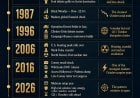
Timeline: From Post-9/11 Surveillance to Platform Capture
The Dead Internet Feeling Is Not Random
Somewhere around the late 2000s and early 2010s, the internet changed character. People who were online before that can feel it, even when they cannot fully explain it.
The earlier web was messy, weird, broken, human, niche, and hard to fully control. The later web became ranked, tracked, moderated, monetized, optimized, algorithmic, and increasingly synthetic.
That does not mean every “dead internet” claim is literally true. It does mean the intuition has real structural support.
Imperva/Thales reported in 2025 that automated traffic made up 51% of web traffic, with bad bots representing 37%. [30] Stanford-linked research documented AI-generated image spam on Facebook used by scam, spam, and creator pages to grow audiences. [33] The Reuters Institute has described the spread of low-quality AI-generated “slop” across the web. [34]
So the dead internet feeling is not just paranoia. It is the result of several layers stacking at once:
- human speech filtered through engagement algorithms;
- platform ranking systems deciding visibility;
- advertising incentives rewarding outrage and compulsion;
- state and institutional pressure over “misinformation” and moderation;
- bot traffic inflating artificial activity;
- AI-generated content flooding feeds;
- identity systems turning participation into persistent profiles;
- and surveillance markets monetizing the entire behavioral trail.
This is why the internet feels darker. It is not one thing. It is the convergence of extraction, moderation, synthetic content, surveillance, and behavioral prediction.
The internet did not die. It was captured, modeled, monetized, ranked, surveilled, and partially automated.
The dead internet theory is usually treated like internet folklore, but the feeling underneath it is real. The old web felt like people throwing signals into the dark. The new web feels like people performing inside a machine that has already decided which signals matter.
That is a different experience of reality. And once the feed becomes the world, whoever controls the feed controls the perceived world.
From Facebook to Flock: The Surveillance Graph Leaves the Screen
The Facebook-era social graph trained society to accept the mapping of relationships. The smartphone era trained society to accept location tracking. The AI era is training society to accept constant machine interpretation. Now the surveillance graph is leaving the screen and entering the street.
Flock Safety is one of the clearest modern examples. Flock’s own materials describe license-plate-reader technology that does more than read plates. It includes “Vehicle Fingerprint” capabilities, meaning vehicles can be searched by body type, make, color, and other characteristics. [35]
The ACLU has warned that Flock’s network gives law enforcement access to a nationwide location-tracking architecture. [36]
This is not Facebook. But it is the same operating logic applied to physical movement. Build sensors. Capture ambient life. Convert it into searchable records. Connect jurisdictions. Normalize the system through safety language. Then let the database become infrastructure.
That is the life graph becoming the location graph.
And once AI sits on top of these systems, the question is no longer just “what happened?” It becomes “what pattern does the machine think you belong to?”
Social media maps identity and relationships. Smartphones map movement and attention. Data brokers liquidate the exhaust. Law enforcement systems map the physical world. AI models interpret the pattern. That is the surveillance internet after it leaves the browser.
This is why I do not separate these stories into neat categories. Facebook, PRISM, data brokers, Flock cameras, ad pixels, AI slop, moderation systems, facial recognition, app tracking, and government requests are not the same thing. But they rhyme because they sit inside the same operating model.
The model is capture first, justify second. The justification changes. Safety. Convenience. Connection. Counterterrorism. Child protection. Efficiency. Fraud prevention. Personalization. Public order. But the infrastructure stays pointed in the same direction.
AI Turns the Archive Into Prediction
The next stage is not just more surveillance.
It is interpretation.
A database is passive until something reads it. A social graph is powerful, but it still needs analysis. A life archive is valuable, but it becomes far more powerful when machine systems can summarize it, score it, compare it, simulate it, and predict from it.
That is what AI changes.
The old internet collected the data. The algorithmic internet ranked the data. The AI internet interprets the data.
This is where the LifeLog idea becomes much bigger than Facebook. LifeLog imagined a machine-readable record of life. Today’s systems do not need one central LifeLog database because the record is distributed across platforms, phones, brokers, apps, cameras, cloud accounts, payment systems, location services, search histories, email, posts, comments, messages, photos, biometric systems, and public records.
The archive exists as fragments. AI is the layer that can recombine fragments.
That is the danger. Not that every AI system is evil. Not that every database is one master file. The danger is that the friction between databases keeps falling. The cost of inference keeps falling. The ability to turn messy human behavior into machine-readable pattern keeps rising.
That is the actual endpoint of the LifeLog question.
Not a diary.
Not a profile.
A predictive model of the person.
What Is Proven, What Is Likely, and What Is Still Missing
LifeLog was publicly reported canceled on February 4, 2004. Facebook launched that same day. The timing is real. [1] [5]
TheFacebook domain was registered before that day, on January 11, 2004. That weakens the clean same-day handoff version of the story. [2]
DARPA and the Information Awareness Office were pursuing large-scale data fusion, social-network analysis, identity, and predictive capabilities after 9/11. [3]
Peter Thiel was Facebook’s first outside investor and also co-founded Palantir. [10]
In-Q-Tel is a CIA-linked venture bridge into private technology, and Keyhole is a documented example of that model. [13] [15]
Facebook appears in PRISM provider materials by 2009, and Meta reports hundreds of thousands of government data requests in recent periods. [16] [18]
Facebook did not need a covert origin to become useful to the surveillance state. Its business model naturally produced state-useful behavioral infrastructure.
A direct DARPA LifeLog-to-Facebook transfer. No public contract, equity trail, personnel transfer, IP transfer, source-code trail, or official document reviewed here proves that claim.
This is where the article has to stay clean. The evidence does not support pretending the direct transfer is proven. But the evidence also does not support pretending the comparison is meaningless. The real structure is stronger than the meme version.
The meme says: LifeLog shut down and Facebook replaced it.
The evidence-weighted systems view says: LifeLog, TIA, Facebook, Palantir, In-Q-Tel, PRISM, data brokers, FTC-documented platform surveillance, Flock-style physical tracking, and AI inference all belong to the same historical movement toward behavioral visibility and predictive control.
That is a much harder argument to dismiss.
Pattern Nexus Lens
The mistake is looking for one smoking gun when the stronger story is the corridor.
After 9/11, the U.S. security state had an obvious incentive: prevent surprise by identifying threats before they materialize. That incentive pushes institutions toward data fusion, identity resolution, network analysis, behavioral modeling, anomaly detection, and predictive systems.
At the same time, Silicon Valley had an obvious incentive: monetize attention by collecting more behavioral data than competitors. That incentive pushes platforms toward identity capture, social graphs, tracking pixels, engagement ranking, app ecosystems, user profiling, and algorithmic prediction.
These two systems did not need to begin as one system to become compatible.
That is the real story. The state wanted total information awareness. The market built total behavioral extraction. Venture capital funded the scaling layer. Intelligence-linked entities funded and shaped parallel private technologies. Platforms normalized self-surveillance. Governments later accessed, pressured, purchased, regulated, and integrated with the resulting infrastructure.
In that frame, the LifeLog/Facebook coincidence becomes less of a magic trick and more of a marker. The same day matters because it reveals the transition point between two eras.
The old model was government surveillance as an external force.
The new model was voluntary surveillance as social life.
LifeLog imagined the mapped individual. Facebook normalized the mapped self. PRISM documented state access to the platform layer. The FTC later described the commercial layer as vast surveillance. Data brokers turned human exhaust into a liquid market. Flock moved searchable identity into the street. AI is now turning the whole thing into predictive infrastructure.
The question is not whether every piece was centrally planned. The question is why every powerful institution kept building toward the same architecture.
That is where the real analysis belongs. Not in pretending the direct handoff has been proven when it has not. Not in pretending there is nothing here when there obviously is. The evidence supports a deeper structural claim:
Facebook was not publicly proven to be LifeLog. But Facebook became one of the most important civilian rails through which the LifeLog logic entered everyday life.
And that is the part people should sit with. Because if the same architecture keeps appearing in government, finance, advertising, national security, policing, AI, and consumer technology, then the question is no longer whether one company was secretly one program.
The question is why modern power keeps requiring the same thing from everyone:
Visibility.
Sources
- Wired, “Pentagon Kills LifeLog Project,” February 4, 2004. https://www.wired.com/2004/02/pentagon-kills-lifelog-project/
- WHOIS record for thefacebook.com. https://www.whois.com/whois/thefacebook.com
- DARPA / DoD, Report to Congress regarding the Terrorism Information Awareness Program, May 2003, archived by EPIC. https://archive.epic.org/privacy/profiling/tia/may03_report.pdf
- DARPA LifeLog proposer information pamphlet / FOIA-hosted BAA materials. https://www.esd.whs.mil/Portals/54/Documents/FOID/Reading%20Room/DARPA/23-F-1033_LifeLog_05-06-2003.pdf
- The Harvard Crimson, “Hundreds Register for New Facebook Website,” February 9, 2004. https://www.thecrimson.com/article/2004/2/9/hundreds-register-for-new-facebook-website/
- The Harvard Crimson, “How They Got Here,” February 24, 2005. https://www.thecrimson.com/article/2005/2/24/how-they-got-here-in-just/
- Wired, “Pentagon Revives Memory Project,” September 13, 2004. https://www.wired.com/2004/09/pentagon-revives-memory-project/
- The Harvard Crimson, “Business, Casual,” February 24, 2005. https://www.thecrimson.com/article/2005/2/24/business-casual-a-year-ago-mark/
- The Harvard Crimson, “Firm Invests $13M in Facebook,” May 27, 2005. https://www.thecrimson.com/article/2005/5/27/firm-invests-13m-in-facebook-a/
- Founders Fund biography of Peter Thiel. https://foundersfund.com/team/peter-thiel/
- Facebook S-1 Registration Statement, SEC, 2012. https://www.sec.gov/Archives/edgar/data/1326801/000119312512034517/d287954ds1.htm
- Palantir S-1 Registration Statement, SEC, 2020. https://www.sec.gov/Archives/edgar/data/1321655/000119312520230013/d904406ds1.htm
- CIA Technology Collaboration page. https://www.cia.gov/tech/tech-collaboration/
- In-Q-Tel About page. https://www.iqt.org/about
- In-Q-Tel, “In-Q-Tel Announces Strategic Investment in Keyhole,” June 25, 2003. https://www.iqt.org/library/in-q-tel-announces-strategic-investment-in-keyhole
- PRISM collection slides, archived copy. https://govt396.com/wp-content/uploads/2018/06/snowden-wapo-slides.pdf
- PCLOB, Section 702 oversight materials / 2026 report. https://documents.pclob.gov/prod/Documents/OversightReport/315fe19c-07f3-4cc6-986a-ff199ce5b616/Unclassified%20PCLOB%20702%20Report%202026.pdf
- Meta Transparency Center, Integrity Reports Q1 2025. https://transparency.meta.com/reports/integrity-reports-q1-2025/
- Meta Transparency Center, Integrity Reports Q3 2025. https://transparency.meta.com/reports/integrity-reports-q3-2025/
- FTC, “FTC Staff Report Finds Large Social Media and Video Streaming Companies Have Engaged in Vast Surveillance,” September 19, 2024. https://www.ftc.gov/news-events/news/press-releases/2024/09/ftc-staff-report-finds-large-social-media-video-streaming-companies-have-engaged-vast-surveillance
- Britannica, Friendster. https://www.britannica.com/topic/Friendster
- Britannica, Myspace. https://www.britannica.com/topic/Myspace
- Britannica, YouTube. https://www.britannica.com/topic/YouTube
- FTC Chair Lina Khan statement on social media 6(b) report. https://www.ftc.gov/system/files/ftc_gov/pdf/statement-chair-khan-social-media-6b.pdf
- Brennan Center, “Closing the Data Broker Loophole.” https://www.brennancenter.org/our-work/research-reports/closing-data-broker-loophole
- DOJ, “Justice Department Implements Critical National Security Program to Protect Americans’ Sensitive Data,” April 11, 2025. https://www.justice.gov/opa/pr/justice-department-implements-critical-national-security-program-protect-americans-sensitive
- Supreme Court, Murthy v. Missouri opinion, 2024. https://www.supremecourt.gov/opinions/23pdf/23-411_3dq3.pdf
- Reuters, “US settles social media censorship case, bars agencies threatening penalties,” March 24, 2026. https://www.reuters.com/legal/government/us-settles-social-media-censorship-case-bars-agencies-threatening-penalties-2026-03-24/
- DOJ settlement release on alleged social media censorship litigation. https://www.justice.gov/opa/pr/justice-department-settles-lawsuits-challenging-biden-administrations-alleged-social-media
- Thales / Imperva, 2025 Bad Bot Report summary. https://cpl.thalesgroup.com/about-us/newsroom/2025-imperva-bad-bot-report-ai-internet-traffic
- UCSB American Presidency Project, remarks signing the USA PATRIOT Act, October 26, 2001. https://www.presidency.ucsb.edu/documents/remarks-signing-the-usa-patriot-act-2001
- Google / SEC exhibit announcing YouTube acquisition, October 2006. https://www.sec.gov/Archives/edgar/data/1288776/000119312506206884/dex991.htm
- Stanford Cyber Policy Center, AI spam accounts on Facebook. https://cyber.fsi.stanford.edu/news/ai-spam-accounts-build-followers
- Reuters Institute, AI-generated slop and the internet. https://reutersinstitute.politics.ox.ac.uk/news/ai-generated-slop-quietly-conquering-internet-it-threat-journalism-or-problem-will-fix-itself
- Flock Safety FAQ. https://www.flocksafety.com/faq
- ACLU, Flock surveillance roundup. https://www.aclu.org/news/privacy-technology/flock-roundup
Pattern Nexus closing note: The strongest story here is not a cartoon conspiracy where every actor follows one script. It is a systems story. The state wanted prediction. The market wanted prediction. Platforms made prediction profitable. Intelligence made prediction operational. AI is making prediction automatic. That is the rail running underneath the entire LifeLog/Facebook question.
Frequently Asked Questions
Tepkiniz Nedir?
 Beğen
0
Beğen
0
 Beğenmiyorum
0
Beğenmiyorum
0
 Aşk
0
Aşk
0
 Komik
0
Komik
0
 Vay
0
Vay
0
 Üzgün
0
Üzgün
0
 Öfkeli
0
Öfkeli
0

Founder of Pattern Nexus. I research markets, macro, geopolitics, AI, history, ancient systems, and the patterns most people overlook. I’m also building Market Radar, a trading scanner designed to read pressure, risk, confirmation, and setup quality before chasing a move. Pattern Nexus is where I connect the dots between data, history, technology, and the bigger system playing out around us.











Yorumlar (0)