

architecture
Automatically classified from article content.
Theses, forecasts, models, and paths
No published research objects yet
This topic is ready for editors to connect a thesis, forecast, model, or research path.
Latest articles
 Article · related
Huawei Turns UnifiedBus Into China’s Nvidia-Bypass AI Factory Stack
Huawei says its Ascend 960DT will be ready in Q1 2027, with Ascend 960PR following in Q3 2027, while its UnifiedBus and Peerium architecture aim to scale AI systems from SuperPoDs to very large SuperClusters. Reuters also reports Huawei says domestic AI-compute demand already exceeds its production capacity, which makes the story less about one chip beating Nvidia and more about whether China can industrialize a substitute stack fast enough.
Published Sep 18, 2026 Article · relatedFed Just Hiked Into a 5% 10-Year: Why the Next Liquidity Cycle May Arrive Faster
The Federal Reserve just raised the federal-funds target to 3.75%–4.00% while the 10-year Treasury closed at 5.01%, the 30-year at 5.35%, and the real 30-year at 3.09%. Pattern Nexus correctly identified the September hike risk and the developing QE/liquidity cycle, but underestimated the Fed’s willingness to raise rates against an already enormous debt and refinancing burden. This report asks the question almost nobody asks after a rate decision: what does the hike eventually break? It connects the September decision to the $40-trillion-plus federal debt structure, more than $1 trillion of annual federal net interest expense, Treasury issuance, long-end buybacks, Federal Reserve reserve-management purchases, hedge-fund leverage, the Treasury basis trade, private credit, housing, commercial real estate, household cashflow and the 2019 repo-market precedent. The conclusion is not that the Fed has deliberately chosen to create a crash. It is that monetary architecture now allows the Fed to tighten the price of credit while separately protecting reserves and market plumbing. The hike therefore does not invalidate the Pattern Nexus QE thesis. If long rates remain near current levels, it accelerates the transmission mechanism that can eventually force the next phase of liquidity support.
Published Sep 17, 2026 Article · related
Space Was Becoming Infrastructure. Now It Has a Weapons Layer: The U.S. Confirms On-Orbit Space-Control Weapons
For the first time, the United States has publicly acknowledged that it operates "on-orbit space control weapons." The hardware remains classified, but the surrounding architecture is not: Space Force doctrine already defines orbital warfare, electromagnetic warfare, cyber operations, reversible denial, degradation and destruction as parts of space control; ground-based counterspace systems are already operational; and China, Russia and other states are developing the same wider capability stack. This Pattern Nexus report separates what is confirmed from what remains unknown, explains the Outer Space Treaty, maps the counterspace technology families, and ties the disclosure directly into earlier Pattern Nexus work on space infrastructure, "Launch. Control. Network.", cislunar logistics, and Control Stack 2.0. The central thesis: space becoming infrastructure was phase one; infrastructure becoming an explicitly armed control layer is phase two.
Published Sep 15, 2026 Article · related
What’s Happening to Our World? AI, Agenda 2030, and the Control System Built in Public
I was reading these documents twenty years ago, when most people thought the warnings were insane. Now the architecture is everywhere. This personal systems essay connects humanity’s inability to absorb accelerating change with Agenda 21, Agenda 2030, post-9/11 legal infrastructure, Klaus Schwab’s own books, digital identity, smart-home surveillance, Wi-Fi sensing, Starlink passive radar, Flock cameras, connected cars and the AI layer that can finally fuse it all together.
Published Aug 26, 2026 Article · related
You Don't Eat Food. You Harvest Electrons: The Electrical Architecture of Life
Food looks like matter, but the energy side of metabolism is a controlled redox system. Cells extract reducing power from carbon-rich molecules, route it through the mitochondrial respiratory chain, convert electron flow into proton motive force and ATP, then spend ATP rebuilding the ion gradients that make nerves, muscles and cognition possible.
Published Aug 15, 2026 Article · related
The Universal Intelligence Economy: AI, Robotics, Jobs, Money, and the 2030–2035 Transition
AI companies are assembling a cognitive-and-physical labor system designed to outscale human work. This forecast maps the 6–18 month robotics crossover, three displacement paths, the break in wage-based demand, and the monetary architecture required if machine output replaces labor income.
Published Aug 10, 2026 Article · relatedDid Life on Earth Begin on Mars? Sample 25, Viking, and the Evidence We Left Behind
Perseverance sealed the strongest potential Martian biosignature yet inside Sample 25. Viking's 1976 results are being re-litigated. NASA's return architecture lost funding as the evidence strengthened. This report reconstructs the science, the institutional bottleneck, the 2028 propulsion test, and the larger possibility that Mars sits upstream of Earth's biology.
Published Aug 9, 2026 Article · related
Pattern Nexus Worldview — Full Digital Edition
Read the complete 10-chapter digital edition of Pattern Nexus Worldview by Christopher Grenke. A systems-level examination of money, liquidity, markets, energy, AI, geopolitics, sovereignty, society, control systems, and the architecture shaping the modern world.
Published Jul 26, 2026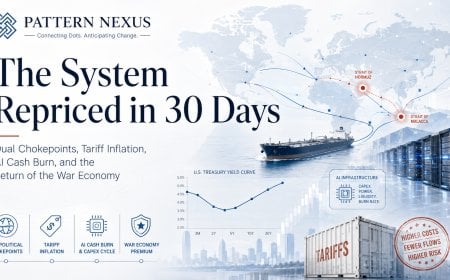 Article · related
The System Repriced in 30 Days: Dual Chokepoints, Tariff Inflation, AI Cash Burn, and the Return of the War Economy
In thirty days, the operating assumptions underneath the global system changed. Two maritime chokepoints came under pressure, the United States expanded war financing and rebuilt its tariff architecture, inflation moved back upstream, long-term yields repriced, AI infrastructure crossed into cash-burn territory, strategic minerals became permissioned leverage, and political command structures began cracking. This Pattern Nexus analysis maps those events as one connected system rather than separate headlines.
Published Jul 24, 2026 Article · related
The Older Signal: Lost Civilizations, Broken Archives, and the Pattern Beneath Human History
A Pattern Nexus three-level research article mapping deep-time human capability, lost archives, drowned coastlines, megalithic architecture, ancient astronomy, undeciphered scripts, UAP secrecy, invention secrecy, and the recurring pattern of civilizational amnesia.
Published Jun 13, 2026 Article · related
OpenAI Builds the Blast Door Into the Agent Stack
OpenAI has made Lockdown Mode available as an opt-in advanced security setting for ChatGPT, with rollout details varying by account type and workspace. The feature limits or disables network-enabled capabilities such as live browsing, deep research, agent mode, file downloads, some web-derived image support, and certain connector actions to reduce prompt-injection-based data exfiltration risk. The Pattern Nexus read: the AI economy is shifting from model intelligence alone toward controlled runtime architecture, where egress, permissions, and side effects become core security primitives.
Published Jun 7, 2026 Video · related
Pattern Nexus Framework: How to See the Hidden Architecture of the Modern World
Pattern Nexus is not just a news site, market blog, or opinion page. It is a framework for reading the modern world as a layered system of liquidity, energy, infrastructure, incentives, control rails, technology, markets, and human behavior. This article explains the Pattern Nexus lens, why it matters, how to use it, and where to begin if you are new to the site.
Published May 29, 2026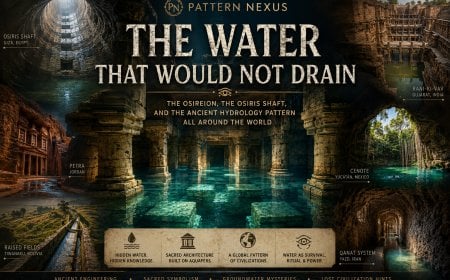 Article · related
The Water That Would Not Drain: The Osireion, the Osiris Shaft, and the Ancient Hydrology Pattern Hiding Under Civilization
The Osireion at Abydos and the Osiris Shaft at Giza are usually treated as Egyptian mysteries, but the deeper pattern is global. Ancient builders repeatedly placed sacred architecture at the boundary between visible water and hidden water: aquifers, shafts, springs, subterranean channels, artificial islands, pressure systems, and ritual wells. This Pattern Nexus research piece separates evidence from exaggeration, examines the real dewatering problem at Abydos, corrects the stronger viral claim around the Osiris Shaft, and then maps the same hydrological intelligence across Petra, Dholavira, Mohenjo-daro, Nasca, Palenque, Angkor, Tiwanaku, Persian qanats, Indian stepwells, and Nuragic Sardinia.
Published May 22, 2026 Article · related
The Script, the Circus, and the Rails
A Pattern Nexus control-lens article on how crisis, spectacle, media concentration, digital money, identity systems, AI, and machine integration fit into the same architecture of control.
Published Apr 4, 2026 Article · related
McDonald’s Did Not Bring Back Value Because It Felt Nostalgic. It Did It Because the System Sees Demand Breaking.
A Pattern Nexus analysis of McDonald’s new under-$3 menu as a signal on consumer stress, franchise economics, real-estate control, fast-casual pressure, and the broader architecture of demand destruction.
Published Apr 4, 2026 Article · related
March Ends With the System Showing Its Seams
A Pattern Nexus end-of-March 2026 master analysis on Hormuz, oil repricing, liquidity stress, inflation pressure, AI infrastructure, Moon Base acceleration, sovereignty, domestic pass-through, and why the system is showing its architecture again.
Published Mar 31, 2026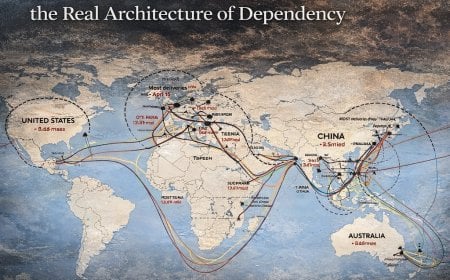 Article · related
The Clock Starts at Hormuz: Oil Corridors, Timed Failure, and the Real Architecture of Dependency
the-clock-starts-at-hormuz-oil-corridors-timed-failure
Published Mar 29, 2026 Article · related
NASA’s Moon Base, MoonFall, Nuclear Missions, and the Drone Layer of Mars
A Pattern Nexus analysis of NASA’s 2026 surface-first lunar architecture, MoonFall hopper drones, lunar nuclear power, nuclear-electric Mars plans, and the next rotorcraft layer after Ingenuity.
Published Mar 26, 2026 Article · related
Ukraine Is the Fault Line: NATO Expansion, Dollar Custody Warfare, and Russia’s Forced Pivot to China
Ukraine is not a regional war. It is the convergence point where NATO’s post-1991 security architecture, the U.S.-led financial control stack (custody, sanctions, settlement), and Russia’s failed integration into the Western order collided. This deep-dive traces the chain from 1990 assurances and NATO expansion through 2008 Bucharest, 2014–2021 freeze failures, the 2022 system shift, and today’s locked endgame. The core mechanism is precedent: territory, security guarantees, sanctions sequencing, and reserve legitimacy must all unwind together or nothing settles. This is the war behind the headlines: buffers, balance sheets, payment rails, collateral, energy, and credibility.
Published Dec 15, 2025 Article · related
The Monetary Break: How Nixon, Silver, & the Eurodollar Rewired the Global System (1968–1979)
Between 1968 and 1979, the collapse of the gold window, the rise of the Eurodollar, and the Petrodollar shift transformed the global monetary system. Nixon’s 1971 shock, oil crises, offshore dollar expansion, and financial deregulation rewired the world’s liquidity architecture and created the modern dollar empire.
Published Dec 2, 2025 Article · related
The Dollar Fortress: How Bretton Woods, the Marshall Plan, and the 1951 Accord Forged the First Dollar Liquidity Regime (1947–1953)
After World War II, the Bretton Woods system, the Marshall Plan, and the 1951 Treasury–Fed Accord fused into a single architecture: the dollar anchored to gold, capital controls, and state-directed credit. Between 1947 and 1953, this “Dollar Fortress” quietly set the rules of global liquidity that still shape markets today.
Published Dec 2, 2025 Article · related
The First AI Age: How the 1870–1914 Industrial Supercycle Built the Modern World — And Why 2025–2035 Rhymes With It.
Between 1870 and 1914, steel, railroads, electricity, and global capital markets fused into the first true industrial supercycle. This era built the financial and energy architecture we still live inside today—and it looks uncannily like the AI–data-center–SMR boom now unfolding into 2025–2035.
Published Dec 1, 2025 Article · related
Market Wrap-Up — November 13, 2025: Red Tape, Strong Dollar, and a Fed That Markets Still Expect to Blink
U.S. markets had their worst day in a month as the Dow fell nearly 800 points, AI stocks sold off, and Fed cut odds briefly slipped to a coin toss. By evening, futures had already drifted back toward a December cut and the dollar stayed firm. A Pattern Nexus breakdown of sentiment whiplash, yields, commodities, and the liquidity architecture beneath the day’s volatility.
Published Nov 13, 2025 Article · related
The Weight of Time: On Building Something That Lasts
Legacy isn’t about memory — it’s about momentum. In an age obsessed with immediacy, this essay explores the deeper architecture of endurance: how systems, people, and civilizations preserve meaning through adaptability. Drawing from philosophy, science, and lived experience, it examines how we build for permanence in a world designed for change.
Published Oct 18, 2025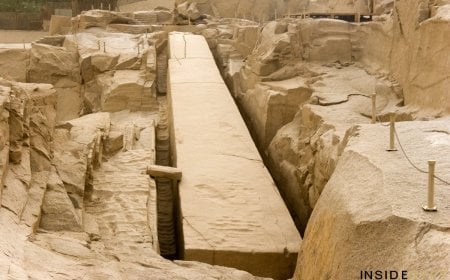 Article · related
Echoes of the Builder: What We Leave Behind
This piece explores the architecture of legacy — not as wealth or fame, but as continuity of thought, creation, and impact. It examines how every system we build, from homes to ideas to businesses, becomes a mirror of our values and a container for future lives. It ties construction, resilience, and philosophy into one continuum — how a person’s blueprint extends beyond their lifetime through what they shape and the principles they leave embedded in their work.
Published Oct 18, 2025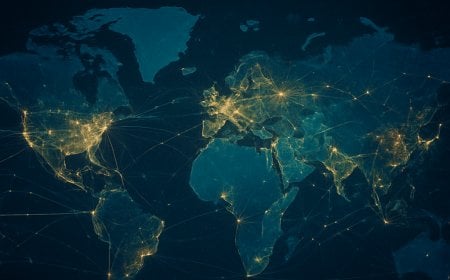 Article · related
The Fracturing World Order: From Unipolar Dominance to Economic Multipolarity
The post–Cold War world promised stability through American dominance. Instead, it produced dependency through debt and energy control. Three decades later, that system is cracking — replaced by a network of regional powers, resource alliances, and digital financial blocs. This analysis examines how power is fragmenting, why liquidity defines modern empire, and what the next monetary architecture may look like.
Published Oct 18, 2025 Article · related
The Age of Algorithmic Influence: How Technology Rewired Human Behavior
Algorithms no longer just deliver content—they shape human behavior, attention, and even identity. In this long analysis, we explore how the digital architecture of the modern world has rewired the human mind, redefined truth, and created a civilization built on data-driven persuasion.
Published Oct 18, 2025