
Domestic Theater vs. Global Projection: Why Americans Misread Geopolitics
Americans see politics through a left–right lens, but the world engages the United States as a single strategic actor. Ilhan Omar’s abroad defense of Trump—and bipartisan efforts like repealing the Patriot Act—reveal how national interest overrides partisan theater on the world stage.

Domestic Theater vs. Global Projection: Why Americans Misread Geopolitics
My view — Chris @ Pattern Nexus
Most Americans don’t realize how different politics looks outside our borders. Here at home, we are trained to see everything through a left–right, culture-war filter. But when the United States steps onto the world stage, it projects something very different: a single strategic actor with enduring institutions, capabilities, and interests that outlast any news cycle or administration.
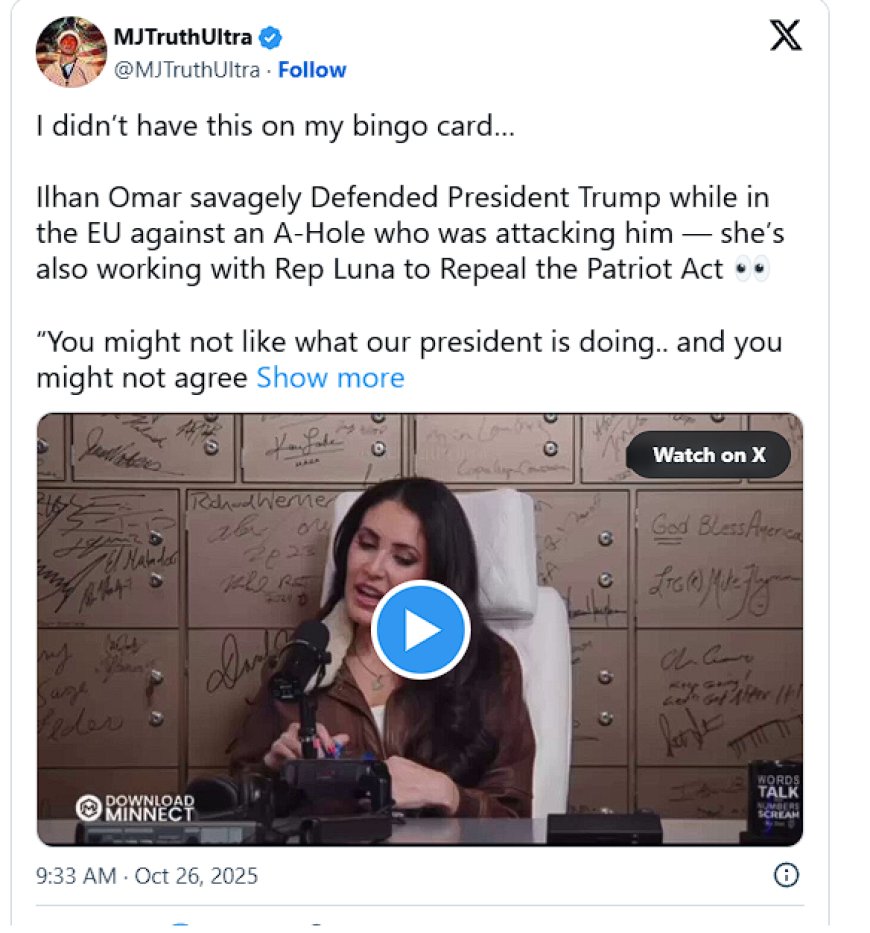
A viral clip making the rounds captures this disconnect. Rep. Anna Paulina Luna said that Rep. Ilhan Omar defended President Trump during a meeting with European politicians—pushing back on a foreign official who was taking shots at the U.S. president. Online, that triggered shock: “How could Omar defend Trump?” But in an international forum, it makes sense. Abroad, the job is not to perform partisan identity; it’s to protect national legitimacy and signal unity of state.
The Unified Field: How State Identity Works
When foreign governments interact with America, they aren’t negotiating with Democrats one day and Republicans the next. They’re engaging with the United States—its military posture, treaty network, dollar system, export controls, intelligence alliances, and diplomatic leverage. The public food fight at home is real, but it is also a domestic feedback loop optimized for attention and votes. Externally, the machine speaks with one voice.
This is why so many Americans misread international politics. They think the world cares about our daily culture-war content. It doesn’t. Partners and rivals price U.S. power, credibility, and constraints. Research across decades shows that despite headline drama, U.S. foreign policy features broad continuity, with bipartisan commitment to core internationalist goals recurring across administrations. Even recent scholarship finds that this bipartisan backbone remains resilient on major external questions.
Case in Point: Repealing the Patriot Act—Unlikely Allies, Coherent Signal
Another example: domestically, you’ll see Omar and Luna framed as polar opposites. Yet in May 2025, Luna introduced the American Privacy Restoration Act to repeal the USA PATRIOT Act, and Omar signed on as a cosponsor days later—joined by members from both parties. That’s not a glitch; that’s the system finding cross-cutting alignments when state power, civil liberties, and public legitimacy collide. See the official record here: H.R.3245 overview and cosponsors list (includes Ilhan Omar, 5/15/2025).
Domestic Theater vs. International Projection
Inside the U.S., our information economy rewards performative division. It keeps citizens locked in a dopamine loop of outrage and identity validation. But externally, the United States behaves like a coherent strategic platform. The public often mistakes televised conflict (tweets, clips, parliamentary zingers) for strategic substance. In reality, the durable variables that guide foreign actors are continuity in alliances, basing rights, financial plumbing (dollar settlement, sanctions, T-bills), and defense-industrial capacity.
- Domestic Narrative: maximize engagement, mobilize tribes, drive turnout.
- External Reality: preserve deterrence, alliances, market confidence, and bargaining power.
Seen through that lens, Omar defending the president abroad isn’t ideological betrayal—it’s statecraft. The signal to foreign partners is that Americans can fight at home and still close ranks when the flag is in the room.
Why This Misread Matters
When citizens confuse partisan theater with the nation’s strategic identity, they become vulnerable to narrative manipulation. They assume every external move is a culture-war proxy, and they miss the deeper pattern: the United States, like every major power, optimizes for credibility, leverage, and system stability across administrations. If you want to forecast outcomes, follow those constants, not the outrage of the day.
How to See the System (Not the Show)
- Track institutions, not personalities. Treaties, statutes, Fed/treasury operations, basing, and alliances are more predictive than speeches.
- Separate incentives. Domestic political incentives reward conflict; international incentives reward reliable commitments.
- Watch bipartisan coalitions on structural bills. They reveal where state interests cut across parties (e.g., surveillance, export controls, industrial policy).
- Price credibility. Markets and allies react to whether the U.S. can deliver on promises, not to who “won” a TV segment.
America will keep arguing with itself. That’s democracy. But the world will continue negotiating with a single actor called the United States. If you can hold both truths at once, you can see past the illusion and read the board as it is.
Sources
- Newsweek — “Ilhan Omar Defended Donald Trump During Meeting, Republican Says”.
- Congress.gov — H.R.3245, American Privacy Restoration Act (Patriot Act repeal) overview; Cosponsors (includes Ilhan Omar, 05/15/2025).
- International Security — “America First? Explaining Continuity and Change in U.S. Foreign Policy”.
- Foreign Policy Analysis — “Bipartisanship Put to the Test: U.S. Policy Toward Ukraine” (2025).
Want the short version for socials? See my Facebook post above. For a follow-up, I’ll map where domestic polarization → external continuity in trade, finance, and defense shows up in the data.
#Geopolitics, #PatternNexus, #PerceptionVsReality, #UnifiedField, #USPolitics, #ForeignPolicy, #NarrativeControl, #IlhanOmar, #PatriotAct, #SystemsThinking
Каква е вашата реакция?
 Харесай
0
Харесай
0
 Не ми харесва
0
Не ми харесва
0
 Любов
0
Любов
0
 Смешно
0
Смешно
0
 Уау
0
Уау
0
 Тъжен
0
Тъжен
0
 Ядосан
0
Ядосан
0











Коментари (0)