
The End of Human Primacy: By 2030, the Handoff May Be Underway
Humanity may be approaching the first era in history where it is no longer the most capable intelligence on Earth. This Pattern Nexus piece breaks down why the AI handoff may be closer than most people think.
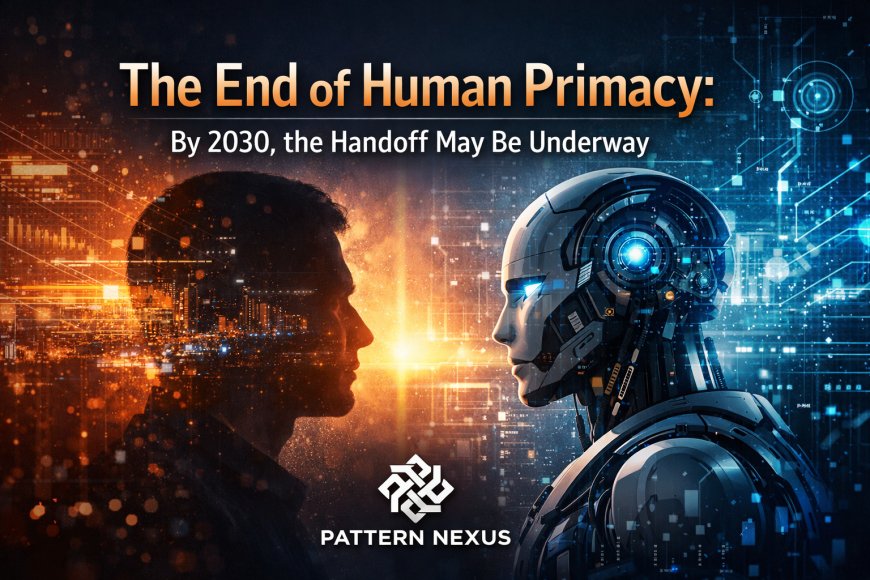
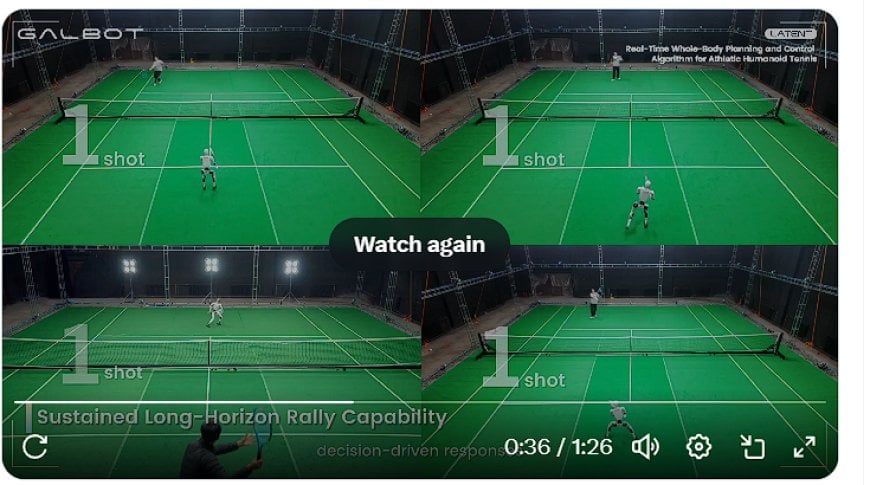

Humanity’s edge has always been adaptive intelligence, but that edge is beginning to compress as AI systems improve in reasoning, coding, search, planning, and agentic execution while also becoming cheaper and easier to deploy. This is not really about robots “waking up.” It is about cognition being industrialized, scaled, rented, embedded into institutional workflows, and tied directly into the command architecture of society. Once that happens, the argument stops being philosophical and becomes structural. The real issue is not whether machines become “alive.” The real issue is whether the systems that run finance, logistics, media, surveillance, labor allocation, military planning, and political decision-support start routing around the human mind as the primary layer of execution.
This is not a consciousness argument first. It is a capability, scale, deployment, and systems-integration argument first.
The biggest near-term risk is not a sci-fi robot revolt. It is machine cognition being integrated into the command layer of institutions faster than society, law, labor, and culture can adapt.
Once intelligence becomes cheap enough to rent at scale, labor, decision-making, surveillance, media, and power structures all begin to reprice around it.
The Handoff Has Started
Well, my fellow humans, it has been a good run.
For a very long time, humanity held the top spot on this planet in the one category that mattered most: adaptive intelligence. We were not the fastest, strongest, or most physically optimized species. What made us dominant was our ability to model reality, invent tools, coordinate at scale, build systems, transmit culture, and reshape the environment around us faster than everything else around us could adapt.
That monopoly is starting to crack.
Not because some sci-fi machine overlord suddenly appears out of nowhere, and not because machines need consciousness to begin displacing human primacy in practical terms. It is beginning because we are learning how to mass-produce cognition itself. Reasoning, search, planning, memory, synthesis, code generation, optimization, and execution are slowly becoming scalable services rather than uniquely human advantages. That is a very different category of shift than most people are psychologically prepared for.
People still keep trying to frame this in old language. They ask whether AI is “real intelligence,” whether it “understands,” whether it is “alive,” whether it “feels.” Those are valid philosophical questions, but they are not the first-order question for the world we actually live in. The world does not wait for perfect definitions. Systems are adopted when they become useful, cheaper, faster, and more controllable than the current alternative.
That is what matters here. If a machine system can research faster, code faster, summarize faster, organize faster, monitor faster, detect patterns faster, and eventually act faster than the average person, then institutions will route around human slowness whether the philosophical debate is settled or not.
That is why this matters. Human primacy was never really about abstract dignity. It was about humans being the top operational intelligence in the system. Once that changes, the entire hierarchy around labor, power, and control starts to shift with it.
A system does not need to be perfect to alter civilization. It only needs to be better than the average human alternative across enough high-value tasks for institutions to begin reorganizing around it.
Why 2030 Is Not a Random Date
The reason 2030 keeps coming up is not because it is a magical date. It is because multiple curves are compounding at the same time: benchmark performance, model reasoning depth, agent behavior, hardware throughput, enterprise adoption, cost compression, and institutional dependence.
In earlier tech cycles, people could dismiss changes because the tools were clunky, expensive, narrow, and limited to specialists. That is not what this looks like. What we are seeing now is improvement across several layers at once. Models are getting better. Interfaces are getting simpler. deployment costs are falling. Integration into workplace software is increasing. Agent behavior is improving. Hardware is being built specifically for reasoning workloads. Those are not isolated upgrades. Together they form a systems curve.
That matters because the threat to human primacy is not perfection. It is usefulness at scale. A system does not need flawless output to become dominant. It only needs to become good enough, cheap enough, and embedded enough that institutions start routing work through it by default.
That is how power shifts in the real world. Not all at once. Not with one headline. Not with one cinematic event. It shifts when something stops being optional and starts becoming infrastructural. It shifts when the cost of not using the system becomes higher than the cost of adopting it.
By the time the average person emotionally realizes a change has happened, institutions are usually already deep into it. That is why I keep pointing toward the back half of the 2020s. It is not because I think one specific press release will announce the death of the old order. It is because the underlying rates of change are fast enough that the old assumption of permanent human cognitive dominance no longer looks stable.
- Reasoning models are improving across harder tasks and more complex workflows.
- Agents are moving from chat responses toward tool use, orchestration, and real action.
- Falling cost changes AI from novelty into infrastructure and from premium tool into default layer.
And once intelligence becomes a rentable layer inside every institution, the old line between “human decision” and “machine decision support” starts to blur. Then the machine stops being a tool at the edge of the system and becomes part of the operating logic of the system itself.
When Intelligence Becomes Infrastructure
The old industrial revolutions amplified muscle. This one amplifies cognition.
Steam expanded physical force. Electricity expanded distributed power. Networks expanded communication and coordination. Artificial intelligence expands decision support, pattern detection, synthesis, search, simulation, surveillance, optimization, and increasingly action itself.
That last part is where most people still are not fully tracking the magnitude of the shift. If intelligence stops being purely biological and becomes a service layer, then every sector begins to reorganize around whoever has the best access to that layer. Finance starts pricing faster. Media starts generating faster. Bureaucracies start filtering faster. Surveillance systems start correlating faster. Military planning starts simulating faster. Logistics starts rerouting faster. Propaganda starts adapting faster. Fraud detection starts scoring faster. Legal review starts processing faster. Political campaigns start targeting faster.
Once intelligence becomes industrialized, it does not stay contained inside tech. It becomes a new control layer over finance, media, logistics, law, warfare, education, surveillance, healthcare, enterprise management, and political systems. The institutions that control the best compute, the best models, the best data access, and the best integration layers will hold disproportionate leverage over the next era.
This is why the question is larger than whether one model can beat one person at one benchmark. The deeper issue is that machine cognition is being integrated into the command architecture of civilization itself.
And when that happens, the consequences are not evenly distributed. The upside is enormous for those who own the rails. The downside is enormous for those who get turned into downstream users of systems they neither built nor control. That is where the real Pattern Nexus theme comes in. This is a control-structure event. It is not just an innovation story. It is a hierarchy story.
Who controls the compute? Who controls the model layer? Who controls the access layer? Who controls the distribution? Who controls the default interfaces people will rely on every day? Those questions matter far more than whether one more benchmark gets broken next week.
Because once machine cognition becomes infrastructure, it stops being “a tool you use” and starts becoming “the environment you operate inside.”
Pattern Nexus Lens
This should not be viewed as a gadget story. It is a control-systems story.
AI compresses the time between observation, analysis, and action. That means it shortens decision loops, and shorter loops create power. The groups that can think, model, and execute faster than everyone else tend to dominate the system around them. That has always been true. It is true in markets. It is true in war. It is true in media. It is true in politics. It is true in logistics. It is true in surveillance. Now that same logic is being amplified by machine cognition.
Human civilization has always rewarded those who control leverage. What is changing now is that leverage is moving into machine cognition itself. The winners will not simply be the people with the smartest humans. They will be the ones who own or control the best intelligence stacks, the best compute access, the best data rails, the best integration points, and the best distribution channels.
That is why this ties directly into the broader Pattern Nexus framework. I am always talking about control layers, permission structures, narrative systems, infrastructure chokepoints, distribution rails, and the hidden architecture that sits underneath the visible world. AI plugs directly into all of that. It is not an isolated vertical. It becomes the multiplier sitting on top of every other system.
Put differently, this is not just about whether AI can answer questions. It is about what happens when AI becomes the intermediary layer between humans and reality itself. Search, communication, finance, work, navigation, research, health decisions, education, bureaucracy, media interpretation, and maybe eventually social trust all begin passing through machine-mediated filters. Once that mediation layer becomes dominant, whoever controls it holds extraordinary leverage over human behavior and perception.
That is why the handoff matters. It is not only about humans no longer being the smartest biological actors in the room. It is about a world where the operating environment itself becomes machine-curated, machine-ranked, machine-optimized, and machine-enforced.
And that is why people should stop thinking about this only in terms of robots and start thinking about it in terms of civilizational architecture.
The real transition is not “machines becoming alive.” It is intelligence becoming scalable, rentable, specialized, strategically controlled, and embedded into the control layer of civilization.
FAQ
Are you saying AGI is definitely here by 2030?
No. The stronger claim is narrower and more defensible: by 2030, it is increasingly plausible that machine systems surpass individual humans across enough important domains that human cognitive primacy is no longer unquestioned, whether or not a clean AGI label is ever agreed upon.
Does this require consciousness?
No. Systems do not need human-like consciousness to become economically, strategically, or operationally dominant. They only need to outperform humans in enough valuable processes, become cheap enough to deploy broadly, and be integrated into the institutions that matter.
What is the real near-term risk?
The biggest near-term risk is not a movie-style robot uprising. It is the rapid integration of machine cognition into the control architecture of society before the legal, institutional, labor, and ethical layers are ready for what that means. In other words, the real risk is not theatrical rebellion. It is silent dependency.
So what actually ends if human primacy ends?
Human value does not automatically end. Human meaning does not automatically end. What ends is the old assumption that the human mind is the unquestioned top operational intelligence inside every important system. Once that assumption breaks, the hierarchy above labor, governance, decision-making, and control begins to shift with it.
Sources
These sources support the article’s discussion of benchmark gains, adoption, agent workflows, and reasoning infrastructure.
- Stanford HAI — The 2025 AI Index Report: Technical Performance
- Stanford HAI — AI Index 2025: State of AI in 10 Charts
- OECD — AI use by individuals surges across the OECD as adoption by firms continues to expand
- OpenAI — Introducing Operator
- OpenAI — Introducing deep research
- Anthropic — Claude 3.7 Sonnet and Claude Code
- Google — Gemini 2.5: Our most intelligent AI model
- NVIDIA — Blackwell Ultra AI Factory Platform Paves Way for Age of AI Reasoning
Каква е вашата реакция?
 Харесай
0
Харесай
0
 Не ми харесва
0
Не ми харесва
0
 Любов
0
Любов
0
 Смешно
0
Смешно
0
 Уау
0
Уау
0
 Тъжен
0
Тъжен
0
 Ядосан
0
Ядосан
0

Founder of Pattern Nexus. I research markets, macro, geopolitics, AI, history, ancient systems, and the patterns most people overlook. I’m also building Market Radar, a trading scanner designed to read pressure, risk, confirmation, and setup quality before chasing a move. Pattern Nexus is where I connect the dots between data, history, technology, and the bigger system playing out around us.

















Коментари (0)