
Parallel Order? Trump, Putin, and the Emergent Board of Peace
Trump’s new “Board of Peace” began as a Gaza conflict tool but is already expanding into something bigger. This piece explores the speculative, but plausible, scenario where it becomes a parallel world-order surface — with Trump and Putin as parallel actors, Europe as spectator, and China as the unspoken center of gravity.


The Board of Peace is not just another “committee.” Its structure — Trump as chair, executive council, billion-dollar founders, hand-picked invitees — makes it a personality-centric, network-native institution that can sit next to, and potentially against, the UN Security Council.
This piece does not allege a secret Trump–Russia conspiracy. It explores a more uncomfortable, but more realistic, possibility: parallel actors exploiting institutional drift in a system where UN veto paralysis and great-power distrust are already pushing states toward alternative venues.
Europe mostly watches from the balcony. The long-term strategic story is not Brussels; it is whether a Trump-anchored Board of Peace and a stressed Russia can, over time, be used to contain the rise of a China-centric Eurasian core without ever saying that out loud.
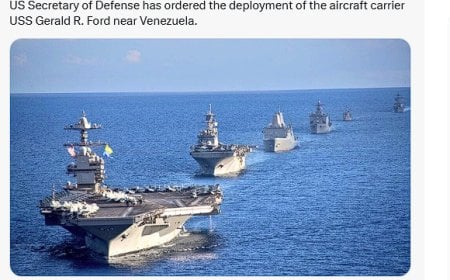
Carrier posture isn’t a prediction of war. It’s the kinetic backstop that makes economic coercion, trusteeship platforms, and “diplomacy under threat” believable.
Venezuela and Hormuz are oil valves that hit Asia first. If you can throttle those flows, you don’t need to “fight China” to pressure China.
The Claim, Translated into Strategic Language
The hypothesis, cleaned into a coherent strategic shape:
- Trump and Russia are moving inside the same window toward a new order dynamic.
- The vehicle is the Board of Peace.
- Europe mostly watches and adapts after the fact.
- The structure bypasses the UN as a practical workflow, even if the UN remains a legal wrapper.
- The silent center of gravity is China.
- Russia’s China relationship is real on paper and brittle in long-run incentives.
This is not the standard Cold War mental model (static blocks with fixed adversaries). It’s a systems model: incentives, leverage, optionality, and institutional drift. The claim is not “this is proven.” The claim is: this is a coherent strategic interpretation of the pattern that has emerged in the last window, and it is under-discussed because most people are still thinking in legacy categories.
The first mistake is treating “Board of Peace” as a headline. The second mistake is treating carriers as “war.” The third mistake is treating Venezuela and Iran as unrelated regional dramas. Those are not separate stories. They are separate components of a single control stack that can pressure the Eurasian core without declaring a new global war.
You don’t need a secret pact for a parallel order to form. You need a venue, a backstop, and valves. If those exist in the same window and get used repeatedly, the system hardens around them because they work.
From Gaza Tool to Parallel Surface: What the Board of Peace Actually Is
Start with the part that isn’t speculative. The Board of Peace exists as a proposed framework, with a chair-centered architecture and an explicit ambition to operate beyond its origin theater. It was marketed as a Gaza oversight and reconstruction mechanism with enough institutional cover to get traction. That initial cover is important: you seed legitimacy, then you scale function.
That narrow scope did not last. The expansion pitch is explicit: the Board is presented not merely as a Gaza mechanism but as a standing platform to address “other conflicts worldwide” and to deliver outcomes where the UN Security Council has repeatedly jammed under veto politics.
The architecture matters because it tells you what the Board really is. A UN-style institution is vote-weighted and charter-bound. The Board is chair-weighted and access-bound. That is a different machine:
- Executive steering: a small core sets agenda and interpretation.
- Invitation-based entry: membership is a prize, not a right.
- Capital-weighted influence: “founding” status and proximity are tied to contribution.
- Brand-first legitimacy: the name “peace” functions as a universal recruitment token.
- Portability: the platform can be lifted into any conflict where paralysis creates demand for faster outcomes.
The Putin ambiguity is not noise. It is the mechanism. One side signals that a channel exists; the other side signals “review.” The channel remains active without a public lock-in. That is exactly how personalist diplomacy keeps optionality alive.
The participation map is itself a signal: a cluster of states across the Middle East, Eastern Europe, Central Asia, and the Global South are lining up, while core Europe is cautious or outwardly resistant. That divergence matters because it reveals where the hunger for alternative venues is greatest: states that want a fast table with leverage, not a slow chamber with speeches.
None of this proves the Board replaces the UN. The more realistic trajectory is bypass-by-usage: the Board becomes where bargaining happens, while the UN becomes where bargaining is narrated.
The UN Security Council is treaty-bound, vote-based, and veto-jammed. The Board of Peace, as currently pitched, is curated, chair-dominated, and capital-weighted. That is not a moral critique. That is a description of a different power machine.
UN vs. Parallel Institutional Order: Why a Bypass Structure Works
The UN is not “useless” in a blanket sense. It is useful for legitimacy, technical agencies, and a large amount of humanitarian and administrative work. The problem is the function that matters most in crisis windows: great-power arbitration. That function is jammed by veto politics and distrust.
When a system jams, actors don’t stop acting. They route around the jam. That is what bypass structures are. They are not philosophical revolutions; they are workflow solutions.
The enforcement architecture of the post-1945 order has already lived outside UN prose for decades. The operational nodes that actually enforce behavior have been:
- Financial gating (sanctions, banks, correspondent rails).
- Security backstops (alliances, basing, naval power).
- Trade and standards (access conditioning).
- Liquidity and development tools (conditional funding).
If a leader’s operating system is deals, relationships, and speed, then the correct move is not to “reform the UN.” It is to build a new table where the leader owns interpretation, where membership is curated, and where money can be routed fast. That is exactly what the Board is designed to be.
The name “Board of Peace” is also a strategic design choice. It is a recruitment mask. It invites states that want stability. It allows participation without ideological confession. It is the kind of language a bypass order uses before it reveals its enforcement role.
The success condition is simple: repeated usage. If crises get routed through the Board because the Board moves faster, the Board becomes real regardless of whether it has a charter.
Incentive Maps: Trump, Russia, Europe, China, and the UN Gap
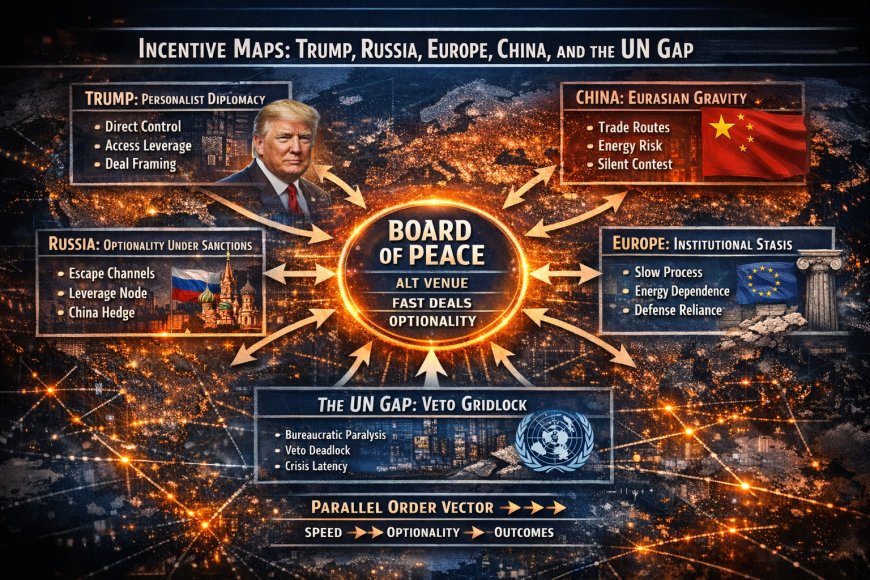
The “parallel order” frame only works if it respects incentives and constraints. Otherwise it becomes fan fiction. Here is the incentive map in operational terms.
Trump: Personalist Diplomacy as a Governance Strategy
The key is not ideology. The key is method. Personalist diplomacy builds power through:
- Direct leader-to-leader channels.
- Transaction-first negotiation.
- Branding the venue so legitimacy follows the brand.
- Access control: who gets in, who sits close, who gets the call.
- Speed: compressing decision cycles so bureaucracy can’t dilute outcomes.
The Board of Peace matches that method perfectly. It creates a platform where the chair is the institution. If the chair controls agenda, membership, and interpretation, then the chair controls the system outputs that matter: ceasefire terms, reconstruction gating, security guarantees, and the status of recognized authority.
Russia: Optionality in a World of Asymmetry
Russia’s stated alignment with China is real, but alignment does not erase asymmetry. Russia’s long-run problem is that China is the only neighboring power with the scale to dominate the Eurasian core. That does not mean Russia “wants war with China.” It means Russia wants optionality.
Optionality is created by multiple channels. A Board of Peace channel offers Russia a way to engage a U.S.-anchored venue without walking into NATO’s moral framework or the UN’s veto theater. If the Board becomes a functional cockpit for crisis bargains, Russia wants a seat because Russia wants leverage. Leverage is survival in a sanctions world.
Europe: The Balcony, Not the Engine
Europe’s power in the post-Cold War era has been institutional. But an institutional power suffers in a world that shifts toward:
- Energy price shocks and commodity stress.
- Security dependency on U.S. capabilities.
- Fragmented internal consensus across multiple electorates.
- Acceleration windows where slow process loses to fast tables.
In this model, Europe is the audience. Europe defends the UN in public, negotiates around outcomes in private, and then adapts to what produces results. The Board doesn’t need Europe to “agree.” It needs Europe to eventually treat it as unavoidable.
China: The Silent Center of Gravity
China is not named because naming it would trigger alliance polarization and accelerate formal bloc formation. The more subtle method is to build a system that pressures China structurally without declaring China the target.
China’s structural exposures include:
- Energy intake and shipping dependence.
- Sanctions-evasion reliance for discounted barrels from sanctioned producers.
- Trade finance and settlement rails that remain influenced by Western compliance norms.
- Chokepoints that are outside China’s direct control.
A Board of Peace that becomes the prestige venue for crisis bargaining is one way to route legitimacy and reconstruction capital through a U.S.-chaired surface rather than through UN frameworks where China can accumulate influence via process. That is a slow form of containment-by-routing.
Force Posture: Why Carrier Tempo Matters in a “Non-Kinetic” Narrative
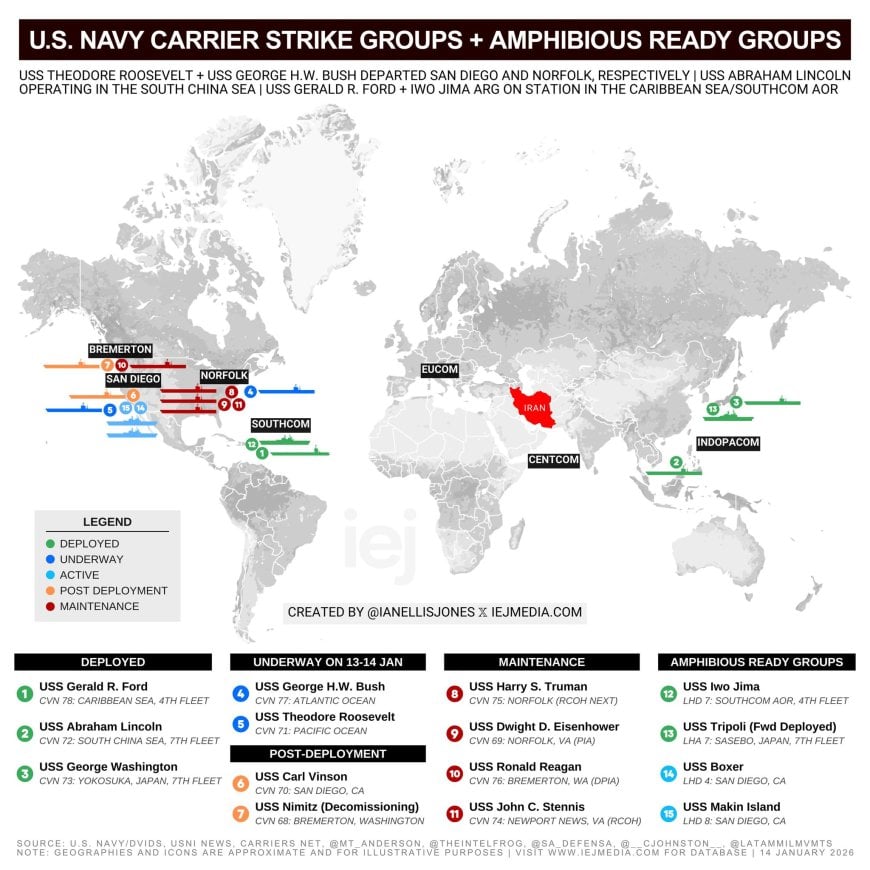
A parallel order does not run on speeches. It runs on enforceability. Enforceability is a spectrum: sanctions, interdictions, seizures, overflight permissions, basing, and, behind it all, the credible ability to escalate if someone calls the bluff.
Elevated carrier posture is the kinetic credibility layer that makes non-kinetic governance work. It is a coercive halo. It changes the calculus of every actor touching shipping, insurance, port permissions, and sanctions compliance.
The “five carriers” detail matters here because it signals multi-theater optionality. The point is not counting hulls for entertainment. The point is that unusually elevated tempo shrinks reaction time and increases the credibility of enforcement across multiple regions in the same window.
This is why the Board of Peace and carrier posture belong in the same article. A peace platform without enforcement is a talk shop. A peace platform with enforcement becomes governance: compliance corridors form because the cost of defiance rises.
The Iran decision window is a clean demonstration of posture leverage. Even without a strike, escalation risk alone forces:
- Risk repricing in energy markets.
- Insurance repricing for shipping routes.
- Posture shifts by regional actors.
- Precautionary drawdowns and hardening of bases.
- Diplomatic churn through intermediaries.
In a control-systems frame, carriers are not “war.” Carriers are actuator capacity — the ability to apply force quickly if the system requires it. The mere presence of that capacity changes behavior.
The significance is not “war tomorrow.” The significance is that elevated posture makes sanctions, interdiction, trusteeship funding, and ultimatum diplomacy function as enforceable policy rather than aspirational rhetoric.
Venezuela: The Western Hemisphere Oil Valve That Hits China First
Venezuela is an oil valve. In a sanctions world, the oil market is no longer only supply and demand; it is also permissions and enforcement.
Venezuela’s sanctioned crude has been flowing into Asia through evasion logistics. When enforcement tightens, the pain lands first on the buyer that has become the dominant sink for discounted sanctioned barrels.
The valve mechanism follows a repeatable pattern:
- Discount creation: sanctions create discount barrels.
- Shadow routing: transshipment, blending, re-labeling, re-flagging, and documentation games keep flow moving.
- Enforcement clamp: seizures, blockades, insurance pressure, port restrictions, shipowner risk aversion.
- Permissioning: licensed reroutes and controlled buyers create conditional flow.
The strategic point is not “Venezuela drama.” The strategic point is that this valve can pressure China-facing intake without a declared Pacific confrontation. If discounted sanctioned barrels are part of China’s energy optimization, then enforcement clamp increases China’s marginal energy cost and narrows its evasion options.
The “operation” layer matters because enforcement is easier when the governing node is captured, flipped, or forced into conditional arrangements. If the U.S. can shape who sells, who ships, and where storage sits, it can shape the flow. Flow becomes policy.
Tightening the Venezuela valve pressures Asia-bound energy intake and sanctions-evasion logistics. It is a way to hit China’s margin without treating China as the headline adversary.
Iran + Hormuz: The Global Oil Valve
Iran sits on a different class of valve: a global chokepoint valve. The Strait of Hormuz is not a symbolic geography. It is a physical constraint. Disruption risk there spreads through:
- Energy pricing.
- Shipping insurance and route planning.
- Strategic reserves decisions.
- Currency and liquidity stress for import-dependent economies.
The key structural point is destination: a large share of Hormuz flows are Asia-bound. That means Hormuz is not simply a Middle East issue; it is an Asia energy security issue.
The Iran decision window is the moment where escalation risk becomes a governance tool. Threat language, retaliation signaling, embassy pullbacks, base hardening, airspace changes, maritime behavior shifts — these are not decorations. They are the observable outputs of a system preparing for higher-than-normal risk.
That risk alone compresses choices:
- Importers hedge, stockpile, and reroute.
- Insurers reprice and restrict.
- Shipping schedules become conditional.
- Diplomacy becomes time-bounded.
Tie it back to China without turning it into a rant: if Iran’s sanctioned oil is heavily oriented toward China, then Iran pressure is also China pressure. Not because someone says it is. Because the pipe is oriented that way.
Venezuela tightening constrains a specific Asia-facing discounted stream. Hormuz tightening threatens an Asia-facing global artery. Both valves narrow downstream choices into higher-cost compliance corridors.
China as the Silent Center: Parallel Actors, Convergent Outcomes
The cleanest way to understand the “parallel order” thesis is to stop asking whether Trump and Putin are secretly coordinating and start asking what happens when multiple power centers exploit the same institutional weakness.
The weakness is structural: UN crisis latency and veto paralysis. The opportunity is structural: build a faster table and back it with enforceability. The rest is routing.
China is the silent center of gravity because the system effects of this stack land downstream on China’s margins:
- Discounted sanctioned barrels become less reliable as enforcement tightens.
- Chokepoint risk reprices Asia-bound energy intake.
- Compliance architecture makes evasion more expensive and fragile.
- Alternative venues route legitimacy and reconstruction away from UN process ecosystems.
This does not require the Board of Peace to be “anti-China” in rhetoric. It only requires the Board to become a working venue where outcomes are made. In a governance system, outcomes are power. Power attracts participation. Participation builds legitimacy. Legitimacy becomes order.
The speculative endpoint is not “a treaty that replaces the UN.” It’s a functional fork: the UN persists as a legal wrapper and legitimacy theater, while the Board becomes the cockpit for high-stakes bargains, backed by posture and valves.
It’s not ideology. It’s infrastructure: who controls the table, who controls the backstop, and who controls the pipes.
The Stack: Governance, Compliance, Money Rails, and Visibility Controls
The “parallel order” is not a single institution. It is a stack. The Board of Peace is the visible political UI. The enforcement layers beneath it are what make it real.
The stack components:
- Governance platform: a portable trusteeship table that can route legitimacy, reconstruction capital, and recognition through curated access.
- Kinetic backstop: posture that makes enforcement credible without firing a shot.
- Energy valves: chokepoints and export streams whose disruption risk compresses downstream choices.
- Compliance stack: KYC/AML/sanctions norms that gate participation in the financial bloodstream.
- Money rails: tokenized dollars and stablecoin settlement that can speed routing, enforce permissions, and harden conditional access.
- Visibility controls: attention throttles that change what narratives spread and which frames become “acceptable reality.”
The key operating principle of modern power is not always prohibition. It is friction. You don’t have to ban. You throttle. You create eligibility gates. You reroute flows. You raise costs until compliance becomes the stable choice.
This is why stablecoin rails and compliance matter in the same article as carriers and oil. In a sanctions world, money movement is a battlespace. If settlement becomes more permissioned, then political platforms that route reconstruction and legitimacy can become materially enforceable without occupying territory.
The Board of Peace becomes more than diplomacy when it can:
- Declare who is legitimate enough to receive reconstruction funding.
- Condition security guarantees on compliance behavior.
- Route contracts through approved entities.
- Coordinate enforcement through partners that control shipping, insurance, banking, and ports.
The most effective orders are the ones that feel voluntary. The stack accomplishes that by narrowing choices, not by issuing edicts.
The new order is increasingly permissioned: identity, payment, shipping, and legitimacy. The Board of Peace is a political interface that can sit on top of that permission stack.
If This Becomes a Parallel Order: Scenarios, Constraints, and the China Question
This is the explicitly speculative layer. Not certainty. Not fantasy. Plausible pathways based on incentive alignment and repeated use.
Scenario 1: The Board Stalls as a Gaza-Plus Talking Shop
The Board remains Gaza-centric and fails to become a default venue. Membership stays partial. Core Europe stays outside. China never joins. UN agencies reclaim implementation roles. The Board becomes symbolic rather than structural.
Scenario 2: The Board Becomes the Side-Channel Cockpit
The Board evolves into the place where real bargaining happens during fast crisis windows, with outcomes later codified through UN text or bilateral deals. The UN remains a legal wrapper. The Board becomes the operational cockpit. Funding flows through Board-adjacent mechanisms, creating a parallel lane of money and influence.
Scenario 3: The Board Becomes a Governance Node in a Wider Pressure Stack
This is the full control-stack pathway. The Board becomes the permissioned legitimacy platform. Force posture provides coercive credibility. Energy valves provide material leverage. Compliance and settlement rails provide enforceability without occupation. The system can pressure the Eurasian core without declaring a formal enemy.
In this scenario, China is never named. The pressure is structural:
- Discounted sanctioned barrels become less reliable.
- Chokepoint risk reprices Asia’s marginal energy cost.
- Compliance and visibility friction narrows evasion and narrative options.
- Alternative venues route legitimacy and reconstruction away from UN ecosystems.
Scenario 4: Counter-Surfaces Emerge
If the Board accumulates enough influence, rivals build counter-surfaces. Competing tables appear. Competing money rails harden. Competing reconstruction banks form. The world becomes less “one order” and more “competing stacks.”
Watch usage, not announcements. Which crises get routed through the Board. Which participation hardens. Which reconstruction flows become conditional. Which valves tighten during leverage windows. Which compliance rails harden. That’s where order shows itself.
Dead Giveaway Signals: What Would Confirm the Trajectory
Signals that would confirm the direction of travel in this framework are not speeches. They are flow changes.
- Russia-to-China flow shift: reduced high-grade hydrocarbon and strategic material flow into China, or higher friction pricing.
- India as participation signal: India joining any serious version of the Board is a sign that the venue has become a real cockpit, not a press prop.
- Europe adaptation event: a unified settlement architecture where Europe quietly coordinates around Board-mediated outcomes because alternatives are worse.
- Oil valve tightening: repeated episodes where Venezuela flow constraints and Hormuz risk premium rise in the same window as diplomatic ultimatums.
- Rail hardening: tighter enforcement on evasion logistics paired with more permissioned settlement routes.
The point is not to “predict collapse.” The point is to identify the mechanical confirmations that a new workflow is replacing an old one.
Institutions become real when flows re-route: energy, money, basing, compliance behavior. That’s the scoreboard.
Historical Parallels: How “Bypass Orders” Actually Form
Parallel orders do not begin as empires. They begin as workarounds.
The pattern is consistent across history:
- Legacy institution becomes slow, contested, or jammed.
- Actors build an alternative venue to solve urgent problems.
- The alternative venue recruits under universal branding (peace, stability, prosperity).
- Usage produces outcomes.
- Outcomes produce legitimacy.
- Legitimacy produces alignment and resource routing.
- The bypass becomes the workflow.
“Bypass orders” often look illegitimate to defenders of the old system because they are not charter-perfect. But legitimacy is not only procedural. In crisis windows, legitimacy follows performance.
The Board of Peace fits the class: it recruits under peace branding, scales through curated membership, and becomes meaningful when it begins routing outcomes and money outside veto-paralyzed institutions.
The structural difference in the modern era is that enforcement stacks are more permissioned than ever: banking rails, compliance gates, shipping insurance, port access, and algorithmic visibility. That makes bypass orders easier to instantiate without formal conquest.
Weeks Where Decades Happen: Why These Arcs Belong in One Frame
The reason Greenland, Venezuela, Iran, and the Board of Peace belong in one frame is not because they are “the same topic.” It is because they are the same window.
This is what acceleration looks like in practice:
- A new governance venue is introduced and immediately expanded beyond its origin scope.
- Force posture shifts toward pre-crisis optionality across multiple theaters.
- Energy valves tighten on flows that disproportionately land in Asia.
- Sanctions enforcement behavior increases friction on evasion logistics.
- Money rails and compliance stacks become more central to statecraft.
In a slow era, these would be separate stories. In an acceleration window, they behave like coupled variables: governance, enforcement, and energy become part of one integrated control system.
That is the central Pattern Nexus claim: modern power is increasingly exercised through control surfaces and routing protocols, not only through speeches and treaties. When multiple controls tighten in the same window, the system reveals its true architecture.
If posture, valves, and governance surfaces keep converging in the same windows, it stops being coincidence. It becomes the method.
Pattern Nexus Lens
The Board of Peace is easiest to understand if you stop thinking in terms of treaties and start thinking in terms of control surfaces.
A parallel order is not declared. It is instantiated. It appears as a stack of controls that together shrink the space of feasible choices for everyone else.
- Control surface: the Board of Peace as a portable governance venue (membership, benchmarks, money, legitimacy).
- Actuator: force posture (carriers, readiness, optionality) as kinetic credibility behind non-kinetic operations.
- Valves: oil chokepoints and export streams (Venezuela, Hormuz) that can throttle downstream consumers.
- Permissions layer: compliance and settlement rails that make access conditional.
- Visibility layer: narrative friction that shapes what spreads and what stalls.
- Feedback: markets, shipping, capital flows, and compliance behavior.
None of these are new individually. The signal is convergence.
The fastest way to pressure a rival isn’t always direct confrontation. It’s controlling the table, the backstop, and the pipes — until the rival’s “choices” shrink into compliance corridors.
FAQ
Is this claiming a secret Trump–Putin conspiracy to build a new world order?
No. The frame here is parallel actors and convergent incentives. A personalist venue can still create systemic outcomes without a hidden pact because repeated usage is what builds order.
Is this anti-UN?
No. The UN still performs essential functions. The critique is narrow and mechanical: veto paralysis and crisis latency create demand for alternative venues. Alternative venues grow when they produce outcomes.
Does “five carriers” mean war is imminent?
Not by itself. Elevated carrier tempo is best read as pre-crisis optionality. Posture can coerce outcomes without firing a shot. The signal is the pattern: elevated posture appearing in the same windows as tightening valves and fast diplomacy.
Why combine Venezuela and Iran?
Because they are valves. Venezuela is a Western Hemisphere valve affecting discounted Asia-bound flows. Hormuz is a global chokepoint valve affecting Asia-bound arteries. Both compress downstream choices through price, risk, and access.
How does this pressure China without naming China?
By staying mechanical: energy intake, chokepoints, settlement permissions, and compliance friction. Pressure is a function of routing constraints, not rhetoric.
Sources
This list includes the underlying reporting and the aligned Pattern Nexus pieces that extend the same framework: governance surfaces, force posture, oil valves, money rails, compliance stacks, and acceleration windows.
- Reuters — “What is Trump’s Board of Peace and who has joined so far?” (Jan 21, 2026)
- ABC News — “Trump plans signing ceremony for Board of Peace in Davos despite reservations from key allies” (Jan 21, 2026)
- ABC News — “Trump could potentially chair Board of Peace for life; $1 billion contributions are voluntary” (Jan 20, 2026)
- AP — “A list of countries joining Trump’s Board of Peace, those not joining and those not committed” (Jan 21, 2026)
- AP — “Trump’s Board of Peace is dividing countries in Europe and the Middle East” (Jan 21, 2026)
- White House — “Statement on President Trump’s Comprehensive Plan to End the Gaza Conflict”
- Reuters (Jan 21, 2026) — Putin says Russia studying Board proposal after Trump says he accepted
- Reuters (Jan 21, 2026) — Witkoff meeting with Putin; Board invite referenced
- Kremlin — Russia–China joint statement (Feb 4, 2022)
- Reuters — Moscow–Beijing partnership “no limits” (Feb 4, 2022)
- CFR — China–Russia relationship analysis
- UN Press — Security Council overhaul debate
- EJIL — UN Security Council reform analysis
- IRPJ — UNSC veto consequences
- Carnegie — UNSC peacekeeping role
- Columbia SIPA — UNSC effectiveness without charter change
- CFR — U.S. grand strategy framing
- International Affairs — Eurasia strategy analysis
- Reuters (Jan 14, 2026) — Venezuelan oil exports to China set to drop; blockade limits cargoes
- Reuters (Jan 21, 2026) — Venezuelan oil exports under U.S. supply deal; licenses and sales
- Reuters (Jan 21, 2026) — Venezuela output can rise; U.S. control objectives
- USCC — China–Venezuela oil ties and evasion methods
- Reuters (Jan 2, 2026) — Trump threatens Iran over protest crackdown
- Reuters (Jan 14, 2026) — Iran retaliation warning; U.S. withdraws some personnel; signals language
- Reuters (Jan 16, 2026) — Protest dynamics and escalation context
- EIA — Strait of Hormuz chokepoint mechanics
- IEA — Strait of Hormuz factsheet
- The War Zone — Middle East posture reporting
- Newsweek — Carrier posture context
- Pattern Nexus — Greenland, Board of Peace, and the Fracturing Order
- Pattern Nexus — Iran Decision Window
- Pattern Nexus — Venezuela: Control Claims, the Oil Valve, and the Stablecoin Rail
- Pattern Nexus — Operation Venezuela
- Pattern Nexus — The Stablecoin Front
- Pattern Nexus — Weeks Where Decades Happen
- Pattern Nexus — The Compliance Stack
- Pattern Nexus — Algorithmic Authority
- Pattern Nexus — Supply Chain Governance
Jaká je vaše reakce?
 Líbí se
0
Líbí se
0
 Nesouhlasím
0
Nesouhlasím
0
 Láska
0
Láska
0
 Vtipné
0
Vtipné
0
 Wow
0
Wow
0
 Sm sad
0
Sm sad
0
 Rozčílený
0
Rozčílený
0
Founder of Pattern Nexus. I research markets, macro, geopolitics, AI, history, ancient systems, and the patterns most people overlook. I’m also building Market Radar, a trading scanner designed to read pressure, risk, confirmation, and setup quality before chasing a move. Pattern Nexus is where I connect the dots between data, history, technology, and the bigger system playing out around us.






Komentáře (0)