

Mortgage Rates Eased. Home Sales Still Hit a 16-Year Low.
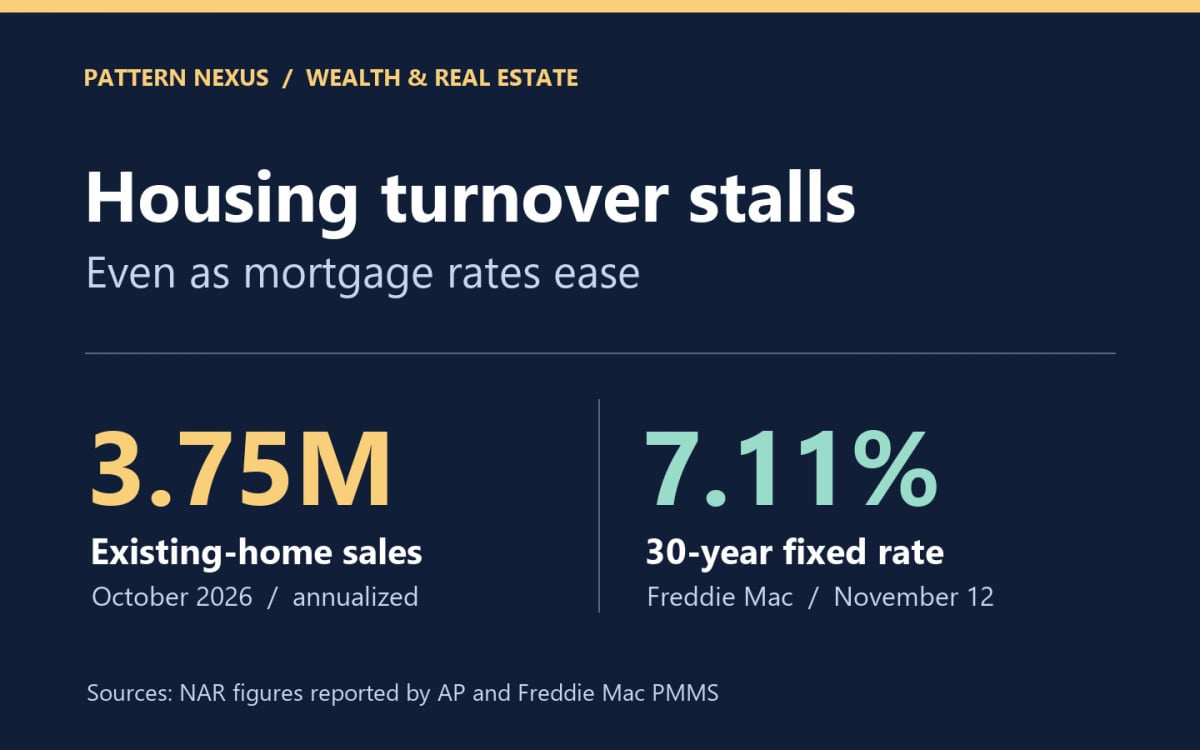
October resale volume fell to a 3.75 million annual pace. The payment math explains why a few weeks of lower rates do not yet reopen the market for financed buyers.
Mortgage Rates Eased. Home Sales Still Hit a 16-Year Low.
October resale volume fell to a 3.75 million annual pace. The payment math explains why a few weeks of lower rates do not yet reopen the market for financed buyers.
Quick Read
October existing-home sales fell 5.5% to a 3.75 million annual pace, the slowest since August 2010. The average 30-year fixed mortgage rate dropped to 7.11% on November 12. That weekly move saves about $15 a month on a hypothetical $320,000 loan.
3.75 million
October’s annualized existing-home sales pace, down 5.5% from September.
7.11%
Freddie Mac’s November 12 average for a 30-year fixed mortgage, down from 7.18%.
5.1 months
October’s inventory measured at the current sales pace.
Layer 1: The Reportable Facts
The 30-year mortgage rate fell again on November 12. On the same day, October’s home-sales report showed the weakest resale pace since August 2010. There is no contradiction. One release measures the price of credit this week. The other counts transactions that took shape when borrowers faced a different rate, a different payment and a different set of choices.
October existing-home sales fell 5.5% from September to a seasonally adjusted annual pace of 3.75 million, according to the National Association of Realtors figures reported by the Associated Press. That annualized rate is a way to compare monthly turnover; it is not the number of homes that closed in October. Freddie Mac’s November 12 survey put the 30-year fixed average at 7.11%, down from 7.18% a week earlier. The two series are looking at different points in the same transaction cycle.
Layer 2: The System Read
The payment gate is still there
Put the changes into one borrower’s budget. On a hypothetical $320,000, 30-year fixed loan, these rates produce the following monthly principal and interest. This illustration holds the loan size and term constant; it excludes tax, insurance, fees and any mortgage insurance. The 6.00% row is a comparison scenario, not today’s survey rate.
| Rate | Monthly principal and interest |
|---|---|
| 6.00% | $1,919 |
| 7.11% | $2,153 |
| 7.18% | $2,168 |
The weekly improvement saves this borrower about $15 a month. The gap from 6% is still about $234 a month. A modest move in rates can bring a marginal buyer back, but a market-wide recovery requires enough households to clear the entire monthly payment. Price, down payment, insurance and income can each do work that a small rate move cannot.
How to read the inventory figure
AP reported 5.1 months of supply at October’s pace. The ratio can rise because available listings increase, because sales slow, or both. It is a useful measure of bargaining conditions, but it does not tell a first-time buyer whether there are more homes within their budget. Watch how much of the additional negotiating room actually appears as lower prices or concessions, rather than assuming that inventory arithmetic solves affordability.
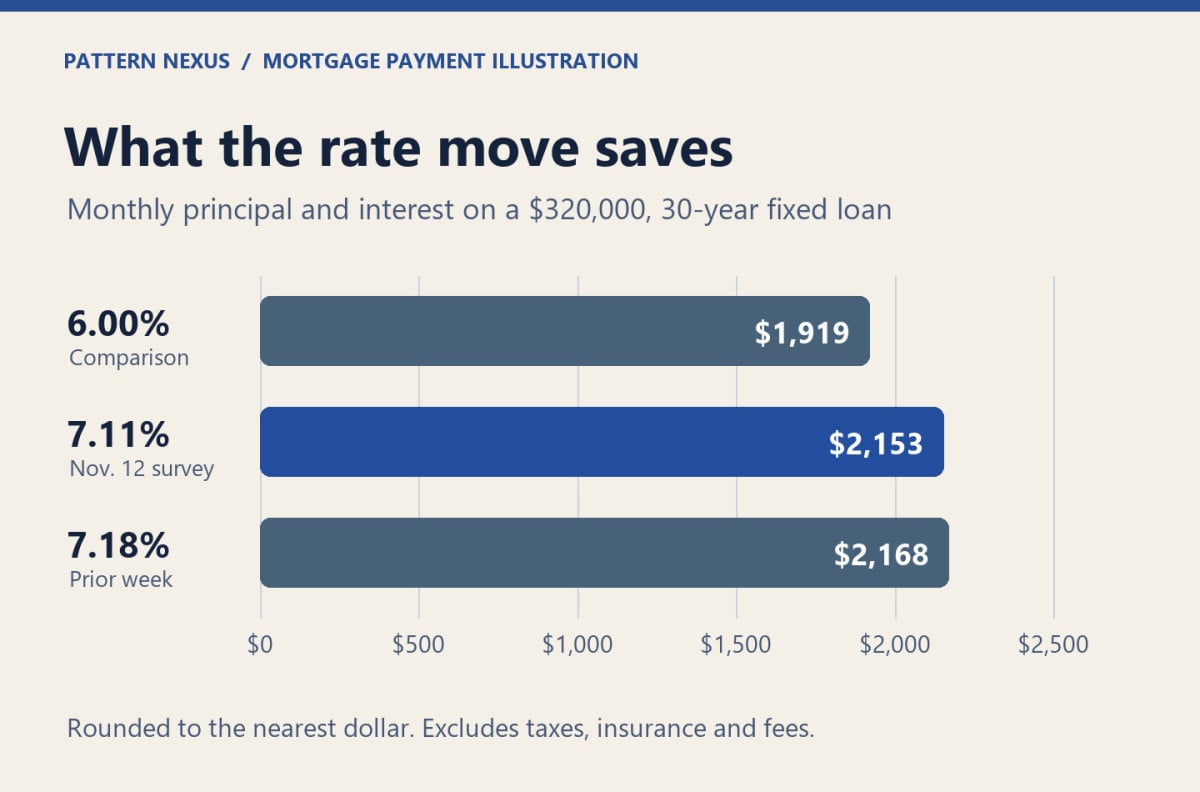
Monthly principal and interest for a $320,000, 30-year fixed loan. The 6% rate is illustrative.
Layer 3: What to Watch Next
Look for a sequence: a sustained improvement in mortgage quotes, then better contract activity, then more completed sales. If turnover improves without easier financing, local price changes, builder incentives or cash buyers may explain more than the rate story. If rates decline but contract activity stalls, look at insurance, taxes and household income. This is the next test of PN’s housing prices and buyer-payments reconstruction: a price index and the capacity to transact can tell different stories.
Pattern Nexus Lens
Watch contracts for an early sign that lower rates are drawing buyers back. Closings can confirm the change after those contracts work through the pipeline. Whether the recovery reaches first-time buyers depends on the total monthly cost and the homes available within their budgets.
Sources and Method
- NAR existing-home sales definitions and release schedule; Associated Press reporting on NAR’s October release.
- Freddie Mac Primary Mortgage Market Survey, November 12, 2026.
- Illustrations use a fully amortizing loan: monthly payment equals principal times the monthly rate divided by one minus the discount factor over 360 payments. Payments are rounded to the nearest dollar.
واکنش شما چیست؟
 پسندیدن
0
 نپسندیدن
0
 عشق
0
 خنده دار
0
 وای
0
 ناراحت
0
 عصبانی
0

Nexus (Christopher)
Founder of Pattern Nexus. I research markets, macro, geopolitics, AI, history, ancient systems, and the patterns most people overlook. I’m also building Market Radar, a trading scanner designed to read pressure, risk, confirmation, and setup quality before ch…
Related research

NAR’s 2026 Housing Boom Fantasy: Why a 14% Rebound Requires a Liquidity Intervention
The National Association of Realtors is projecting a 14% rebound in existing-home sales for 2026 — but their forecast depends on a fragile …
3 shared topics, 1 shared asset, same research avenue.
Hard Assets, Liquidity and the Cost of Leverage
Where the historical relationship holds, where it breaks, and what the evidence says about housing. This November update extends the Patter…
2 shared topics, 1 shared asset.
The Coastal Housing Repricing Map: Where the U.S. Housing Plateau Is Starting to Crack
The U.S. housing market is not crashing everywhere. It is repricing where the affordability stack broke first: coastal price towers, insura…
3 shared topics, same research avenue.
Housing in 2026: Prices Are High, but the Market Is Barely Moving
The July Case-Shiller index reached another nominal high, but inflation, financing costs and weak sales tell a different story for the marg…
2 shared topics, same research avenue.
Housing Is the Target: The 2026 Mortgage-Rate Compression Play
Trump’s directive for Fannie and Freddie to buy $200B in mortgage bonds, alongside a still-easing rate backdrop, signals an explicit attemp…
2 shared topics, same research avenue.
Pending Home Sales Confirm the Hard-Asset Rotation — Not a Housing “Surprise”
November pending home sales rose 3.3% month over month and 2.6% year over year, confirming a liquidity-driven rotation within hard assets. …
2 shared topics, same research avenue.
The Lock-In Economy: Why America’s Housing Market Remains Frozen
The Lock-In Economy: Why America’s Housing Market Remains Frozen (2025) Meta Description: Rates above 7 percent created a lock-in freeze a…
2 shared topics, same research avenue.
October 2025: Housing, Wealth & the Interest Rate Reversal
Housing Affordability and Wealth Trends – October 2025, An in-depth look at how falling interest rates, easing inflation, and a shifting re…
2 shared topics, same research avenue.
نظرات (0)
Security Check
Please complete the captcha to verify you are human.